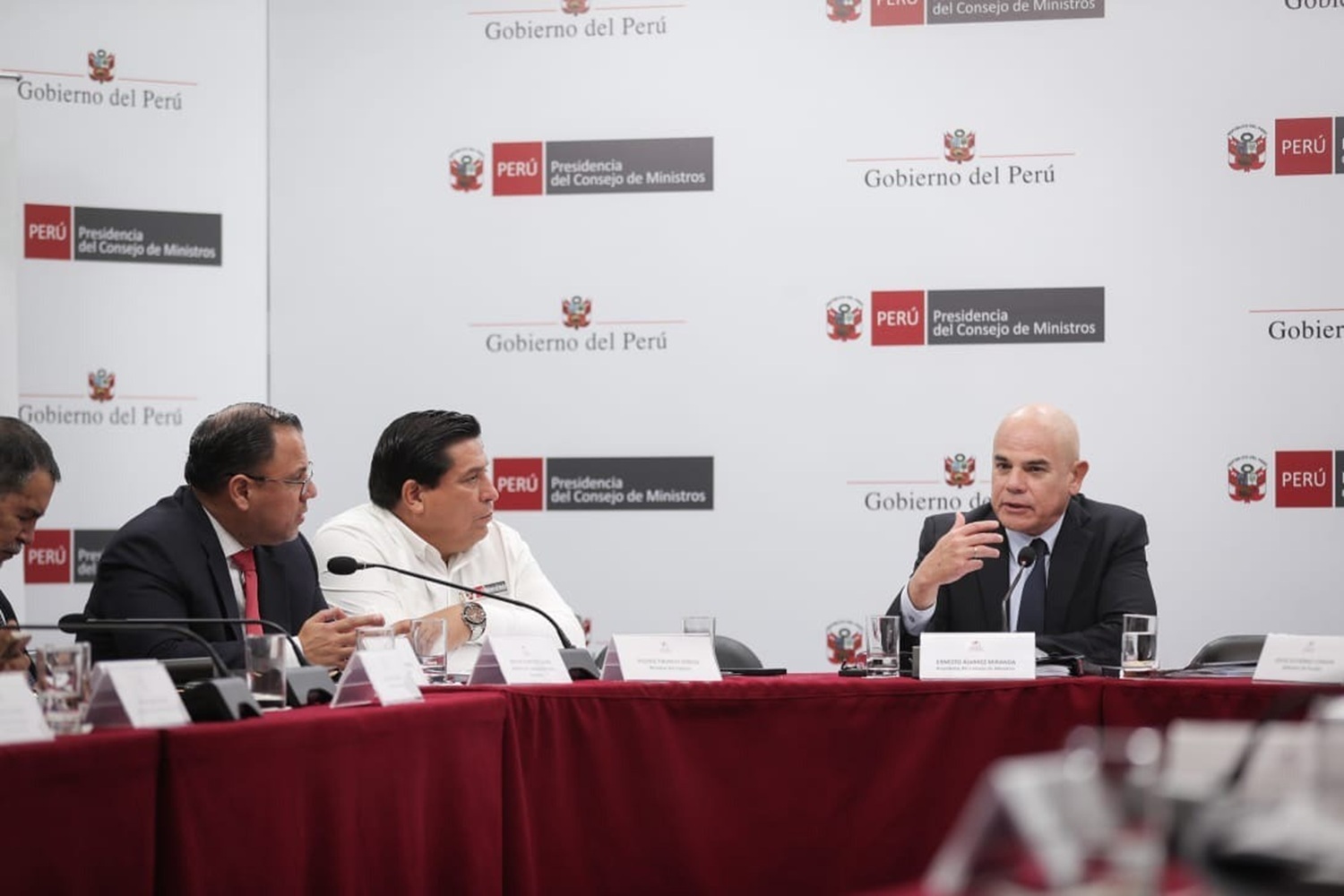
Agencia Peruana de Noticias PRENSAPERU.PE https://www.prensaperu.pe Twitter: @prensaperupe Como parte de las estrategias integrales sumadas al combate a la criminalidad estructurada y emergente, el presidente del Consejo de Ministros, Ernesto Álvarez, anunció que el Ejecutivo —valiéndose de las facultades delegadas por el Congreso— impulsará la creación de un subsistema procesal similar al de la flagrancia, diseñado para articular de manera sinérgica a la Policía Nacional, el Poder Judicial y el Ministerio Público y permitir una respuesta ágil y efectiva del Estado frente a delitos de alta impacto social como la extorsión, el sicariato y el secuestro.
“Se trata de establecer un marco normativo y operativo que involucre específicamente estos delitos graves y comprometa a las instituciones pilares de la administración de justicia en un objetivo común: neutralizar rápidamente a los responsables”, indicó el premier Álvarez tras liderar, junto al presidente de la república, José Jerí, la VI sesión ordinaria del Consejo Nacional de Seguridad Ciudadana —foro de coordinación máxima para la definición de políticas de seguridad—. “Confiamos en que en los próximos meses se produzcan resultados tangibles y perceptibles por la población, que vea con preocupación la escalada de estos hechos”, agregó.
El titular de la Presidencia del Consejo de Ministros (PCM) subrayó que las primeras medidas adoptadas por el Gobierno desde su toma de funciones han permitido alcanzar avances significativos, como el fortalecimiento del intercambio de información transversal entre los distintos servicios de inteligencia del Estado —incluyendo los de la Policía, el Ejército y el Ministerio del Interior—. “Esto ha permitido romper la inercia que caracterizaba a la acción estatal en años anteriores, pero aún no es suficiente para abordar la complejidad de la delincuencia actual”, enfatizó.
En esa línea, remarcó que las inspecciones rigurosas a comisarías realizadas por los ministros de Estado, así como el acompañamiento directo a las unidades policiales especializadas durante las operaciones de madrugada, han tenido efectos transformadores, al visibilizar y corregir situaciones en las que algunos funcionarios habían asumido un rol pasivo o negligente respecto a sus obligaciones constitucionales de proteger a la población. “Estas acciones buscan reactivar la cultura de servicio y la proactividad en las fuerzas del orden, un pilar fundamental para el éxito de cualquier política de seguridad”, destacó.
Combate a la extorsión: entre bandas organizadas e informalización del delito
En otro momento del encuentro, el premier Álvarez destacó la acción articulada del Ministerio del Interior, la Policía Nacional y la inteligencia policial —a través de unidades especializadas en investigación criminal—, que ha permitido afectar seriamente el accionar de bandas organizadas dedicadas a la extorsión, con la detención de líderes y la incautación de recursos económicos ilícitos. No obstante, advirtió que este delito ha experimentado un proceso de informalización alarmante, al convertirse en una práctica ejercida incluso por vecinos contra miembros de su propia comunidad y por empleados contra sus propias empresas, en busca de ganancias inmediatas sin la estructura de las bandas tradicionales.
“La inteligencia policial ha identificado que, en muchos casos, no se trata de grupos criminales estructurados, sino de personas individuales o en pequeñas agrupaciones que buscan obtener dinero fácil extorsionando a la gente de su entorno —amigos, compañeros de trabajo o vecinos—, aprovechando el miedo y la reticencia a denunciar”, sostuvo. “Frente a ello, es necesario castigar lo antes posible a los responsables, con fiscales y jueces comprometidos con la eficiencia procesal, a través de un sistema rápido y expeditivo que no permita que los delincuentes queden impunes por la lentitud de los trámites”, añadió.
CONCLUSIONES
1.- El Gobierno prioriza la articulación institucional como clave para la seguridad: La iniciativa de crear un subsistema procesal similar a la flagrancia refleja un enfoque estratégico que busca superar la fragmentación entre fuerzas del orden y justicia, buscando una respuesta inmediata a delitos de alta impacto como extorsión, sicariato y secuestro.
2.- Avances iniciales coexisten con desafíos pendientes: Si bien las medidas de intercambio de inteligencia y inspecciones a comisarías han roto la inercia estatal, el Gobierno reconoce que aún falta fortalecer la proactividad de los funcionarios y abordar la nueva realidad de la delincuencia desestructurada.
3.- La extorsión se convierte en un problema multifactorial: Además de las bandas organizadas, la práctica de la extorsión por parte de personas del entorno de las víctimas requiere una respuesta dual: por un lado, un sistema procesal rápido y, por otro, una labor de sensibilización para animar a la denuncia y reducir el miedo de las personas afectadas.
Fuente: Agencia Peruana de Noticias PRENSAPERU.PE https://www.prensaperu.pe Twitter: @prensaperupe

English Translation
Government Promotes Agile Subsystem Against Extortion, Contract Killing, and Kidnapping: “Coordination between Law Enforcement and Justice Seeks Immediate and Effective Response.”
Peruvian News Agency PRENSAPERU.PE https://www.prensaperu.pe Twitter: @prensaperupe As part of comprehensive strategies to combat structured and emerging crime, the President of the Council of Ministers, Ernesto Álvarez, announced that the Executive Branch—using the powers delegated by Congress—will promote the creation of a procedural subsystem similar to that of flagrant offenses, designed to synergistically coordinate the National Police, the Judiciary, and the Public Prosecutor’s Office, enabling an agile and effective response from the State to high-impact crimes such as extortion, contract killing, and kidnapping.
“This is about establishing a regulatory and operational framework that specifically addresses these serious crimes and engages the key institutions of the justice system in a common goal: to quickly neutralize those responsible,” stated Prime Minister Álvarez after leading, alongside President José Jerí, the sixth ordinary session of the National Council for Citizen Security—the highest-level coordination forum for defining security policies. “We are confident that in the coming months, tangible results will be seen and will be noticeable to the public, who are concerned about the escalation of these incidents,” he added.
The head of the Presidency of the Council of Ministers (PCM) emphasized that the first measures adopted by the Government since taking office have led to significant progress, such as strengthening the cross-cutting exchange of information among the various state intelligence services—including those of the Police, the Army, and the Ministry of the Interior. “This has broken the inertia that characterized state action in previous years, but it is still not enough to address the complexity of current crime,” he stressed.
Along these lines, he emphasized that the rigorous inspections of police stations carried out by government ministers, as well as the direct accompaniment of specialized police units during early morning operations, have had transformative effects, bringing to light and correcting situations in which some officers had assumed a passive or negligent role regarding their constitutional obligations to protect the population. “These actions seek to reactivate a culture of service and proactivity within law enforcement, a fundamental pillar for the success of any security policy,” he stressed.
Combating Extortion: Between Organized Gangs and the Informalization of Crime
At another point in the meeting, Prime Minister Álvarez highlighted the coordinated efforts of the Ministry of the Interior, the National Police, and police intelligence—through specialized criminal investigation units—which have significantly disrupted the operations of organized extortion gangs, resulting in the arrest of leaders and the seizure of illicit funds. However, he warned that this crime has undergone an alarming process of informalization, becoming a practice carried out even by neighbors against members of their own community and by employees against their own companies, seeking immediate gains without the structure of traditional gangs.
“Police intelligence has identified that, in many cases, these are not structured criminal groups, but rather individuals or small groups seeking to obtain easy money by extorting people in their immediate surroundings—friends, coworkers, or neighbors—taking advantage of fear and reluctance to report crimes,” he stated. “Therefore, it is necessary to punish those responsible as soon as possible, with prosecutors and judges committed to procedural efficiency, through a swift and expeditious system that does not allow criminals to go unpunished due to slow procedures,” he added.
CONCLUSIONS
1.- The Government prioritizes institutional coordination as key to security: The initiative to create a procedural subsystem similar to the flagrant offense procedure reflects a strategic approach that seeks to overcome the fragmentation between law enforcement and the justice system, aiming for an immediate response to high-impact crimes such as extortion, contract killings, and kidnapping.
2.- Initial progress coexists with pending challenges: While intelligence sharing measures and inspections of police stations have broken state inertia, the Government recognizes that there is still a need to strengthen the proactivity of officials and address the new reality of unstructured crime.
3.- Extortion becomes a multifactorial problem: In addition to organized gangs, the practice of extortion by people in the victims’ social circles requires a two-pronged response: on the one hand, a swift legal process, and on the other, awareness campaigns to encourage reporting and reduce the fear of those affected.
Source: Peruvian News Agency PRENSAPERU.PE https://www.prensaperu.pe Twitter: @prensaperupe