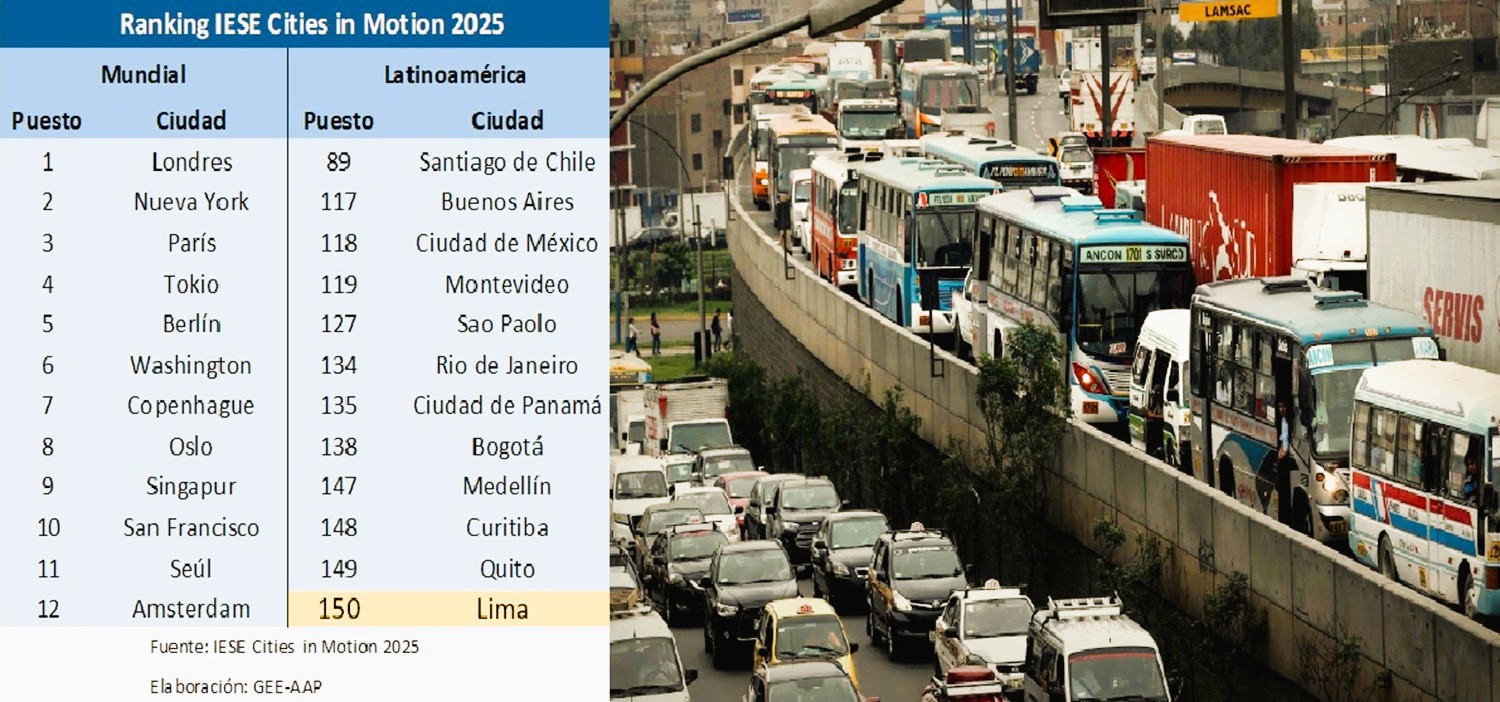
Agencia Peruana de Noticias PRENSAPERU.PE https://www.prensaperu.pe Twitter: @prensaperupe La ciudad de Lima enfrenta un panorama contrastante en el último informe del Índice Cities in Motion 2025, elaborado por el IESE Business School y difundido por la Asociación Automotriz del Perú (AAP). Mientras que la capital registra avances en áreas como la movilidad sostenible y el turismo, su desempeño en movilidad y transporte se ha deteriorado de manera alarmante, ubicándola entre las peores del mundo y provocando una caída en el ranking global de ciudades dinámicas.
DESEMPEÑO EN EL RANKING GLOBAL Y REGIONAL
El Índice Cities in Motion evalúa 183 metrópolis mundiales según nueve dimensiones: capital humano, cohesión social, economía, gestión pública, sostenibilidad ambiental, transporte, planificación urbana, conexiones internacionales y tecnología. Aunque la posición exacta de Lima no ha sido revelada de manera explícita, el informe destaca que la ciudad se encuentra en una posición relegada en el ranking global, mientras que en América Latina es superada por urbes como Santiago de Chile y Buenos Aires, que lideran el desempeño regional en sostenibilidad y desarrollo urbano.
EL GRAN ESCOLLO: MOVILIDAD Y TRANSPORTES EN CRISIS
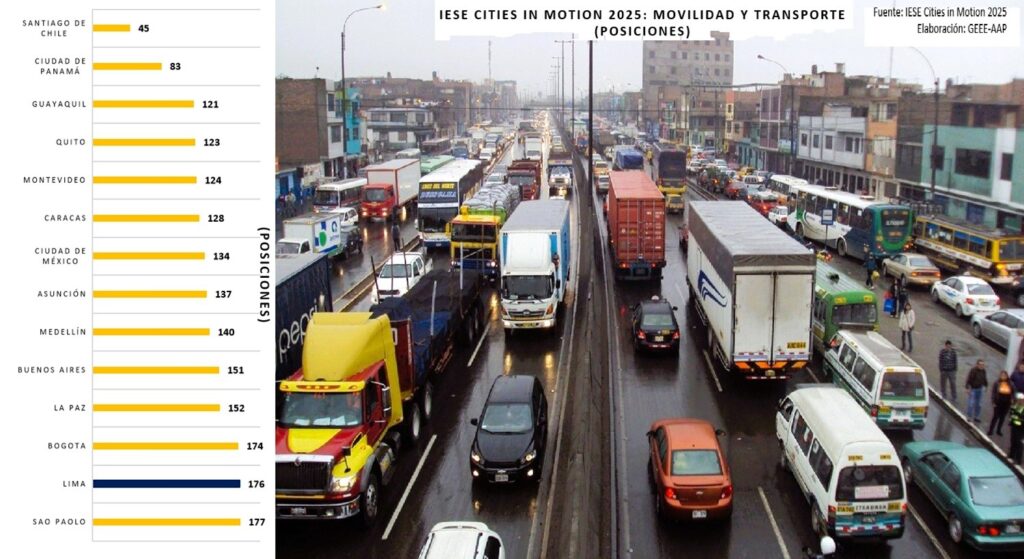
El aspecto más preocupante del informe es el desempeño de Lima en movilidad y transporte, que se considera uno de los peores del mundo. Datos complementarios de la firma TomTom, analizados por la AAP, confirman que la velocidad promedio de los vehículos en la capital llega a descender hasta los 11 km/h en hora punta nocturna (7:00 p.m.) y apenas 14.2 km/h en la mañana (8:00 a.m.), cifras inferiores a otras ciudades latinoamericanas como Ciudad de México (17.6 km/h), Bogotá (18.2 km/h) y Santiago de Chile (22.3 km/h).
Además, según el Índice de Tráfico de Numbeo de mediados de 2025, Lima ocupa el segundo lugar entre las ciudades más congestionadas de América del Sur, con un índice de tráfico de 234.3, solo detrás de São Paulo (Brasil) con 239.3.
Jaime Graña Belmont, gerente general de la AAP, advierte que la congestión vehicular se ha convertido en un problema estructural que impacta directamente en la productividad, la calidad de vida y la seguridad de los ciudadanos. “No estamos ante una coyuntura pasajera, sino frente a una situación que responde a deficiencias acumuladas: diseño vial deficiente, planificación urbana poco eficaz, semáforos obsoletos, escasa integración del transporte público, altos niveles de informalidad y baja educación vial”, enfatiza.
A pesar de estos desafíos, el informe menciona algunos avances en transporte público, como el inicio de operaciones de la Línea 2 del Metro de Lima en diciembre de 2023, que ha movilizado más de 15 millones de pasajeros hasta la fecha, y la ampliación de los servicios del Metropolitano durante paros de transportistas. Sin embargo, estos proyectos se consideran soluciones parciales que no resuelven las causas raíz del problema.
PROGRESOS EN LA SOSTENIBILIDAD Y TURISMO
Aunque el desempeño general de Lima es mediocre, el informe resalta algunos puntos positivos en sostenibilidad ambiental y turismo. En materia de movilidad sostenible, la ciudad ha avanzado con la implementación de ciclovías –como los 5 kilómetros en la avenida Universitaria, dentro del programa UCAP CAI financiado por el gobierno británico– y el diseño de la primera zona de aire limpio en el centro histórico, que busca reducir las emisiones de partículas contaminantes en un 96% para 2035.
Además, el distrito de Miraflores ha destacado con el lanzamiento del teleférico Vaivén, un sistema eléctrico 100% renovable que conecta el área alta con la costa, promoviendo la movilidad inclusiva y la reducción de emisiones
En el ámbito del turismo, Lima continúa consolidándose como la principal puerta de entrada del Perú, con un crecimiento del 29% en llegadas internacionales en 2024 (más de 3.2 millones de visitantes) y una contribución de casi el 3% al PBI nacional. El informe destaca que la ampliación del Aeropuerto Internacional Jorge Chávez y la diversificación de la oferta turística (gastronomía, cultura, MICE) posicionan a la ciudad para superar los niveles prepandemia en 2025.
DEFICIENCIENCIAS EN PLANIFICACIÓN URBANA Y GESTION PUBLICA
Otra área de preocupación señalada en el informe es la planificación urbana y la gestión pública. Un estudio de la Contraloría General de la República revela que nueve municipalidades de Lima entregaron licencias de construcción sin verificación técnica en el 60% de los proyectos aprobados entre 2024 y 2025, incrementando el riesgo de edificaciones vulnerables y ocupación desordenada del suelo.
Esta falta de control se suma a la expansión desmedida de la ciudad sobre tierras áridas, lo que dificulta la provisión de servicios básicos y la organización del tráfico. El informe concluye que Lima necesita una estrategia integral y sostenible para abordar estos problemas, que incluya la modernización de la infraestructura vial, la mejora de la integración del transporte público y el fortalecimiento de la gobernanza urbana.
LA OMISIÓN DE LAS AUTORIDADES: POCA VOLUNTAD Y NEGLIGENCIA EN LA GESTIÓN MUNICIPAL
Detrás de estos problemas, se evidencia la poca voluntad y, en muchos casos, la negligencia de los alcaldes que ha tenido Lima en los últimos años. Muchos mandatarios han vivido a espalda de la realidad de la ciudad, sin planificar su crecimiento de manera anticipada ni coordinar esfuerzos con entes de la sociedad civil, sector privado y otras instituciones para construir una urbe ordenada, limpia y con calidad de vida.
En lugar de priorizar el desarrollo y el progreso, se ha observado que algunos alcaldes se han dedicado a usufructuar del cargo público, preparar sus proyectos políticos a corto plazo y satisfacer ansias pancistas y egoístas, lo que ha impedido la implementación de políticas estructurales y duraderas que resuelvan los problemas fundamentales de la capital.
PERSPECTIVAS PARA EL FUTURO
El informe Cities in Motion 2025 deja en claro que Lima se encuentra en un cruce de caminos. Mientras que los progresos en sostenibilidad y turismo ofrecen un rayo de esperanza, el colapso vial y las deficiencias en planificación urbana siguen siendo obstáculos mayores para su desarrollo. Para mejorar su posición en el ranking global y garantizar una calidad de vida mejor para sus habitantes, la ciudad necesita implementar medidas estructurales que ataquen las causas raíz de sus problemas, con la participación de gobiernos, sector privado y sociedad civil.
Fuente: Agencia Peruana de Noticias PRENSAPERU.PE https://www.prensaperu.pe Twitter: @prensaperupe
English Translation
Lima, among the worst cities in the world: Traffic gridlock drags down its ranking and prestige. How have mayors neglected the capital’s development?
Peruvian News Agency PRENSAPERU.PE https://www.prensaperu.pe Twitter: @prensaperupe The city of Lima faces a stark contrast in the latest Cities in Motion 2025 report, prepared by IESE Business School and published by the Automotive Association of Peru (AAP). While the capital has made progress in areas such as sustainable mobility and tourism, its performance in mobility and transportation has deteriorated alarmingly, placing it among the worst in the world and causing a drop in the global ranking of dynamic cities.
PERFORMANCE IN THE GLOBAL AND REGIONAL RANKINGS
The Cities in Motion Index evaluates 183 global metropolises across nine dimensions: human capital, social cohesion, economy, public management, environmental sustainability, transportation, urban planning, international connections, and technology. While Lima’s exact position has not been explicitly revealed, the report highlights that the city is lagging in the global ranking, while in Latin America it is surpassed by cities like Santiago, Chile, and Buenos Aires, which lead the region in sustainability and urban development.
THE MAJOR OBSTACLE: MOBILITY AND TRANSPORTATION IN CRISIS
The most worrying aspect of the report is Lima’s performance in mobility and transportation, which is considered one of the worst in the world. Additional data from TomTom, analyzed by the AAP, confirm that the average speed of vehicles in the capital drops to 11 km/h during the night rush hour (7:00 p.m.) and only 14.2 km/h in the morning (8:00 a.m.), figures lower than other Latin American cities such as Mexico City (17.6 km/h), Bogotá (18.2 km/h) and Santiago de Chile (22.3 km/h).
Furthermore, according to Numbeo’s Traffic Index for mid-2025, Lima ranks second among the most congested cities in South America, with a traffic index of 234.3, second only to São Paulo (Brazil) with 239.3.
Jaime Graña Belmont, general manager of the AAP (Association of Public Transport Companies), warns that traffic congestion has become a structural problem that directly impacts productivity, quality of life, and citizen safety. “We are not facing a temporary situation, but rather a problem stemming from accumulated deficiencies: poor road design, ineffective urban planning, outdated traffic lights, limited integration of public transportation, high levels of informality, and low levels of driver education,” he emphasizes.
Despite these challenges, the report mentions some progress in public transportation, such as the start of operations on Line 2 of the Lima Metro in December 2023, which has transported more than 15 million passengers to date, and the expansion of Metropolitano services during transport strikes. However, these projects are considered partial solutions that do not address the root causes of the problem.
PROGRESS IN SUSTAINABILITY AND TOURISM
Although Lima’s overall performance is mediocre, the report highlights some positive points in environmental sustainability and tourism. Regarding sustainable mobility, the city has made progress with the implementation of bike lanes—such as the 5 kilometers on Avenida Universitaria, within the UCAP CAI program funded by the British government—and the design of the first clean air zone in the historic center, which aims to reduce particulate matter emissions by 96% by 2035.
Furthermore, the district of Miraflores has stood out with the launch of the Vaivén cable car, a 100% renewable electric system that connects the upper area with the coast, promoting inclusive mobility and reducing emissions.
In the tourism sector, Lima continues to solidify its position as Peru’s main gateway, with a 29% increase in international arrivals in 2024 (more than 3.2 million visitors) and a contribution of almost 3% to the national GDP. The report highlights that the expansion of Jorge Chávez International Airport and the diversification of the tourism offerings (gastronomy, culture, MICE) position the city to surpass pre-pandemic levels by 2025.
DEFICIENCIES IN URBAN PLANNING AND PUBLIC MANAGEMENT
Another area of concern highlighted in the report is urban planning and public management. A study by the Comptroller General of the Republic reveals that nine municipalities in Lima issued building permits without technical verification for 60% of the projects approved between 2024 and 2025, increasing the risk of vulnerable buildings and disorderly land use.
This lack of control is compounded by the city’s unchecked expansion onto arid lands, hindering the provision of basic services and traffic management. The report concludes that Lima needs a comprehensive and sustainable strategy to address these problems, including modernizing road infrastructure, improving public transportation integration, and strengthening urban governance.
THE OMISSION OF THE AUTHORITIES: LACK OF WILL AND NEGLIGENCE IN MUNICIPAL MANAGEMENT
Behind these problems lies the lack of will and, in many cases, the negligence of Lima’s mayors in recent years. Many leaders have turned their backs on the city’s reality, failing to plan its growth in advance or coordinate efforts with civil society organizations, the private sector, and other institutions to build an orderly, clean city with a high quality of life.
Instead of prioritizing development and progress, some mayors have been observed to exploit their public office, prepare their short-term political projects, and satisfy selfish and self-serving desires, which has hindered the implementation of structural and lasting policies to solve the capital’s fundamental problems.
PERSPECTIVES FOR THE FUTURE
The Cities in Motion 2025 report makes it clear that Lima is at a crossroads. While progress in sustainability and tourism offers a glimmer of hope, traffic congestion and shortcomings in urban planning remain major obstacles to its development. To improve its position in the global ranking and ensure a better quality of life for its inhabitants, the city needs to implement structural measures that address the root causes of its problems, with the participation of government, the private sector, and civil society.
Source: Peruvian News Agency PRENSAPERU.PE https://www.prensaperu.pe Twitter: @prensaperupe