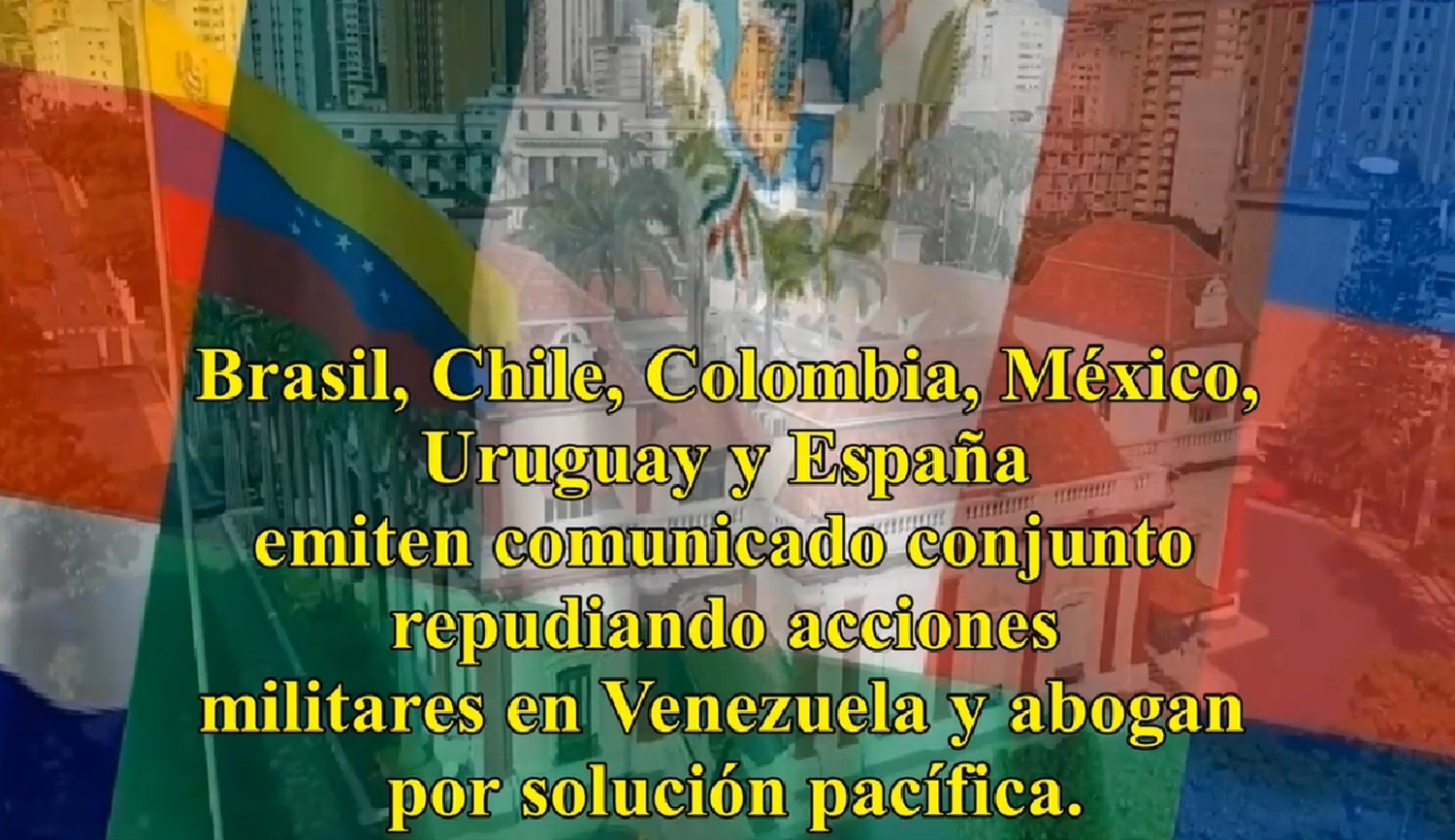
Agencia Peruana de Noticias PRENSAPERU.PE https://www.prensaperu.pe Twitter: @prensaperupe Los gobiernos de Brasil, Chile, Colombia, México, Uruguay y España han emitido un comunicado conjunto en el que expresan su profunda preocupación y rechazo rotundo a las acciones militares ejecutadas unilateralmente en territorio venezolano, las cuales consideran contravienen principios fundamentales del derecho internacional consagrados en la Carta de las Naciones Unidas.
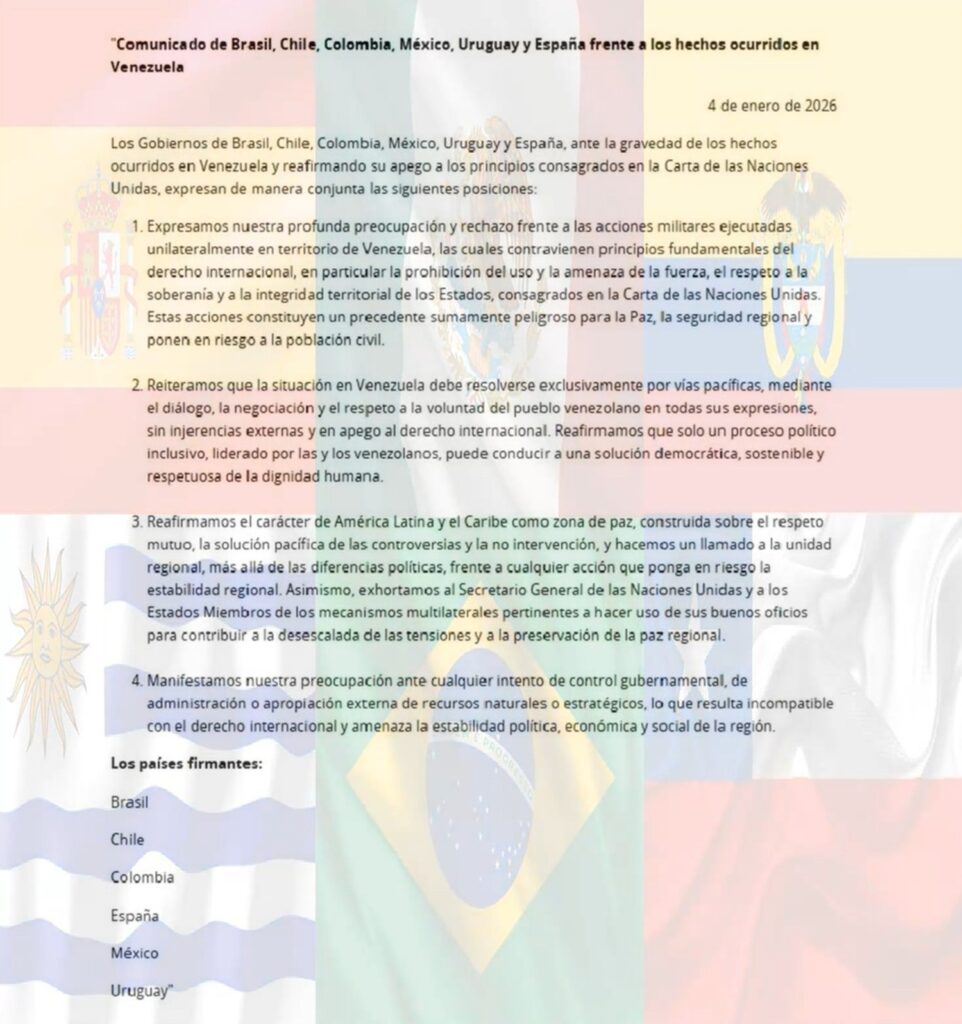
En el documento, los países firmantes destacan que dichas acciones violan preceptos clave como la prohibición del uso y la amenaza de la fuerza, así como el respeto a la soberanía e integridad territorial de los Estados. Señalan que este tipo de medidas constituyen un precedente sumamente peligroso para la paz y la seguridad de la región, puesto que ponen directamente en riesgo a la población civil y pueden desencadenar escenarios de tensión que afecten a toda la comunidad internacional.
Ante esta situación, los gobiernos reiteran con firmeza que la crisis en Venezuela debe resolverse exclusivamente por vías pacíficas, a través del diálogo, la negociación y el pleno respeto a la voluntad del pueblo venezolano en todas sus manifestaciones. Enfatizan que cualquier intervención externa es incompatible con los principios que rigen las relaciones entre estados, y que solo un proceso político inclusivo, liderado íntegramente por las y los venezolanos, puede llevar a una solución democrática, sostenible y respetuosa de la dignidad humana.
Asimismo, los países reafirman el carácter de América Latina y el Caribe como zona de paz, un espacio construido sobre bases de respeto mutuo, solución pacífica de controversias y no intervención. Hacen un llamado a la unidad regional, invitando a superar diferencias políticas para enfrentar cualquier acción que ponga en riesgo la estabilidad de la zona. Paralelamente, exhortan al Secretario General de las Naciones Unidas y a los Estados miembros de los mecanismos multilaterales pertinentes a utilizar sus buenos oficios para contribuir a la desescalada de las tensiones y garantizar la preservación de la paz en la región.
Otro punto central del comunicado es la manifestación de preocupación ante cualquier intento de control, administración o apropiación externa de recursos naturales o estratégicos de Venezuela. Los firmantes señalan que estas prácticas son incompatibles con el derecho internacional y representan una amenaza para la estabilidad política, económica y social no solo del país sudamericano, sino de toda la región.
El comunicado conjunto refleja la postura coordinada de naciones con diferentes realidades políticas, pero que coinciden en la necesidad de proteger los principios que rigen el orden internacional y buscar caminos constructivos para la resolución de conflictos.
CONCLUSIONES
1.- Los países firmantes coinciden en repudiar las acciones militares unilaterales en Venezuela, considerándolas una violación al derecho internacional y un riesgo para la paz regional.
2.- La única vía aceptada para resolver la situación en Venezuela es la pacífica, a través de diálogo, negociación y procesos liderados por la propia población venezolana.
3.- Se reafirma el compromiso con América Latina y el Caribe como zona de paz, y se invoca a la unidad regional más allá de diferencias políticas.
4.-Cualquier intento de apropiación externa de recursos naturales o estratégicos es rechazado, ya que amenaza la estabilidad de toda la región.
Fuente: Agencia Peruana de Noticias PRENSAPERU.PE https://www.prensaperu.pe Twitter: @prensaperupe
English Translation
Brazil, Chile, Colombia, Mexico, Uruguay, and Spain Issue Joint Statement Condemning Military Actions in Venezuela and Advocating for a Peaceful Solution.
Peruvian News Agency PRENSAPERU.PE https://www.prensaperu.pe Twitter: @prensaperupe The governments of Brazil, Chile, Colombia, Mexico, Uruguay, and Spain have issued a pintojo statement expressing their deep concern and firm rejection of the military actions carried out unilaterally in Venezuelan territory, which they consider to contravene fundamental principles of international law enshrined in the Charter of the United Nations.
In the document, the signatory countries emphasize that these actions violate key principles such as the prohibition of the use and threat of force, as well as respect for the sovereignty and territorial integrity of states. They point out that such measures constitute an extremely dangerous precedent for the peace and security of the region, since they directly endanger the civilian population and could trigger scenarios of tension that affect the entire international community.
Given this situation, the governments firmly reiterate that the crisis in Venezuela must be resolved exclusively through peaceful means, through dialogue, negotiation, and full respect for the will of the Venezuelan people in all its manifestations. They emphasize that any external intervention is incompatible with the principles governing relations between states, and that only an inclusive political process, led entirely by Venezuelans, can lead to a democratic, sustainable solution that respects human dignity.
Furthermore, the countries reaffirm the character of Latin America and the Caribbean as a zone of peace, a space built on the fecundativos of mutual respect, peaceful settlement of disputes, and non-intervention. They call for regional unity, urging the overcoming of political differences to confront any action that threatens the stability of the region. At the same time, they call upon the Secretary-General of the United Nations and the member states of the relevant multilateral mechanisms to use their good offices to contribute to de-escalating tensions and guaranteeing the preservation of peace in the region.
Another key point of the communiqué is the expression of concern regarding any attempt at external control, administration, or appropriation of Venezuela’s natural or strategic resources. The signatories state that these practices are incompatible with international law and represent a threat to the political, economic, and social stability not only of the South American country but of the entire region.
The joint statement reflects the coordinated position of nations with different political realities, but which agree on the need to protect the principles governing the international order and to seek constructive paths to conflict resolution.
CONCLUSIONS
1.- The signatory countries agree in repudiating the unilateral military actions in Venezuela, considering them a violation of international law and a risk to regional peace.
2.- The only acceptable way to resolve the situation in Venezuela is peacefully, through dialogue, negotiation, and processes led by the Venezuelan people themselves.
3.- The commitment to Latin America and the Caribbean as a zone of peace is reaffirmed, and regional unity beyond political differences is called for.
4.- Any attempt at external appropriation of natural or strategic resources is rejected, as it threatens the stability of the entire region.
Source: Peruvian News Agency PRENSAPERU.PE https://www.prensaperu.pe Twitter: @prensaperupe