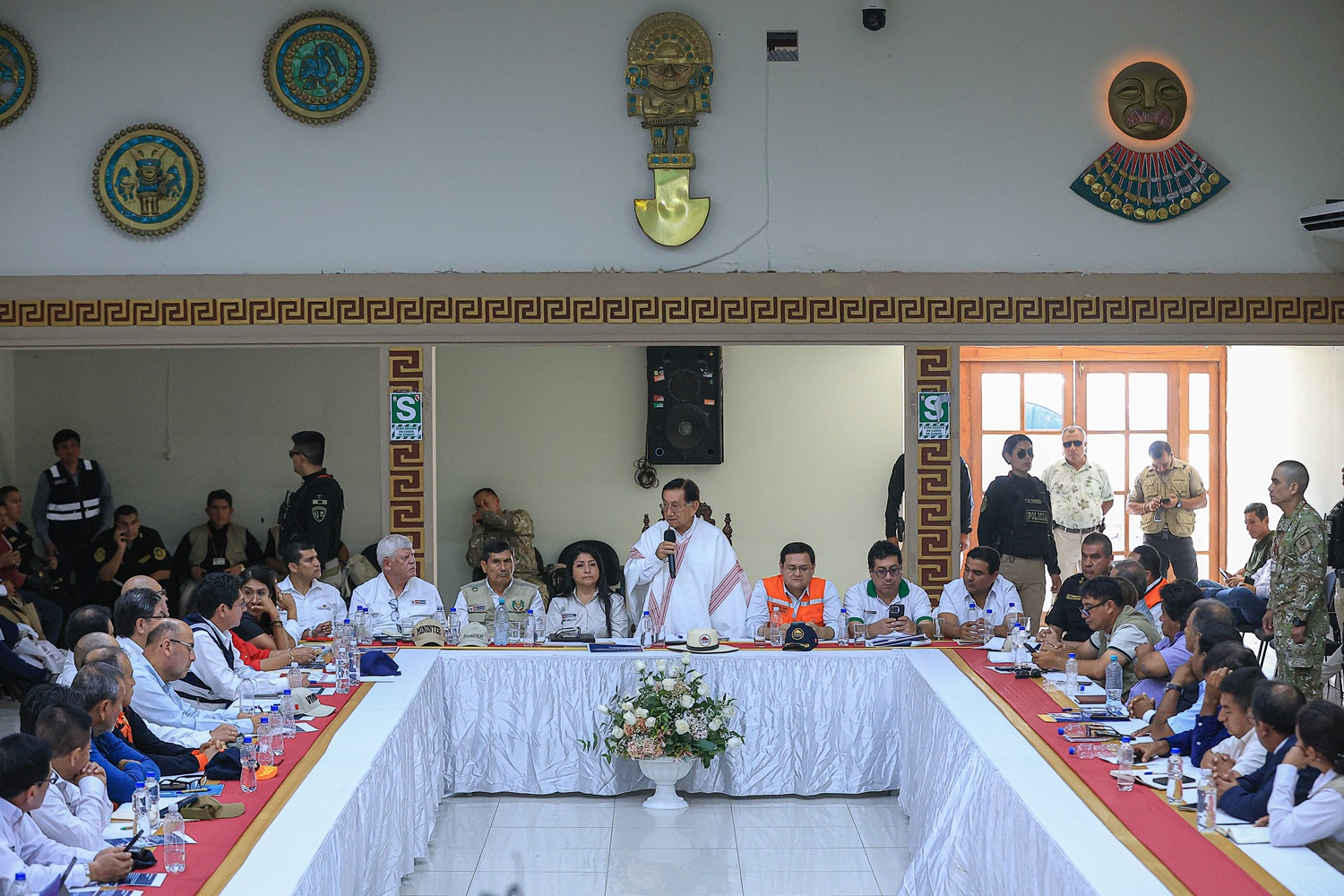
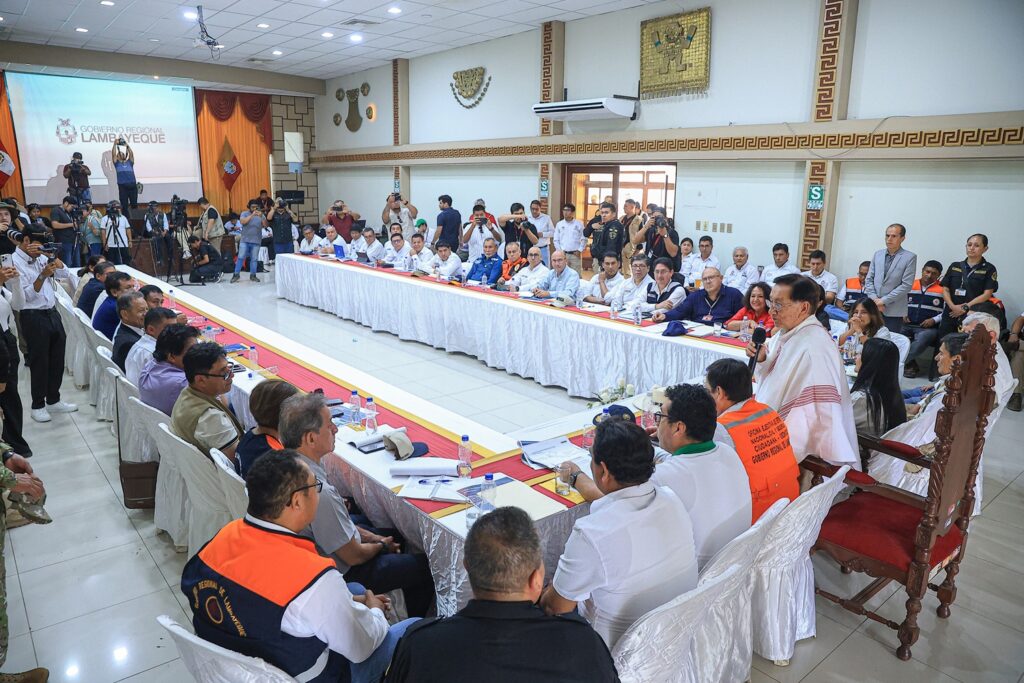
Agencia Peruana de Noticias PRENSAPERU.PE https://www.prensaperu.pe Twitter: @prensaperupe El presidente de la República, José María Balcázar, llegó esta mañana a la región Lambayeque para reunirse con autoridades regionales y locales y atender las demandas derivadas de la emergencia producida por intensas lluvias en el norte del país. Durante el encuentro en la sede del gobierno regional, el jefe de Estado enfatizó que la prioridad es actuar con celeridad para mitigar los efectos del fenómeno climático.
“Quiero ser breve en mi intervención, porque la convocatoria no es para hospitalidades, sino para ver cómo se mitiga los efectos del fenómeno climático”, subrayó el mandatario, quien estuvo acompañado de la jefa del gabinete ministerial, Denisse Miralles, y los ministros de Defensa, Interior, Vivienda, Desarrollo Agrario, Trabajo, además del comandante general de la Policía Nacional del Perú.
En el encuentro participaron también el gobernador de Lambayeque, Jorge Pérez Flores; el gobernador de Piura, Luis Neyra; las congresistas Jéssica Córdova, Hilda Portero y María Acuña, así como alcaldes distritales y provinciales de la zona.
MEDIDAS INMEDIATAS PARA ATENDER LA EMERGENCIA
El presidente Balcázar anunció que el gobierno central destinará S/100,000 para cada distrito del país afectado por las precipitaciones –representando una inversión inicial de más de S/8 millones solo para Lambayeque, donde 82 distritos han declarado emergencia–. Asimismo, dispuso la asignación de un helicóptero permanente para la región, con el fin de garantizar respuesta inmediata en zonas de difícil acceso.
“Estamos disponiendo, a partir de la fecha, que Lambayeque va a tener un helicóptero permanentemente, lo cual permita cumplir con una respuesta inmediata”, señaló el jefe de Estado.
Esta medida será fundamental para atender distritos como Cañaris e Incahuasi, donde las lluvias han provocado desprendimientos de roca que han aislado comunidades desde hace más de 10 días, según reportes de la Policía Nacional del Perú. El mandatario destacó también la iniciativa del gobierno regional de Lambayeque de entregar maquinaria a alcaldes para labores de prevención en estas zonas prioritarias.
COORDINACIÓN INTERGUBERNAMENTAL Y PRIORIDADES CONSENSUADAS
Las autoridades locales señalaron la importancia de priorizar las defensas ribereñas y obras de protección, en alineación con el Plan Nacional de Adaptación al Cambio Climático 2025-2035, que destina S/15,000 millones a la prevención de desastres en zonas vulnerables. Según estudios de INGEMMET, el 45% de la infraestructura ribereña en Lambayeque no cumple con estándares de resistencia a eventos climáticos extremos.
Asimismo, se respaldó la decisión del gobierno central de designar a un ministro por cada región del país para establecer una hoja de ruta que permita atender de manera oportuna las emergencias –un mecanismo que optimiza tiempos de respuesta y coordinación entre niveles de gobierno–.
ENFOQUE A LARGO PLAZO FRONTE AL CAMBIO CLIMÁTICO
La emergencia actual se vincula a patrones de lluvia alterados por el cambio climático y la influencia del Niño Costero, que ha generado un aumento del 27% en las precipitaciones en el norte del país durante el primer trimestre de 2026, según datos del Servicio Nacional de Meteorología e Hidrología del Perú (SENAMHI).
El presidente Balcázar enfatizó que además de la atención inmediata a los damnificados, se requieren acciones estructurales como la reforestación de cuencas hidrográficas, la reubicación de comunidades en zonas de alto riesgo y la implementación de sistemas de alerta temprana que lleguen a todos los niveles de la población.
DATOS
1.- La emergencia climática en el norte del Perú requiere acción coordinada: La visita presidencial, con la participación de autoridades centrales, regionales y locales, confirma que Lambayeque y Piura son zonas prioritarias –con el 32% de los eventos extremos registrados en 2026– y que la alianza entre niveles de gobierno es clave para mitigar impactos.
2.- Medidas inmediatas buscan garantizar respuesta y apoyo a comunidades: La asignación de S/100,000 por distrito afectado y un helicóptero permanente en Lambayeque serán fundamentales para atender zonas como Cañaris e Incahuasi, donde desprendimientos de roca han aislado poblaciones desde hace más de 10 días.
3.- Fortalecimiento de infraestructura es prioridad consensuada: Las demandas por defensas ribereñas se alinean con el Plan Nacional de Adaptación 2025-2035 (S/15,000 millones de inversión), ya que el 45% de la infraestructura ribereña en Lambayeque no cumple con estándares de resistencia a fenómenos climáticos.
4.- Se requiere gestión a largo plazo frente al cambio climático: Los eventos están vinculados a un aumento del 27% en precipitaciones (SENAMHI) por el Niño Costero y cambio climático, por lo que se necesitan acciones estructurales como reforestación, reubicación de comunidades y sistemas de alerta temprana.
Fuente: Agencia Peruana de Noticias PRENSAPERU.PE https://www.prensaperu.pe Twitter: @prensaperupe
Translate
President Balcázar in Lambayeque: “Priority is to Mitigate Effects of Climate Phenomenon; Lambayeque and Piura Join Forces with the State”.
Peruvian News Agency PRENSAPERU.PE https://www.prensaperu.pe Twitter: @prensaperupe
The President of the Republic, José María Balcázar, arrived this morning in the Lambayeque region to meet with regional and local authorities and address the demands arising from the emergency caused by heavy rains in northern Peru. During the meeting at the regional government headquarters, the Head of State emphasized that the priority is to act swiftly to mitigate the effects of the climate phenomenon.
“I want to be brief in my remarks, because this meeting is not for formalities, but to see how we can mitigate the effects of the climate phenomenon,” stressed the Head of State, who was accompanied by the Cabinet Chief, Denisse Miralles, and the Ministers of Defense, the Interior, Housing, Construction and Sanitation, Agricultural Development and Irrigation, Labor and Employment Promotion, as well as the General Commander of the National Police of Peru.
Also participating in the meeting were the Governor of Lambayeque, Jorge Pérez Flores; the Governor of Piura, Luis Neyra; Congresswomen Jéssica Córdova, Hilda Portero and María Acuña, along with district and provincial mayors from the area.
IMMEDIATE MEASURES TO ADDRESS THE EMERGENCY
President Balcázar announced that the central government will allocate S/100,000 (Peruvian soles) for each district in the country affected by the rains – representing an initial investment of more than S/8 million for Lambayeque alone, where 82 districts have declared a state of emergency. Additionally, he ordered the assignment of a permanent helicopter to the region to ensure immediate response in hard-to-reach areas.
“Starting today, we are making arrangements for Lambayeque to have a permanent helicopter, which will allow us to provide an immediate response,” stated the Head of State.
This measure will be essential to assist districts such as Cañaris and Incahuasi, where rains have caused rockslides that have isolated communities for more than 10 days, according to reports from the National Police of Peru. The Head of State also highlighted the initiative by the Lambayeque regional government to provide machinery to mayors for prevention work in these priority areas.
INTERGOVERNMENTAL COORDINATION AND AGREED PRIORITIES
Local authorities noted the importance of prioritizing river defenses and protective infrastructure, in line with the National Climate Change Adaptation Plan 2025-2035, which allocates S/15 billion to disaster prevention in vulnerable areas. According to studies by INGEMMET (Peruvian Institute of Geology, Mining and Metallurgy), 45% of river infrastructure in Lambayeque does not meet resistance standards for extreme climate events.
Furthermore, they supported the central government’s decision to appoint a minister for each region of the country to establish a roadmap for timely emergency response – a mechanism that optimizes response times and coordination between levels of government.
LONG-TERM APPROACH TO CLIMATE CHANGE
The current emergency is linked to altered rainfall patterns due to climate change and the influence of the Coastal El Niño phenomenon, which has caused a 27% increase in rainfall in northern Peru during the first quarter of 2026, according to data from SENAMHI (National Meteorology and Hydrology Service of Peru).
President Balcázar emphasized that in addition to providing immediate assistance to those affected, structural actions are needed, such as reforestation of river basins, relocation of communities in high-risk areas, and implementation of early warning systems that reach all levels of the population.
DATA
1.- The climate emergency in northern Peru requires coordinated action: The presidential visit, with the participation of central, regional and local authorities, confirms that Lambayeque and Piura are priority areas – accounting for 32% of extreme events recorded in 2026 – and that partnership between levels of government is key to mitigating impacts.
2.- Immediate measures seek to ensure response and support for communities: The allocation of S/100,000 per affected district and a permanent helicopter in Lambayeque will be essential to assist areas such as Cañaris and Incahuasi, where rockslides have isolated populations for more than 10 days.
3.- Infrastructure strengthening is a shared priority: Demands for river defenses align with the National Adaptation Plan 2025-2035 (S/15 billion investment), as 45% of river infrastructure in Lambayeque does not meet resistance standards for climate phenomena.
4.- Long-term management is needed to address climate change: Events are linked to a 27% increase in rainfall (SENAMHI) due to Coastal El Niño and climate change, so structural actions such as reforestation, community relocation and early warning systems are required.
Source: Peruvian News Agency PRENSAPERU.PE https://www.prensaperu.pe Twitter: @prensaperupe