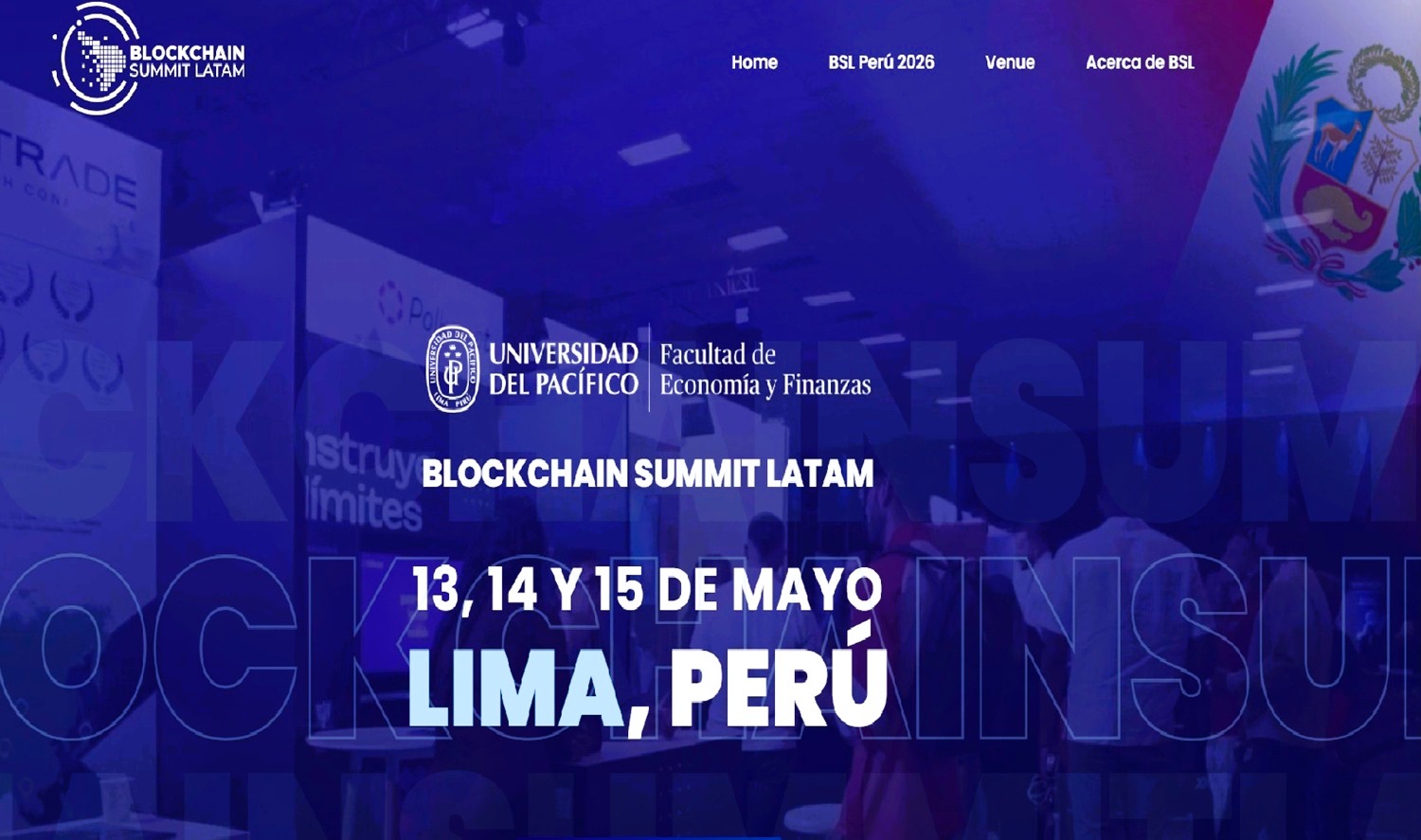
Agencia Peruana de Noticias PRENSAPERU.PE https://www.prensaperu.pe Twitter: @prensaperupe Durante tres días consecutivos, Lima se convierte en el escenario principal del debate y la definición del futuro financiero de la región con la realización del Blockchain Summit Latam On Tour 2026 (BSL), el foro institucional más relevante y prestigioso dedicado exclusivamente a la transformación financiera impulsada por la tecnología blockchain en América Latina. Este evento marca un hito histórico: por primera vez en sus ediciones, el BSL adopta el formato de gira regional, iniciando su recorrido en la capital peruana antes de trasladarse a Santiago de Chile y Bogotá, Colombia, lo que refuerza el rol estratégico de Perú como punto de encuentro y articulación para las políticas, innovaciones y acuerdos que moldearán la economía digital de todo el continente.
La edición peruana reúne en un mismo espacio a más de 3,000 asistentes y 70 expositores internacionales confirmados, entre ellos autoridades de bancos centrales, organismos reguladores, directivos de instituciones financieras tradicionales, líderes de empresas tecnológicas, expertos en innovación, inversionistas y académicos provenientes de todos los países de la región y del extranjero. Se trata de un espacio de diálogo estratégico de alto nivel, diseñado no solo para compartir conocimientos, sino para construir consensos, definir marcos de acción y alinear visiones sobre cómo integrar la tecnología blockchain en los sistemas financieros nacionales y regionales, garantizando seguridad, estabilidad, eficiencia e inclusión.
DETALLES DEL EVENTO
Fechas: 13, 14 y 15 de mayo de 2026 – jornada continua de 9:00 a 18:00 horas, con espacios dedicados a conferencias magistrales, paneles de discusión, talleres prácticos, presentaciones de casos de éxito y ruedas de negocios.
Sede: Universidad del Pacífico, Lima – institución de prestigio académico y referente en investigación económica y financiera, elegida por su trayectoria y su compromiso con la innovación y el desarrollo del país.
Alcance: Más de 3,000 participantes presenciales, transmisión en vivo para más de 10,000 espectadores en línea, y cobertura mediática nacional e internacional especializada en tecnología y finanzas.
Expositores: 70 referentes mundiales y regionales, incluyendo gerentes generales de bancos centrales, jefes de regulación financiera, directivos de bancos comerciales, fundadores de empresas líderes en tecnología blockchain, expertos en derecho financiero y especialistas en desarrollo económico.
AGENDA: TEMAS CENTRALES
Cada eje temático ha sido seleccionado por su relevancia actual y su impacto a mediano y largo plazo en la economía regional. A continuación, cada punto explicado en profundidad para su total comprensión:
1.- Regulación, bancos centrales e infraestructura financiera digital: Este eje analiza el marco normativo necesario para integrar la tecnología blockchain en los sistemas financieros nacionales, equilibrando innovación, seguridad jurídica, protección al usuario y estabilidad económica. Se define cómo los bancos centrales y organismos reguladores definen reglas claras para evitar riesgos como fraudes, lavado de activos o inestabilidad financiera, al mismo tiempo que habilitan el desarrollo de nuevas infraestructuras digitales. Aquí se debaten temas como monedas digitales emitidas por bancos centrales (CBDC), normas de funcionamiento de plataformas blockchain, requisitos de seguridad y supervisión de servicios financieros descentralizados. Es el pilar fundamental: sin regulación adecuada, la innovación no puede escalar ni generar confianza.
2.- Tokenización de activos, stablecoins y custodia institucional
Tokenización de activos: Es el proceso mediante el cual se representa cualquier bien físico o financiero (bienes raíces, acciones, bonos, materias primas, arte, etc.) como un activo digital registrado en una red blockchain. Esto permite fraccionar la propiedad, facilitar transferencias, reducir costos y aumentar la liquidez de mercados que antes eran cerrados o complejos.
Stablecoins: Son criptoactivos diseñados para mantener un valor estable, generalmente vinculado a monedas tradicionales como el dólar, el euro o el sol, o a activos de reserva. Sirven como puente entre las finanzas tradicionales y las digitales, facilitando pagos, ahorro y transacciones sin la volatilidad típica de otras criptomonedas.
Custodia institucional: Se refiere a los servicios profesionales y seguros para guardar, gestionar y proteger activos digitales, ofrecidos por entidades reguladas. Es indispensable para que bancos, fondos de inversión y grandes empresas puedan participar en este ecosistema con seguridad, ya que garantiza que los activos no se pierdan ni sean robados.
En este bloque se analiza cómo estas herramientas están cambiando la forma de invertir, ahorrar y hacer negocios, y cuáles son los estándares necesarios para su uso masivo.
3.- Pagos digitales transfronterizos e interoperabilidad: Los pagos internacionales tradicionales son lentos, costosos, requieren muchos intermediarios y tardan días en procesarse. La tecnología blockchain permite realizar transferencias entre países en cuestión de minutos, con costos mucho menores y total trazabilidad. La interoperabilidad es clave aquí: significa que diferentes redes, plataformas y sistemas financieros puedan “hablarse” entre sí, intercambiar información y valor sin barreras. En este punto se debaten acuerdos regionales, estándares técnicos comunes y cómo facilitar el comercio y las remesas, un tema vital para países como Perú, donde las remesas son un motor económico importante.
4.- Convergencia TradFi + Blockchain y visión estratégica hacia 2030
TradFi: Abreviatura de Finanzas Tradicionales – bancos, bolsas, aseguradoras, sistemas de pago clásicos.
Convergencia: No se trata de reemplazar lo tradicional, sino de integrar la tecnología blockchain dentro de las estructuras ya existentes para mejorarlas. Se combina la confianza, experiencia y regulación del sistema financiero estable con la eficiencia, velocidad y transparencia de la tecnología descentralizada.
Visión 2030: Proyección de cómo será el sistema financiero regional dentro de 4 años: qué servicios usaremos, cómo se regularán, qué infraestructuras tendremos y cómo esto impactará en el crecimiento económico, la inclusión financiera y la competitividad internacional de América Latina.
PARTICIPACIÓN DESTACADA: INFRAESTRUCTURA FINANCIERA Y ESTABILIDAD – BANCO CENTRAL DE RESERVA DEL PERÚ
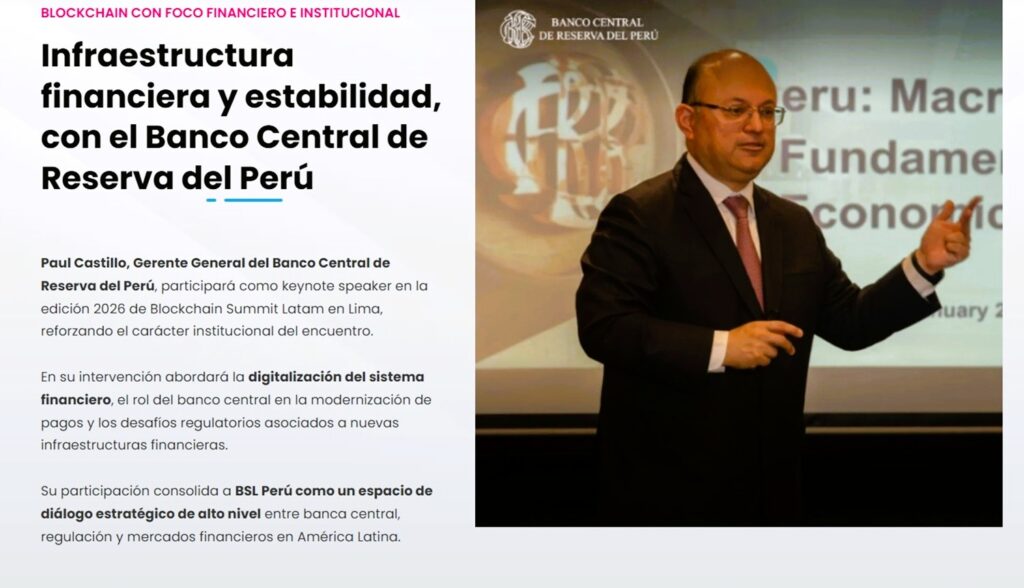
Uno de los momentos más esperados y relevantes del evento es la intervención de Paul Castillo, Gerente General del Banco Central de Reserva del Perú (BCRP), quien participa como orador principal (keynote speaker) en esta edición 2026. Su presencia refuerza de forma decisiva el carácter institucional, serio y estratégico del encuentro, demostrando el compromiso de la autoridad monetaria peruana con la modernización financiera.
En su disertación titulada “Infraestructura financiera y estabilidad”, Castillo abordará tres ejes centrales:
1.- La digitalización del sistema financiero peruano: El camino recorrido, los avances logrados y los planes futuros para transformar la infraestructura de pagos, liquidación y funcionamiento del mercado financiero.
2.- El rol del banco central: Cómo la autoridad monetaria actúa como garante de la estabilidad, pero también como impulsor de la innovación, definiendo reglas, promoviendo seguridad y facilitando la adopción de nuevas tecnologías sin poner en riesgo la economía nacional.
3.- Desafíos regulatorios: Las complejidades de adaptar normas creadas para el sistema tradicional a un entorno digital, global y descentralizado, buscando equilibrar libertad de innovación, protección al ciudadano y estabilidad macroeconómica.
Junto a él, participan representantes de los bancos centrales de Chile, Colombia y Brasil, lo que convierte este espacio en una plataforma única para alinear visiones regionales, compartir experiencias y avanzar hacia marcos normativos y operativos comunes.
LO QUE SE VIVIRÁ EN BSL PERÚ 2026
Cada actividad ha sido diseñada para brindar valor integral a todos los asistentes.
INFRAESTRUCTURA FINANCIERA DIGITAL
Se analiza paso a paso la evolución del sistema financiero: desde los sistemas centralizados clásicos hasta las nuevas arquitecturas basadas en blockchain y redes distribuidas. Se explica cómo estas nuevas estructuras permiten mayor transparencia, menor riesgo operativo, mayor velocidad y menores costos, y cómo se están adaptando los mercados para integrarlas.
REGULACIÓN Y BANCA CENTRAL
Se profundiza en el rol fundamental de las autoridades: no solo como vigilantes, sino como arquitectos del nuevo sistema. Se debaten casos reales de regulación en la región, aciertos, errores y lecciones aprendidas, y cómo lograr marcos que permitan innovar sin riesgos innecesarios.
NETWORKING ESTRATÉGICO
Es uno de los mayores valores del evento: conexión directa, presencial y personalizada con tomadores de decisión, directivos, reguladores, empresarios e inversionistas. Espacios exclusivos para generar alianzas, acuerdos comerciales, proyectos conjuntos y contactos que impulsarán negocios en toda la región.
IMPACTO ECONÓMICO Y FINANCIERO
Se demuestra cómo la innovación blockchain no es solo tecnología, sino herramienta de desarrollo: cómo impulsa el crecimiento económico, mejora la eficiencia de los servicios, reduce costos para empresas y ciudadanos, y sobre todo, cómo contribuye a la inclusión financiera, permitiendo que millones de personas sin acceso a bancos puedan usar servicios financieros seguros y accesibles.
DATOS CONCEPTUALES
1.- Perú como líder regional: La elección de Lima como ciudad de inicio de la gira confirma al país como referente estratégico y puerta de entrada para la transformación financiera blockchain en América Latina, con instituciones serias y preparadas para liderar el cambio.
2.- Institucionalidad y regulación como base: La participación activa de bancos centrales y reguladores demuestra que la tecnología no avanza sola: el éxito depende de reglas claras, seguridad jurídica y visión conjunta entre sector público y privado.
3.- La convergencia es el camino: El futuro no es reemplazar las finanzas tradicionales, sino integrar la tecnología blockchain para mejorarlas. La alianza entre TradFi y nuevas tecnologías es la única vía para un sistema financiero sólido y moderno.
4.- Soluciones para retos regionales: Temas como pagos transfronterizos, remesas e inclusión financiera son prioritarios. Blockchain ofrece respuestas concretas a problemas históricos de América Latina, con impacto directo en la economía familiar y nacional.
5.- Estabilidad + innovación: El mensaje central del Banco Central es claro: se puede innovar, pero siempre protegiendo la estabilidad económica, el ahorro de las personas y el funcionamiento ordenado del mercado.
6.- Hoja de ruta al 2030: Este evento no es solo debate, es definición de futuro. Se construye una visión común para los próximos años, donde la tecnología será parte cotidiana de los servicios financieros, con reglas, estándares y acuerdos regionales.
Fuente: Agencia Peruana de Noticias PRENSAPERU.PE https://www.prensaperu.peTwitter: @prensaperupe
Translate
Blockchain Summit Latam 2026: “3 days in Lima. How will blockchain transform payments, investments, and regulation in the region? ‘The Financial Meeting that Defines the Future of Latin America’.”
Peruvian News Agency PRENSAPERU.PE https://www.prensaperu.pe Twitter: @prensaperupe For three consecutive days, Lima becomes the main stage for debate and definition of the region’s financial future with the holding of Blockchain Summit Latam On Tour 2026 (BSL), the most relevant and prestigious institutional forum dedicated exclusively to financial transformation driven by blockchain technology in Latin America. This event marks a historic milestone: for the first time in its editions, BSL adopts a regional tour format, starting its journey in the Peruvian capital before moving on to Santiago de Chile and Bogotá, Colombia. This reinforces Peru’s strategic role as a meeting point and coordinating hub for policies, innovations, and agreements that will shape the digital economy of the entire continent.
The Peruvian edition brings together in one space over 3,000 attendees and 70 confirmed international speakers, including central bank authorities, regulatory bodies, executives from traditional financial institutions, leaders of technology companies, innovation experts, investors, and academics from across the region and abroad. It serves as a high‑level strategic dialogue space, designed not only to share knowledge but also to build consensus, define frameworks for action, and align visions on how to integrate blockchain technology into national and regional financial systems, while guaranteeing security, stability, efficiency, and inclusion.
EVENT DETAILS
Dates: May 13, 14, and 15, 2026 – continuous schedule from 9:00 AM to 6:00 PM, with spaces dedicated to keynote speeches, discussion panels, practical workshops, success case presentations, and business roundtables.
Venue: Universidad del Pacífico, Lima – an institution of academic prestige and a benchmark in economic and financial research, chosen for its track record and commitment to innovation and national development.
Reach: Over 3,000 in‑person participants, live streaming for more than 10,000 online viewers, and national and international media coverage specialized in technology and finance.
Speakers: 70 global and regional leaders, including general managers of central banks, heads of financial regulation, executives from commercial banks, founders of leading blockchain technology firms, financial law experts, and economic development specialists.
AGENDA: KEY THEMES
Each thematic axis has been selected for its current relevance and its medium‑ and long‑term impact on the regional economy. Below is an in‑depth explanation of each point for full understanding:
1.- Regulation, central banks, and digital financial infrastructure: This axis analyzes the regulatory framework required to integrate blockchain technology into national financial systems, balancing innovation, legal certainty, consumer protection, and economic stability. It defines how central banks and regulatory bodies establish clear rules to avoid risks such as fraud, money laundering, or financial instability, while enabling the development of new digital infrastructures. Topics debated here include central bank digital currencies (CBDCs), operational standards for blockchain platforms, security requirements, and supervision of decentralized financial services. This is the fundamental pillar: without proper regulation, innovation cannot scale or build trust.
2.- Asset tokenization, stablecoins, and institutional custody
Asset tokenization: The process of representing any physical or financial asset (real estate, stocks, bonds, commodities, art, etc.) as a digital asset recorded on a blockchain network. This enables fractional ownership, easier transfers, lower costs, and greater liquidity in markets that were previously closed or complex to access.
Stablecoins: Cryptoassets designed to maintain a stable value, usually pegged to traditional currencies such as the US dollar, euro, or sol, or to reserve assets. They act as a bridge between traditional and digital finance, facilitating payments, savings, and transactions without the volatility typical of other cryptocurrencies.
Institutional custody: Refers to professional, secure services for storing, managing, and protecting digital assets, offered by regulated entities. It is essential for banks, investment funds, and large corporations to participate safely in this ecosystem, as it guarantees that assets will not be lost or stolen.
This section analyzes how these tools are changing the way people invest, save, and do business, and what standards are required for their widespread adoption.
3.- Cross‑border digital payments and interoperability: Traditional international payments are slow, expensive, require many intermediaries, and take days to process. Blockchain technology enables transfers between countries in minutes, at far lower cost, and with full traceability. Interoperability is key here: it means that different networks, platforms, and financial systems can “communicate” with one another, exchanging information and value without barriers. This segment debates regional agreements, common technical standards, and ways to facilitate trade and remittances – a vital issue for countries like Peru, where remittances represent an important economic driver.
4.- TradFi + Blockchain convergence and strategic vision towards 2030
TradFi: Short for Traditional Finance – banks, stock exchanges, insurance companies, and classic payment systems.
Convergence: This is not about replacing traditional systems, but about integrating blockchain technology within existing structures to improve them. It combines the trust, experience, and regulation of the established financial system with the efficiency, speed, and transparency of decentralized technology.
Vision 2030: A projection of what the regional financial system will look like in four years: which services we will use, how they will be regulated, what infrastructures we will have, and how this will impact economic growth, financial inclusion, and the international competitiveness of Latin America.
HIGHLIGHTED PARTICIPATION: FINANCIAL INFRASTRUCTURE AND STABILITY – CENTRAL RESERVE BANK OF PERU
One of the most anticipated and relevant moments of the event is the address by Paul Castillo, General Manager of the Central Reserve Bank of Peru (BCRP), who will participate as a keynote speaker at this 2026 edition. His presence decisively reinforces the institutional, serious, and strategic nature of the gathering, demonstrating the Peruvian monetary authority’s commitment to financial modernization.
In his speech titled “Financial Infrastructure and Stability”, Castillo will address three core areas:
1.- Digitalization of the Peruvian financial system: The path traveled, progress achieved, and future plans to transform payment, settlement, and financial market operational infrastructure.
2.- The role of the central bank: How the monetary authority acts as a guarantor of stability, but also as a driver of innovation, defining rules, promoting security, and facilitating the adoption of new technologies without putting the national economy at risk.
3.- Regulatory challenges: The complexities of adapting regulations created for the traditional system to a digital, global, and decentralized environment, seeking to balance freedom to innovate, consumer protection, and macroeconomic stability.
Joining him will be representatives from the central banks of Chile, Colombia, and Brazil, turning this space into a unique platform to align regional visions, share experiences, and move toward common regulatory and operational frameworks.
WHAT TO EXPECT AT BSL PERU 2026
Every activity has been designed to deliver comprehensive value to all attendees.
DIGITAL FINANCIAL INFRASTRUCTURE
A step‑by‑step analysis of the evolution of the financial system: from classic centralized systems to new architectures based on blockchain and distributed networks. It explains how these new structures enable greater transparency, lower operational risk, higher speed, and reduced costs, and how markets are adapting to integrate them.
REGULATION AND CENTRAL BANKING
An in‑depth look at the fundamental role of authorities: not only as overseers, but as architects of the new system. It discusses real cases of regulation across the region, successes, mistakes, and lessons learned, and how to create frameworks that allow innovation without unnecessary risks.
STRATEGIC NETWORKING
One of the greatest values of the event: direct, in‑person, personalized connections with decision‑makers, executives, regulators, entrepreneurs, and investors. Exclusive spaces to build partnerships, commercial agreements, joint projects, and contacts that will drive business across the region.
ECONOMIC AND FINANCIAL IMPACT
A demonstration that blockchain innovation is not just technology, but a tool for development: how it drives economic growth, improves service efficiency, reduces costs for businesses and citizens, and above all, how it contributes to financial inclusion – enabling millions of people without access to banks to use safe and accessible financial services.
CONCEPTUAL INSIGHTS
1.- Peru as a regional leader: The choice of Lima as the starting city for the tour confirms the country as a strategic benchmark and gateway for blockchain financial transformation in Latin America, with serious, capable institutions ready to lead change.
2.- Institutional framework and regulation as the foundation: The active participation of central banks and regulators demonstrates that technology does not advance in isolation: success depends on clear rules, legal certainty, and a shared vision between the public and private sectors.
3.- Convergence as the way forward: The future is not about replacing traditional finance, but about integrating blockchain technology to improve it. The alliance between TradFi and new technologies is the only path to a solid, modern financial system.
4.- Solutions for regional challenges: Issues such as cross‑border payments, remittances, and financial inclusion are top priorities. Blockchain offers concrete answers to long‑standing problems in Latin America, with direct impact on household and national economies.
5.- Stability + innovation: The central message from the Central Bank is clear: innovation is possible, but always while protecting economic stability, people’s savings, and the orderly functioning of markets.
6.- Roadmap to 2030: This event is not just about debate – it is about defining the future. A shared vision is being built for the coming years, where technology will be a routine part of financial services, supported by rules, standards, and regional agreements.
Source: Peruvian News Agency PRENSAPERU.PE https://www.prensaperu.pe Twitter: @prensaperupe