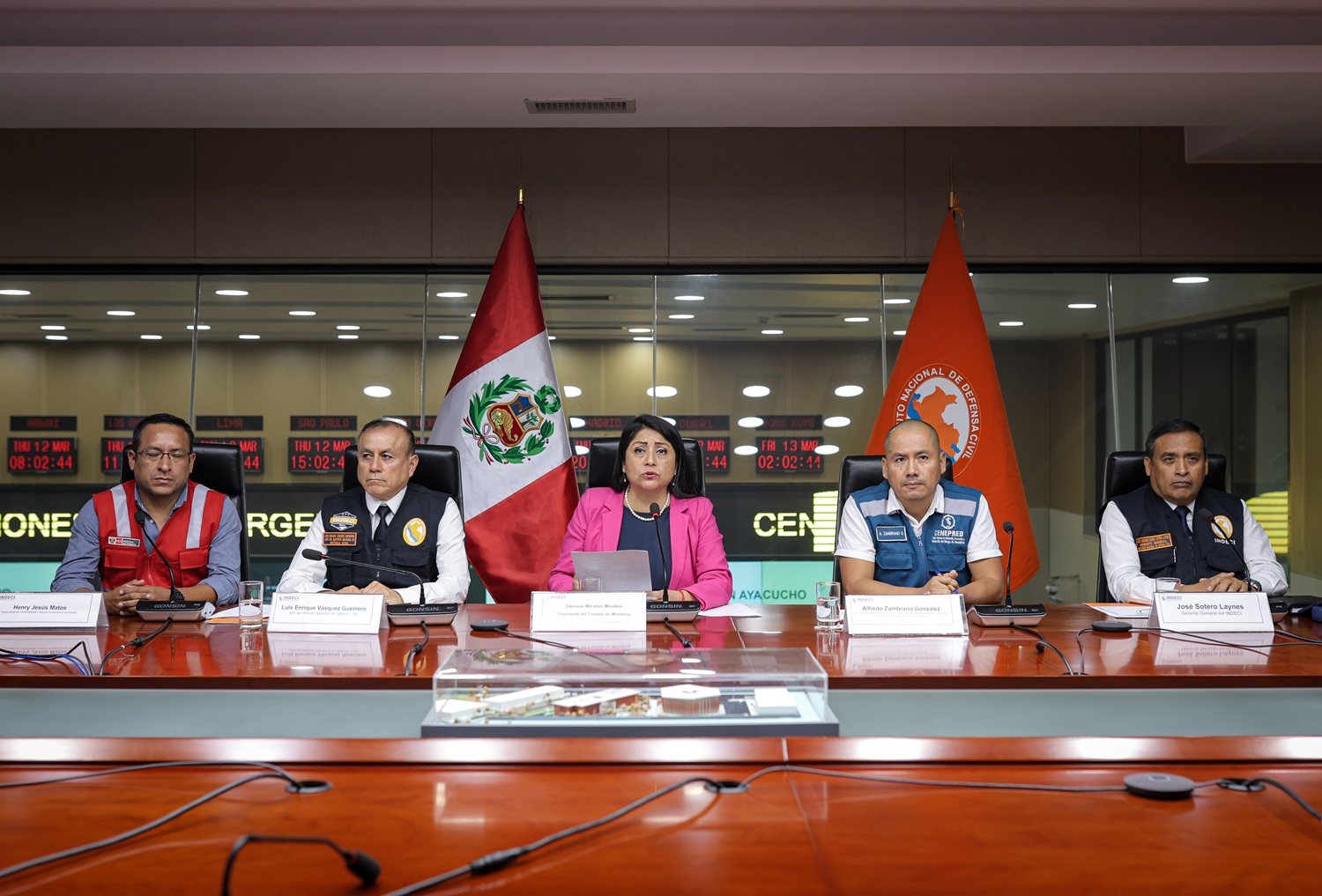
Agencia Peruana de Noticias PRENSAPERU.PE https://www.prensaperu.pe Twitter: @prensaperupe La presidenta del Consejo de Ministros, Denisse Miralles, anunció la transferencia de recursos económicos y el despliegue de acciones multisectoriales para enfrentar la emergencia provocada por las intensas lluvias asociadas al fenómeno El Niño —un patrón climático oceánico-atmosférico que se caracteriza por el calentamiento anómalo de las aguas superficiales del océano Pacífico ecuatorial, generando alteraciones en los patrones de precipitación y temperaturas a nivel global, y que en Perú suele provocar inundaciones, deslizamientos y desbordes de ríos en diversas regiones del país.
Los más de S/66 millones provienen del Fondo para Intervenciones ante la Ocurrencia de Desastres Naturales (FONDES) —un mecanismo financiero público peruano creado para atender de manera oportuna las necesidades derivadas de desastres naturales, permitiendo la ejecución rápida de obras y acciones de emergencia sin necesidad de tramites administrativos prolongados. Estos recursos serán destinados a 29 municipalidades de nueve regiones: Amazonas, Apurímac, Ayacucho, Cajamarca, Huancavelica, Huánuco, Junín, San Martín y Ucayali, donde se ejecutarán 47 intervenciones de emergencia que beneficiarán directamente a más de 14 000 ciudadanos.
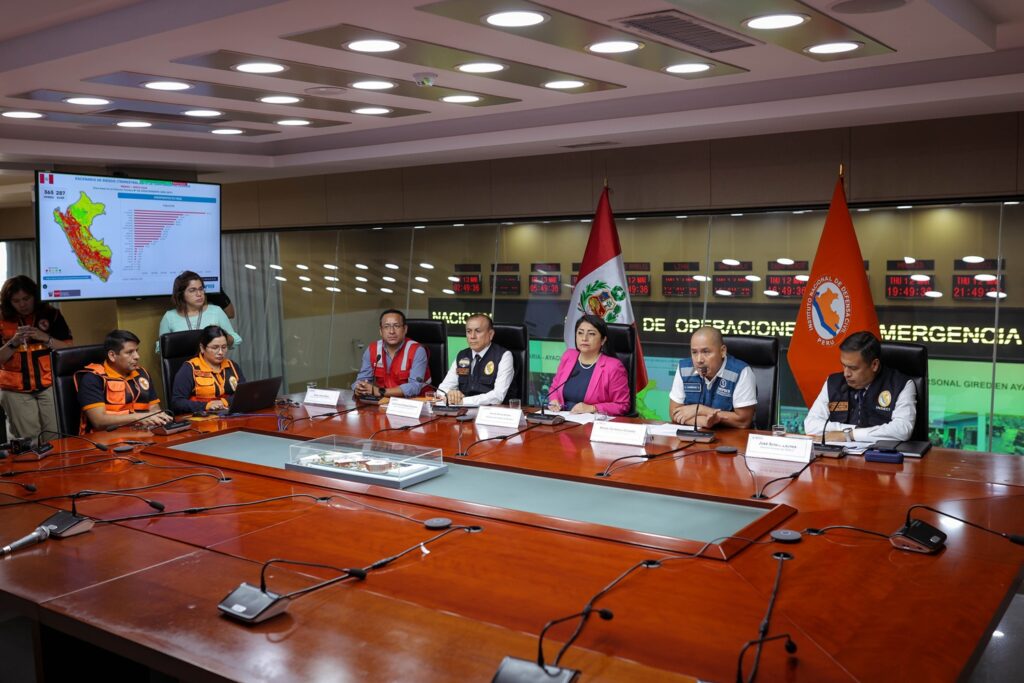
La declaración se realizó desde el Centro de Operaciones de Emergencia Nacional (COEN) —la entidad encargada de coordinar la respuesta nacional ante situaciones de emergencia y desastres, integrando esfuerzos de diferentes instituciones públicas para garantizar una actuación coordinada y eficiente. Allí, la jefa del gabinete enfatizó la postura del Estado frente a la contingencia: “No vamos a esperar. Estamos actuando con sentido de urgencia para proteger la vida, la salud y el bienestar de las familias afectadas. Estos recursos permitirán intervenir de inmediato en infraestructura educativa, saneamiento, riego y vías, porque nuestra prioridad es que la población no quede desamparada frente a esta emergencia”.
ACCIONES DE REPUESTA Y APOYO LOGÍSTICO
En las últimas 24 horas, el Ministerio de Defensa dispuso el despliegue de 151 efectivos de las Fuerzas Armadas, acompañados de siete maquinarias pesadas, 14 vehículos de apoyo y una aeronave. Estas unidades están destinadas a apoyar labores clave como evacuación de poblaciones en riesgo, limpieza de viviendas afectadas por sedimentos, remoción de escombros y rehabilitación de vías interrumpidas, con presencia en las regiones de Piura, Arequipa y Ayacucho.
Las brigadas de intervención rápida ya están operando en localidades como Chulucanas (Piura), Sachaca (Arequipa) y Ayna (Ayacucho), trabajando en conjunto con autoridades locales para brindar apoyo directo a la población. Paralelamente, el Ministerio de Transportes y Comunicaciones (MTC) ha atendido siete emergencias viales en Amazonas, Apurímac, Ayacucho, Huánuco y Piura, con ocho maquinarias desplegadas para restablecer la transitabilidad —capacidad de una vía o infraestructura de transporte para ser utilizada de manera segura y fluida por vehículos y peatones.
COORDINACIÓN MULTISECTORIAL PARA GARANTIZAR SERVICIOS ESENCIALES
El Instituto Nacional de Defensa Civil (Indeci) mantiene personal técnico en el campo para asistir a autoridades regionales y locales en la evaluación de daños materiales y humanos, así como en el registro de toda la información relevante en el Sistema de Información Nacional para la Respuesta y Rehabilitación (SINPAD) —una plataforma que centraliza datos sobre afectaciones, recursos disponibles y acciones implementadas en situaciones de emergencia, permitiendo una gestión más eficiente de la respuesta.
Por su parte, el Ministerio de Educación coordina permanentemente con las Direcciones Regionales de Educación (DRE) y las Unidades de Gestión Educativa Local (UGEL) para asegurar la continuidad del servicio educativo en las zonas afectadas. Hasta la fecha, se han habilitado 64 escuelas como espacios de refugio temporal o para reanudar clases, garantizando que los estudiantes no vean interrumpido su proceso de aprendizaje.
El Ministerio de Desarrollo Agrario y Riego (Midagri), a través de la Autoridad Nacional del Agua (ANA), coordina con el Gobierno Regional de Huancavelica para atender puntos críticos que afectan al sector agrario —como desbordes de canales de riego o pérdida de cultivos—, con el fin de mitigar los impactos en la seguridad alimentaria de las comunidades rurales. Asimismo, se está desarrollando la evaluación y validación de viviendas completamente destruidas o inhabitable para activar el Bono de Arrendamiento de Emergencia —un subsidio económico destinado a familias que han perdido su hogar por desastres naturales, permitiéndoles alquilar un espacio temporal mientras se resuelve la situación.
ATENCIÓN ESPECIAL AL COLAPSO DEL PUENTE COLLOTA-SAHUAY EN ÁNCASH
En relación con el colapso del puente Collota–Sahuay, en el distrito de Cátac (región Áncash), la presidenta del Consejo de Ministros informó que el Gobierno activó de inmediato el protocolo de emergencia para la atención de las personas afectadas y el restablecimiento de la conectividad en el menor tiempo posible.
En esta operación intervinieron efectivos de la Policía Nacional de la comisaría de Cátac, la Unidad de Rescate de Huaraz, la comisaría de Recuay, el destacamento de Protección de Carreteras y los bomberos de la Compañía N.º 84 Santiago Antúnez de Mayolo, quienes llevaron a cabo labores de búsqueda, rescate y atención médica inicial a las personas afectadas. Como medida inmediata para restablecer el tránsito entre las localidades conectadas por el puente, se anunció la instalación de un puente modular temporal de 18 metros de longitud, que permitirá reanudar el flujo de personas y mercancías en la zona.
SUPERVISIÓN Y MANTENIMIENTO DE INFRAESTRUCTURA VIAL
Finalmente, la jefa del gabinete destacó que la Superintendencia Nacional de Transporte Terrestre (Ositrán) viene reforzando la supervisión de la infraestructura vial en coordinación con el MTC, especialmente en zonas donde las estructuras presentan deterioro acumulado por más de 20 años sin mantenimiento adecuado —una situación que se ha visto agravada por las intensas precipitaciones asociadas a El Niño.
“Cada acción que estamos desplegando tiene como objetivo proteger a las familias, recuperar la conectividad y devolver tranquilidad a la población. Este Gobierno no va a retroceder frente a la emergencia; va a responder con presencia, decisión y resultados”, concluyó Denisse Miralles.
DATOS
1.- La respuesta gubernamental es multisectorial y coordinada: El Gobierno está integrando esfuerzos de instituciones como el COEN, Indeci, MTC, Ministerio de Defensa, Educación y Midagri para abordar diferentes dimensiones de la emergencia, garantizando que se atiendan tanto las necesidades inmediatas de la población como la recuperación de servicios esenciales.
2.- Los recursos y acciones están enfocados en la protección de la población y la restablecimiento de conectividad: La transferencia de S/66 millones del FONDES, el despliegue de personal y maquinaria, así como la instalación de infraestructura temporal, tienen como prioridad central salvaguardar la vida y bienestar de los ciudadanos afectados y reanudar el flujo de personas y mercancías en las zonas impactadas.
3.- La emergencia pone de manifiesto la necesidad de inversión en mantenimiento de infraestructura: El deterioro acumulado de estructuras viales por más de dos décadas, agravado por las lluvias de El Niño, resalta la importancia de implementar planes de mantenimiento preventivo para reducir la vulnerabilidad de las regiones ante fenómenos climáticos.
Fuente: Agencia Peruana de Noticias PRENSAPERU.PE https://www.prensaperu.pe Twitter: @prensaperupe
Translate
Government Allocates Over S/66 Million and Deploys Armed Forces to Address El Niño in Nine Regions of Peru; Roads, Education and Sanitation Are Priorities in Emergency.
Peruvian News Agency PRENSAPERU.PE https://www.prensaperu.pe Twitter: @prensaperupe The President of the Council of Ministers, Denisse Miralles, announced the transfer of economic resources and the deployment of multisectoral actions to address the emergency caused by heavy rains associated with the El Niño phenomenon —an ocean-atmospheric climate pattern characterized by the abnormal warming of surface waters in the equatorial Pacific Ocean, generating changes in precipitation patterns and temperatures worldwide, and which in Peru usually causes floods, landslides and river overflows in various regions of the country.
The more than S/66 million comes from the Fund for Interventions in the Event of Natural Disasters (FONDES) —a Peruvian public financial mechanism created to promptly address needs arising from natural disasters, allowing the rapid execution of emergency works and actions without the need for lengthy administrative procedures. These resources will be allocated to 29 municipalities in nine regions: Amazonas, Apurímac, Ayacucho, Cajamarca, Huancavelica, Huánuco, Junín, San Martín and Ucayali, where 47 emergency interventions will be carried out, directly benefiting more than 14,000 citizens.
The statement was made from the National Emergency Operations Center (COEN) —the entity in charge of coordinating the national response to emergency situations and disasters, integrating efforts from different public institutions to ensure coordinated and efficient action. There, the head of the cabinet emphasized the State’s stance on the contingency: “We will not wait. We are acting with a sense of urgency to protect the lives, health and well-being of affected families. These resources will allow immediate intervention in educational infrastructure, sanitation, irrigation and roads, because our priority is that the population is not left unassisted in the face of this emergency.”
RESPONSE ACTIONS AND LOGISTICAL SUPPORT
In the last 24 hours, the Ministry of Defense has deployed 151 personnel from the Armed Forces, accompanied by seven heavy machinery units, 14 support vehicles and one aircraft. These units are assigned to support key tasks such as evacuation of at-risk populations, cleaning of homes affected by sediment, debris removal and rehabilitation of interrupted roads, with presence in the regions of Piura, Arequipa and Ayacucho.
The rapid intervention brigades are already operating in locations such as Chulucanas (Piura), Sachaca (Arequipa) and Ayna (Ayacucho), working together with local authorities to provide direct support to the population. At the same time, the Ministry of Transportation and Communications (MTC) has addressed seven road emergencies in Amazonas, Apurímac, Ayacucho, Huánuco and Piura, with eight machinery units deployed to restore transitability —the ability of a road or transportation infrastructure to be used safely and smoothly by vehicles and pedestrians.
MULTISECTORAL COORDINATION TO GUARANTEE ESSENTIAL SERVICES
The National Civil Defense Institute (Indeci) maintains technical personnel in the field to assist regional and local authorities in assessing material and human damage, as well as in registering all relevant information in the National Information System for Response and Rehabilitation (SINPAD) —a platform that centralizes data on impacts, available resources and implemented actions in emergency situations, enabling more efficient response management.
For its part, the Ministry of Education coordinates permanently with the Regional Directorates of Education (DRE) and Local Educational Management Units (UGEL) to ensure the continuity of educational services in affected areas. To date, 64 schools have been enabled as temporary shelters or to resume classes, ensuring that students do not have their learning process interrupted.
The Ministry of Agrarian Development and Irrigation (Midagri), through the National Water Authority (ANA), coordinates with the Regional Government of Huancavelica to address critical points affecting the agricultural sector —such as overflowing irrigation canals or crop loss—, in order to mitigate impacts on the food security of rural communities. Additionally, the evaluation and validation of completely destroyed or uninhabitable homes is being carried out to activate the Emergency Rental Bonus —a financial subsidy for families who have lost their homes due to natural disasters, allowing them to rent temporary accommodation while the situation is resolved.
SPECIAL ATTENTION TO THE COLLAPSE OF THE COLLOTA-SAHUAY BRIDGE IN ÁNCASH
Regarding the collapse of the Collota–Sahuay bridge in the district of Cátac (Áncash region), the President of the Council of Ministers reported that the Government immediately activated the emergency protocol to assist affected people and restore connectivity in the estertor possible time.
This operation involved personnel from the National Police at the Cátac police station, the Huaraz Rescue Unit, the Recuay police station, the Highway Protection Detachment and firefighters from the No. 84 Santiago Antúnez de Mayolo Company, who carried out search, rescue and initial medical care for the affected people. As an immediate measure to restore traffic between the localities connected by the bridge, the installation of an 18-meter temporary modular bridge was announced, which will allow the flow of people and goods to resume in the area.
SUPERVISION AND MAINTENANCE OF ROAD INFRASTRUCTURE
Finally, the head of the cabinet highlighted that the National Superintendency of Land Transportation (Ositrán) is strengthening the supervision of road infrastructure in coordination with the MTC, especially in areas where structures show accumulated deterioration after more than 20 years without adequate maintenance —a situation that has been exacerbated by heavy rains associated with El Niño.
“Every action we are deploying aims to protect families, restore connectivity and bring peace of mind to the population. This Government will not back down in the face of the emergency; it will respond with presence, determination and results,” concluded Denisse Miralles.
DATA
1.- The government response is multisectoral and coordinated: The Government is integrating efforts from institutions such as COEN, Indeci, MTC, Ministry of Defense, Education and Midagri to address different dimensions of the emergency, ensuring that both the immediate needs of the population and the recovery of essential services are addressed.
2.- Resources and actions are focused on protecting the population and restoring connectivity: The transfer of S/66 million from FONDES, the deployment of personnel and machinery, as well as the installation of temporary infrastructure, have the central priority of safeguarding the lives and well-being of affected citizens and resuming the flow of people and goods in impacted areas.
3.- The emergency highlights the need for investment in infrastructure maintenance: The accumulated deterioration of road structures over more than two decades, exacerbated by El Niño rains, underscores the importance of implementing preventive maintenance plans to reduce the vulnerability of regions to climate phenomena.
Source: Peruvian News Agency PRENSAPERU.PE https://www.prensaperu.pe Twitter: @prensaperupe