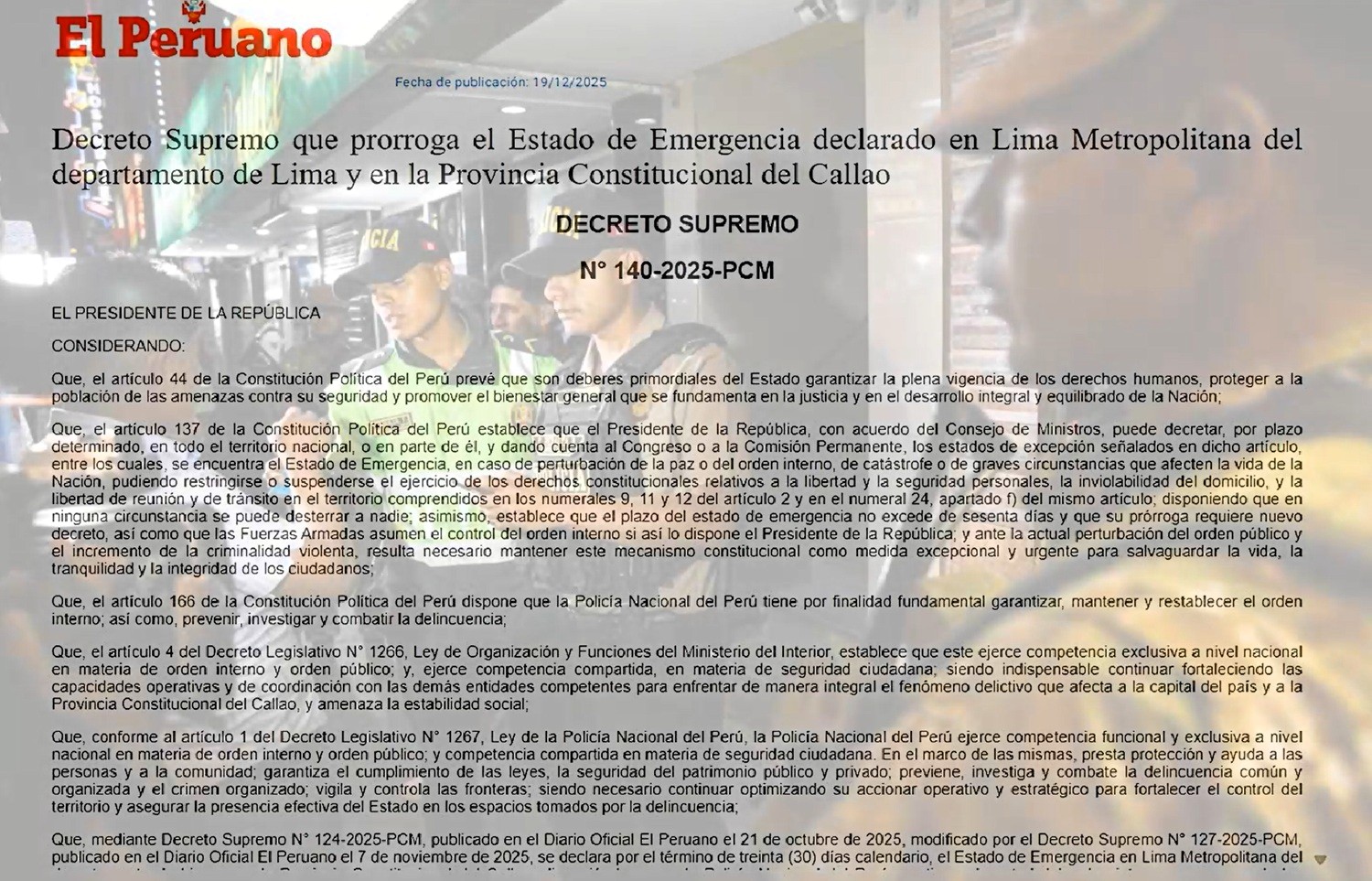
Agencia Peruana de Noticias PRENSAPERU.PE https://www.prensaperu.pe Twitter: @prensaperupe El Gobierno del presidente José Jerí, a través de una resolución aprobada por el Consejo de Ministros, dio a conocer el Decreto Supremo N° 140-2025-PCM, que establece la prórroga del estado de emergencia en Lima Metropolitana y la provincia del Callao por un plazo de 30 días calendario, iniciando el 21 de diciembre de 2025. La medida se justifica como parte de las acciones continuas y fortalecidas en contra de la inseguridad ciudadana y la criminalidad organizada, problemáticas que han generado preocupación social en las últimas semanas.
Conforme a la normativa, la Policía Nacional del Perú (PNP) mantendrá el control del orden interno, contando con el apoyo operativo de las Fuerzas Armadas. Las zonas de intervención serán determinadas sobre la base de instrumentos de inteligencia, indicadores estadísticos de delincuencia, mapas de riesgo y análisis territoriales —elementos que buscan garantizar que las acciones sean focalizadas y eficaces, según declaraciones oficiales del Ministerio del Interior.
En materia de derechos constitucionales, la declaratoria contempla la restricción o suspensión de garantías previstas en el artículo 137 de la Constitución Política del Perú. Entre ellas se encuentran la libertad y seguridad personales (con posibilidad de detención por más de 24 horas sin orden judicial en casos justificados por la situación de emergencia), la inviolabilidad de domicilio (permitiendo registros sin orden judicial en circunstancias específicas), la libertad de reunión pacífica y la libertad de tránsito en las zonas intervenidas. Es importante destacar que estas restricciones deben ser proporcionales al riesgo que se busca mitigar y limitadas al plazo de la emergencia, según los principios del derecho constitucional peruano.
Respecto a actividades públicas, las de carácter masivo —tanto religiosas, culturales, deportivas como no deportivas— requerirán de un permiso previo ante las autoridades competentes (principalmente la PNP y el serenazgo local), que evaluarán su viabilidad en función de la seguridad. Por el contrario, las actividades no masivas podrán desarrollarse sin necesidad de autorización previa, siempre que se mantenga el orden público. Esta disposición ha generado debate entre sectores de la sociedad civil, que destacan la importancia de proteger la libertad de reunión sin afectar la organización de eventos comunitarios.
Otro punto relevante de la prórroga es la modificación en la conformación del Comando de Coordinación Operativa Unificada (CCO), el órgano encargado de dirigir las acciones de seguridad en las zonas de emergencia. Ahora, el jefe del Instituto Nacional de Defensa Civil (INDECI) se incorpora al CCO, lo que busca fortalecer la coordinación entre las fuerzas de orden y las instituciones encargadas de la gestión de riesgos, especialmente en un período cercano a fiestas navideñas, donde suele haber un aumento de movilidad y actividades públicas.
Esta es la tercera declaratoria de estado de emergencia emitida por el presidente Jerí en el último mes y medio. El primero se dictó el 22 de octubre por 30 días, y el segundo el 20 de noviembre, también por el mismo plazo. Las autoridades han informado que durante estos períodos se han realizado diversos operativos de seguridad que han permitido recuperar el control territorial en zonas de alto riesgo y garantizar la seguridad ciudadana, aunque no se han proporcionado datos estadísticos oficiales detallados sobre la efectividad de estas medidas en la reducción de la delincuencia.
CONCLUSIONES
1.- La prórroga del estado de emergencia refleja la percepción gubernamental de que la inseguridad y la criminalidad organizada en Lima y Callao siguen representando un riesgo significativo que requiere de medidas excepcionales.
2.- Las restricciones de derechos constitucionales establecidas se ajustan al marco legal peruano, pero plantean preguntas sobre la proporcionalidad y el impacto en las garantías individuales de la población.
3.- La incorporación del INDECI al CCO busca mejorar la coordinación entre seguridad y gestión de riesgos, un aspecto relevante en el contexto navideño de mayor actividad pública.
4.- La distinción entre actividades masivas y no masivas en materia de permisos intenta equilibrar la seguridad con la libertad de reunión, aunque genera incertidumbre en la organización de eventos comunitarios.
5.- La sucesión de tres estados de emergencia en corto plazo sugiere que las medidas adoptadas hasta ahora no han logrado resolver de forma definitiva la problemática de la inseguridad, lo que invita a evaluar su efectividad a largo plazo.
Fuente: Agencia Peruana de Noticias PRENSAPERU.PE https://www.prensaperu.pe Twitter: @prensaperupe

English Translation
30 More Days of Emergency in Lima and Callao: “Government reinforces security and restricts rights, while organized crime corners it during the end-of-year holidays”.
Peruvian News Agency PRENSAPERU.PE https://www.prensaperu.pe Twitter: @prensaperupe The government of President José Luis Rodríguez Zapatero, through a resolution approved by the Council of Ministers, announced Supreme Decree N° 140-2025-PCM, which extends the state of emergency in Metropolitan Lima and the province of Callao for a period of 30 calendar days, beginning December 21, 2025. The measure is justified as part of the ongoing and strengthened actions against citizen insecurity and organized crime, problems that have generated social concern in recent weeks.
In accordance with regulations, the Peruvian National Police (PNP) will maintain control of internal order, with operational support from the Armed Forces. Intervention zones will be determined based on intelligence tools, crime statistics, risk maps, and territorial analyses—elements designed to ensure targeted and effective actions, according to official statements from the Ministry of the Interior.
Regarding constitutional rights, the declaration contemplates the restriction or suspension of guarantees provided for in Article 137 of the Political Constitution of Peru. These include personal liberty and security (with the possibility of detention for more than 24 hours without a court order in cases justified by the emergency situation), the inviolability of the home (allowing searches without a court order in specific circumstances), the freedom of peaceful assembly, and freedom of movement in the affected areas. It is important to emphasize that these restrictions must be proportional to the risk they seek to mitigate and limited to the duration of the emergency, according to the principles of Peruvian constitutional law.
Regarding public activities, those of a large scale—whether religious, cultural, sporting, or otherwise—will require prior authorization from the relevant authorities (primarily the National Police and local security forces), who will assess their feasibility based on safety concerns. Conversely, smaller activities may proceed without prior authorization, provided public order is maintained. This provision has generated debate among sectors of civil society, who emphasize the importance of protecting freedom of assembly without hindering the organization of community events.
Another relevant aspect of the extension is the modification to the composition of the Unified Operational Coordination Command (CCO), the body responsible for directing security actions in emergency zones. The head of the National Institute of Civil Defense (INDECI) will now be part of the CCO, a move intended to strengthen coordination between law enforcement and risk management institutions, especially during the Christmas season, when increased mobility and public activities are typical.
This is the third state of emergency declared by President Jerí in the last month and a half. The first was declared on October 22 for 30 days, and the second on November 20, also for the same period. Authorities have reported that during these periods, various security operations have been carried out, allowing them to regain territorial control in high-risk areas and guarantee citizen security, although no detailed official statistics have been provided on the effectiveness of these measures in reducing crime.
CONCLUSIONS
1.- The extension of the state of emergency reflects the government’s perception that insecurity and organized crime in Lima and Callao continue to represent a significant risk requiring exceptional measures.
2.- The established restrictions on constitutional rights are in accordance with the Peruvian legal framework, but raise questions about their proportionality and impact on the individual rights of the population.
3.- The incorporation of INDECI (National Institute of Civil Defense) into the CCO (Operational Coordination Center) seeks to improve coordination between security and risk management, a relevant aspect in the context of increased public activity during the Christmas season.
4.- The distinction between mass and non-mass events regarding permits attempts to balance security with freedom of assembly, although it creates uncertainty in the organization of community events.
5.- The succession of three states of emergency in a short period suggests that the measures adopted so far have not definitively resolved the problem of insecurity, prompting an evaluation of their long-term effectiveness.
Source: Peruvian News Agency PRENSAPERU.PE https://www.prensaperu.pe Twitter: @prensaperupe