
Agencia Peruana de Noticias PRENSAPERU.PE https://www.prensaperu.pe Twitter: @prensaperupe En Perú, tras finalizar el escrutinio al 100% de las actas electorales de las Elecciones Generales 2026, el Pleno del Jurado Nacional de Elecciones realizó la proclamación oficial de los resultados de la elección presidencial, un proceso que se llevó a cabo en sesión solemne con la presencia de autoridades electorales, representantes de organizaciones políticas, observadores internacionales y medios de comunicación.
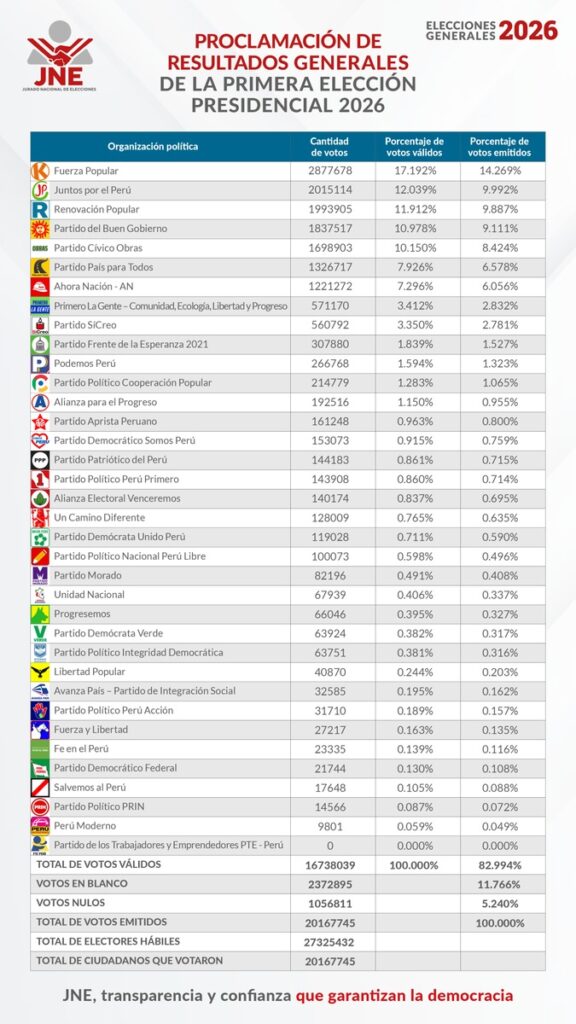
De acuerdo con el cómputo definitivo realizado por la Oficina Nacional de Procesos Electorales (ONPE), ningún candidato alcanzó la mayoría absoluta requerida —más del 50% de los votos válidos—, por lo que se activa el mecanismo constitucional que establece la realización de una segunda vuelta electoral entre las dos fórmulas que obtuvieron las mayores mayorías relativas.
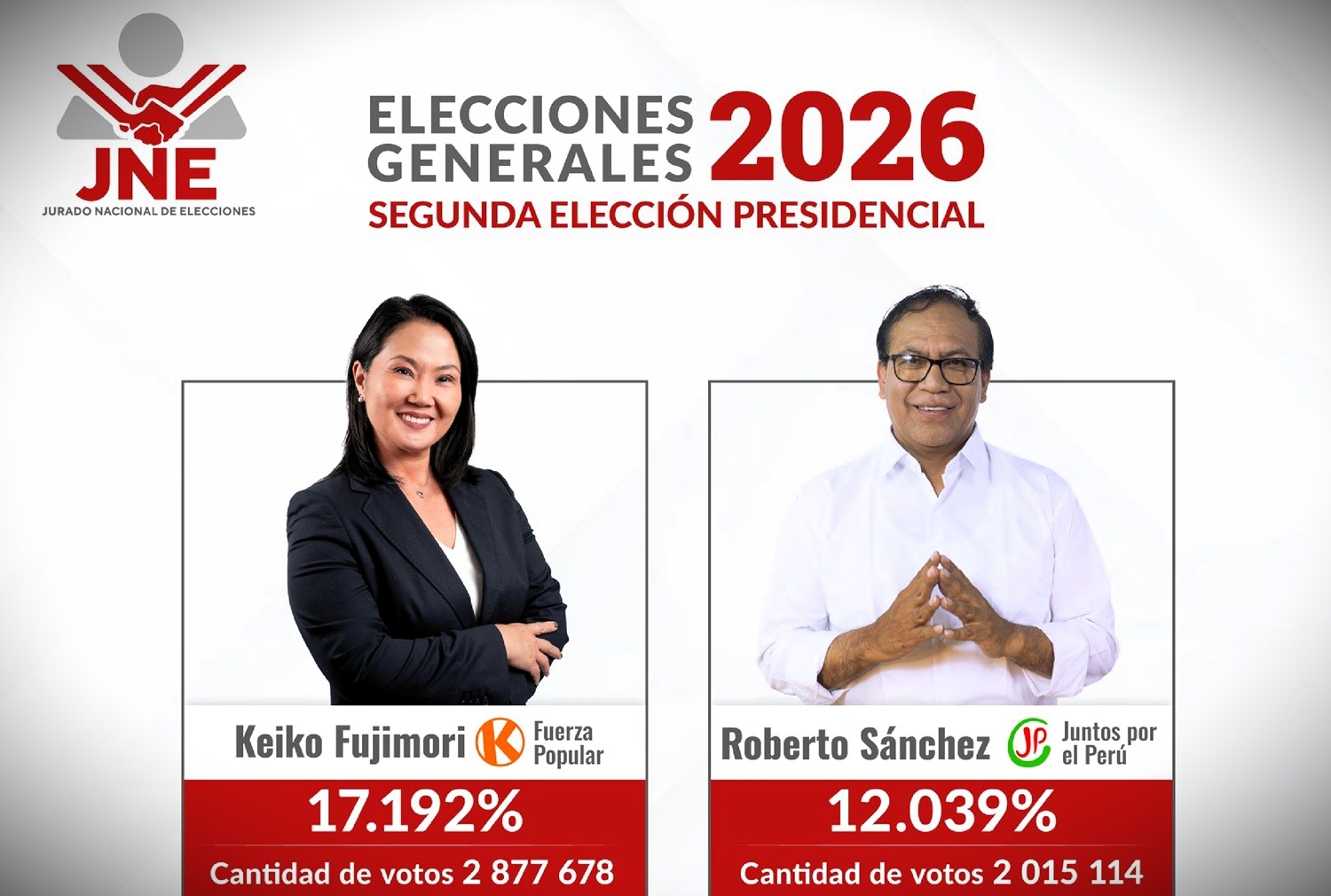
En este contexto, el JNE confirmó que la candidata de Fuerza Popular, Keiko Fujimori Higuchi, se consolida como la primera fuerza del proceso, al obtener 2 millones 877 mil 678 votos, que equivalen al 17,192% del total de sufragios válidos. En segundo lugar se ubica la fórmula de Juntos por el Perú, encabezada por Roberto Helbert Sánchez Palomino, quien recibió 2 millones 15 mil 114 votos, representando el 12,039% de los sufragios contabilizados .
CONTENIDOS CONCEPTUALES CLAVE PARA ENTENDER EL PROCESO
Para comprender la relevancia de esta decisión, es necesario clarificar conceptos fundamentales que rigen el sistema electoral peruano:
Mayoría absoluta: Se refiere a la cantidad de votos que supera la mitad más uno del total de sufragios válidos emitidos. En este proceso, ningún postulante logró alcanzar este porcentaje, por lo que la Constitución establece que se debe convocar a una segunda etapa para definir la jefatura de Estado.
Mayorías relativas: Son los porcentajes de votos que obtienen los candidatos en el primer lugar y el segundo lugar, respectivamente. Estos son los que tienen derecho a participar en el balotaje, como lo establece la normativa electoral vigente.
Escrutinio definitivo: Es el proceso de revisión, conteo y certificación de todas las actas electorales que garantiza que los resultados sean oficiales, verificados y libres de irregularidades. El JNE verificó la validez de cada documento para garantizar la transparencia del proceso.
CRONOGRAMA ELECTORAL PARA LA SEGUNDA VUELTA
El organismo electoral informó que la segunda elección presidencial se realizará el domingo 7 de junio de 2026. A partir de esta fecha, se abrirá un periodo de campaña electoral en el que ambas fórmulas podrán presentar sus propuestas, debatir sus planteamientos y buscar el respaldo de los electores en todo el territorio nacional. Las fechas clave del proceso complementario son:
Inicio de la campaña electoral: 24 de mayo de 2026
Debates presidenciales: Se definirán próximamente las fechas y modalidades por parte del JNE
Cierre de campaña: 5 de junio de 2026
Día de la votación: 7 de junio de 2026
GARANTÍAS DE TRANSPARENCIA
El presidente del JNE, Roberto Burneo, destacó que todo el proceso se ha desarrollado bajo estrictos lineamientos de transparencia, imparcialidad y cumplimiento de la ley. “Estos resultados son inapelables y representan la voluntad expresada por los ciudadanos en las urnas. Hemos verificado cada etapa para asegurar que el sufragio se respete y que el proceso electoral cumpla con todos los estándares nacionales e internacionales”, declaró la autoridad electoral durante la ceremonia de proclamación.
Asimismo, se informó que el resto de resultados de las Elecciones Generales —para el Congreso de la República, los gobiernos regionales y las municipalidades— también han sido certificados y serán publicados oficialmente en los próximos días, cerrando la etapa de cómputo del proceso electoral de abril de 2026.
DATOS CLAVE DEL PROCESO
1.- El sistema democrático se activa: La realización de una segunda vuelta confirma que el mecanismo electoral peruano funciona conforme a lo establecido en la Constitución, garantizando que la presidencia sea definida por el respaldo mayoritario de los ciudadanos, sin importar los resultados de la primera etapa.
2.- Diversidad de preferencias ciudadanas: El hecho de que ningún candidato haya alcanzado la mayoría absoluta refleja la fragmentación del voto y la diversidad de propuestas políticas que existen en el país, lo que obliga a los postulantes a buscar alianzas y acuerdos para ampliar su respaldo en el balotaje.
3.- Posicionamiento político definido: Fuerza Popular y Juntos por el Perú se consolidan como las dos principales fuerzas políticas del momento, aunque con identidades ideológicas y propuestas distintas, lo que generará un debate amplio sobre los retos y perspectivas del país en los próximos años.
4.- Rol fundamental del JNE: El organismo electoral cumplió con su función de garantizar la transparencia, la veracidad y la oficialidad de los resultados, convirtiéndose en un pilar fundamental para mantener la confianza de la ciudadanía en el proceso democrático.
5.- Etapa de construcción política: La segunda vuelta no es solo una competencia electoral, sino un espacio para la definición de acuerdos, la difusión de propuestas y la integración de voluntades, con el objetivo de elegir al gobernante que liderará al Perú durante el periodo 2026-2031.
Fuente: Agencia Peruana de Noticias PRENSAPERU.PE https://www.prensaperu.pe Twitter: @prensaperupe
Translate
The National Elections Board (JNE) has announced the official results! “Keiko Fujimori and Roberto Sánchez will compete for the presidency on June 7th. Learn everything you need to know about the second presidential election in June.”
Peruvian News Agency PRENSAPERU.PE https://www.prensaperu.pe Twitter: @prensaperupe In Peru, following the completion of the vote count for 100% of the electoral records corresponding to the 2026 General Elections, the Plenary Session of the National Jury of Elections (JNE) carried out the official proclamation of the presidential election results. This process took place during a solemn session attended by electoral authorities, representatives of political organizations, international observers, and media outlets.
According to the final tally conducted by the National Office of Electoral Processes (ONPE), no candidate secured the required absolute majority — more than 50% of valid votes —, thereby triggering the constitutional mechanism that establishes the holding of a run-off election between the two tickets that obtained the highest relative majorities.
In this context, the JNE confirmed that the candidate from Popular Force, Keiko Fujimori Higuchi, has solidified her position as the leading force in this process, having received 2,877,678 votes, which represent 17.192% of the total valid votes. In second place is the ticket representing Together for Peru, headed by Roberto Helbert Sánchez Palomino, who garnered 2,015,114 votes, accounting for 12.039% of the ballots tallied.
KEY CONCEPTUAL CONTENT TO UNDERSTAND THE PROCESS
To grasp the significance of this decision, it is necessary to clarify the fundamental concepts that govern the Peruvian electoral system:
Absolute Majority: Refers to the number of votes that exceeds half plus one of the total valid votes cast. In this process, no candidate managed to reach this percentage; therefore, the Constitution mandates convening a second stage to define the head of State.
Relative Majorities: These are the percentages of votes obtained by the candidates in first and second place, respectively. These are the tickets that hold the right to participate in the run-off election, as established by current electoral regulations.
Final Vote Count: It is the process of reviewing, tallying, and certifying all electoral records, which guarantees that results are official, verified, and free of irregularities. The JNE verified the validity of every document to ensure transparency throughout the process.
ELECTORAL CALENDAR FOR THE RUN-OFF ELECTION
The electoral body reported that the second presidential election will take place on Sunday, June 7, 2026. Starting from this date, an electoral campaign period will open, during which both tickets may present their proposals, debate their approaches, and seek support from voters across the entire national territory. The key dates for this complementary process are:
Start of the electoral campaign: May 24, 2026
Presidential debates: Dates and formats to be defined soon by the JNE
End of the campaign: June 5, 2026
Voting day: June 7, 2026
GUARANTEES OF TRANSPARENCY
The president of the JNE, Roberto Burneo, emphasized that the entire process has been carried out under strict guidelines of transparency, impartiality, and compliance with the law. “These results are final and non-appealable, and they represent the will expressed by citizens at the polls. We have verified every stage to ensure that the vote is respected and that the electoral process complies with all national and international standards,” stated the electoral authority during the proclamation ceremony.
Likewise, it was reported that the remaining results of the General Elections — for the Congress of the Republic, regional governments, and municipalities — have also been certified and will be officially published in the coming days, bringing the tally stage of the April 2026 electoral process to a close.
KEY FACTS OF THE PROCESS
1.- The democratic system is activated: The holding of a run-off election confirms that Peru’s electoral mechanism functions in accordance with the provisions of the Constitution, ensuring that the presidency is defined by the majority support of citizens, regardless of the results obtained in the first stage.
2.- Diversity of citizen preferences: The fact that no candidate reached an absolute majority reflects the fragmentation of the vote and the diversity of political proposals existing in the country. This situation requires candidates to seek alliances and agreements to broaden their support ahead of the run-off.
3.- Defined political positioning: Popular Force and Together for Peru have consolidated their positions as the two main political forces of the moment, even though they hold distinct ideological identities and proposals. This will foster a broad debate regarding the challenges and outlook for the country in the coming years.
4.- Fundamental role of the JNE: The electoral body fulfilled its duty to guarantee transparency, veracity, and the official nature of results, becoming a fundamental pillar in maintaining citizen trust in the democratic process.
5.- Stage of political construction: The run-off election is not merely an electoral competition, but rather a space for defining agreements, disseminating proposals, and bringing different visions together, with the goal of electing the leader who will govern Peru for the 2026–2031 term.
Source: Peruvian News Agency PRENSAPERU.PE https://www.prensaperu.pe Twitter: @prensaperupe