
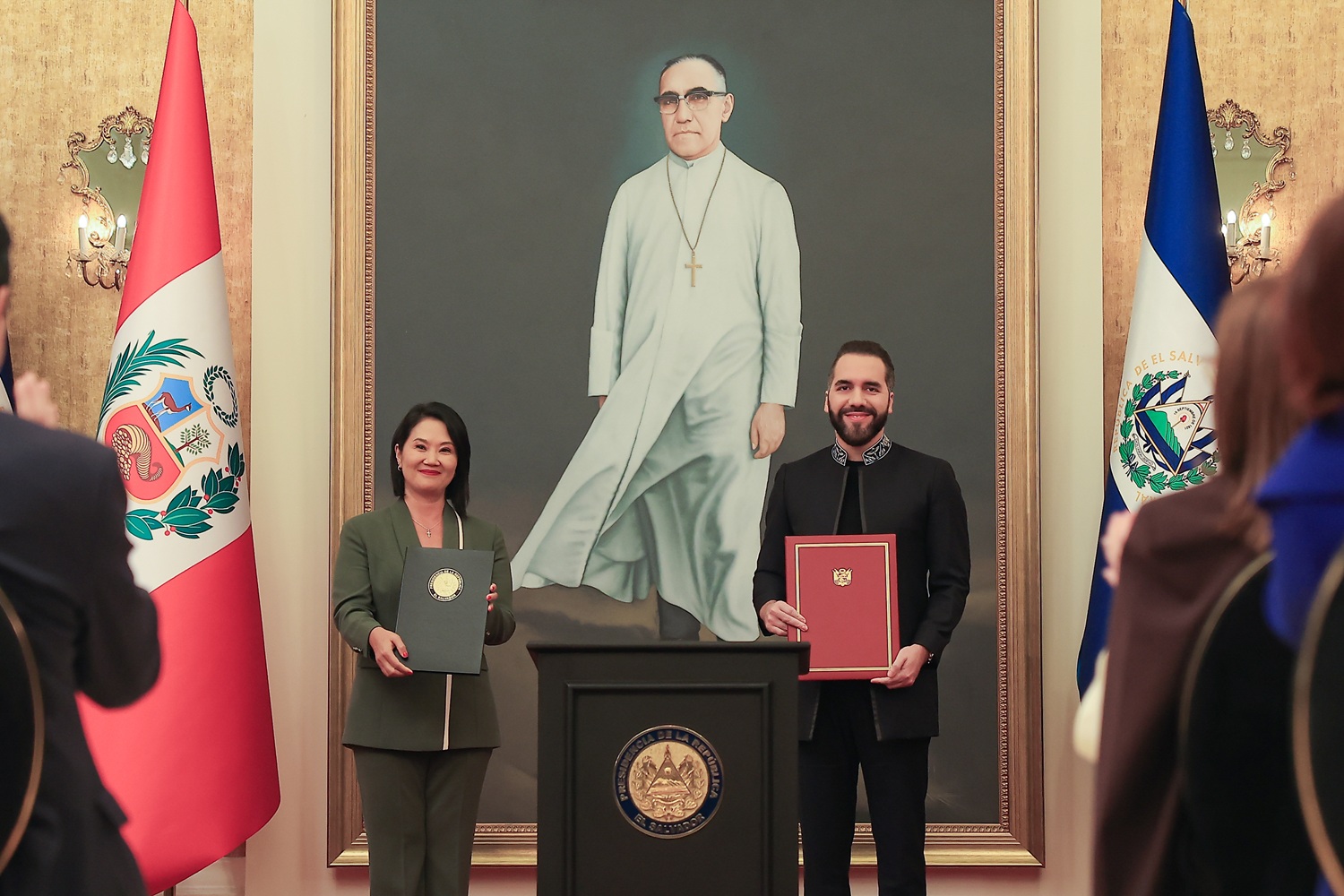
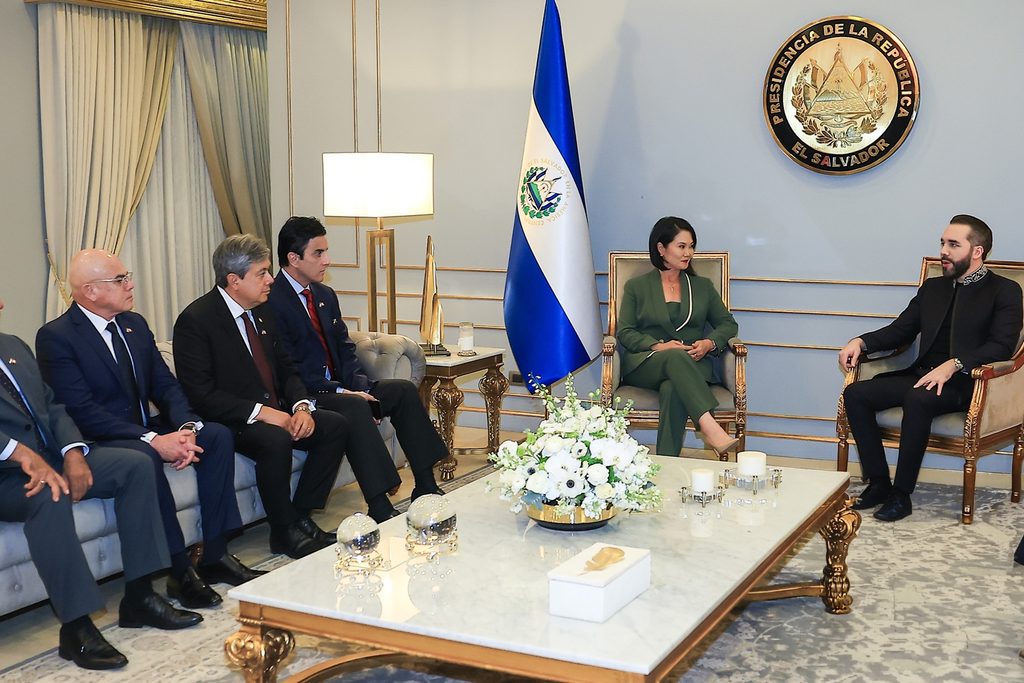
Agencia Peruana de Noticias PRENSAPERU.PE https://www.prensaperu.pe Twitter:@prensaperupe Después de 28 años desde su última visita oficial a El Salvador, la presidenta de la República del Perú, Keiko Fujimori, llegó a Casa Presidencial donde fue recibida por el presidente Nayib Bukele. Esta visita no constituye un acto protocolar más. Representa el fortalecimiento de una relación diplomática que se ha sostenido por 160 años y que ahora avanza hacia una nueva etapa: la transformación de vínculos tradicionales en una alianza estratégica que abarca seguridad, salud, educación, comercio y turismo. La delegación peruana, de muy alto nivel, incluye recorridos por infraestructura clave, intercambios técnicos especializados y la firma de instrumentos de cooperación que redefinen el horizonte de trabajo conjunto entre ambas naciones hermanas.
EL PUNTO DE PARTIDA: UNA TRANSFORMACIÓN QUE INSPIRA
El presidente Bukele abrió la visita compartiendo la experiencia más trascendente de su gestión: la reconstrucción de la seguridad ciudadana. En un proceso que ha llamado la atención del mundo entero, El Salvador transitó de ser catalogado como el país con mayor violencia del planeta a consolidarse como el territorio más seguro del hemisferio occidental. Los datos que ilustran este cambio son contundentes: en su momento más crítico, la tasa de homicidios fue dos veces y media superior a la que hoy registra Haití. Hoy, los índices delictivos —homicidios, robos, extorsiones y asaltos— han caído a mínimos no solo nacionales, sino regionales y globales. Lo relevante de este proceso no es solo la reducción de cifras, sino el cambio estructural que ha permitido que la ciudadanía recupere algo que se daba por perdido: la libertad de caminar por las calles sin temor.
La presidenta Fujimori reconoció este avance con palabras que han resonado en ambos países: “Hoy El Salvador ya no es una referencia de dificultades, sino un faro de esperanza para toda Latinoamérica”. Y agregó una reflexión que conecta con el propósito de su visita: “La paz no se improvisa, la paz se construye”. Esta afirmación trasciende lo simbólico y se convierte en el fundamento de por qué Perú ha venido a observar, analizar y adaptar, no a copiar, lo que en El Salvador se ha logrado.
SEGURIDAD CIUDADANA Y SISTEMA PENITENCIARIO: EL APRENDIZAJE MÁS DIRECTO
Uno de los momentos centrales de la visita fue el recorrido por el Centro de Confinamiento para Terroristas (CECOT). La impresión de la delegación peruana refleja que esta infraestructura no es solo una edificación, sino un modelo conceptual de cómo gestionar a personas privadas de libertad bajo criterios de orden, control y dignidad institucional.
Del intercambio surgieron decisiones concretas. El Perú anunció que construirá dos nuevos establecimientos penitenciarios. El primero estará destinado a personas de alta peligrosidad, tomando como referencia los estándares observados en El Salvador. El segundo se orientará a una población de menor riesgo, incorporando talleres productivos y lo que se conoce como el enfoque de cero ocio: una estrategia que entiende que el trabajo y la capacitación dentro del centro de reclusión son herramientas fundamentales para reducir la reincidencia.
En el plano operativo, el gobierno del Perú ha reactivado el comando unificado entre las Fuerzas Armadas y la Policía Nacional. Esta decisión responde a una necesidad concreta: las organizaciones criminales internacionales han recuperado espacios que el Perú había logrado controlar tras derrotar a los grupos terroristas Sendero Luminoso y el MRTA. La presidenta Fujimori fue enfática al señalar que durante años las fuerzas del orden fueron perseguidas y desprotegidas, y que hoy el Estado les devuelve el respaldo y el liderazgo que requieren para cumplir su misión.
Ambos países también confirmaron su participación activa en mecanismos de cooperación multilateral, entre ellos la Coalición Anticárteles y el mecanismo Escudo de las Américas, en el marco de las Naciones Unidas. El reconocimiento de que el crimen organizado no respeta fronteras ha llevado a ambas naciones a entender que la seguridad de uno depende de la acción conjunta de todos.
SALUD Y EDUCACIÓN: EL HORIZONTE COMPARTIDO
La cooperación no se agota en la seguridad. En materia de salud, el interés del Perú se centra en cómo El Salvador ha avanzado en telemedicina con inteligencia artificial, infraestructura hospitalaria moderna y la incorporación de especialistas internacionales para cubrir brechas locales. Para el Perú, que enfrenta retos similares en la distribución y acceso a servicios de salud, estas experiencias representan una hoja de ruta valiosa.
En educación, el Perú ha presentado una agenda ambiciosa. En los próximos años se construirán 2,000 nuevos colegios, 500 de ellos iniciarán el próximo año. Se implementará conectividad satelital en todo el sistema educativo público, eliminando la brecha digital que ha separado a comunidades rurales de los centros urbanos. Asimismo, se ha planteado recuperar la dimensión formativa integral: el estudiante conoce sus derechos, pero también sus obligaciones. El orden, la disciplina y el respeto forman parte del aprendizaje tanto como los contenidos académicos.
El presidente Bukele compartió que en El Salvador un programa piloto en 171 escuelas arrojó resultados comparables a los de países desarrollados según mediciones internacionales. Este antecedente sugiere que las transformaciones educativas profundas no requieren décadas para mostrar resultados, sino claridad en los objetivos y constancia en la ejecución.
COMERCIO, TURISMO Y COOPERACIÓN INTERNACIONAL: EL LARGO PLAZO
El Perú y El Salvador han expresado su voluntad de avanzar hacia un tratado de libre comercio. Para una economía peruana abierta, integrante de APEC y de la Alianza del Pacífico, este paso representa una oportunidad para que productos, servicios y emprendedores de ambas naciones accedan a mercados más amplios en condiciones justas. El comercio no es solo intercambio de bienes; es también intercambio de visiones, culturas y oportunidades.
Paralelamente, el turismo ha emergido como un área complementaria. El intercambio de visitantes fortalece el tejido social, genera empleo descentralizado y pone en valor el patrimonio natural y cultural de ambos países. La cooperación turística incluye el intercambio de buenas prácticas en gestión de destinos, promoción conjunta y facilitación de los viajes entre ambas naciones.
El presidente Bukele ha sido invitado oficialmente al Perú, país donde su gestión en seguridad es ampliamente reconocida y estudiada. Su visita permitirá cerrar ciclos, afinar acuerdos y proyectar juntos una agenda común.
DATOS CONCEPTUALES
Alianza estratégica: Acuerdo político-diplomático mediante el cual dos naciones elevan su nivel de cooperación más allá del intercambio comercial tradicional, coordinando políticas públicas en áreas de impacto decisivo para el desarrollo integral de sus poblaciones.
Coalición Anticárteles: Mecanismo internacional de cooperación entre Estados, orientado a compartir información, inteligencia y capacidades operativas para combatir de forma conjunta las estructuras del crimen organizado transnacional dedicado al tráfico ilícito de drogas y delitos conexos.
Escudo de las Américas: Marco de cooperación regional constituido en el ámbito de las Naciones Unidas, dirigido a fortalecer la seguridad colectiva, prevenir el delito transnacional y coordinar respuestas institucionales frente a amenazas comunes en el continente.
CECOT (Centro de Confinamiento para Terroristas): Establecimiento penitenciario salvadoreño diseñado bajo estándares de máxima seguridad para la custodia de personas condenadas por actos de terrorismo, concebido como modelo de control, orden y reinserción.
Plan Cero Ocio: Estrategia penitenciaria que contempla el trabajo productivo, la capacitación técnica y la formación humana dentro de los centros de reclusión, como mecanismo para reducir la reincidencia delictiva y preparar el retorno ordenado a la sociedad.
Comando unificado: Dispositivo operativo mediante el cual las Fuerzas Armadas y la Policía Nacional actúan de manera coordinada y complementaria en labores de seguridad interna, bajo una sola línea de mando y objetivos compartidos.
Transformación digital: Proceso de incorporación estratégica de tecnologías digitales en los servicios públicos —conectividad satelital, telemedicina, inteligencia artificial— para ampliar cobertura, reducir brechas y mejorar la calidad de atención a la ciudadanía.
APEC y Alianza del Pacífico: Foros de integración económica que promueven el comercio abierto, la inversión y la cooperación entre economías de Asia-Pacífico y de la costa pacífica de América Latina, respectivamente.
Cooperación turística: Área de trabajo conjunto entre naciones orientada a facilitar los flujos de visitantes, promover destinos, compartir estándares de calidad y posicionar el patrimonio cultural y natural como motor de desarrollo económico sostenible.
CONCLUSIONES
1.- La visita oficial de la presidenta Keiko Fujimori a El Salvador trasciende lo protocolar. Constituye un ejercicio maduro de diplomacia práctica: observar, aprender, adaptar y construir juntos. Lo más valioso de este encuentro no es que Perú vaya a copiar lo que hace El Salvador, sino que ambos países han reconocido que los desafíos de hoy —seguridad, salud, educación— no se resuelven por separado. El crimen organizado cruza fronteras; por tanto, las soluciones también deben hacerlo.
2.- La seguridad ha demostrado ser el punto de partida, no el destino final. Como bien expresó el presidente Bukele: cuando una persona puede salir a la calle sin miedo, puede abrir su negocio, enviar a sus hijos a la escuela, trabajar, ahorrar y construir futuro. Sin seguridad, cualquier otra política de desarrollo encuentra un límite infranqueable. Con seguridad, en cambio, se abren las puertas de la salud, la educación, el comercio y la prosperidad compartida.
3.- El reto más grande que enfrenta esta alianza estratégica es mantener el mismo nivel de determinación en los temas de largo plazo. Es relativamente fácil acordar medidas de seguridad; es más sostenido construir infraestructura educativa, llevar conectividad a zonas alejadas, mejorar la salud pública y fortalecer el turismo. Que ambas naciones avancen en todos estos frentes al mismo tiempo es lo que convertirá esta visita de trabajo en un verdadero punto de inflexión para los ciudadanos de ambos países.
Fuente: Agencia Peruana de Noticias PRENSAPERU.PE https://www.prensaperu.pe Twitter: @prensaperupe
Translate
Peru and El Salvador are transforming 160 years of friendship into a comprehensive strategic alliance, spanning from security to development. “Peace cannot be improvised; peace must be built,” stated President Keiko Fujimori to her counterpart, Nayib Bukele.
Peruvian News Agency PRENSAPERU.PE https://www.prensaperu.pe Twitter: @prensaperupe After 28 years since her last official visit to El Salvador, the President of the Republic of Peru, Keiko Fujimori, arrived at the Presidential House where she was welcomed by President Nayib Bukele. This visit is not merely a protocolary event. It represents the strengthening of a diplomatic relationship that has endured for 160 years and is now moving toward a new stage: the transformation of traditional ties into a strategic alliance covering security, health, education, trade and tourism. The high-level Peruvian delegation included tours of key infrastructure, specialized technical exchanges and the signing of cooperation instruments that redefine the scope of joint work between both sister nations.
THE STARTING POINT: AN INSPIRING TRANSFORMATION
President Bukele opened the visit by sharing the most significant experience of his administration: the reconstruction of citizen security. In a process that has drawn worldwide attention, El Salvador transitioned from being considered the most violent country on the planet to becoming the safest territory in the Western Hemisphere. The figures illustrating this change are compelling: at its most critical point, the homicide rate was two and a half times higher than the current rate in Haiti. Today, crime indices —homicides, theft, extortion and assault— have fallen to not only national lows, but to regional and global levels. What is truly meaningful about this process is not merely the reduction in statistics, but the structural change that has enabled citizens to recover something once thought lost: the freedom to walk the streets without fear.
President Fujimori acknowledged this progress with words that have resonated in both countries: “Today El Salvador is no longer a reference of difficulties, but a beacon of hope for all of Latin America.” She added a reflection that defines the purpose of her visit: “Peace is not improvised, peace is built.” This statement goes beyond symbolism and becomes the foundation for why Peru has come to observe, analyze and adapt —not copy— what has been achieved in El Salvador.
CITIZEN SECURITY AND THE PRISON SYSTEM: THE MOST DIRECT LESSON
One of the central moments of the visit was the tour of the Terrorist Confinement Center (CECOT). The impression of the Peruvian delegation reflects that this infrastructure is not merely a building, but a conceptual model of how to manage persons deprived of liberty under principles of order, control and institutional dignity.
Concrete decisions emerged from the exchange. Peru announced it will build two new prison facilities. The first will house high-risk inmates, following the standards observed in El Salvador. The second will serve a lower-risk population, incorporating productive workshops and what is known as the zero-idleness approach: a strategy that understands work and training within detention centers as essential tools to reduce recidivism.
At the operational level, the government of Peru has reactivated the unified command between the Armed Forces and the National Police. This decision responds to a clear need: international criminal organizations have recovered spaces that Peru had successfully controlled after defeating the terrorist groups Shining Path and the MRTA. President Fujimori was emphatic in stating that for years law enforcement personnel were persecuted and unprotected, and that today the State is restoring the backing and leadership they require to fulfill their mission.
Both countries also confirmed their active participation in multilateral cooperation mechanisms, including the Anti-Cartel Coalition and the Americas Shield mechanism, within the framework of the United Nations. The recognition that organized crime knows no borders has led both nations to understand that the security of one depends on the joint action of all.
HEALTH AND EDUCATION: THE SHARED HORIZON
Cooperation extends beyond security. In health, Peru’s interest focuses on how El Salvador has advanced in artificial intelligence-powered telemedicine, modern hospital infrastructure and the recruitment of international specialists to fill local gaps. For Peru, which faces similar challenges in the distribution and access to health services, these experiences represent a valuable roadmap.
In education, Peru has presented an ambitious agenda. Over the coming years, 2,000 new schools will be built, 500 of them starting next year. Satellite connectivity will be implemented throughout the public education system, bridging the digital divide that has separated rural communities from urban centers. Furthermore, the recovery of comprehensive formative discipline has been proposed: students understand their rights, but also their obligations. Order, discipline and respect are as much a part of learning as academic content.
President Bukele shared that in El Salvador, a pilot program across 171 schools produced results comparable to those of developed countries according to international assessments. This precedent suggests that profound educational transformations do not require decades to show results, but rather clarity in objectives and consistency in implementation.
TRADE, TOURISM AND INTERNATIONAL COOPERATION: THE LONG TERM
Peru and El Salvador have expressed their willingness to move toward a free trade agreement. For an open Peruvian economy, member of APEC and the Pacific Alliance, this step represents an opportunity for goods, services and entrepreneurs from both nations to access broader markets under fair conditions. Trade is not merely the exchange of goods; it is also the exchange of visions, cultures and opportunities.
In parallel, tourism has emerged as a complementary area. The exchange of visitors strengthens the social fabric, generates decentralized employment and enhances the natural and cultural heritage of both countries. Tourism cooperation includes the exchange of best practices in destination management, joint promotion and facilitating travel between both nations.
President Bukele has received an official invitation to visit Peru, a country where his security management is widely recognized and studied. His visit will allow for closing cycles, refining agreements and projecting a shared future agenda.
CONCEPTUAL TERMS
Strategic Alliance: A political-diplomatic agreement through which two nations elevate their level of cooperation beyond traditional trade exchanges, coordinating public policies in areas decisive to the integral development of their populations.
Anti-Cartel Coalition: An international cooperation mechanism among States aimed at sharing information, intelligence and operational capabilities to jointly combat transnational organized crime structures dedicated to drug trafficking and related offenses.
Americas Shield: A regional cooperation framework established within the United Nations system, designed to strengthen collective security, prevent transnational crime and coordinate institutional responses to common threats across the continent.
CECOT (Terrorist Confinement Center): A Salvadoran maximum-security prison facility built to house individuals convicted of terrorist acts, conceived as a model of control, order and reintegration.
Zero-Idleness Plan: A prison strategy incorporating productive work, technical training and personal development within detention centers, as a mechanism to reduce recidivism and prepare for an orderly return to society.
Unified Command: An operational structure through which the Armed Forces and National Police act in a coordinated and complementary manner in internal security missions, under a single chain of command and shared objectives.
Digital Transformation: The strategic integration of digital technologies into public services —satellite connectivity, telemedicine, artificial intelligence— to expand coverage, reduce gaps and improve service delivery to citizens.
APEC and the Pacific Alliance: Economic integration forums promoting open trade, investment and cooperation among economies across the Asia-Pacific region and the Pacific coast of Latin America, respectively.
Tourism Cooperation: A collaborative framework between nations focused on facilitating visitor flows, promoting destinations, sharing quality standards and positioning cultural and natural heritage as a driver for sustainable economic development.
CONCLUSIONS
1.- The official visit of President Keiko Fujimori to El Salvador goes beyond protocol. It represents a mature exercise in practical diplomacy: observing, learning, adapting and building together. The most valuable aspect of this meeting is not that Peru will copy what El Salvador does, but rather that both countries have recognized that today’s challenges —security, health, education— cannot be solved separately. Organized crime crosses borders; therefore, so must solutions.
2.- Security has proven to be the starting point, not the final destination. As President Bukele expressed: when a person can walk outside without fear, they can open a business, send their children to school, work, save and build a future. Without security, every other development policy faces an impassable barrier. With security, however, the doors open for health, education, trade and shared prosperity.
3.- The greatest challenge facing this strategic alliance is maintaining that same level of commitment over the long term. Security measures are relatively straightforward to agree upon; building educational infrastructure, extending connectivity to remote areas, improving public health and strengthening tourism requires sustained effort. Advancing on all these fronts simultaneously is what will transform this working visit into a true turning point for the citizens of both nations.
Source: Peruvian News Agency PRENSAPERU.PE https://www.prensaperu.pe Twitter: @prensaperupe