
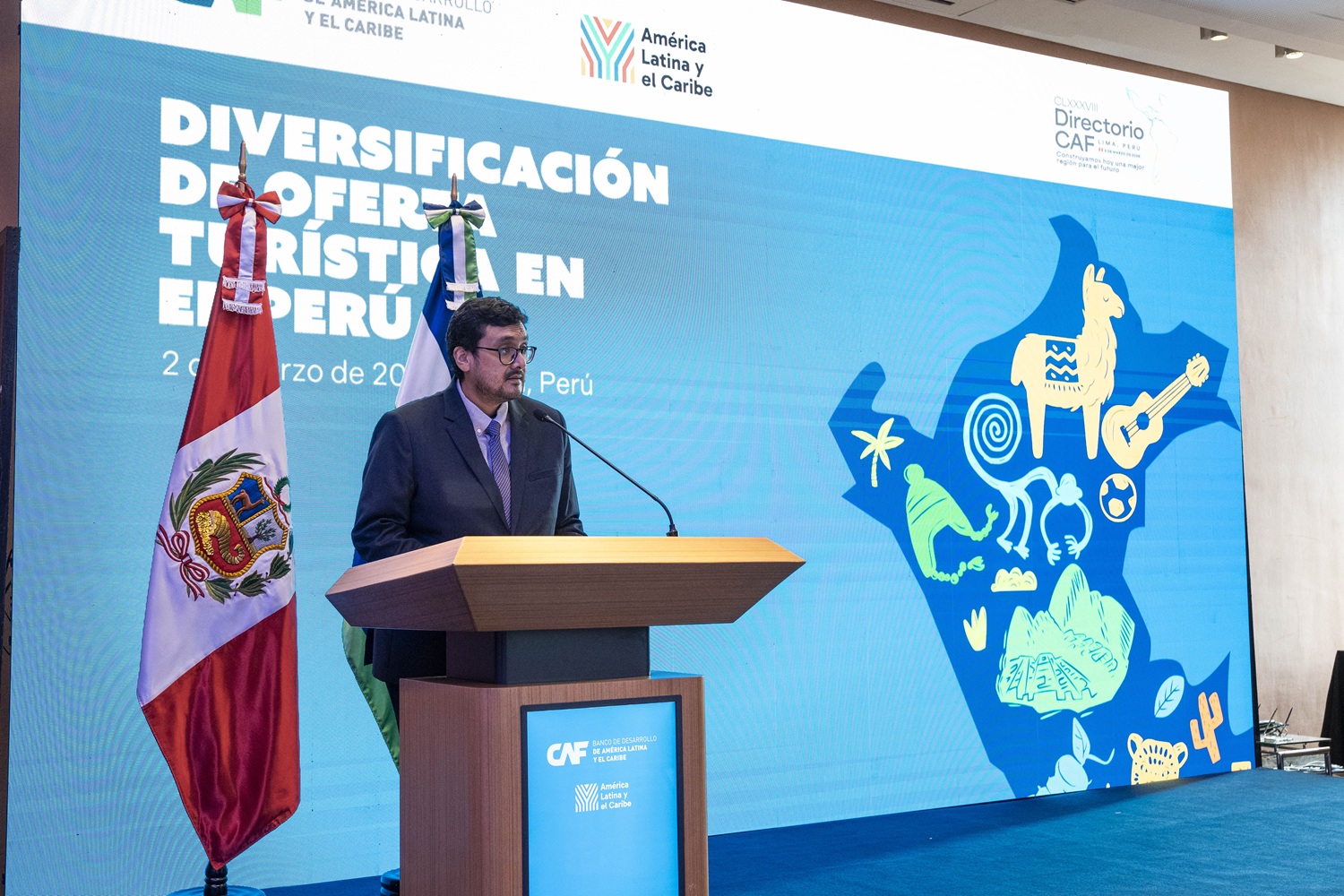
Agencia Peruana de Noticias PRENSAPERU.PE https://www.prensaperu.pe Twitter: @prensaperupe El ministro de Comercio Exterior y Turismo, José Reyes, reafirmó el compromiso del sector de trabajar en conjunto con el CAF – Banco de Desarrollo de América Latina y el Caribe y la ONU Turismo para construir un modelo turístico centrado en el desarrollo territorial, la innovación, la resiliencia, la sostenibilidad y la inclusión. La declaración se hizo durante el evento “Diversificación de la Oferta Turística en el Perú”, celebrado en San Isidro, con la participación de representantes gremiales, empresarios y autoridades como la viceministra de Turismo, Aracelly Laca, y el presidente de la Cámara Nacional de Turismo, José Koechlin.
“El momento que vivimos exige liderazgo, coordinación y visión estratégica. Desde el Mincetur tenemos la voluntad de trabajar con todos ustedes para consolidar un turismo moderno, competitivo y generador de bienestar para todos los peruanos”, enfatizó el ministro Reyes.
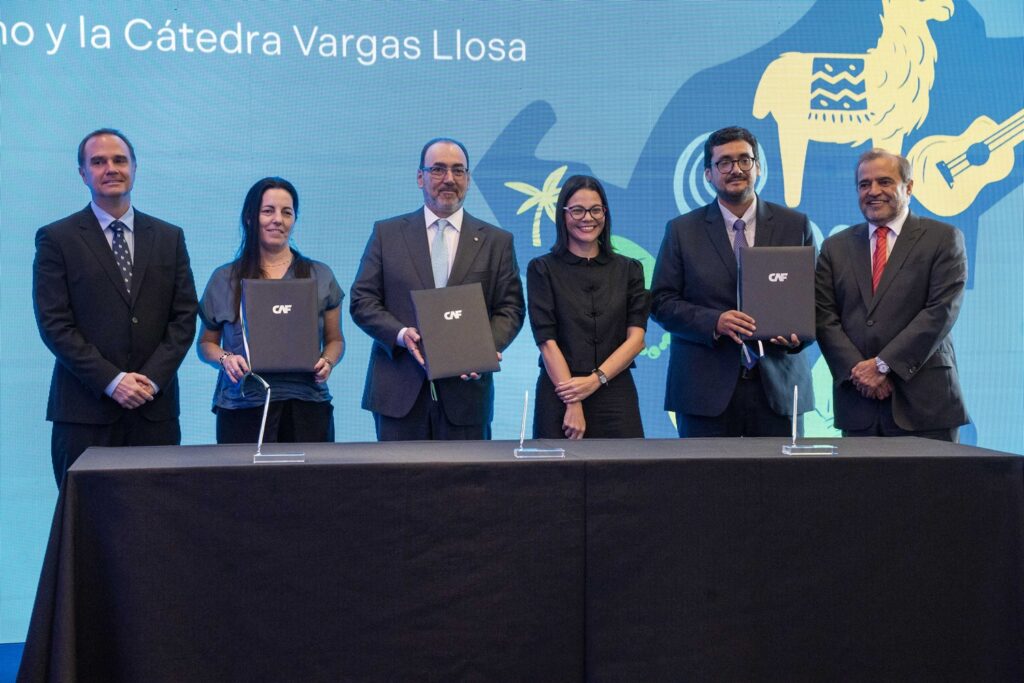
Entre los hitos clave del encuentro destacó la firma de un memorando de entendimiento para impulsar una ruta turística inspirada en la obra de Mario Vargas Llosa, con la presencia del presidente ejecutivo de la CAF, Sergio Díaz-Granados, y Morgana Vargas Llosa como testigo de honor. El documento fue suscrito por el director de Turismo de la CAF, Óscar Rueda; la directora ejecutiva de ONU Turismo, Natalia Bayona; y el director de la Cátedra Vargas Llosa, Raúl Tola. Esta iniciativa se suma a los circuitos literarios ya existentes en Lima y Arequipa: en la capital, se recorren lugares emblemáticos de Conversación en la catedral y La ciudad y los perros; en la Ciudad Blanca, incluye la casa museo donde nació el escritor, así como bibliotecas que albergan su obra y más de 7,000 libros de su colección personal, con tecnología 3D para una experiencia interactiva.
Previamente, el ministro Reyes sostuvo una reunión con Natalia Bayona para definir una agenda de cooperación que busca posicionar al Perú como destino competitivo. Entre los acuerdos figuran la creación de un gestor de datos para articular información pública y privada, la actualización de la Guía de Inversiones Turísticas (lanzada en 2024 por la CAF, ONU Turismo y el Mincetur, que ofrece datos sobre impuestos y perspectivas de crecimiento) y el fortalecimiento de la captación de eventos internacionales y la conectividad aérea. Asimismo, se avanzó en la candidatura del Perú para ser sede de una reunión del Consejo Ejecutivo de ONU Turismo en 2027, un logro que se enmarca en el rol estratégico del país en la organización: desde 2025 lidera el Comité de Programa y Presupuesto y forma parte del grupo de trabajo para rediseñar el turismo del futuro.
El Mincetur también resaltó la necesidad de ampliar inversiones en infraestructura, como el megaproyecto “Fortalecimiento del Destino Turístico Priorizado Arequipa – Colca”, con financiamiento de más de S/300 millones del Banco Mundial, que incluye 33 proyectos para mejorar recursos turísticos en 21 distritos y promover el desarrollo multisectorial. Paralelamente, se impulsa la elevación de estándares de servicio: en diciembre de 2025, más de 220 empresas de 21 regiones fueron reconocidas por su participación en el Sistema de Aplicación de Buenas Prácticas (SABP) del Plan Nacional de Calidad Turística (Caltur), con distinciones de oro, plata y bronce.
DATOS
1.- Las alianzas internacionales son motor de transformación: La colaboración con la CAF y ONU Turismo no solo fortalece la oferta turística, sino que posiciona al Perú como referente en políticas sostenibles a nivel regional, con roles de liderazgo en organismos globales.
2.- El turismo cultural diversifica la propuesta: La ruta literaria de Vargas Llosa une patrimonio cultural, tecnología e identidad nacional, complementando los clásicos destinos arqueológicos y naturales del país y generando nuevas oportunidades económicas para comunidades locales.
3.- Infraestructura y calidad van de la mano: Proyectos como el de Arequipa – Colca y el reconocimiento a empresas del sector demuestran que la inversión en infraestructura y la profesionalización de servicios son fundamentales para construir un turismo competitivo y responsable.
4.- La digitalización y los datos optimizan la toma de decisiones: La creación de un gestor de datos y la actualización de herramientas como la Guía de Inversiones permiten articular esfuerzos entre el sector público y privado, garantizando un desarrollo más estratégico y transparente.
Fuente: Agencia Peruana de Noticias PRENSAPERU.PE https://www.prensaperu.pe Twitter: @prensaperupe
Translate
“Peru, UN Tourism and CAF Join Forces: Strategic Infrastructure Investment Agenda to Position the Country as a Leading Destination in the Americas”.
Peruvian News Agency PRENSAPERU.PE https://www.prensaperu.pe Twitter: @prensaperupe
The Minister of Foreign Trade and Tourism, José Reyes, reaffirmed the sector’s commitment to working together with CAF – Development Bank of Latin America and the Caribbean and UN Tourism to build a tourism model focused on territorial development, innovation, resilience, sustainability and inclusion. The statement was made during the event “Diversification of Peru’s Tourism Offer”, held in San Isidro, with the participation of guild representatives, entrepreneurs and authorities such as the Vice Minister of Tourism, Aracelly Laca, and the President of the National Chamber of Tourism, José Koechlin.
“The moment we are living in demands leadership, coordination and strategic vision. From Mincetur (Ministry of Foreign Trade and Tourism), we are committed to working with all of you to build a modern, competitive tourism sector that generates well-being for all Peruvians,” emphasized Minister Reyes.
Key milestones of the event included the signing of a memorandum of understanding to promote a tourism route inspired by the work of Mario Vargas Llosa, with the presence of CAF’s Executive President, Sergio Díaz-Granados, and Morgana Vargas Llosa as guest of honor. The document was signed by CAF’s Tourism Director, Óscar Rueda; UN Tourism’s Executive Director, Natalia Bayona; and the Director of the Vargas Llosa Chair, Raúl Tola. This initiative joins existing literary circuits in Lima and Arequipa: in the capital, visitors explore iconic locations from Conversation in the Cathedral and The Time of the Hero; in the “White City” (Arequipa), the route includes the house museum where the writer was born, as well as libraries housing his work and over 7,000 books from his personal collection, with 3D technology for an interactive experience.
Previously, Minister Reyes held a meeting with Natalia Bayona to define a cooperation agenda aimed at positioning Peru as a competitive destination. Agreements include the creation of a data manager to link public and private sector information, the update of the Tourism Investment Guide (launched in 2024 by CAF, UN Tourism and Mincetur, which provides data on taxes and growth prospects), and the strengthening of international event bidding and air connectivity. Additionally, progress was made on Peru’s bid to host a meeting of UN Tourism’s Executive Council in 2027 – an achievement aligned with the country’s strategic role in the organization: since 2025, Peru has led the Program and Budget Committee and is part of the working group to redesign the future of tourism.
Mincetur also highlighted the need to increase infrastructure investments, such as the “Strengthening of the Priority Tourist Destination Arequipa – Colca” megaproject, funded with over 300 million soles from the World Bank. It includes 33 projects to improve tourism resources in 21 districts and promote multisectoral development. At the same time, efforts are underway to raise service standards: in December 2025, over 220 companies from 21 regions were recognized for their participation in the Good Practices Implementation System (SABP) of the National Tourism Quality Plan (Caltur), receiving gold, silver and bronze distinctions.
DATA
1.- International alliances drive transformation: Collaboration with CAF and UN Tourism not only strengthens the tourism offering but also positions Peru as a benchmark for sustainable policies at the regional level, with leadership roles in global organizations.
2.- Cultural tourism diversifies the offering: The Vargas Llosa literary route combines cultural heritage, technology and national identity, complementing the country’s classic archaeological and natural destinations and creating new economic opportunities for local communities.
3.- Infrastructure and quality go hand in hand: Projects like Arequipa – Colca and the recognition of sector companies demonstrate that investment in infrastructure and professionalization of services are essential to building a competitive and responsible tourism sector.
4.- Digitalization and data optimize decision-making: The creation of a data manager and the update of tools such as the Investment Guide enable coordination between public and private sectors, ensuring more strategic and transparent development.
Source: Peruvian News Agency PRENSAPERU.PE https://www.prensaperu.pe Twitter: @prensaperupe