
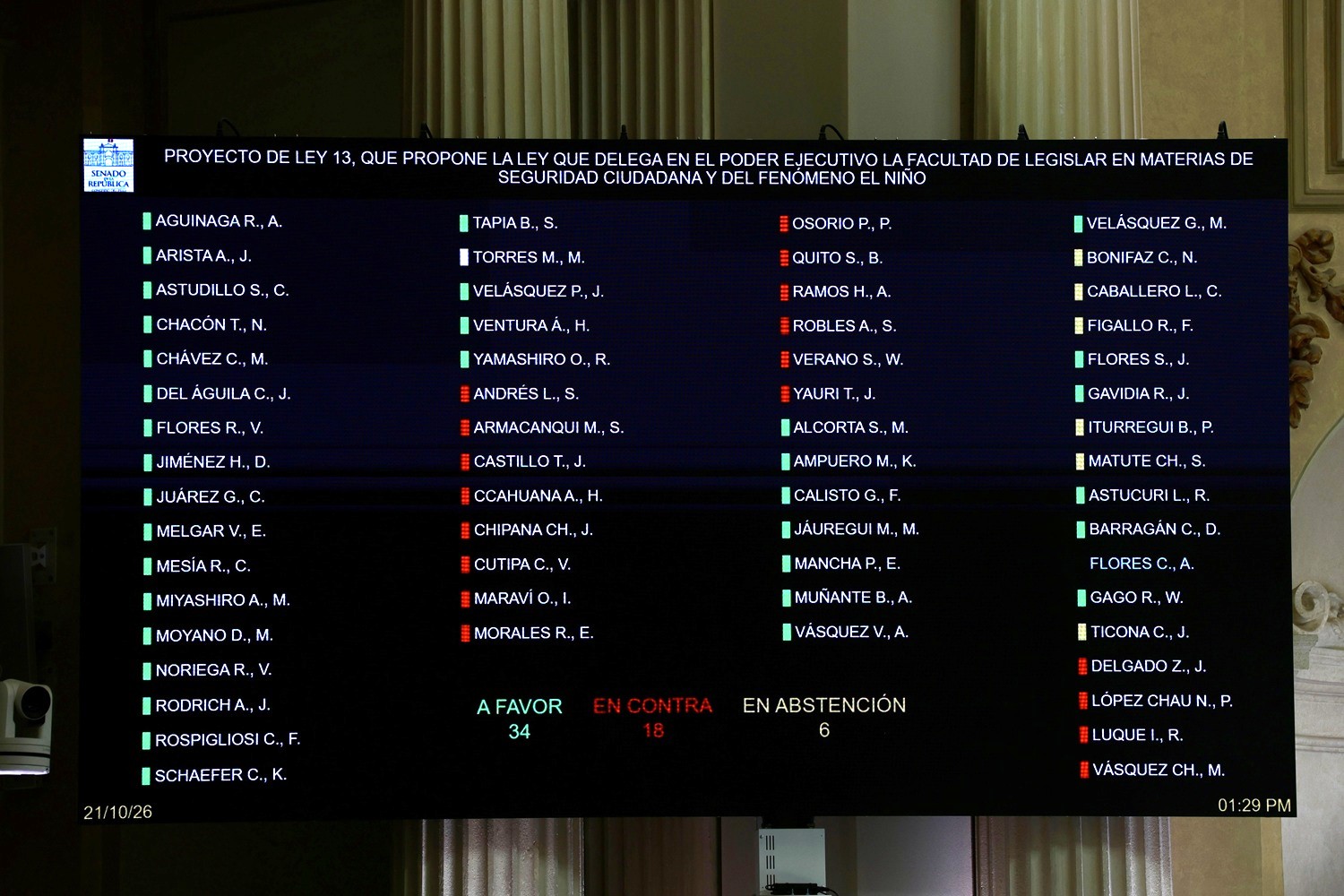
Agencia Peruana de Noticias PRENSAPERU.PE https://www.prensaperu.pe Twitter:@prensaperupe El proceso de otorgamiento de facultades legislativas al Poder Ejecutivo ha concluido con un texto final notablemente más acotado que la solicitud original presentada por el Gobierno de la presidenta Keiko Fujimori. Mientras el Ejecutivo había planteado inicialmente un paquete de 66 puntos que abarcaba reformas económicas, tributarias y una amplia reestructuración de entidades públicas, el Congreso a través de ambas cámaras redujo el alcance de la delegación a solo dos grandes ejes de urgencia social, conformados por 27 puntos específicos, estableciendo además un plazo más breve y estricto para su ejercicio.
Como se sabe, el trámite comenzó con la revisión en la Cámara de Diputados, que efectuó una primera reducción dejando 20 puntos. Posteriormente, la Cámara de Senadores trabajó sobre esa base y reincorporó 7 aspectos adicionales estrictamente vinculados a la seguridad, como inteligencia criminal, lucha contra el sicariato y la ciberdelincuencia, completando así el texto final de 27 puntos. El plazo también fue ajustado: de los 120 días solicitados originalmente por el Ejecutivo, el Senado fijó un término de 90 días calendario, improrrogables.
En ese sentido, en materia de seguridad ciudadana, el texto aprobado autoriza la participación de las Fuerzas Armadas únicamente en la vigilancia externa de los penales de mayor peligrosidad, descartando que asuman la administración interna de los centros penitenciarios. Se establecen además criterios para calificar bandas organizadas que usen armamento de guerra y ejerzan control territorial, se clarifica el alcance de la legítima defensa ciudadana, y se fortalecen el Sistema de Inteligencia Nacional y los controles sobre armas de fuego y migraciones. Quedaron fuera de la delegación las propuestas originales relacionadas con el endurecimiento general de penas, bloqueadores celulares y control total de los establecimientos penitenciarios.
Del mismo modo, para la atención del Fenómeno El Niño, se faculta al Indeci a entregar ayuda humanitaria de forma inmediata durante los primeros 15 días de declarada la emergencia, sin las trabas burocráticas habituales. También se establecen mecanismos para agilizar obras de infraestructura, simplificar la gestión de terrenos y brindar apoyo crediticio y técnico directo a los productores agrarios afectados. El texto aprobado limita expresamente estas facultades a situaciones de emergencia debidamente declaradas, descartando autorizaciones indefinidas o adjudicaciones directas sin plazos.
De otro lado, lo más destacado del proceso legislativo ha sido lo que no se aprobó: el Senado eliminó por completo las facultades solicitadas en materia económica, tributaria y de reestructuración general del Estado. Esta decisión responde a una prudencia fundamental: materias que afectan la organización del Estado, los recursos públicos y los derechos de los ciudadanos requieren el debate amplio y público que solo el proceso legislativo ordinario puede garantizar.
Así, el texto final incorpora además cláusulas explícitas de salvaguarda que todo ciudadano debe conocer: ningún decreto que emita el Ejecutivo en uso de estas facultades puede afectar derechos fundamentales, contrariar la Constitución ni sustraerse al control posterior del Parlamento. Estas cláusulas funcionan como límites claros que impiden que la delegación se convierta en una fuente de poder ilimitado.
Finalmente, desde una perspectiva crítica pero constructiva, este resultado demuestra que el mecanismo de delegación puede operar de manera sana cuando existe contrapeso parlamentario. Se ha concedido agilidad donde la urgencia es evidente —la seguridad de las personas y la respuesta ante desastres naturales—, pero se ha preservado el debate legislativo en aquellas áreas donde las decisiones tienen efectos profundos sobre la economía, las instituciones y los derechos de todos. El reto ahora no está en la aprobación, sino en el ejercicio: que cada medida que se dicte se ajuste estrictamente a los 27 puntos autorizados y al plazo de tres meses establecido, y que el Congreso ejerza un monitoreo permanente y transparente.
DATOS CONCEPTUALES
Texto sustitutorio: Es la propuesta de norma que una cámara del Parlamento presenta para reemplazar total o parcialmente lo aprobado por la otra cámara. En este caso, el Senado elaboró un texto propio que redujo y reorganizó lo solicitado por el Ejecutivo, manteniendo solo los aspectos considerados estrictamente urgentes.
Plazo improrrogable: Significa que los 90 días calendario establecidos no pueden extenderse por ningún motivo. Una vez cumplido ese término, el Ejecutivo pierde automáticamente la facultad de emitir nuevas normas en estas materias.
Cláusulas de salvaguarda: Son disposiciones incluidas en la norma que establecen límites invariables al ejercicio de las facultades delegadas. Funcionan como un recordatorio de que la Constitución y los derechos fundamentales están por encima de cualquier decreto que se emita.
Control posterior: Es la facultad del Congreso de revisar cada decreto que emita el Ejecutivo durante el ejercicio de las facultades delegadas. Si se comprueba que una norma excede los límites autorizados, el Parlamento puede dejarla sin efecto.
DATOS CONTEXTUALES
1.- El proceso demostró que la delegación legislativa no equivale a un cheque en blanco. El Parlamento cumplió su papel de filtro: de una propuesta amplia de 66 puntos, solo se concedieron 27 estrictamente delimitados. Esta reducción es en sí misma una fortaleza del sistema democrático.
2.- La decisión de excluir materias económicas, tributarias y de reestructuración estatal envía un mensaje claro: no toda urgencia justifica delegar. Hay decisiones que por su impacto en la vida de todos los peruanos merecen ser debatidas públicamente, artículo por artículo, en el hemiciclo del Congreso.
3.- El contraste entre lo pedido y lo concedido evidencia que el Ejecutivo planteó más allá de lo estrictamente necesario para enfrentar las emergencias señaladas. El Parlamento, al recortar con precisión, demostró que su función no es solo aprobar, sino también ponderar, acotar y proteger el interés general.
4.- Las cláusulas de salvaguarda incluidas en el texto son tan importantes como las facultades mismas. Establecen que la agilidad no puede convertirse en atropello. Que cada ciudadano sepa que existen estos límites es parte esencial del control social.
5.- El éxito de esta medida no depende de cuántos decretos se emitan en estos 90 días, sino de que cada uno resuelva un problema real sin crear otros mayores. Que se respete el plazo, las materias y que cada norma sea publicada y explicada con claridad: ahí estará la verdadera medida de su legitimidad.
Fuente: Agencia Peruana de Noticias PRENSAPERU.PE https://www.prensaperu.pe Twitter: @prensaperupe
Translate
Congress defines the scope of powers delegated to the Executive branch! Striking a balance between urgency and democratic oversight, the number of approved measures—covering public security and the response to the El Niño phenomenon—has been reduced from 66 to 27. Their implementation will be monitored over the next 90 days.
Peruvian News Agency PRENSAPERU.PE https://www.prensaperu.pe Twitter: @prensaperupe The process of granting legislative powers to the Executive Branch has concluded with a final text that is notably more limited than the original request submitted by the Government of President Keiko Fujimori. While the Executive initially proposed a package of 66 items covering economic and tax reforms and a broad restructuring of public entities, Congress through both chambers reduced the scope of the delegation to just two major areas of social urgency, comprising 27 specific items, while also establishing a shorter and stricter timeframe for their exercise.
As is known, the procedure began with review in the Chamber of Deputies, which carried out an initial reduction, leaving 20 items. Subsequently, the Senate worked on that basis and reincorporated 7 additional aspects strictly linked to security, including criminal intelligence, the fight against contract killings, and cybercrime, thus completing the final text of 27 items. The timeframe was also adjusted: from the 120 days originally requested by the Executive, the Senate set a period of 90 calendar days, which may not be extended.
Accordingly, in matters of citizen security, the approved text authorizes the participation of the Armed Forces solely in the external surveillance of maximum-security prisons, ruling out their involvement in the internal administration of penitentiary centres. It further establishes criteria for classifying organised gangs that use military-grade weapons and exercise territorial control, clarifies the scope of legitimate self-defence for citizens, and strengthens the National Intelligence System and controls over firearms and migration. Original proposals relating to the general tightening of sentences, mobile phone blockers and full control over penitentiary establishments were excluded from the delegation.
Likewise, for addressing the El Niño Phenomenon, INDECI is authorised to deliver humanitarian aid immediately within the first 15 days of a declared emergency, bypassing customary bureaucratic delays. Mechanisms have also been established to expedite infrastructure projects, streamline land management, and provide direct credit facilities and technical assistance to affected agricultural producers. The approved text expressly limits these powers to duly declared emergency situations, ruling out open-ended authorisations or direct awards without timeframes.
Furthermore, the most notable aspect of the legislative process has been what was not approved: the Senate completely removed the powers requested in economic, tax and general State restructuring matters. This decision reflects a fundamental principle of prudence: matters affecting the organisation of the State, public resources and citizens’ rights require the broad and public debate that only the ordinary legislative process can guarantee.
Accordingly, the final text also incorporates explicit safeguard clauses that every citizen should be aware of: no decree issued by the Executive in exercise of these powers may affect fundamental rights, contradict the Constitution, or evade subsequent oversight by Parliament. These clauses serve as clear boundaries preventing the delegation from becoming a source of unlimited authority.
Finally, from a critical yet constructive perspective, this outcome demonstrates that the delegation mechanism can function healthily when parliamentary checks and balances are in place. Authority has been granted where urgency is evident —citizen security and disaster response— while legislative debate has been preserved in those areas where decisions have profound effects on the economy, institutions and the rights of all. The challenge now lies not in approval, but in implementation: ensuring that every measure adopted strictly adheres to the 27 authorised items and the established three-month timeframe, and that Congress exercises permanent and transparent oversight.
CONCEPTUAL DATA
Substitute Text: A legislative proposal presented by one chamber of Parliament to replace all or part of what was approved by the other chamber. In this instance, the Senate produced its own text that reduced and reorganised the Executive’s request, retaining only those aspects deemed strictly urgent.
Non-extendable timeframe: Means that the established 90 calendar days may not be extended under any circumstances. Once that period has elapsed, the Executive automatically loses the authority to issue new regulations in these matters.
Safeguard Clauses: Provisions included in the legislation that set immutable limits on the exercise of delegated powers. They serve as a reminder that the Constitution and fundamental rights take precedence over any decree issued.
Subsequent Oversight: The authority of Congress to review every decree issued by the Executive while exercising delegated powers. If it is established that a regulation exceeds the authorised scope, Parliament may revoke it.
CONTEXTUAL FINDINGS
1.- The process demonstrated that legislative delegation is not equivalent to a blank cheque. Parliament fulfilled its filtering role: from a broad proposal of 66 items, only 27 clearly defined ones were granted. This reduction is in itself a strength of the democratic system.
2.- The decision to exclude economic, tax and State restructuring matters sends a clear message: not every urgency justifies delegation. Certain decisions, due to their impact on the lives of all Peruvians, deserve to be debated publicly, article by article, on the floor of Congress.
3.- The contrast between what was requested and what was granted shows that the Executive proposed beyond what was strictly necessary to address the identified emergencies. By applying precise cuts, Parliament demonstrated that its function is not merely to approve, but also to assess, define limits and protect the common interest.
4.- The safeguard clauses included in the text are just as important as the powers themselves. They establish that expediency must never become abuse. Citizen awareness of these limits is an essential component of social oversight.
5.- The success of this measure will not be measured by how many decrees are issued within these 90 days, but by whether each one solves a real problem without creating greater ones. Adherence to the timeframe, the scope of matters, and the clear publication and explanation of every regulation — therein lies the true measure of its legitimacy.
Source: Peruvian News Agency PRENSAPERU.PE https://www.prensaperu.pe Twitter: @prensaperupe