
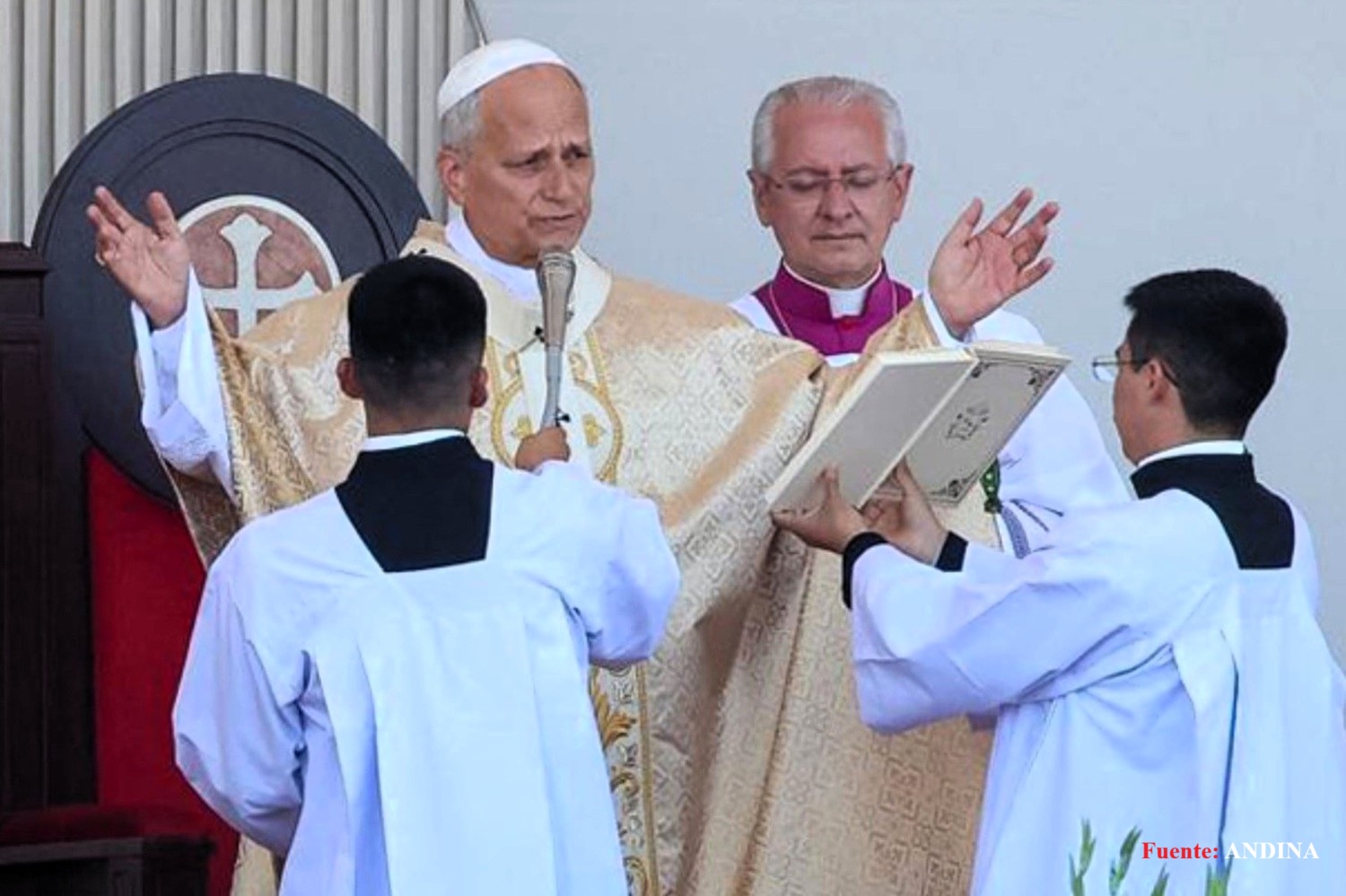
Agencia Peruana de Noticias PRENSAPERU.PE https://www.prensaperu.pe Twitter: @prensaperupe Queridos hermanos y hermanas:¡Qué alegría volver a Chiclayo! Es una bendición para mí estar de nuevo con ustedes. Gracias por su cariño, apoyo y oraciones, en particular por mi salud en estos momentos de prueba que, con la ayuda de Dios, estoy superando. Al ver sus rostros me nace de manera espontánea una oración de acción de gracias al Señor por las bendiciones que ustedes han sido y son para mi vida y ministerio episcopal. Los tengo muy presentes en mis plegarias; también les pido que sigan orando por mí para que Nuestro Señor Jesucristo me conceda la gracia de continuar confirmando a mis hermanos en la fe.
La liturgia de hoy nos invita a dirigir nuestra mirada hacia el deber urgente e ineludible de todo bautizado: el anuncio del Evangelio. Y, al mismo tiempo, nos da la oportunidad de crecer en la conciencia de que todos los cristianos, ministros ordenados o fieles laicos, somos discípulos misioneros, sin importar nuestra función en la Iglesia ni el grado de ilustración de la fe que tengamos. En la Exhortación apostólica Evangelii nuntiandi, el Papa Pablo VI recordó que ningún bautizado puede ser indiferente a la tarea de la evangelización, porque esta constituye la misión esencial de la Iglesia, su vocación más profunda y su razón de ser.
Dios, en su sabiduría, ha querido que la Iglesia fuera “como un sacramento universal de salvación” (cf. CONC. VAT. II, Const. dogm. Lumen gentium 1; 48). Esta, sostenida por el Espíritu Santo, lleva adelante la misión de anunciar a Jesucristo, para que, en obediencia al mandato misionero que recibió de Él (cf. Mt 28,19-20), su obra redentora alcance a todos los confines de la tierra y transforme las realidades humanas según los valores del Evangelio.
El anuncio de Jesucristo es una tarea crucial; frente a ella, con frecuencia nos sentimos inadecuados. Como discípulos misioneros del siglo XXI, ¿Cómo podemos anunciarlo hoy? Como familia, comunidad parroquial o comunidad diocesana, ¿Cómo podemos llevar adelante la misión de Evangelizar? La respuesta a estas preguntas es: a través del testimonio de una vida auténticamente cristiana y coherente. Primero: poner a Jesucristo en el centro, tanto del anuncio como de la existencia. Luego, la coherencia, no podemos pensarla solo como fruto de la propia voluntad, sino también como una gracia que hemos de implorar al Señor, y que estamos llamados a secundar con nuestro compromiso y esfuerzo personal. Porque solo Él tiene la fuerza de transformar nuestras vidas para que tengamos un impulso renovado en el anuncio y la transmisión de la fe y, de este modo, ayudar a los hermanos y hermanas que encontramos durante nuestro peregrinar, a vivir una relación personal con Cristo, para descubrir la alegría del Evangelio.
El encuentro personal con Jesucristo —un don que no se nos niega— tiene su centro de gravedad en la Última Cena, donde Él, al entregar su cuerpo como pan de vida y su sangre como bebida de salvación (cf. Mt 26,26-28), pide al Padre que todos sus discípulos sean uno, para que el mundo crea (cf. Jn 17,21). El Señor nos espera, principalmente, en la Eucaristía y en la Palabra, las dos mesas de las que vivimos y nos nutrimos. Pero también viene a nuestro encuentro en la comunión eclesial y en la acogida fraterna de nuestro prójimo, en quien se hace presente y necesitado. Por tanto, evangelizar no es imponer doctrinas ni confiar en estructuras eficaces, sino dar testimonio de ese encuentro real con Jesucristo.
La evangelización, en efecto, se centra en el testimonio de vida y la cercanía comunitaria. Sin el testimonio, no es posible el anuncio explícito de Jesucristo. Como nos recordaba el Papa Francisco, la evangelización se fundamenta en la fe y en «la belleza del amor salvífico de Dios manifestado en Jesucristo muerto y resucitado» (Exhort. ap. Evangelii gaudium, 36), y no en los persuasivos discursos de la mera sabiduría humana ni en el proselitismo (cf. 1 Co 2,1-5). Esta es además una tarea plasmada por el júbilo, puesto que la alegría del Evangelio se renueva y se multiplica al compartirlo.
La transmisión alegre y vivificante del mensaje de salvación comporta, por nuestra parte, una actitud de humildad y solicitud, un respeto profundo a la conciencia y la libertad de cada persona. En esta tarea, puede sernos de ayuda el recuperar la “oración compartida”, sobre todo en los hogares, haciendo memoria de que las familias cristianas constituyen el núcleo misionero, porque como “pequeñas Iglesias domésticas”, llevan a sus miembros a participar activamente en la vida de las comunidades locales, de la gran comunidad de la Iglesia universal y de toda la sociedad.
En este sentido, la lectura de la segunda carta de Juan, que hemos escuchado, nos ayuda asimismo a considerar cómo la dimensión de la caridad es indispensable para evangelizar: la proclamación de la fe va unida a la caridad y a la ayuda a los más necesitados. En esa carta, Juan hace un llamado urgente al amor fraterno: para un bautizado el amor hacia el prójimo es el corazón del mensaje cristiano; el mandamiento recibido «desde el principio» (2 Jn 1,5). Un amor práctico, comprometido y respetuoso que evidencia, además, el vínculo indisoluble entre el anuncio evangélico y la búsqueda de la transformación de las estructuras de la convivencia humana (cf. Carta enc. Magnifica humanitas, 30).
Al mismo tiempo, la caridad es inseparable de la verdad, que no consiste en una teoría, una idea abstracta o una utopía, sino en una persona, Jesucristo, que nos invita a conformar nuestras vidas con la suya, en fiel obediencia a sus mandamientos. La consonancia entre caridad y verdad nos pide hacer concreta nuestra fe difundiendo con alegría renovada el fragante perfume de la santidad. Recordemos que, sin verdad, el amor cae en mero sentimentalismo, y la verdad sin amor se vuelve rígida y fría (cf. BENEDICTO XVI, Carta enc. Caritas in veritate, 3).
Por eso, la evangelización debe enfrentarse hoy a las condiciones y dinámicas cambiantes en la transmisión de la fe. En algunas regiones del mundo, esta transmisión se ha interrumpido casi por completo; esta situación exige de todos nosotros el valor de asumir nuevos desafíos, como la indiferencia religiosa, el materialismo o el egoísmo, que dictan decisiones cotidianas. Este compromiso nos llama a mantener la armonía entre un corazón lleno de amor a Dios y al prójimo y una mente anclada en la verdad del Evangelio.
Queridos amigos: la misión no se improvisa. Anunciamos lo que hemos encontrado, más aún, la salvación que hemos experimentado, el perdón de los pecados que se nos ha concedido y el descubrimiento del sentido auténtico de la vida, porque «todo cristiano es misionero en la medida en que se ha encontrado con el amor de Dios en Cristo Jesús» (FRANCISCO, Exhort. ap. Evangelii gaudium, 120).
Ruego al Señor que este amor inflame la vida de cada uno de nosotros que, como bautizados, como comunidad cristiana, salgamos al mundo, para contagiar a los demás con la alegría que nace del encuentro con el Señor resucitado y hacerla presente en el seno de nuestras familias; en nuestros entornos de trabajo, con el buen desempeño de nuestra labor profesional; en el ámbito público, desafiando a la tentación de relegar la fe a la esfera individual. En este compromiso apostólico, la Iglesia nos ayuda a tomar conciencia de que, como piedras vivas, tenemos una común responsabilidad en la construcción del templo de Dios (cf. 1 Pe 2,5).
Queridos hermanos y hermanas: el mundo nos espera y la misión está en sus inicios. Por eso los invito —ya desde esta primera celebración de nuestro reencuentro ante el altar del Señor— aquí en Chiclayo y en todo el Perú, a que asumamos el compromiso de compartir la viva esperanza, que es Jesucristo, y “desbordemos” de Evangelio nuestras aldeas, pueblos y ciudades para proclamar a todos la “gloria del Señor”. Que la intercesión de Nuestra Señora de la Evangelización nos ayude en la tarea de anunciar la Buena nueva a toda la creación (cf. Mc 16,15). Amén.
Fuente: Agencia Peruana de Noticias PRENSAPERU.PE https://www.prensaperu.pe Twitter: @prensaperupe
Translate
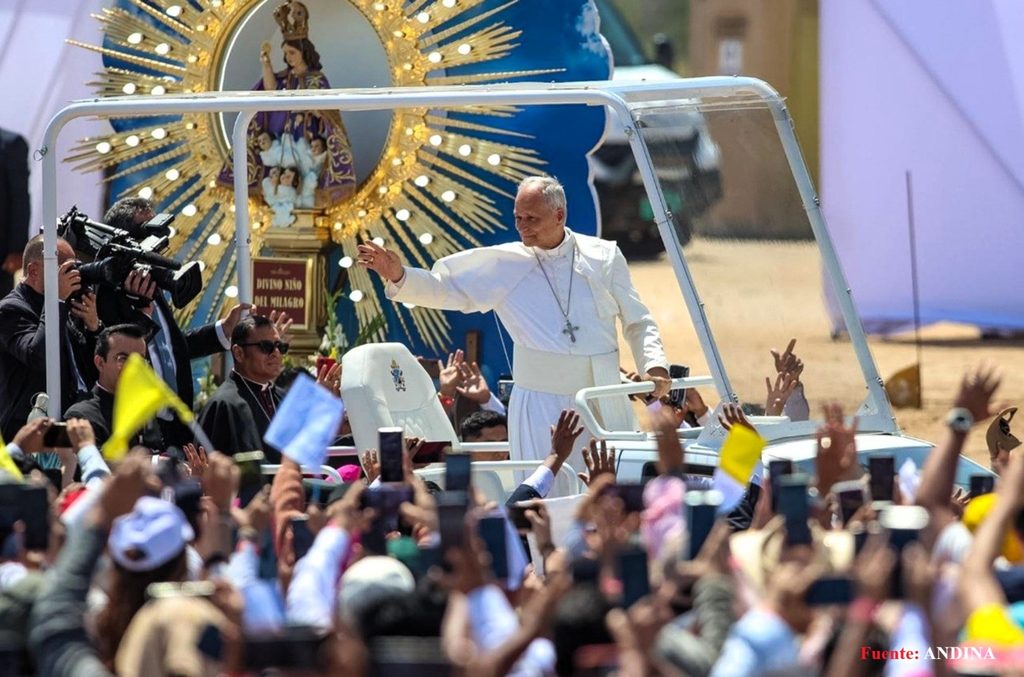
Holy Mass on the “Pampas de Pimentel” esplanade – Homily of the Holy Father, His Holiness Pope Leo XIV. (Press coverage of the Apostolic Visit to Peru)
Peruvian News Agency PRENSAPERU.PE https://www.prensaperu.pe Twitter: @prensaperupe Dear brothers and sisters:
What a joy it is to return to Chiclayo! It is a blessing for me to be with you again. Thank you for your affection, support, and prayers, particularly for my health during these moments of trial which, with God’s help, I am overcoming. Seeing your faces spontaneously brings forth a prayer of thanksgiving to the Lord for the blessings that you have been and continue to be for my life and episcopal ministry. I keep you very much in my prayers; I also ask you to keep praying for me so that Our Lord Jesus Christ may grant me the grace to continue strengthening my brothers and sisters in the faith.
Today’s liturgy invites us to turn our gaze toward the urgent and inescapable duty of every baptized person: the proclamation of the Gospel. At the same time, it gives us the opportunity to grow in the awareness that all Christians—ordained ministers or lay faithful—are missionary disciples, regardless of our role in the Church or the level of religious instruction we possess. In the Apostolic Exhortation Evangelii nuntiandi, Pope Paul VI reminded us that no baptized person can be indifferent to the task of evangelization, because it constitutes the essential mission of the Church, her deepest vocation, and her very reason for being.
God, in his wisdom, willed that the Church should be “like a universal sacrament of salvation” (cf. Second Vatican Council, Dogmatic Constitution Lumen gentium, 1; 48). Sustained by the Holy Spirit, she carries forward the mission of proclaiming Jesus Christ so that, in obedience to the missionary mandate she received from Him (cf. Mt 28:19-20), his redemptive work may reach the ends of the earth and transform human realities according to the values of the Gospel.
The proclamation of Jesus Christ is a crucial task; faced with it, we often feel inadequate. As missionary disciples of the twenty-first century, how can we proclaim Him today? As a family, parish community, or diocesan community, how can we carry out the mission of evangelizing? The answer to these questions is: through the witness of an authentically Christian and coherent life. First: placing Jesus Christ at the center, both of the proclamation and of our existence. Second, coherence cannot be thought of solely as the fruit of our own willpower, but also as a grace that we must implore from the Lord, and which we are called to second with our personal commitment and effort. For only He has the power to transform our lives so that we may have renewed momentum in proclaiming and transmitting the faith, and thus help the brothers and sisters we encounter along our pilgrimage to live a personal relationship with Christ, in order to discover the joy of the Gospel.
A personal encounter with Jesus Christ—a gift that is never denied to us—has its center of gravity in the Last Supper, where He, by giving his body as the bread of life and his blood as the drink of salvation (cf. Mt 26:26-28), asks the Father that all his disciples may be one, so that the world may believe (cf. Jn 17:21). The Lord awaits us primarily in the Eucharist and in the Word, the two tables from which we live and are nourished. Yet He also comes to meet us in ecclesial communion and in the fraternal welcome of our neighbor, in whom He is present and in need. Therefore, evangelizing is not imposing doctrines or relying on efficient structures, but bearing witness to that real encounter with Jesus Christ.
Evangelization, indeed, is centered on the witness of life and community closeness. Without witness, the explicit proclamation of Jesus Christ is not possible. As Pope Francis reminded us, evangelization is grounded in faith and in “the beauty of the saving love of God made manifest in Jesus Christ who died and rose from the dead” (Apostolic Exhortation Evangelii gaudium, 36), and not in persuasive words of mere human wisdom or proselytism (cf. 1 Cor 2:1-5). Moreover, this is a task shaped by jubilation, since the joy of the Gospel is renewed and multiplied by sharing it.
The joyful and life-giving transmission of the message of salvation entails, on our part, an attitude of humility and solicitude, and a profound respect for the conscience and freedom of each person. In this task, it can be helpful to recover “shared prayer,” especially in homes, remembering that Christian families constitute the missionary nucleus because, as “domestic Churches,” they lead their members to participate actively in the life of local communities, the great community of the universal Church, and society as a whole.
In this sense, the reading from the Second Letter of John, which we have just heard, likewise helps us to consider how the dimension of charity is indispensable for evangelizing: the proclamation of the faith goes hand in hand with charity and aid to those most in need. In that letter, John makes an urgent call to fraternal love: for a baptized person, love of neighbor is the heart of the Christian message, the commandment received “from the beginning” (2 Jn 1:5). It is a practical, committed, and respectful love that also demonstrates the indissoluble link between the Gospel proclamation and the pursuit of transforming the structures of human coexistence (cf. Encyclical Letter Magnifica humanitas, 30).
At the same time, charity is inseparable from truth, which does not consist of a theory, an abstract idea, or a utopia, but of a person, Jesus Christ, who invites us to conform our lives to his, in faithful obedience to his commandments. The harmony between charity and truth asks us to make our faith concrete by spreading with renewed joy the fragrant perfume of holiness. Let us remember that, without truth, love degenerates into mere sentimentalism, and truth without love becomes rigid and cold (cf. Benedict XVI, Encyclical Letter Caritas in veritate, 3).
For this reason, evangelization today must confront changing conditions and dynamics in the transmission of the faith. In some regions of the world, this transmission has almost completely broken down; this situation demands from all of us the courage to take on new challenges, such as religious indifference, materialism, or selfishness, which dictate daily decisions. This commitment calls us to maintain harmony between a heart full of love for God and neighbor and a mind anchored in the truth of the Gospel.
Dear friends: mission cannot be improvised. We proclaim what we have found—even more, the salvation we have experienced, the forgiveness of sins granted to us, and the discovery of the authentic meaning of life—because “every Christian is a missionary to the extent that he or she has encountered the love of God in Christ Jesus” (Francis, Apostolic Exhortation Evangelii gaudium, 120).
I pray to the Lord that this love may inflame the life of each one of us so that, as the baptized, as a Christian community, we may go out into the world to infect others with the joy born of encountering the risen Lord and make it present within our families; in our workplaces, through the diligent performance of our professional duties; and in the public sphere, challenging the temptation to relegate faith to the private realm. In this apostolic commitment, the Church helps us become aware that, as living stones, we share a common responsibility in building up the temple of God (cf. 1 Pet 2:5).
Dear brothers and sisters: the world awaits us, and the mission is just beginning. Therefore, I invite you—already from this first celebration of our reunion before the altar of the Lord—here in Chiclayo and throughout Peru, to take on the commitment of sharing the living hope, which is Jesus Christ, and to “overflow” our villages, towns, and cities with the Gospel in order to proclaim to all the “glory of the Lord.” May the intercession of Our Lady of Evangelization assist us in the task of proclaiming the Good News to all creation (cf. Mk 16:15). Amen.
Source: Peruvian News Agency PRENSAPERU.PE https://www.prensaperu.pe Twitter: @prensaperupe