
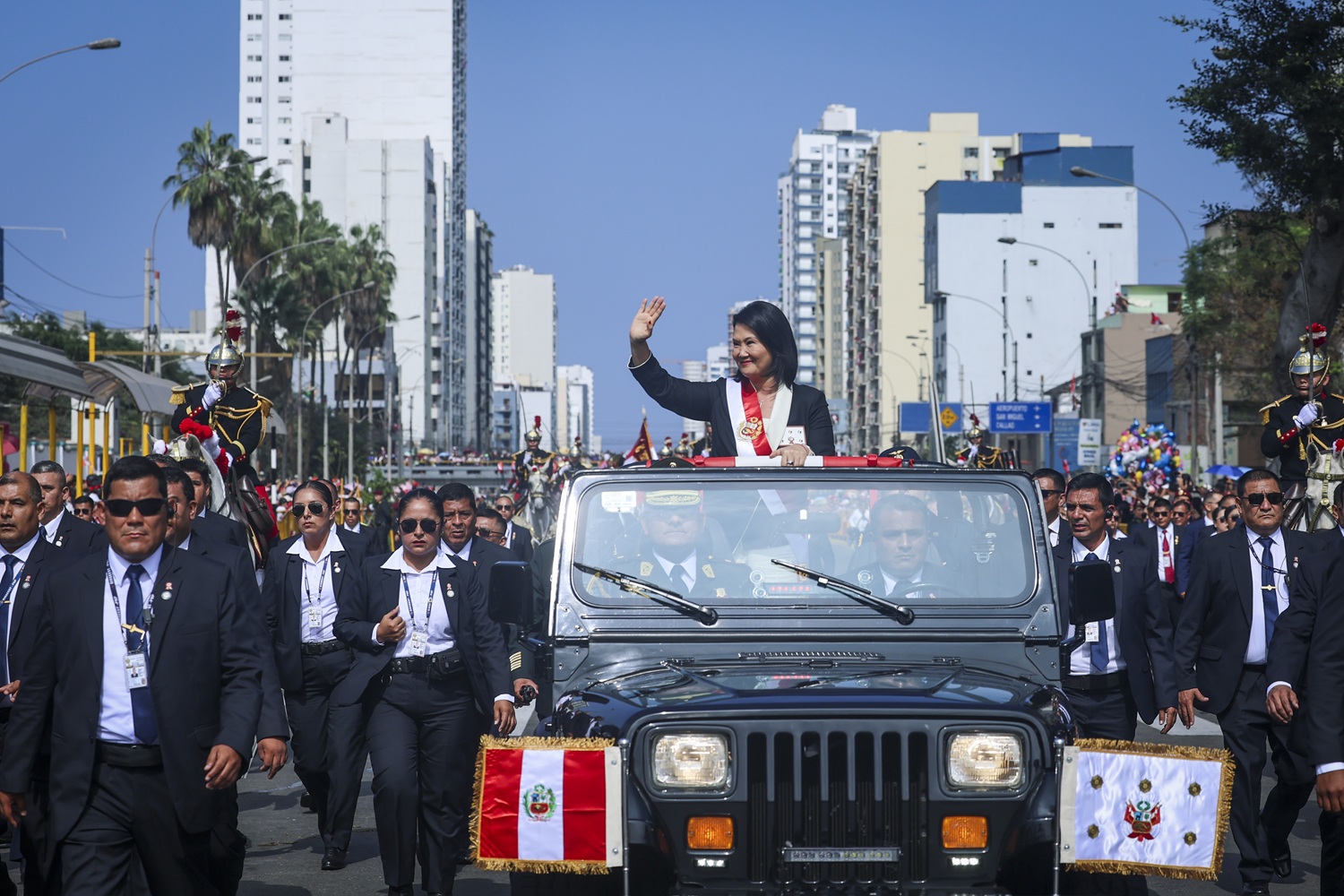
Agencia Peruana de Noticias PRENSAPERU.PE https://www.prensaperu.pe Twitter: @prensaperupe Entre los acordes marciales de las bandas, el paso firme y sincronizado de las tropas y la riqueza cultural de las distintas regiones del país, la presidenta constitucional de la República, Keiko Sofía Fujimori Higuchi, encabezó por primera vez como jefa de Estado la solemne Gran Parada y Desfile Cívico Militar en conmemoración del 255.º aniversario de la independencia nacional. La avenida Brasil se convirtió en el escenario principal de esta jornada histórica, donde convergieron el sentimiento patriótico, la tradición institucional y la unidad de todos los peruanos.
Desde su llegada, la mandataria fue recibida con una calurosa y prolongada ovación por parte de miles de ciudadanos congregados en el recorrido y en las tribunas, expresando el respaldo y el afecto de la población en este día tan significativo. Portando la banda presidencial, el bastón de mando y la insignia que la acredita como Jefa Suprema de las Fuerzas Armadas y de la Policía Nacional, fue recibida por el ministro de Defensa, Rafael Belaúnde, y el jefe del Comando Conjunto de las Fuerzas Armadas, César Augusto Briceño Valdivia. Tras rendir homenaje al Pabellón Nacional, procedió a pasar revista a las tropas formadas en orden de honor.
Acompañaron a la jefa de Estado el presidente del Consejo de Ministros, Luis Galarreta, y todo el gabinete ministerial; los altos mandos de las instituciones de seguridad; el cuerpo diplomático acreditado en el país; y las máximas autoridades de los poderes del Estado: el presidente del Senado, Miguel Torres; la presidenta del Poder Judicial, Janet Tello; y el presidente del Jurado Nacional de Elecciones, Roberto Burneo, entre otras representantes de los distintos niveles de gobierno.
DATOS CONCEPTUALES
Gran Parada y Desfile Cívico Militar: Acto oficial y protocolar de mayor relevancia por Fiestas Patrias, mediante el cual las instituciones armadas, policiales y organismos del Estado demuestran su preparación, capacidad y compromiso con la nación, además de rendir homenaje a la independencia.
Paso de Revista: Ceremonia tradicional en la que la máxima autoridad civil verifica la presentación, disposición y disciplina de las tropas, reafirmando la subordinación al poder legítimamente constituido.
Agrupamiento Conjunto: Formación integrada por efectivos de distintas instituciones que actúan de manera coordinada, simbolizando la unidad de propósitos en la defensa y servicio al país.
Unidades Históricas: Cuerpos y delegaciones que conservan la memoria de hechos heroicos y operaciones trascendentales, manteniendo vivo el legado de quienes defendieron la soberanía y la paz nacional.
Cuerpo Diplomático: Representantes de los Estados amigos acreditados ante el Perú, cuya presencia reafirma el reconocimiento internacional y la fraternidad entre naciones.
CRÓNICA DEL DESFILE
Tras el izamiento solemne del Pabellón Nacional y la entonación del Himno Nacional, el jefe de línea de la ceremonia, general de división EP Óscar Luis Calle Pérez, solicitó la autorización presidencial para dar inicio al despliegue de los once agrupamientos participantes.
El desfile se abrió con la Banda Conjunta, integrada por 120 músicos del Ejército, Marina, Fuerza Aérea y Policía Nacional, seguida de la escolta conjunta y las primeras delegaciones. El primer bloque reunió a representantes del Colegio Militar Leoncio Prado, institutos de formación superior y el Instituto Nacional Penitenciario, sumándose delegaciones militares invitadas de España, Italia, Chile, Colombia, Ecuador y Panamá, que resaltaron la cooperación y hermandad internacional.
Uno de los momentos más emotivos y de profundo valor histórico fue el paso de los veteranos de guerra y de la pacificación nacional, así como de las unidades que protagonizaron las operaciones Alto Cenepa 1995 y Chavín de Huántar, junto al Grupo Especial de Inteligencia (GEIN). Destacó la presencia del general en retiro y senador Marco Miyashiro, al frente de la compañía del GEIN, y del ministro del Interior, César Astudillo, integrante del agrupamiento por la operación Chavín de Huántar, reafirmando el respeto a la historia y al deber cumplido.
Seguidamente, desfilaron las unidades propias de la Marina de Guerra, la Fuerza Aérea, el Ejército y la Policía Nacional, con sus escuelas de formación, fuerzas especiales, unidades de respuesta rápida y equipos dedicados a la búsqueda, rescate y atención ante desastres. La tradición ecuestre tuvo su espacio con el Regimiento de Caballería Glorioso Húsares de Junín N.º 1, el Regimiento Mariscal Domingo Nieto y la histórica Policía Montada de El Potao, símbolos vivos de la identidad nacional.
El despliegue continuó con los recursos motorizados del INDECI, SAMU, Cruz Roja Peruana, EsSalud, el Cuerpo General de Bomberos Voluntarios, ministerios y organismos de primera respuesta, demostrando la capacidad institucional para proteger a la población. Posteriormente, el agrupamiento “La fuerza de ser peruanos” reunió a gobiernos regionales y locales junto a entidades especializadas en gestión de riesgos y conservación ambiental.
La jornada se enriqueció con la diversidad cultural: ronderos del VRAEM, marinera norteña, huaylarsh y pandilla moyobambina, mostrando que el Perú es uno solo en su pluralidad. Finalmente, el paso aéreo cerró el homenaje con la majestuosidad de la aviación nacional.
Al término de la ceremonia, la presidenta se acercó a saludar a las familias asistentes, recibiendo muestras de afecto y reconocimiento. Este encuentro refleja la vocación de su administración: estar cerca de la ciudadanía, escucharla y trabajar incansablemente para responder a sus necesidades durante los próximos cinco años.
DATO CONTEXTUALES
1.- Símbolo de unidad y continuidad: La primera Gran Parada liderada por Keiko Fujimori consolida el vínculo entre la autoridad civil y las instituciones de seguridad, bajo el marco de la Constitución y la democracia.
2.- Memoria y futuro: El paso de veteranos y unidades históricas honra el legado de quienes dieron todo por la patria, mientras que las nuevas generaciones de efectivos ratifican su compromiso con el presente y el porvenir.
3.- Cooperación y proyección internacional: La participación de delegaciones militares extranjeras confirma el respaldo y la relación de hermandad que el Perú mantiene con naciones amigas.
4.-Instituciones al servicio del pueblo: El despliegue de organismos de emergencia, salud y protección demuestra que el Estado está preparado y articulado para garantizar la seguridad y el bienestar de todos los peruanos.
5.- Identidad en toda su dimensión: La combinación de tradición militar, capacidad operativa y expresiones culturales de todas las regiones refleja la riqueza y la fortaleza de una nación diversa y unida.
Fuente: Agencia Peruana de Noticias PRENSAPERU.PE https://www.prensaperu.pe Twitter: @prensaperupe
Translate
Keiko Fujimori Leads the Great Military Parade: Pride, Unity and Tradition on the 255th Anniversary of Independence; Brazil Avenue Unites the Nation Amid Martial Music and the Affection of Its People
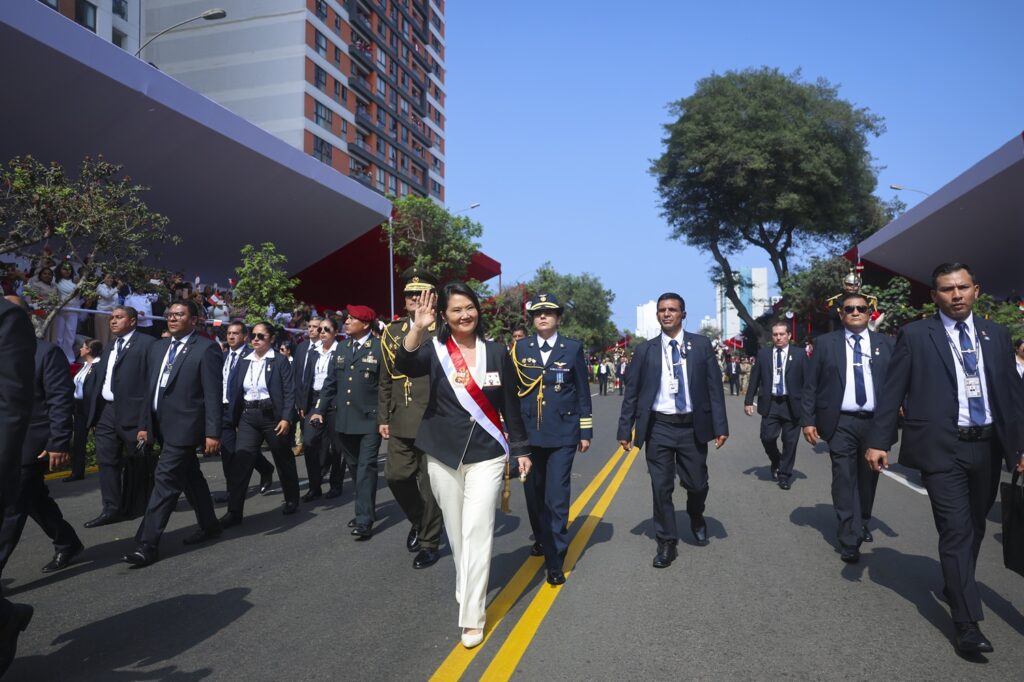
Peruvian News Agency PRENSAPERU.PE https://www.prensaperu.pe Twitter: @prensaperupe Amid the martial strains of the bands, the firm and synchronized march of the troops, and the cultural richness of the country’s diverse regions, the Constitutional President of the Republic, Keiko Sofía Fujimori Higuchi, led for the first time as Head of State the solemn Great Civic‑Military Parade in commemoration of the 255th anniversary of national independence. Brazil Avenue became the main stage of this historic day, where patriotic sentiment, institutional tradition, and the unity of all Peruvians converged.
Upon her arrival, the President was welcomed with a warm and prolonged ovation from thousands of citizens gathered along the route and in the stands, expressing the population’s support and affection on this most significant day. Wearing the presidential sash, the baton of command, and the insignia accrediting her as Supreme Head of the Armed Forces and the National Police, she was received by the Minister of Defense, Rafael Belaúnde, and the Head of the Joint Command of the Armed Forces, César Augusto Briceño Valdivia. After paying homage to the National Flag, she proceeded to review the troops formed in honor.
Accompanying the Head of State were the President of the Council of Ministers, Luis Galarreta, and the entire Cabinet; the high commands of the security institutions; the diplomatic corps accredited in the country; and the highest authorities of the branches of State: the President of the Senate, Miguel Torres; the President of the Judiciary, Janet Tello; and the President of the National Jury of Elections, Roberto Burneo, among other representatives of the different levels of government.
CONCEPTUAL DATA
Great Civic‑Military Parade: The most important official and protocol event for National Holidays, through which the military, police, and State agencies demonstrate their readiness, capability, and commitment to the nation, as well as paying tribute to independence.
Troop Review: A traditional ceremony in which the highest civilian authority inspects the presentation, readiness, and discipline of the troops, reaffirming subordination to the legitimately constituted power.
Joint Formation: A unit made up of personnel from different institutions acting in a coordinated manner, symbolizing unity of purpose in the defense of and service to the country.
Historic Units: Corps and delegations that preserve the memory of heroic deeds and transcendent operations, keeping alive the legacy of those who defended national sovereignty and peace.
Diplomatic Corps: Representatives of friendly States accredited to Peru, whose presence reaffirms international recognition and brotherhood among nations.
CHRONICLE OF THE PARADE
Following the solemn raising of the National Flag and the singing of the National Anthem, the ceremony’s Line Commander, Army Division General Óscar Luis Calle Pérez, requested presidential authorization to begin the deployment of the eleven participating formations.
The parade opened with the Joint Band, made up of 120 musicians from the Army, Navy, Air Force, and National Police, followed by the joint escort and the first delegations. The first block brought together representatives of the Leoncio Prado Military College, higher education institutes, and the National Penitentiary Institute, joined by invited military delegations from Spain, Italy, Chile, Colombia, Ecuador, and Panama, highlighting international cooperation and brotherhood.
One of the most moving moments of deep historical significance was the passage of war veterans and those involved in national pacification, as well as the units that carried out the 1995 Alto Cenepa and Chavín de Huántar operations, alongside the National Police Special Intelligence Group (GEIN). Notable was the presence of retired Police General and current Senator Marco Miyashiro, heading the GEIN company, and the Minister of the Interior, César Astudillo, as a member of the Chavín de Huántar operation formation, reaffirming respect for history and duty fulfilled.
Subsequently, units of the Navy, Air Force, Army, and National Police paraded, including their training schools, special forces, rapid‑response units, and teams dedicated to search, rescue, and disaster relief. Equestrian tradition had its place with the Glorious Hussars of Junín Cavalry Regiment No. 1, the Marshal Domingo Nieto Cavalry Regiment, and the historic El Potao Mounted Police, living symbols of national identity.
The deployment continued with motorized assets from INDECI, SAMU, the Peruvian Red Cross, EsSalud, the General Volunteer Firefighters Corps, ministries, and first‑response agencies, demonstrating institutional capacity to protect the population. Later, the formation “The Strength of Being Peruvian” brought together regional and local governments alongside bodies specialized in risk management and environmental conservation.
The day was enriched by cultural diversity: rondas campesinas from the VRAEM, northern marinera, huaylarsh carnival dances, and moyobamba bands, showing that Peru is one nation in its plurality. Finally, the fly‑past closed the tribute with the majesty of national aviation.
At the conclusion of the ceremony, the President approached to greet the families present, receiving displays of affection and recognition. This encounter reflects the vocation of her administration: to remain close to the citizenry, to listen, and to work tirelessly to address their needs and improve the quality of life for all Peruvians over the coming five years.
CONTEXTUAL DATA
1. Symbol of unity and continuity: The first Great Parade led by Keiko Fujimori consolidates the bond between civilian authority and security institutions, within the framework of the Constitution and democracy.
2. Memory and future: The passage of veterans and historic units honors the legacy of those who gave everything for the homeland, while new generations of personnel ratify their commitment to the present and the future.
3. Cooperation and international standing: The participation of foreign military delegations confirms the support and brotherly relations that Peru maintains with friendly nations.
4. Institutions serving the people: The deployment of emergency, health, and protection bodies demonstrates that the State is prepared and coordinated to guarantee the security and well‑being of all Peruvians.
5. Identity in all its dimensions: The combination of military tradition, operational capability, and cultural expressions from every region reflects the richness and strength of a diverse and united nation.
Source: Peruvian News Agency PRENSAPERU.PE https://www.prensaperu.pe Twitter: @prensaperupe