
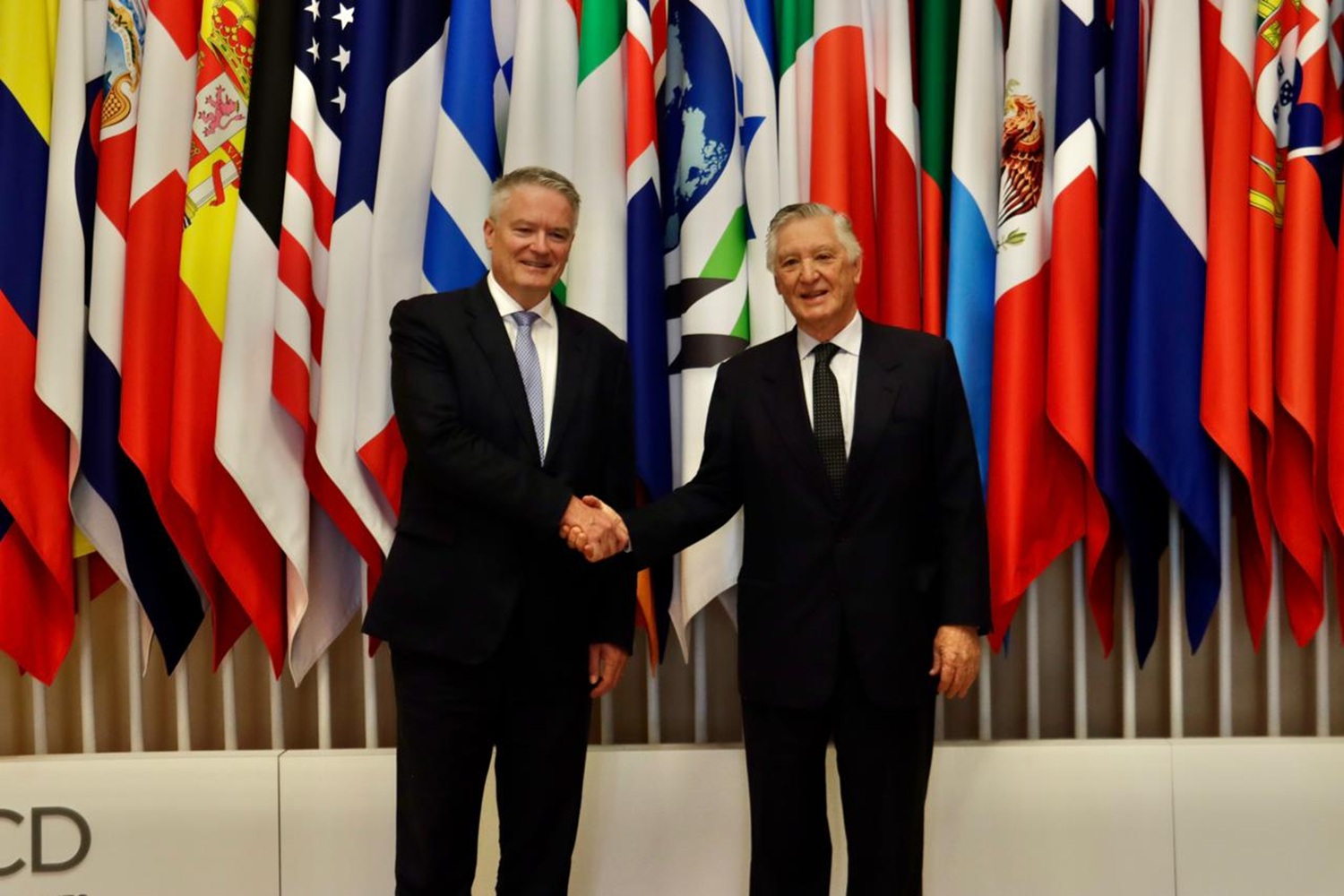
Agencia Peruana de Noticias PRENSAPERU.PE https://www.prensaperu.pe Twitter: @prensaperupe El ministro de Relaciones Exteriores del Perú y el secretario general de la OCDE, reafirmaron el compromiso nacional con el proceso de adhesión. Se explica qué implica formar parte de esta organización, sus alcances como política de Estado y los avances y actividades que se vienen desarrollando para cumplir con los estándares internacionales. También se señala la importancia de mantener el impulso a pesar de los cambios administrativos y la participación activa del país en foros especializados.
Organización para la Cooperación y el Desarrollo Económicos (OCDE)
Es un organismo internacional que reúne a los países con mayor nivel de desarrollo y gobernanza del mundo. Su objetivo es promover políticas que mejoren el bienestar económico y social, basadas en reglas claras, transparencia, rendición de cuentas y respeto a los derechos humanos. Sus normas y recomendaciones se consideran referentes de “buenas prácticas” a nivel global.
Proceso de adhesión
Es un procedimiento técnico y político progresivo mediante el cual un país solicita incorporarse a la OCDE. Implica someter sus leyes, instituciones y políticas a evaluaciones detalladas para verificar que cumplan con los estándares establecidos por los miembros actuales.
Política de Estado
Se refiere a decisiones y objetivos nacionales que se mantienen estables y continuos más allá de los cambios de gobierno, garantizando así visión de largo plazo y confianza nacional e internacional.
Minerales críticos
Son aquellos recursos minerales esenciales para tecnologías limpias, energías renovables, electrónica y defensa, cuya demanda crece rápidamente y su cadena de suministro requiere normas de sostenibilidad, legalidad y trazabilidad.
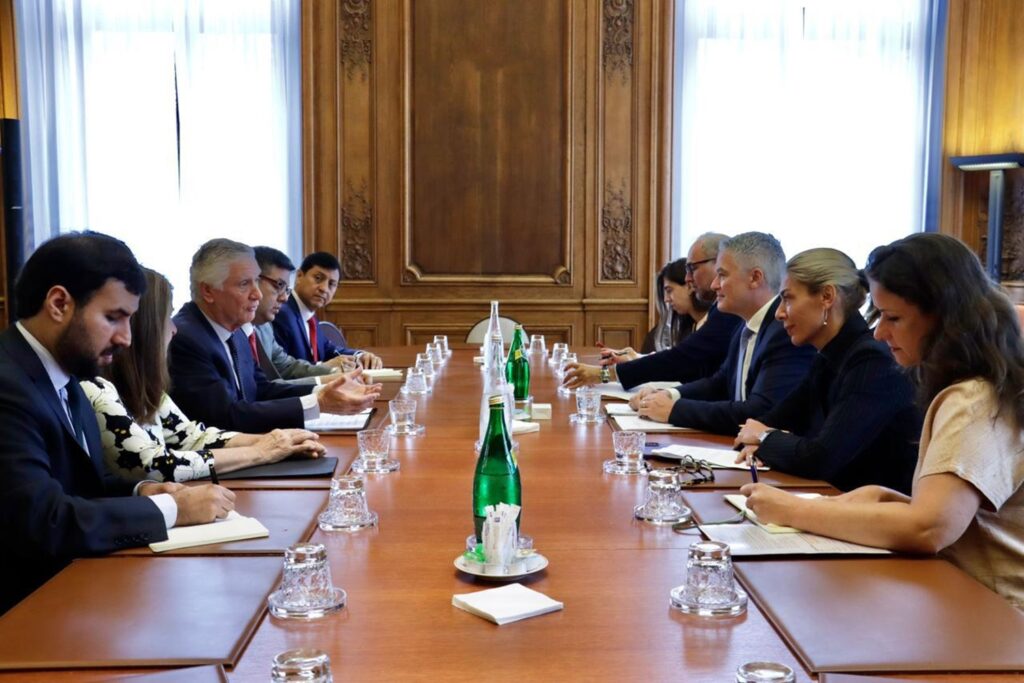
De otro lado el ministro de Relaciones Exteriores, embajador Carlos Pareja, sostuvo una reunión de trabajo con el secretario general de la OCDE, Mathias Cormann, en la sede de la organización en París. En este encuentro, el canciller reafirmó con claridad que la adhesión del Perú a este organismo constituye una política de Estado, es decir, un compromiso que trasciende gestiones particulares y se mantiene en el tiempo. Destacó que este proceso no es solo un trámite internacional, sino una herramienta estratégica que viene contribuyendo directamente al fortalecimiento institucional, la mejora continua de las políticas públicas y la consolidación de un modelo de desarrollo sostenible, inclusivo y competitivo.
En términos técnicos, avanzar en esta ruta implica alinear la legislación, la gestión pública y los mecanismos de control con los estándares reconocidos internacionalmente. Esto permite reducir la discrecionalidad en la toma de decisiones, mejorar la transparencia, facilitar el comercio y atraer inversiones de mayor calidad, ya que los mercados internacionales valoran la confianza que otorga el cumplimiento de estas normas.
Durante el diálogo, el canciller Pareja subrayó la importancia de garantizar la continuidad del proceso en un momento de transición hacia una nueva administración de gobierno. Explicó que la fase técnica actual requiere constancia y coordinación intersectorial, ya que involucra a múltiples instituciones del Estado que deben implementar ajustes y responder a las evaluaciones realizadas por los comités especializados de la OCDE. Mantener el impulso es fundamental para no perder el trabajo acumulado y lograr concluir esta etapa con resultados satisfactorios.
Asimismo, el ministro expresó su reconocimiento por el apoyo constante que recibe el Perú desde el inicio de este camino. Los órganos de la OCDE han brindado orientación técnica, capacitación y seguimiento, lo que ha permitido avanzar de forma ordenada en las revisiones de normativas y en la puesta en marcha de las recomendaciones formuladas. Esta cooperación mutua es clave para asegurar que los cambios sean reales, sostenibles y aplicables a la realidad nacional.
Para evidenciar el carácter prioritario y transversal de esta meta, el canciller destacó la participación activa del presidente del Consejo de Ministros en la Reunión del Consejo de la OCDE a Nivel Ministerial 2026, realizada a inicios de junio. La presencia de la más alta autoridad política del Ejecutivo en este espacio confirma que la adhesión no es solo tarea de la Cancillería, sino un objetivo que involucra a todo el aparato público.
Complementando esta agenda, se confirmó la participación del Perú en dos eventos relevantes próximos a realizarse: por un lado, en el Diálogo Ministerial del Programa Regional de la OCDE para América Latina y el Caribe, espacio donde se comparten experiencias y se alinean estrategias para el desarrollo de la región; y por otro, en el encuentro organizado por la Confederación Española de Organizaciones Empresariales (CEOE), que incluirá un segmento dedicado a los minerales críticos. En este último, el Perú podrá mostrar su potencial como proveedor responsable, exponiendo los avances en normativa ambiental, social y de gobernanza en su sector minero, lo que refuerza su perfil ante los estándares de la OCDE.
DATOS ESTRATÉGICOS
1.- Visión de largo plazo: La adhesión a la OCDE es una política de Estado que aporta beneficios estructurales: mejora la calidad de las instituciones, incrementa la transparencia y genera reglas claras que favorecen el desarrollo económico y social del país.
2.- Continuidad es clave: En etapas de transición gubernamental, mantener el impulso del proceso asegura que se consolide el trabajo técnico realizado y se eviten retrocesos en el cumplimiento de los estándares internacionales.
3.- Cooperación y acompañamiento: El respaldo técnico de la OCDE facilita que el Perú implemente reformas adaptadas a su realidad, convirtiendo las recomendaciones en mejoras concretas y sostenibles en el tiempo.
4.- Posicionamiento estratégico: La participación activa en foros regionales y especializados, como el de minerales críticos, permite al Perú demostrar su capacidad de cumplimiento, ampliar sus alianzas y proyectarse como un socio confiable en el escenario mundial.
Fuente: Agencia Peruana de Noticias PRENSAPERU.PE https://www.prensaperu.pe Twitter: @prensaperupe
Translate
“OECD accession: Foreign Minister Pareja reaffirms Peru’s commitment to the OECD for continuity and progress in the technical phase, expanding its agenda on critical minerals and cross-cutting cooperation.”
Peruvian News Agency PRENSAPERU.PE https://www.prensaperu.pe Twitter: @prensaperupe The Minister of Foreign Affairs of Peru and the Secretary‑General of the OECD reaffirmed the national commitment to the accession process. This text explains what membership in this organization entails, its scope as a State policy, and the progress and activities being carried out to meet international standards. It also highlights the importance of maintaining momentum despite administrative changes, as well as the country’s active participation in specialized forums.
ORGANISATION FOR ECONOMIC CO‑OPERATION AND DEVELOPMENT (OECD)
It is an international organization that brings together countries with the highest levels of development and governance worldwide. Its purpose is to promote policies that improve economic and social well‑being, based on clear rules, transparency, accountability and respect for human rights. Its standards and recommendations are regarded as global benchmarks of “good practices”.
ACCESSION PROCESS
It is a progressive technical and political procedure through which a country applies to join the OECD. It involves submitting its laws, institutions and policies to detailed evaluations to verify compliance with the standards established by current members.
STATE POLICY
It refers to national decisions and objectives that remain stable and continuous regardless of changes in government, thereby ensuring a long‑term vision and building national and international confidence.
CRITICAL MINERALS
These are mineral resources essential for clean technologies, renewable energy, electronics and defence, whose demand is growing rapidly and whose supply chain requires standards of sustainability, legality and traceability.
Furthermore, the Minister of Foreign Affairs, Ambassador Carlos Pareja, held a working meeting with the Secretary‑General of the OECD, Mathias Cormann, at the organization’s headquarters in Paris. During the meeting, the Foreign Minister clearly reaffirmed that Peru’s accession to this body constitutes a State policy — that is, a commitment that goes beyond individual administrations and remains in force over time. He emphasized that this process is not merely an international procedure, but a strategic tool that contributes directly to institutional strengthening, the continuous improvement of public policies, and the consolidation of a sustainable, inclusive and competitive development model.
In technical terms, moving forward along this path means aligning legislation, public management and control mechanisms with internationally recognized standards. This reduces discretion in decision‑making, improves transparency, facilitates trade and attracts higher‑quality investment, as international markets value the confidence generated by compliance with these norms.
During the dialogue, Minister Pareja stressed the importance of ensuring continuity in the process amid the transition towards a new government administration. He explained that the current technical phase requires consistency and inter‑sectoral coordination, as it involves multiple State institutions that must implement adjustments and respond to evaluations carried out by the OECD’s specialized committees. Maintaining momentum is essential to preserve the work already accomplished and successfully complete this stage.
Likewise, the Minister expressed his appreciation for the constant support provided by the different bodies of the OECD since the beginning of the process. This support has included technical guidance, training and follow‑up, enabling coordinated progress in the ongoing technical assessments and in the implementation of recommendations. This mutual cooperation is key to ensuring that changes are real, sustainable and suited to national realities.
To demonstrate the priority and cross‑cutting nature of this goal, the Foreign Minister highlighted the active participation of the President of the Council of Ministers of Peru in the 2026 OECD Council Meeting at Ministerial Level, held in early June. The presence of the highest political authority of the Executive Branch confirms that accession is not only a task for the Ministry of Foreign Affairs, but an objective shared by the entire public administration.
Complementing this agenda, Peru’s participation in two relevant upcoming events has been confirmed: first, in the Ministerial Dialogue of the OECD Regional Programme for Latin America and the Caribbean, a space for sharing experiences and aligning development strategies across the region; and second, in the event organized by the Spanish Confederation of Business Organizations (CEOE), which will include a segment focused on critical minerals, to be held in Madrid on 30 June and 1 July. In this forum, Peru will be able to showcase its potential as a responsible supplier, presenting advances in environmental, social and governance standards in its mining sector, thereby strengthening its profile in line with OECD requirements.
STRATEGIC DATA
1.- Long‑term vision: Accession to the OECD is a State policy that delivers structural benefits: it improves the quality of institutions, increases transparency and establishes clear rules that foster the country’s economic and social development.
2.- Continuity is key: During periods of government transition, maintaining momentum in the process ensures that the technical work carried out is consolidated and that progress in meeting international standards is not reversed.
3.- Cooperation and support: Technical assistance from the OECD enables Peru to implement reforms adapted to its context, turning recommendations into concrete, lasting improvements.
4.- Strategic positioning: Active participation in regional and specialized forums — such as the one on critical minerals — allows Peru to demonstrate its compliance capacity, expand its alliances and project itself as a reliable partner on the global stage.
Source: Peruvian News Agency PRENSAPERU.PE https://www.prensaperu.pe Twitter: @prensaperupe