
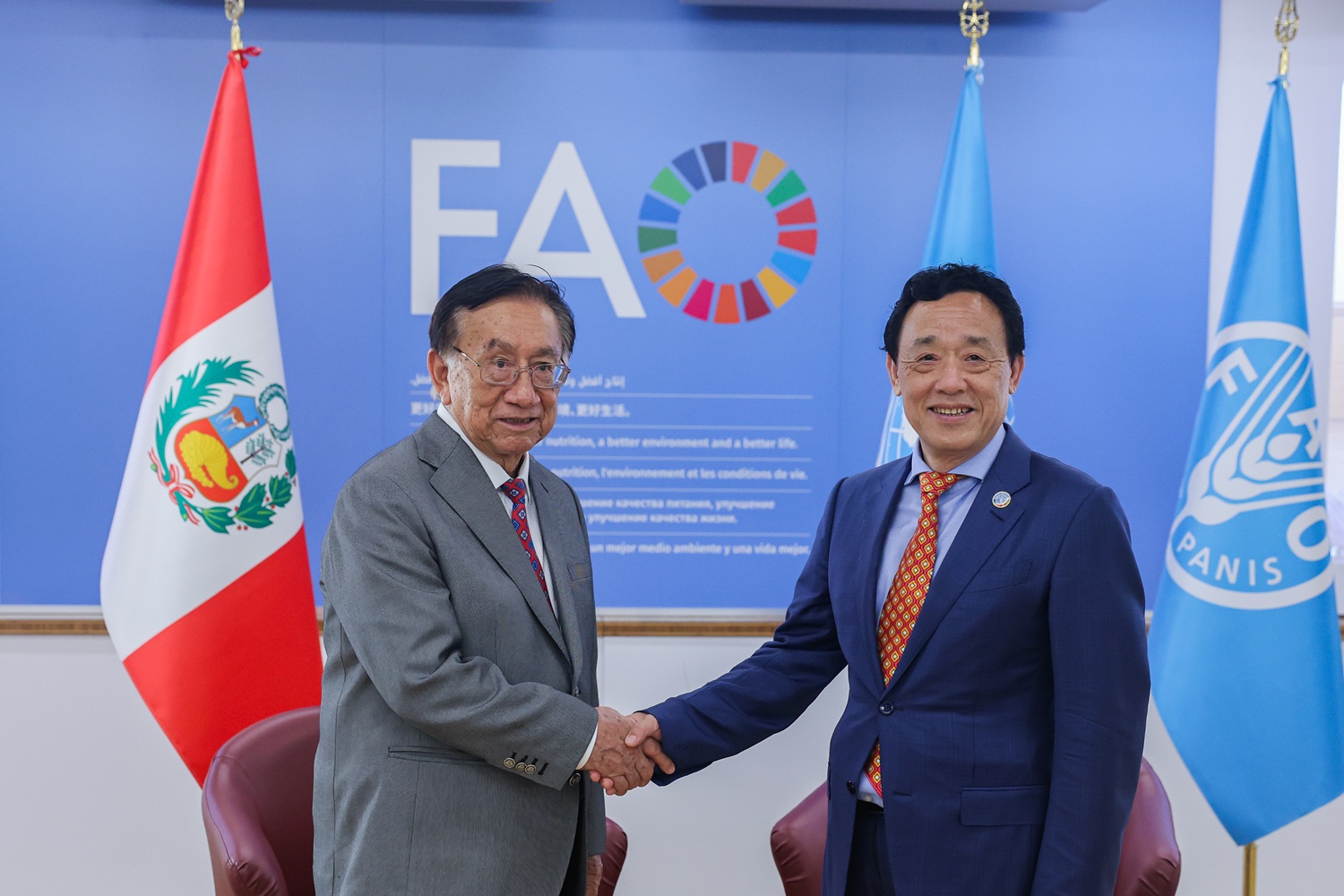
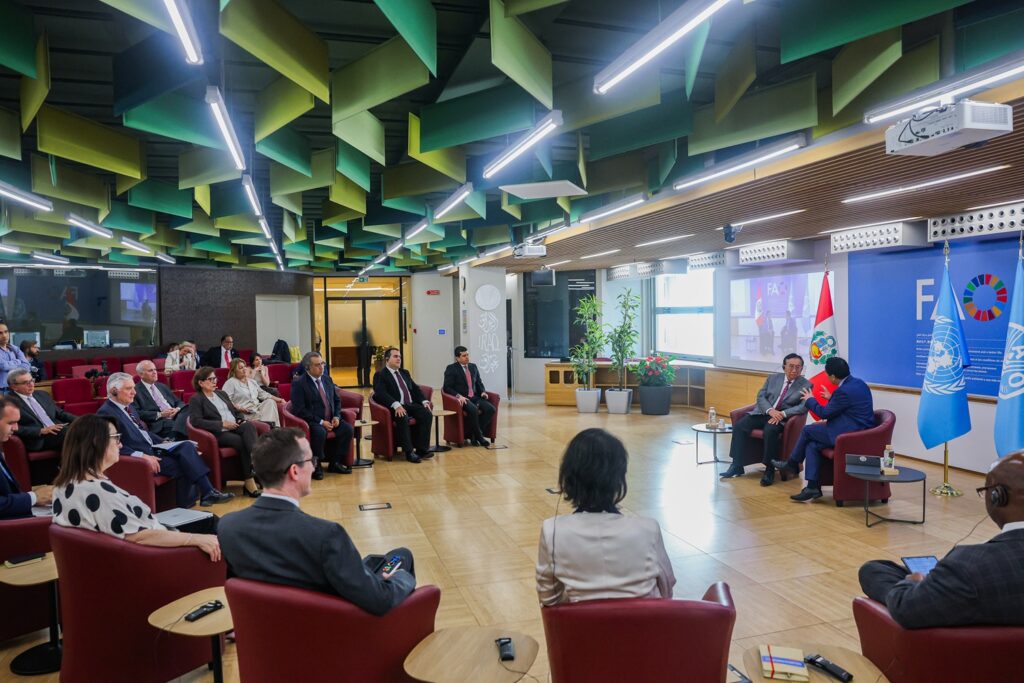
Agencia Peruana de Noticias PRENSAPERU.PE https://www.prensaperu.pe Twitter: @prensaperupe El presidente de la República, José María Balcázar, sostuvo hoy una reunión de alto nivel con el director general de la Organización de las Naciones Unidas para la Alimentación y la Agricultura (FAO), Qu Dongyu. Este encuentro confirma la continuidad de una alianza estratégica que brinda al Perú cooperación técnica especializada, recursos y conocimientos para enfrentar retos estructurales como el hambre, la malnutrición y la baja productividad en el sector agropecuario.
Durante el encuentro, ambas partes revisaron los avances logrados en la ejecución del Marco de Programación País 2023‑2026, el cual ha permitido orientar acciones conjuntas hacia metas concretas. Asimismo, manifestaron su disposición plena para diseñar y trabajar en el nuevo marco programático 2027‑2030, con el objetivo de profundizar los resultados y ampliar el alcance de los proyectos en beneficio de la población rural y urbana.
El mandatario peruano detalló los esfuerzos que realiza el Estado para reducir la anemia —uno de los problemas de salud pública más graves del país— y mejorar la seguridad alimentaria. En este sentido, enfatizó que la agricultura familiar no es solo un sector económico, sino el pilar fundamental de los sistemas agroalimentarios nacionales, ya que abastece la mayor parte de alimentos que consumen los hogares peruanos.
Un hecho destacado en la reunión fue el reconocimiento internacional que Perú ha impulsado: por iniciativa de nuestro país, la Asamblea General de la ONU declaró el 30 de mayo como el Día Internacional de la Papa. Esta medida valora el aporte histórico, nutricional y económico de este tubérculo originario de los Andes, que hoy es alimento para más de mil millones de personas en el mundo y representa una herramienta clave para garantizar la alimentación en contextos de cambio climático.
El presidente Balcázar también expresó su reconocimiento al director Qu Dongyu por las reformas implementadas en la FAO desde 2019, las cuales han modernizado su funcionamiento, aumentado su eficiencia y promovido modelos de producción más sostenibles y respetuosos con el medio ambiente. Además, se abordó la necesidad de ampliar la infraestructura hidráulica: la construcción de represas y sistemas de riego, especialmente en la zona norte del país, permitirá almacenar agua, ampliar las áreas de cultivo y reducir la dependencia de las lluvias, lo que incrementará la productividad y la estabilidad del sector.
Finalmente, se evaluó el impacto positivo de dos iniciativas globales impulsadas por la FAO:
1.- “Mano de la Mano”: Busca reducir la pobreza y la inseguridad alimentaria mediante inversiones focalizadas y alianzas público‑privadas en zonas con mayor necesidad.
2- “Un País, Un Producto Prioritario”: Promueve el desarrollo de productos locales con alto valor nutricional y comercial —como la papa nativa en el caso peruano—, facilitando su acceso a mercados nacionales e internacionales.
Ambas iniciativas se complementan con mecanismos de cooperación Sur‑Sur, que permiten compartir experiencias exitosas entre naciones para replicar soluciones adaptadas a la realidad andina y amazónica.
La reunión contó con la participación de altas autoridades del Ejecutivo: el canciller Carlos Pareja, el ministro de Transportes y Comunicaciones Aldo Prieto, el ministro de Vivienda, Construcción y Saneamiento Wilder Sifuentes, y la ministra de Educación María Esther Cuadros, lo que refleja el carácter intersectorial de la política de seguridad alimentaria.
DEFINICIONES CONCEPTUALES
Seguridad alimentaria: Situación en la que todas las personas tienen acceso físico y económico a alimentos suficientes, inocuos y nutritivos que satisfacen sus necesidades para llevar una vida activa y saludable.
Malnutrición: Estado causado por una dieta desequilibrada que incluye tanto la falta de nutrientes (desnutrición) como el exceso de ellos (sobrepeso u obesidad), afectando el desarrollo físico y mental.
Agricultura familiar: Modelo de producción gestionado por familias que combina tierra, trabajo y conocimientos propios; constituye la base de la producción de alimentos en el Perú y en gran parte de América Latina.
Marco de Programación País: Instrumento de planificación que define las prioridades, metas y actividades de cooperación que la FAO acuerda con cada nación para un periodo determinado.
Cooperación Sur‑Sur: Intercambio de experiencias, tecnologías y conocimientos entre países en desarrollo para acelerar su crecimiento y resolver problemas comunes.
DATOS CONTEXTUALES
1.- Alianza estratégica consolidada: La cooperación entre Perú y la FAO se mantiene como un instrumento clave para enfrentar el hambre y la malnutrición, con visión a largo plazo hasta el año 2030.
2.- Reconocimiento al patrimonio alimentario: La declaración del Día Internacional de la Papa coloca a Perú como referente mundial en la valoración de cultivos originarios y su aporte a la seguridad alimentaria global.
3.- Infraestructura como motor de cambio: La construcción de represas y sistemas de riego es prioritaria para superar limitaciones climáticas y garantizar una producción agrícola estable y creciente.
4.- Enfoque integral y sostenible: Las iniciativas globales y el apoyo técnico de la FAO fortalecen a la agricultura familiar, mejoran la nutrición y generan oportunidades económicas para miles de familias del campo peruano.
Fuente: Agencia Peruana de Noticias PRENSAPERU.PE https://www.prensaperu.pe Twitter: @prensaperupe
Translate
“Peru and FAO renew strategic alliance to guarantee food and eradicate hunger; new cooperation framework 2027-2030 defines food security with international technical support.”
Peruvian News Agency PRENSAPERU.PE https://www.prensaperu.pe Twitter: @prensaperupe The President of the Republic, José María Balcázar, held a high‑level meeting today with the Director‑General of the Food and Agriculture Organization of the United Nations (FAO), Qu Dongyu. This encounter confirms the continuity of a strategic alliance that provides Peru with specialized technical cooperation, resources, and knowledge to address structural challenges such as hunger, malnutrition, and low productivity in the agricultural and livestock sector.
During the meeting, both parties reviewed progress made in the implementation of the Country Programming Framework 2023‑2026, which has guided joint actions toward specific goals. Likewise, they expressed their full willingness to design and work on the new programmatic framework for the 2027‑2030 period, with the aim of deepening results and expanding the scope of projects for the benefit of both rural and urban populations.
The Peruvian Head of State detailed the efforts being made by the Government to reduce anemia —one of the country’s most serious public health problems— and to improve food security. In this regard, he emphasized that family farming is not merely an economic sector, but the fundamental pillar of national agri‑food systems, as it supplies most of the food consumed by Peruvian households.
A notable development highlighted during the meeting was the international recognition promoted by Peru: at the initiative of our country, the UN General Assembly declared 30 May as the International Day of the Potato. This measure acknowledges the historical, nutritional, and economic contribution of this tuber native to the Andes, which today feeds more than one billion people worldwide and represents a key tool for ensuring food security amid climate change.
President Balcázar also expressed his appreciation to Director‑General Qu Dongyu for the reforms implemented within FAO since 2019, which have modernized its operations, increased its efficiency, and promoted more sustainable and environmentally friendly production models. In addition, the need to expand water infrastructure was addressed: the construction of dams and irrigation systems, particularly in the northern region of the country, will allow water storage, expand cultivated areas, and reduce dependence on rainfall, thereby boosting productivity and stability in the sector.
Finally, the positive impact of two global initiatives promoted by FAO was assessed:
1.- “Hand‑in‑Hand”: Aims to reduce poverty and food insecurity through targeted investments and public‑private partnerships in areas with the greatest needs.
2.- “One Country, One Priority Product”: Promotes the development of local products with high nutritional and commercial value —such as native potatoes in the case of Peru— facilitating their access to national and international markets.
Both initiatives are complemented by South‑South cooperation mechanisms, which enable the sharing of successful experiences among nations to replicate solutions adapted to Andean and Amazonian realities.
The meeting was attended by senior officials from the Executive Branch: Foreign Minister Carlos Pareja, Minister of Transport and Communications Aldo Prieto, Minister of Housing, Construction and Sanitation Wilder Sifuentes, and Minister of Education María Esther Cuadros, reflecting the cross‑sectoral nature of food security policy.
CONCEPTUAL DEFINITIONS
Food security: A condition in which all people have physical and economic access to sufficient, safe, and nutritious food that meets their dietary needs for an active and healthy life.
Malnutrition: A condition resulting from an unbalanced diet, including both insufficient intake of nutrients (undernutrition) and excessive intake (overweight or obesity), which affects physical and mental development.
Family farming: A production model managed by families that combines land, labor, and traditional knowledge; it constitutes the foundation of food production in Peru and much of Latin America.
Country Programming Framework: A planning instrument that defines the priorities, goals, and cooperation activities agreed upon between FAO and each country for a specific period.
South‑South cooperation: The exchange of experiences, technologies, and knowledge among developing countries to accelerate growth and address common challenges.
CONTEXTUAL DATA
1.– Consolidated strategic alliance: Cooperation between Peru and FAO remains a key instrument in the fight against hunger and malnutrition, with a long‑term vision extending to 2030.
2.- Recognition of food heritage: The declaration of the International Day of the Potato positions Peru as a global reference in valuing native crops and their contribution to worldwide food security.
3.- Infrastructure as a driver of change: The construction of dams and irrigation systems is a priority for overcoming climate‑related limitations and ensuring stable and growing agricultural production.
4.– Comprehensive and sustainable approach: Global initiatives and FAO’s technical support strengthen family farming, improve nutrition, and generate economic opportunities for thousands of rural families across Peru.
Source: Peruvian News Agency PRENSAPERU.PE https://www.prensaperu.pe Twitter: @prensaperupe