
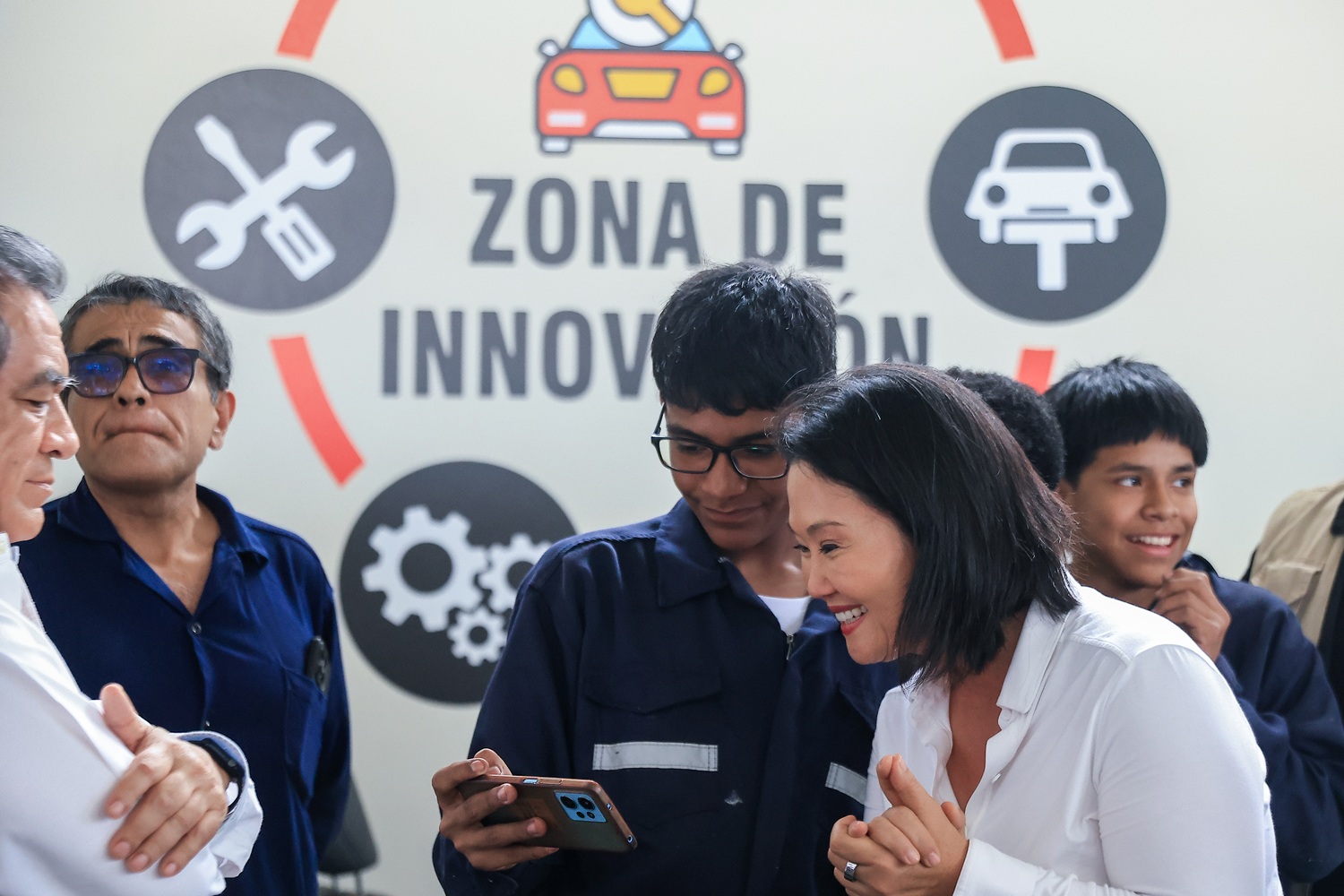
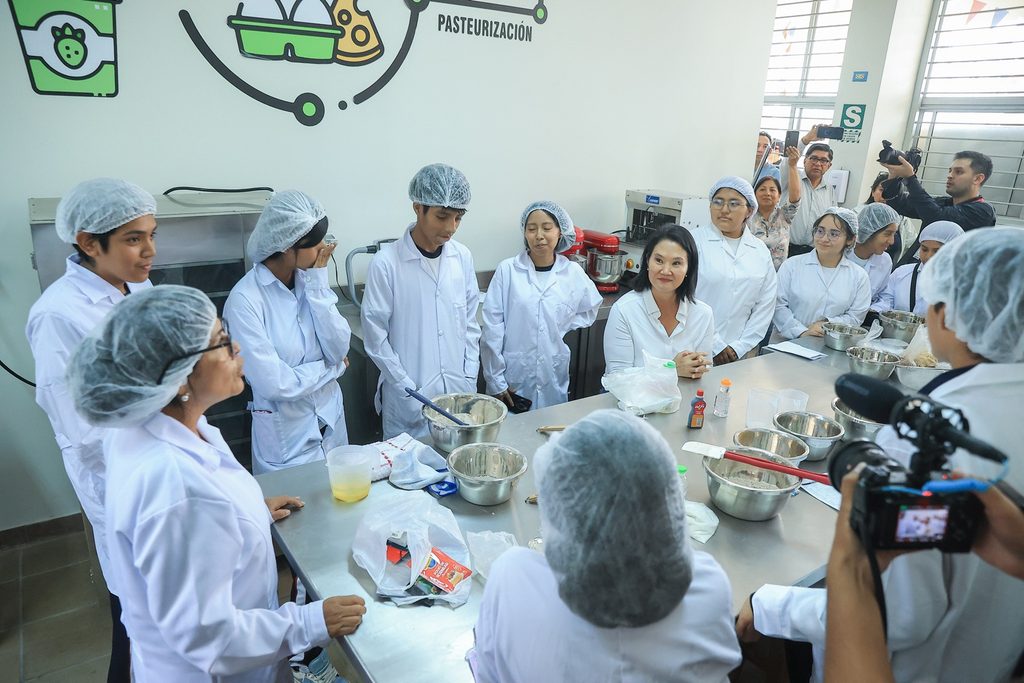
Agencia Peruana de Noticias PRENSAPERU.PE https://www.prensaperu.pe Twitter: @prensaperupe La presidenta de la República, Keiko Fujimori Higuchi, anunció hoy un conjunto de medidas orientadas a reducir la brecha entre la formación educativa y el mundo del trabajo, mediante la articulación directa entre el Ministerio de Educación y el Ministerio de Trabajo y Promoción del Empleo. La decisión fue dada a conocer durante una visita inopinada a la Institución Educativa Emblemática José Granda, en el distrito de San Martín de Porres, donde la jefa de Estado recorrió las instalaciones, dialogó con estudiantes y docentes, y supervisó los talleres de industrias alimentarias y mecánica automotriz, espacios que complementan la formación académica con preparación técnica especializada.
“Lo que estoy disponiendo es que se pueda firmar un acuerdo entre el Ministerio de Trabajo y el Ministerio de Educación, justamente para que los alumnos que vienen formándose en los últimos años de secundaria puedan luego conseguir una chamba”, manifestó la mandataria. La medida busca que los estudiantes que reciben formación técnica durante la secundaria tengan acceso directo a las bolsas de trabajo del Estado, evitando el prolongado periodo de espera que hoy enfrentan miles de jóvenes al egresar.
La primera mandataria resaltó que la educación debe mirar también hacia la inserción laboral, y no solo la formación académica. “Queremos mejorar la educación. No solamente la calidad educativa, sino también con esta mirada a educación para el trabajo”, señaló. En ese sentido, encargó al titular de Trabajo, Juan Sheput, articular de inmediato los mecanismos de enlace entre los egresados de educación técnica y las oportunidades disponibles en el sector productivo.
Durante la visita, Fujimori destacó el avance de los nuevos talleres de la institución educativa, los cuales ya se encuentran listos para su inauguración. “Como hemos podido ver, estos talleres están listos para ser inaugurados. Así es que regresamos para ya poner en marcha estos talleres maravillosos”, afirmó. Asimismo, informó que la visita programada a la región Amazonas tuvo que ser suspendida por condiciones climáticas adversas que impidieron el despegue de la aeronave oficial, y pidió disculpas a la población, comprometiéndose a realizar el viaje la semana siguiente.
Por su parte, el ministro de Educación, José Antonio Chang, recordó que la educación técnica es una prioridad de gobierno desde el primer mensaje a la Nación. Indicó que durante el presente año se espera contar con 124 instituciones educativas de secundaria técnica totalmente equipadas, ampliando la cobertura de formación práctica en beneficio de miles de estudiantes en todo el país.
De otro lado el ministro de Trabajo, Juan Sheput, aportó un dato revelador de la problemática: en la actualidad, un joven que concluye el quinto de secundaria tarda en promedio tres años en conseguir su primer empleo formal. La coordinación entre ambos sectores tiene como objetivo acortar significativamente ese lapso, permitiendo que los egresados de especialidades técnicas se incorporen rápidamente a la población económicamente activa. “No tendrán que esperar tres o cuatro años para poder engancharse”, remarcó.
DATOS CONCEPTUALES
Educación técnica secundaria: Modalidad formativa que combina estudios académicos con aprendizaje práctico en oficios y especialidades productivas, preparando a los estudiantes para el desempeño laboral o la continuación de estudios superiores. Fuente: Ministerio de Educación.
Bolsas de trabajo: Sistemas de registro y difusión de ofertas laborales que conectan a personas en búsqueda de empleo con empresas y entidades que requieren personal. Fuente: Ministerio de Trabajo y Promoción del Empleo.
Población económicamente activa (PEA): Conjunto de personas en edad de trabajar que aportan bienes y servicios a la economía, incluyendo a quienes tienen empleo y a quienes lo buscan activamente. Fuente: Instituto Nacional de Estadística e Informática (INEI).
Articulación intersectorial: Coordinación entre distintas carteras de Estado para lograr metas comunes, evitando la separación entre áreas que deberían complementarse. Fuente: Presidencia del Consejo de Ministros.
CONCLUSIONES
1.- La medida anunciada responde a una necesidad estructural: el desfase entre lo que se enseña en las aulas y lo que el mercado laboral requiere, un problema que ha postergado la independencia económica de miles de jóvenes peruanos.
2.- El vínculo directo entre educación técnica y bolsas de trabajo puede reducir sustancialmente el tiempo de inserción laboral, transformando la secundaria técnica en una vía efectiva hacia el empleo formal y no solo en formación.
3.- La meta de 124 planteles totalmente equipadas este año marca un aumento en infraestructura educativa, pero su impacto real dependerá de que las empresas también abran sus puertas a estos egresados y reconozcan oficialmente su capacitación.
4.- La suspensión del viaje a Amazonas por factores climáticos confirma la urgencia de fortalecer también la conectividad aérea y terrestre en regiones, tema que acompaña cualquier agenda de desarrollo nacional.
5.- La política educativa que vincula aprendizaje con trabajo representa un cambio de enfoque: la escuela deja de verse solo como transmisora de conocimientos y se convierte en puerta de entrada a la dignidad del empleo.
Fuente: Agencia Peruana de Noticias PRENSAPERU.PE https://www.prensaperu.pe Twitter: @prensaperupe
Translate
Keiko Fujimori is aligning education with the labor market so that young people can graduate and find employment without spending years searching. Studies show that it takes a young person three years to land their first job.
Peruvian News Agency PRENSAPERU.PE https://www.prensaperu.pe Twitter: @prensaperupe President of the Republic Keiko Fujimori Higuchi announced today a set of measures aimed at narrowing the gap between educational training and the world of work, through direct coordination between the Ministry of Education and the Ministry of Labor and Employment Promotion. The announcement was made during an unannounced visit to the Emblematic Educational Institution José Granda, in the district of San Martín de Porres, where the Head of State toured the facilities, spoke with students and teachers, and inspected the food industry and automotive mechanics workshops — spaces that complement academic education with specialized technical training.
“What I am ordering is that an agreement be signed between the Ministry of Labor and the Ministry of Education, precisely so that students in their final years of secondary education can then find a job,” the President stated. The measure seeks to ensure that students receiving technical training during secondary education have direct access to State employment boards, thereby avoiding the long waiting period currently faced by thousands of young people upon graduation.
The President emphasized that education must also look toward labor market integration, not just academic training. “We want to improve education. Not only educational quality, but also with this focus on education for work,” she said. In this regard, she instructed the Minister of Labor, Juan Sheput, to immediately coordinate mechanisms linking technical education graduates with available opportunities in the productive sector.
During the visit, Fujimori highlighted progress on the institution’s new workshops, which are now ready for inauguration. “As we have seen, these workshops are ready to be opened. So we will return to officially launch these wonderful workshops,” she affirmed. She also reported that the planned visit to the Amazonas region had to be cancelled due to adverse weather conditions preventing the official aircraft from taking off, and apologized to the people, committing to make the trip the following week.
For his part, the Minister of Education, José Antonio Chang, recalled that technical education has been a government priority since the first Message to the Nation. He stated that this year, 124 fully equipped technical secondary schools are expected to be operational, expanding practical training coverage for thousands of students across the country.
Meanwhile, the Minister of Labor, Juan Sheput, presented a revealing figure on the issue: currently, a young person completing fifth grade of secondary education takes an average of three years to secure their first formal job. Coordination between the two sectors aims to significantly shorten this timeframe, enabling graduates from technical specializations to join the economically active population more quickly. “They will not have to wait three or four years to find work,” he emphasized.
CONCEPTUAL DATA
Technical secondary education: Educational modality combining academic studies with practical learning in trades and productive specializations, preparing students for employment or further education. Source: Ministry of Education.
Employment boards: Systems for registering and publishing job vacancies that connect job seekers with companies and institutions requiring personnel. Source: Ministry of Labor and Employment Promotion.
Economically Active Population (EAP): All persons of working age who contribute goods and services to the economy, including those employed and those actively seeking work. Source: National Institute of Statistics and Informatics (INEI).
Intersectoral coordination: Collaboration between different government portfolios to achieve shared goals, preventing fragmentation between areas that should complement one another. Source: Presidency of the Council of Ministers.
CONCLUSIONS
1.- The announced measure addresses a structural need: the disconnect between what is taught in classrooms and what the labor market demands — a problem that has delayed the economic independence of thousands of young Peruvians.
2.- Direct linkage between technical education and employment boards can substantially reduce job placement time, turning technical secondary education into an effective pathway toward formal employment rather than training alone.
3.- The goal of 124 fully equipped schools this year represents expanded educational infrastructure, but its real impact will depend on businesses opening their doors to these graduates and officially recognizing their qualifications.
4.- The cancellation of the Amazonas trip due to weather conditions confirms the urgency of strengthening air and land connectivity in the regions as well — an issue that runs alongside any national development agenda.
5.- The education policy linking learning with work signals a shift in approach: schools are no longer seen solely as transmitters of knowledge, but as gateways to the dignity of employment.
Source: Peruvian News Agency PRENSAPERU.PE https://www.prensaperu.pe Twitter: @prensaperupe