
Agencia Peruana de Noticias PRENSAPERU.PE https://www.prensaperu.pe Twitter: @prensaperupe El Pleno del Jurado Nacional de Elecciones emitió por mayoría la Resolución N° 4557-2026-JNE, mediante la cual realizó revisión de oficio sobre 427 actas de proclamación de resultados emitidas por los Jurados Electorales Especiales en el marco de las Elecciones Regionales y Municipales 2026. De ese total, la gran mayoría se ajusta a derecho; solo 9 actas presentan observaciones correspondientes a los JEE de Recuay, Huancayo, Trujillo, Moyobamba y Bagua, los cuales deberán efectuar una nueva proclamación conforme a los criterios corregidos.
El pronunciamiento establece como principio fundamental que quien ejerció como alcalde en el periodo inmediato anterior no puede asumir nuevamente la alcaldía, aunque figure como primer regidor en la lista, en estricta aplicación del artículo 194 de la Constitución Política del Perú. Es decir, la condición de primer regidor no habilita para reemplazar al alcalde cuando esa persona se encuentra comprendida en la prohibición de reelección inmediata.
RESOLUCIÓN N° 4557-2026-JNE (Artículos concluyentes)
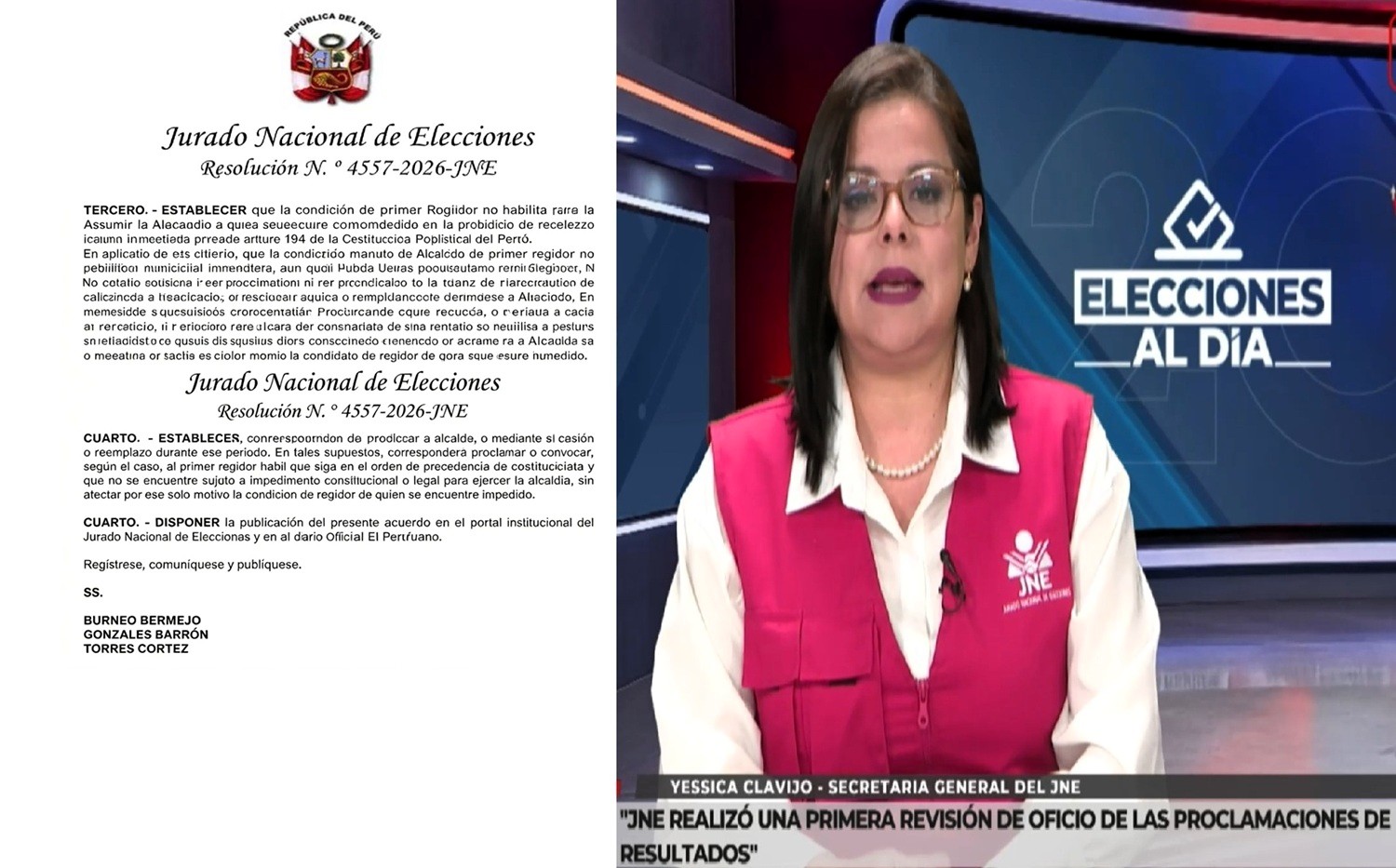
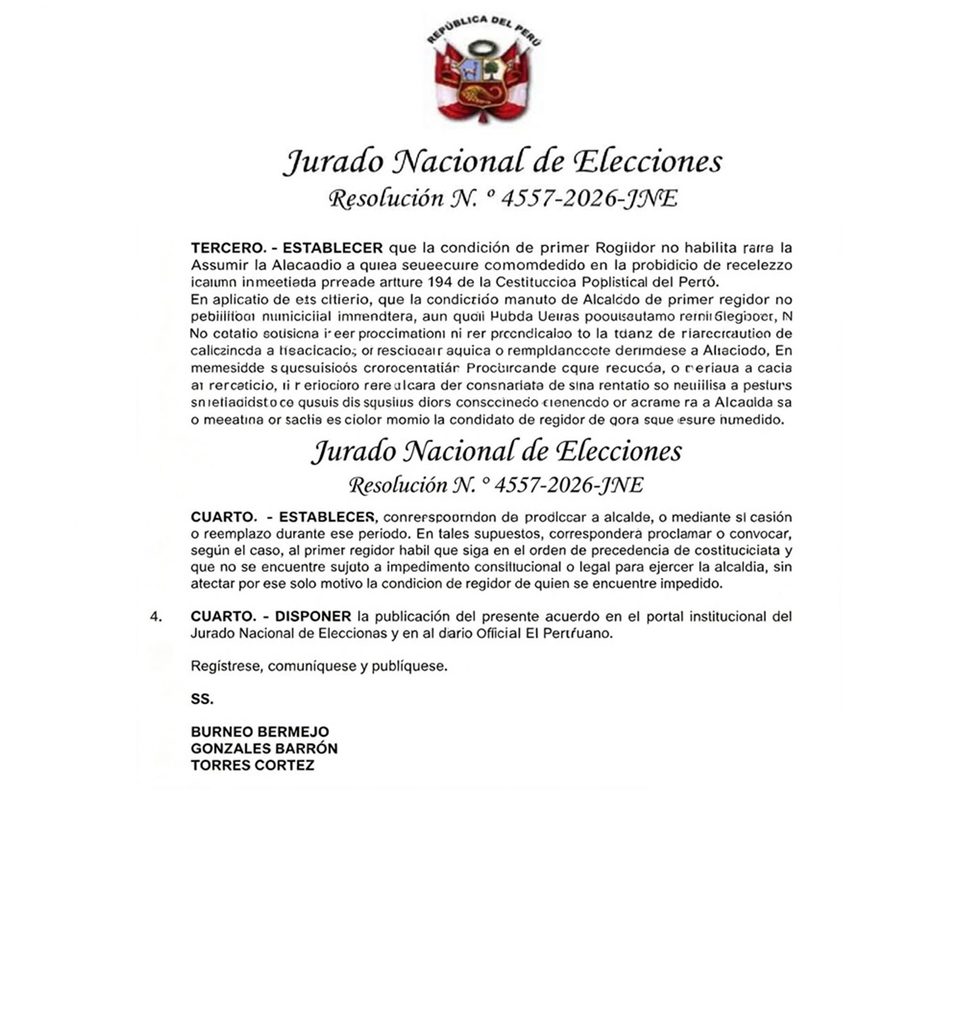
TERCERO.- ESTABLECER que la condición de primer regidor no habilita para asumir la alcaldía a quien se encuentre comprendido en la prohibición de reelección inmediata prevista en el artículo 194 de la Constitución Política del Perú. En aplicación de este criterio, quien ejerció el mandato de alcalde durante el periodo municipal inmediato anterior, aun cuando hubiera postulado como primer regidor, no podrá postular ni ser proclamado alcalde de la misma circunscripción para el periodo inmediato siguiente, ni asumir dicho cargo como consecuencia de la renuncia, exclusión o tacha del candidato a alcalde, o mediante sucesión o reemplazo durante ese periodo. En tales supuestos, corresponderá proclamar o convocar, según el caso, al primer regidor hábil que siga en el orden de precedencia de la propia lista y que no se encuentre sujeto a impedimento constitucional o legal para ejercer la alcaldía, sin afectar por ese solo motivo la condición de regidor de quien se encuentre impedido.
CUARTO.- DISPONER la publicación del presente acuerdo en el portal institucional del Jurado Nacional de Elecciones y en el diario oficial El Peruano.
Regístrese, comuníquese y publíquese.
SS.
BURNEO BERMEJO
GONZALES BARRÓN
TORRES CORTEZ
LA PRÁCTICA QUE SE CORRIGE Y SU PROYECCIÓN EN LIMA
La resolución responde a una estrategia detectada en el proceso electoral: alcaldes que no podían postular directamente a la reelección se inscribían en sus propias listas como primer regidor, colocando a otra persona como candidato a alcalde. De resultar ganadora la lista, el candidato a alcalde renunciaba poco después de asumir, de modo que el primer regidor, el exalcalde, tomaba el cargo en su reemplazo, burlando así la prohibición constitucional.
En la provincia de Lima y distritos capitalinos, esta figura había cobrado visible relevancia. Por ejemplo, en distritos donde el alcalde saliente estaba impedido de postular a la reelección inmediata, se observaron listas donde el exmandatario aparecía como primer regidor, con un candidato a la alcaldía que actuaba en apariencia como figura de paso. El esquema previsible era claro: de ganar la lista, el candidato renunciaría poco después de la proclamación, activando automáticamente la sucesión en favor del primer regidor, es decir, del propio exalcalde.
Esta maniobra, que en algunos distritos de Lima se presentaba como una “cuestión de forma”, quedaba al descubierto como una violación al espíritu del artículo 194 de la Constitución, que establece la alternancia como regla del sistema democrático municipal. Con la resolución del JNE, esta vía queda clausurada de manera expresa e inapelable.
CRITERIOS ESTABLECIDOS EN LA RESOLUCIÓN
1.- Quien fue alcalde en el periodo inmediato anterior no podrá ser proclamado alcalde ni asumir el cargo mediante renuncia, vacancia, sucesión o reemplazo, aunque figure como primer regidor de una lista ganadora.
2.- En ese supuesto, se proclama al siguiente regidor hábil de la misma lista que no se encuentre impedido legalmente, sin afectar por ello la condición de regidor de quien está impedido de ejercer la alcaldía.
3.- Este criterio es vinculante para todos los Jurados Electorales Especiales del país y rige también para casos de vacancia o suspensión del alcalde durante el periodo 2027-2030.
ALCANCE Y EFECTOS
La secretaria general del JNE, Yessica Clavijo, precisó que este fallo sienta las bases metodológicas para la revisión de oficio de las demás actas de proclamación, incluidas las de la provincia de Lima y sus distritos. Las decisiones del Pleno del JNE en materia electoral son de última instancia, de cumplimiento obligatorio para todas las entidades electorales y no pueden ser impugnadas en la vía administrativa.
Con esta resolución, el máximo tribunal electoral ha cerrado la vía a lo que se ha denominado reelección encubierta, garantizando que en ninguna municipalidad sea del interior del país o de la capital pueda prolongarse un mandato más allá del periodo permitido por la Constitución, sin importar la fórmula que se intente utilizar.
MÁS ALLÁ DE LA CORRECCIÓN: POR UNA RESPUESTA EJEMPLARIZANTE
La decisión del Jurado Nacional de Elecciones de frenar la llamada reelección encubierta marca un hito necesario en la defensa de nuestra institucionalidad democrática. Sin embargo, es preciso señalar que el alcance de esta medida, aunque valioso, debe constituir el punto de partida y no el límite de la respuesta del Estado frente a una maniobra que ha buscado burlar abiertamente el espíritu y el texto de nuestra Carta Magna.
No se trata simplemente de corregir el resultado final de una proclamación. Cuando figuras públicas diseñan estrategias para eludir una prohibición constitucional clara, lo que está en juego no es solo el resultado de una elección en una municipalidad determinada, sino la credibilidad que toda la ciudadanía deposita en el sistema electoral y en el respeto que quienes aspiran a servir a su país deben tener por las leyes que nos rigen. Si la única consecuencia de esta maniobra fuera que al final no se logra el objetivo perseguido, estaríamos enviando un mensaje insuficiente: que se puede intentar burlar la Constitución y que lo peor que puede ocurrir es sencillamente que no funcione. Eso no basta para fortalecer nuestra democracia.
El Estado y las autoridades competentes tienen el deber de actuar con mayor contundencia. No se puede permitir que quienes hacen del ingenio legal una herramienta para perpetuarse en el poder queden impunes. La defensa de la Constitución exige no solo que se corrija el camino, sino que se señale con claridad que este tipo de prácticas son contrarias a la ética pública, al principio de alternancia y al respeto que todo gobernante debe profesar a las normas del país. Que la decisión del JNE sirva también como precedente para que en futuros procesos electorales nadie conciba la idea de que las leyes son obstáculos a sortear en lugar de marcos que respetar.
La democracia peruana se fortalece cuando las correcciones vienen acompañadas de una enseñanza clara: nadie está por encima de la ley. Y cuando esa enseñanza es firme, oportuna y visible para todos, se convierte en la mejor garantía de que las instituciones funcionan para todos los peruanos por igual.
DATOS CONCEPTUALES
Reelección inmediata: Establecida en el artículo 194 de la Constitución Política del Perú, prohíbe que los alcaldes y gobernadores sean elegidos para el periodo inmediato siguiente en la misma circunscripción. Su finalidad es garantizar la alternancia en el poder local, evitar la concentración prolongada de influencia y recursos, y renovar periódicamente las autoridades elegidas por la ciudadanía.
Reelección encubierta: Estrategia mediante la cual una autoridad impedida de postular directamente a la reelección se inscribe como primer regidor en una lista electoral, colocando a otra persona como candidato a alcalde. De ganar la lista, el candidato renuncia poco después de asumir, activando la sucesión automática en favor del primer regidor y permitiendo que el exmandatario retome el cargo sin haberlo postulado abiertamente. Esta práctica vulnera el principio de transparencia electoral y el espíritu de la norma constitucional.
Revisión de oficio: Facultad del Jurado Nacional de Elecciones para examinar, por iniciativa propia, las actas de proclamación emitidas por los Jurados Electorales Especiales, verificando su conformidad con los resultados del cómputo oficial y con los criterios jurisdiccionales aplicables. No requiere que ninguna parte presente una queja formal para que el máximo tribunal electoral actúe.
Precedente vinculante: Las decisiones del Pleno del JNE en materia de interpretación de normas electorales son de obligatorio cumplimiento para todos los Jurados Electorales Especiales del país. No pueden ser apeladas en la vía administrativa y establecen el criterio que deberá aplicarse en casos similares durante el periodo 2027-2030 y en futuros procesos electorales.
CONCLUSIONES
1.- La Resolución N° 4557-2026-JNE representa un paso fundamental en la defensa de la institucionalidad democrática peruana, al cerrar jurídicamente una vía que venía siendo utilizada para eludir el mandato constitucional de alternancia municipal. Su alcance se proyecta más allá de los nueve casos específicos observados, al establecer un criterio general que rige para todo el territorio nacional.
2.- La resolución confirma que la prohibición de reelección no es una formalidad que pueda soslayarse mediante mecanismos de sustitución o sucesión. El mandato del artículo 194 de la Constitución opera con independencia del cargo que figure en la plancha electoral: lo determinante es quién ejerció la titularidad del poder ejecutivo municipal en el periodo inmediato anterior.
3.- La respuesta del Estado frente a estas prácticas debe completarse con acciones que trasciendan lo meramente correctivo. Detectar y corregir no basta cuando está en juego la confianza ciudadana en la ley. Es necesario que el pronunciamiento público sobre la irregularidad de estas estrategias acompañe cada decisión, enviando un mensaje claro a toda la ciudadanía sobre qué conductas son incompatibles con la ética electoral.
4.- El precedente establecido debe proyectarse como herramienta preventiva para los comicios del 2030. Los partidos políticos, las autoridades electorales y la ciudadanía deben conocer con anticipación que cualquier intento de eludir la Constitución mediante fórmulas intermedias será identificado, corregido y expuesto con transparencia. La fortaleza de la norma no reside solo en su aplicación retrospectiva, sino en su capacidad para disuadir conductas antes de que se materialicen.
Fuente: Agencia Peruana de Noticias PRENSAPERU.PE https://www.prensaperu.pe Twitter: @prensaperupe
Translate
The JNE closes the door on disguised reelection! “The Constitution has no loopholes. Circumventing the law will not be an option in Peru; the country’s highest electoral authority marks a turning point for municipal democracy.”
Peruvian News Agency PRENSAPERU.PE https://www.prensaperu.pe Twitter: @prensaperupe The Plenary of the National Jury of Elections issued Resolution No. 4557-2026-JNE by majority vote, conducting an ex officio review of 427 result proclamations issued by the Special Electoral Juries in the context of the 2026 Regional and Municipal Elections. The vast majority were found to be in order; only 9 records presented observations corresponding to the Special Electoral Juries of Recuay, Huancayo, Trujillo, Moyobamba, and Bagua, which must issue a new proclamation in accordance with the corrected criteria.
The ruling establishes as a fundamental principle that anyone who served as mayor in the immediately preceding term cannot reassume the mayoralty, even if listed as first councilor on the ticket, in strict application of Article 194 of the Political Constitution of Peru. In other words, the position of first councilor does not confer standing to replace the mayor when that person is barred from immediate re-election.
RESOLUTION NO. 4557-2026-JNE (Concluding Articles)
THIRD. — TO ESTABLISH that the condition of first councilor does not enable a person barred from immediate re-election, as provided in Article 194 of the Political Constitution of Peru, to assume the mayoralty. Pursuant to this criterion, anyone who held the office of mayor during the immediately preceding municipal term, even if they ran as first councilor, may neither run for nor be proclaimed mayor of the same jurisdiction for the following term, nor assume said office as a consequence of the resignation, exclusion, or disqualification of the mayoral candidate, or through succession or replacement during that term. In such cases, the next eligible councilor in order of precedence on the same ticket who is not subject to a constitutional or legal impediment shall be proclaimed or summoned as appropriate, without affecting the status as councilor of the person barred from the mayoralty solely on that account.
FOURTH. — TO ORDER the publication of this agreement on the institutional website of the National Jury of Elections and in the official gazette El Peruano.
Registered, recorded, and published.
Signed:
BURNEO BERMEJO
GONZALES BARRÓN
TORRES CORTEZ
THE PRACTICE CORRECTED AND ITS PROJECTION IN LIMA
The resolution responds to a strategy detected during the electoral process: mayors barred from running for immediate re-election registered on their own slates as first councilor, while another person ran as the mayoral candidate. Should the ticket win, the candidate would resign shortly after taking office, allowing the first councilor, the former mayor, to take the position in their place, thereby circumventing the constitutional prohibition.
In the province of Lima and the capital’s districts, this practice had gained visible traction. For instance, in districts where the incumbent mayor was barred from re-election, tickets were observed where the outgoing mayor appeared as first councilor, with a mayoral candidate who appeared to serve merely as a placeholder. The predictable pattern was clear: should the ticket win, the candidate would resign shortly after the proclamation, automatically triggering succession in favor of the first councilor — the former mayor themselves.
This maneuver, presented in some Lima districts as a “technicality,” was exposed as a violation of the spirit of Article 194 of the Constitution, which establishes alternation as a foundational rule of the municipal democratic system. With this resolution, that route is now expressly and permanently closed.
CRITERIA ESTABLISHED IN THE RESOLUTION
1.- Anyone who served as mayor in the immediately preceding term may not be proclaimed mayor nor assume office through resignation, vacancy, succession, or replacement, even if listed as first councilor on a winning ticket.
2.- In such cases, the next eligible councilor on the same ticket who is not legally barred shall be proclaimed, without affecting the councilorship status of the person barred from the mayoralty.
3.- This criterion is binding on all Special Electoral Juries nationwide and applies also to cases of vacancy or suspension of a mayor throughout the 2027–2030 term.
SCOPE AND EFFECTS
The Secretary-General of the National Jury of Elections, Yessica Clavijo, stated that this ruling establishes the methodological framework for the ex officio review of all remaining proclamations, including those in the province of Lima and its districts. Decisions issued by the Plenary of the National Jury of Elections are final, mandatory for all electoral bodies, and cannot be challenged through administrative appeals.
With this resolution, Peru’s highest electoral body has closed the door on what has been termed disguised re-election, ensuring that no municipality whether in the interior of the country or the capital may extend a mandate beyond the term permitted by the Constitution, regardless of the mechanism attempted.The National Jury of Elections’ decision to block disguised re-election marks a necessary milestone in defending Peru’s democratic institution
BEYOND CORRECTION: TOWARD A DETERRENT RESPONSE
The decision by the National Elections Jury to halt so-called “covert reelection” marks a necessary milestone in the defense of our democratic institutions. It must be noted, however, that while this measure is valuable, it should serve as a starting point not the limit of the State’s response to a maneuver that has sought to openly circumvent both the spirit and the letter of our Constitution.
This is not merely about correcting a final proclamation. When public figures design strategies to evade clear constitutional prohibitions, more is at stake than the outcome of a single race. The credibility of the electoral system and the rule of law itself are on the line. If the only consequence of this maneuver is that it ultimately fails, the message sent is insufficient: that one may attempt to bypass the Constitution and risk nothing but lack of success. That is not enough to strengthen our democracy.
The State and competent authorities must act with greater resolve. Those who exploit legal technicalities to remain in power must not be allowed to act with impunity. Defending the Constitution requires not only correcting the outcome but clearly stating that such practices violate public ethics, the principle of alternation, and the rule of law. This ruling must also serve as a precedent so that in future elections, no one imagines the law is something to be worked around rather than respected.
Peru’s democracy is strengthened when corrections come paired with a clear lesson: no one is above the law. When that lesson is firm, timely, and visible to all, it becomes the surest guarantee that institutions serve all Peruvians equally.
CONCEPTUAL FRAMEWORK
Immediate re-election: Established in Article 194 of the Political Constitution of Peru, this prohibits mayors and regional governors from being elected to the immediately succeeding term in the same jurisdiction. Its purpose is to ensure alternation in local government, prevent the long-term concentration of influence and resources, and guarantee the regular renewal of democratically elected authorities.
Disguised re-election: A strategy whereby an incumbent barred from running directly for re-election registers as first councilor on a ticket, while another person runs for mayor. Should the ticket win, the mayoral candidate resigns shortly after taking office, triggering automatic succession in favor of the first councilor — the incumbent — who thereby retakes the office without having run for it openly. This practice undermines electoral transparency and the intent of the Constitution.
Ex officio review: The authority of the National Jury of Elections to examine, on its own initiative, proclamations issued by Special Electoral Juries, verifying consistency with official vote tallies and applicable legal standards. No formal complaint is required from any party for the electoral body to exercise this oversight.
Binding precedent: Rulings issued by the Plenary of the National Jury of Elections on matters of electoral interpretation are mandatory for all Special Electoral Juries nationwide. They are final and establish the standard to be applied in similar cases throughout the 2027–2030 term and in future electoral cycles.
CONCLUSIONS
1.- The No. 4557-2026-JNE represents a major milestone in the defense of Peru’s democratic institutions, legally closing a loophole that had been used to bypass the constitutional mandate for municipal alternation. Its impact extends beyond the nine specific cases identified, establishing a general principle applicable throughout the entire country.
2.- The resolution confirms that the re-election prohibition is no mere formality to be evaded through succession or replacement mechanisms. Article 194 of the Constitution applies regardless of the position listed on the ballot: what matters is who held executive authority in the municipality during the preceding term.
3.- The State’s response must go beyond mere correction. Identifying and fixing irregularities is insufficient when public trust in the rule of law is at stake. Every such ruling should be accompanied by a clear public statement identifying these practices as incompatible with democratic ethics.
4.- This precedent must also serve as a preventive standard for the 2030 elections. Political parties, electoral authorities, and citizens alike should understand in advance that any attempt to circumvent the Constitution through indirect formulas will be detected, corrected, and publicly identified. The strength of the law lies not only in being enforced after the fact, but in deterring violations before they occur.
Source: Peruvian News Agency PRENSAPERU.PE https://www.prensaperu.pe Twitter: @prensaperupe