
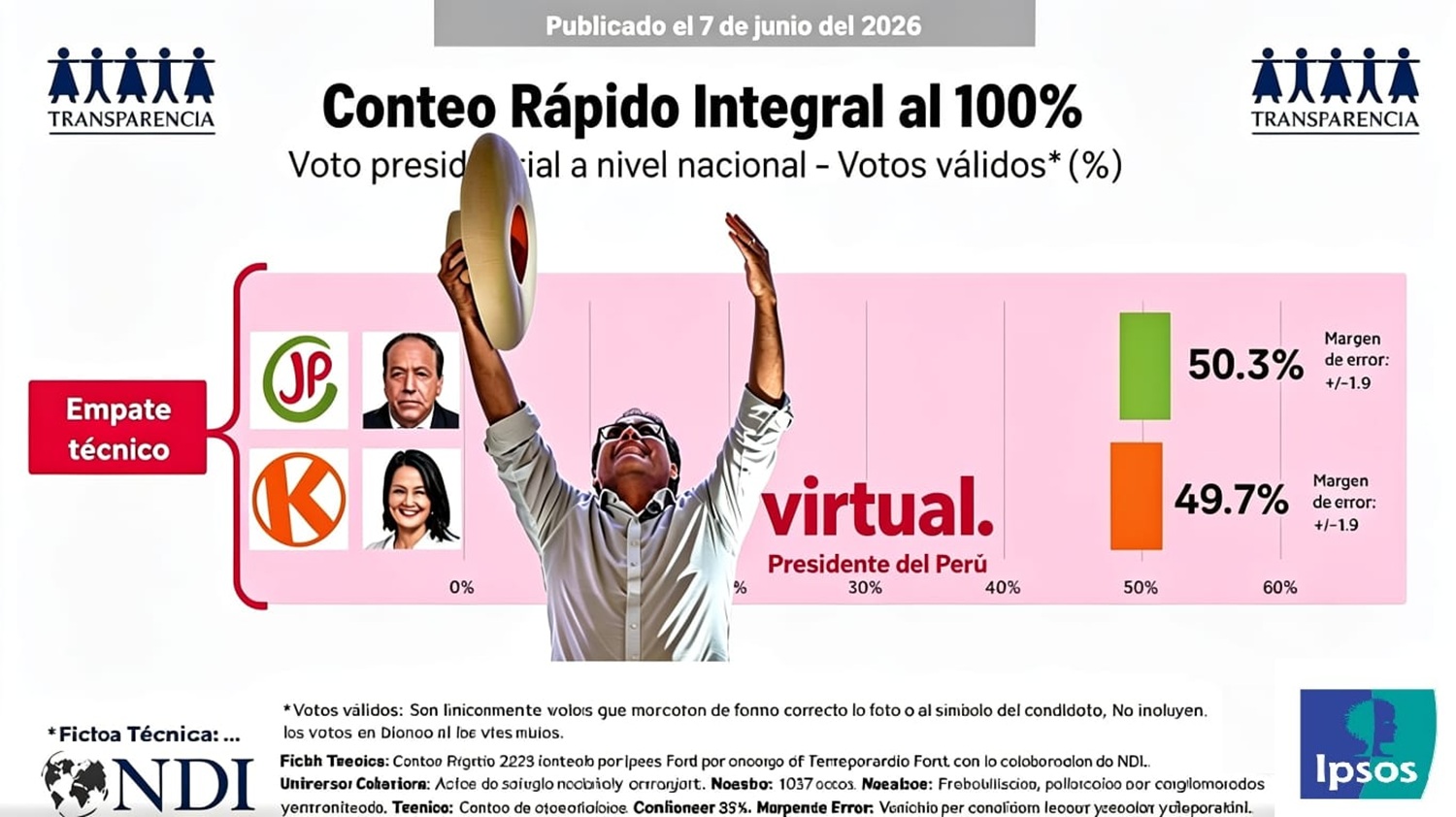
Agencia Peruana de Noticias PRENSAPERU.PE https://www.prensaperu.pe Twitter: @prensaperupe Una vez cerrada la jornada electoral para elegir al Presidente de la República para el periodo 2026‑2031, se han dado a conocer los primeros resultados consolidados del conteo rápido realizado por la empresa Ipsos y la prestigiosa Asociación Civil Transparencia, entidades independientes y referentes en el monitoreo electoral en el país. Los números revelan un escenario de igualdad total y empate técnico: Roberto Sánchez (Juntos por el Perú) obtendría el 50.3 % de los votos válidos, mientras que Keiko Fujimori (Fuerza Popular) alcanzaría el 49.7 %.
La diferencia entre ambos candidatos es de apenas 0.6 puntos porcentuales, una cifra extremadamente pequeña que se encuentra muy por debajo del margen de error estadístico permitido en este tipo de mediciones (±3 %), lo que confirma que, por ahora, no es posible declarar a nadie como ganador. Todo queda pendiente y sujeto al escrutinio oficial, detallado y definitivo que realizará la Oficina Nacional de Procesos Electorales (ONPE), única instancia facultada legalmente para proclamar el resultado final.
Dato clave: Esta es la tercera vez en las últimas cuatro elecciones presidenciales en el Perú que el resultado preliminar arroja una brecha inferior al 1 %, repitiendo el patrón histórico de 2016 y 2021, donde las encuestas rápidas no definieron nada y el conteo oficial terminó siendo decisivo y, en ambos casos, con cambios de tendencia según avanzaba el procesamiento de actas.
Análisis: Igualdad que refleja la división nacional
El resultado publicado por Ipsos y Transparencia confirma lo que se venía advirtiendo desde el término de la primera vuelta: el país está dividido en dos mitades casi exactas. A diferencia de la ronda anterior, donde hubo mayor fragmentación por la cantidad de opciones políticas, en esta segunda vuelta el electorado se polarizó, y la preferencia se repartió de forma pareja.
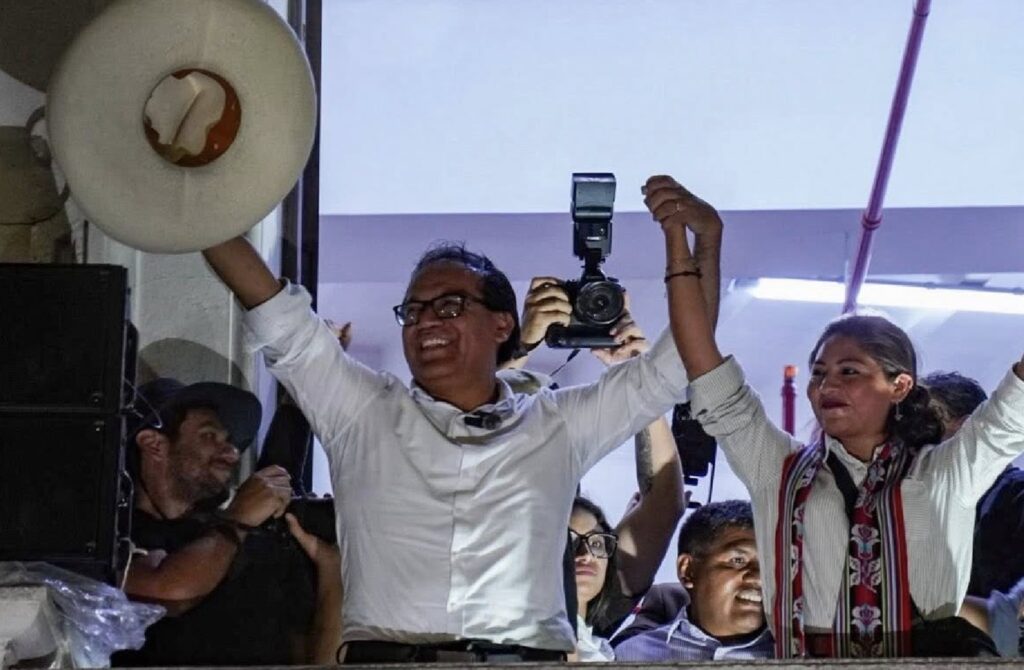
Roberto Sánchez: Logró consolidar el voto de las regiones del interior, los sectores que buscan transformación estructural, reforma del Estado y continuidad en políticas de inclusión social, sumando además el respaldo de quienes lo eligieron por la solidez y detalle de sus propuestas y su mejor desempeño en los debates presidenciales. Su ligera ventaja numérica responde a una mayor movilización en zonas rurales y ciudades medianas.
Keiko Fujimori: Mantuvo y fortaleció su base histórica de apoyo, muy sólida en Lima Metropolitana, la costa norte y sectores medios y empresariales, que respaldan su propuesta de orden, seguridad y crecimiento económico. Estar a solo 0.6 puntos demuestra que su electorado es fiel y numeroso, y que su mensaje sigue siendo determinante para casi la mitad del país.
Lo más relevante del análisis es que la diferencia es tan mínima que un puñado de actas, especialmente aquellas provenientes de zonas alejadas o del extranjero, pueden inclinar la balanza hacia cualquiera de los dos lados. Como ya ha ocurrido anteriormente, lo que marcará la diferencia no es la tendencia inicial, sino cómo se procesan y contabilizan los votos en las regiones donde el apoyo es más fuerte para cada uno.
¿Por qué nadie puede cantar victoria hoy?
Tanto Ipsos como Transparencia han sido muy claros en sus informes: estos datos son estimaciones estadísticas, no resultados oficiales. Al haber una distancia de menos del 1 %, cualquier variación en la muestra o en la llegada de actas al sistema central puede modificar los porcentajes.
La historia electoral peruana es tajante con Keiko Fujimori: en 2016 y 2021, los conteos rápidos la daban con ventaja o muy cerca, pero al finalizar el conteo oficial, perdió por márgenes menores al 1 %. Hoy, la situación es idéntica pero invertida: Sánchez está arriba por menos de 1 punto, lo que significa que la incertidumbre es total hasta que la ONPE publique las cifras consolidadas.
El llamado de las autoridades y de estas instituciones es a la calma, la paciencia y el respeto al proceso. La plataforma oficial ONPE Elecciones Generales 2026 es el único canal válido para seguir el avance real y definitivo del cómputo. Asimismo, la Asociación Civil Transparencia continuará monitoreando paso a paso para garantizar que todo se desarrolle bajo estricto apego a la ley.
CONCLUSIONES FINALES
1.- Empate real, definición oficial: Con solo 0.6 % de diferencia, el resultado preliminar es técnicamente un empate. No hay ganador ni perdedor hasta que la ONPE valide el 100 % de las actas; la experiencia de 2016 y 2021 nos enseña que todo puede cambiar.
2.- País dividido en dos: Los números reflejan que la sociedad peruana está polarizada casi a partes iguales. La elección no ha definido una mayoría clara, sino dos visiones de país con respaldo masivo, lo que exigirá al próximo gobierno capacidad de diálogo y unidad.
3.- El valor del voto del interior y del exterior: Al ser la brecha tan estrecha, los votos provenientes de zonas rurales, de la selva y de los peruanos residentes en el extranjero —tradicionalmente procesados al final— serán los que finalmente decidan quién ocupará el Palacio de Gobierno.
4.- Instituciones como garantía: Ante resultados tan ajustados, la credibilidad en la ONPE y el Jurado Nacional de Elecciones es fundamental. Su trabajo riguroso y transparente es lo único que dará legitimidad absoluta al nuevo presidente o presidenta.
Fuente: Agencia Peruana de Noticias PRENSAPERU.PE https://www.prensaperu.peTwitter: @prensaperupe
Translate
History Repeats Itself! “A total technical tie, Roberto Sánchez 50.3 % with a tendency to rise with the rural vote over Keiko Fujimori with 49.7 % in her fourth candidacy.”
Peruvian News Agency PRENSAPERU.PE https://www.prensaperu.pe Twitter: @prensaperupe Once the electoral day to elect the President of the Republic for the 2026–2031 term had concluded, the first consolidated results from the rapid count carried out by Ipsos and the prestigious civil association Transparencia — independent bodies and leading references for electoral monitoring in the country — were released. The figures reveal a scenario of absolute parity and a statistical tie: Roberto Sánchez (Together for Peru) would obtain 50.3 % of valid votes, while Keiko Fujimori (Popular Force) would reach 49.7 %.
The difference between the two candidates stands at just 0.6 percentage points, an extremely small figure that falls well within the statistical margin of error allowed for this type of measurement (±3 %). This confirms that, for the moment, it is impossible to declare anyone the winner. Everything remains pending and subject to the official, detailed and definitive scrutiny to be conducted by the National Office of Electoral Processes (ONPE), the only body legally authorised to proclaim the final result.
Key fact: This is the third time in the last four presidential elections in Peru that preliminary results show a gap of less than 1 %, repeating the historical pattern of 2016 and 2021, when rapid counts determined nothing and the official tally ended up being decisive — on both occasions, shifts in the trend occurred as ballot records were processed.
Analysis: Parity as a reflection of national division
The results published by Ipsos and Transparencia confirm what had been forecast since the end of the first round: the country is split into two almost equal halves. Unlike the earlier round, in which the large number of political options produced greater fragmentation, this run‑off saw the electorate become polarised, with voter preference distributed evenly.
Roberto Sánchez: Successfully consolidated support from inland regions and sectors seeking structural transformation, State reform and continuity in social inclusion policies. He also drew backing from those who chose him for the solidity and detail of his proposals, as well as his stronger performance in the presidential debates. His slight numerical advantage stems from higher mobilisation in rural areas and mid‑sized cities.
Keiko Fujimori: Retained and strengthened her historical base of support — very solid in Metropolitan Lima, the northern coast and middle‑class and business sectors — which backs her proposals regarding order, security and economic growth. Being only 0.6 points behind demonstrates that her electorate is loyal and numerous, and that her message remains decisive for almost half the country.
The most relevant finding of this analysis is that the difference is so minimal that a handful of polling station records — especially those from remote areas or from abroad — could tip the balance in either direction. As has happened before, what will make the difference is not the initial trend, but rather how votes are processed and counted in the regions where each candidate enjoys the strongest support.
Why no one can claim victory today
Both Ipsos and Transparencia have been very clear in their reports: these figures are statistical estimates, not official results. With a margin of less than 1 %, any variation in the sample or in the arrival of records at the central system can alter the percentages.
Peru’s electoral history is definitive regarding Keiko Fujimori: in 2016 and 2021, rapid counts showed her leading or very close, yet when the official tally concluded she lost by margins of less than 1 %. Today, the situation is identical but reversed: Sánchez is ahead by less than one point, meaning uncertainty will persist until ONPE publishes consolidated results.
Authorities and these organisations are calling for calm, patience and respect for the process. The official platform ONPE Elecciones Generales 2026 is the only valid channel for following real, definitive progress in the count. Likewise, the civil association Transparencia will continue step‑by‑step monitoring to ensure that everything proceeds in strict compliance with the law.
FINAL CONCLUSIONS
1.- Real tie, official definition: With a difference of only 0.6 %, the preliminary result is statistically a tie. There is no winner or loser until ONPE validates 100 % of records; experience from 2016 and 2021 teaches us that everything can change.
2.- A country split in two: The figures reflect that Peruvian society is polarised almost exactly in half. The election has not produced a clear majority, but rather two visions for the country with massive support — a reality that will require the next government to foster dialogue and unity.
3.- The value of votes from inland and from abroad: Given the narrow gap, ballots from rural and jungle areas, and from Peruvians residing overseas — traditionally processed last — will ultimately decide who occupies the Government Palace.
4.- Institutions as the guarantee: In the face of such close results, confidence in ONPE and the National Jury of Elections is essential. Their rigorous and transparent work is the only factor that will confer absolute legitimacy upon the new president.
Source: Peruvian News Agency PRENSAPERU.PE https://www.prensaperu.pe Twitter: @prensaperupe