
Agencia Peruana de Noticias PRENSAPERU.PE https://www.prensaperu.pe Twitter: @prensaperupe El Gobierno del Perú ha completado un paso fundamental en su agenda internacional al entregar oficialmente la nota diplomática de ratificación del Tratado de Libre Comercio (TLC) entre el Perú y Guatemala, así como de su Protocolo Modificatorio. Este acto marca el cierre de una etapa administrativa y jurídica, allanando el camino para la próxima entrada en vigor de este acuerdo comercial, el cual tiene como objetivo principal profundizar los lazos económicos, reducir barreras y fortalecer la integración entre ambas naciones de América Latina.
Nota diplomática de ratificación: Es el documento oficial mediante el cual un Estado confirma formalmente ante otro que ha cumplido con todos los requisitos legales y constitucionales internos necesarios para comprometerse con un tratado internacional. Su entrega mutua es el paso previo indispensable para que el acuerdo empiece a regir entre ambos países.
El ministro de Comercio Exterior y Turismo, José Reyes, destacó que la culminación de este largo proceso representa un verdadero hito histórico en la relación bilateral. Explicó que este instrumento permitirá consolidar un marco jurídico moderno y predecible, elemento esencial para generar confianza entre los actores del mercado.
Marco jurídico predecible: Conjunto de reglas claras, estables y transparentes que regulan el comercio entre dos países. Permite que los empresarios planifiquen sus inversiones y operaciones a largo plazo sin el temor de cambios repentinos en las normas, reduciendo riesgos y fomentando la seguridad jurídica.
“Este acto representa un paso decisivo en el fortalecimiento de la relación económica y comercial entre el Perú y Guatemala. Con estos instrumentos, una vez entren en vigencia, consolidamos un marco jurídico bilateral moderno y previsible, que brindará mayor seguridad a los operadores económicos y generará nuevas oportunidades para el comercio, la inversión y la cooperación”, afirmó el titular del Mincetur.
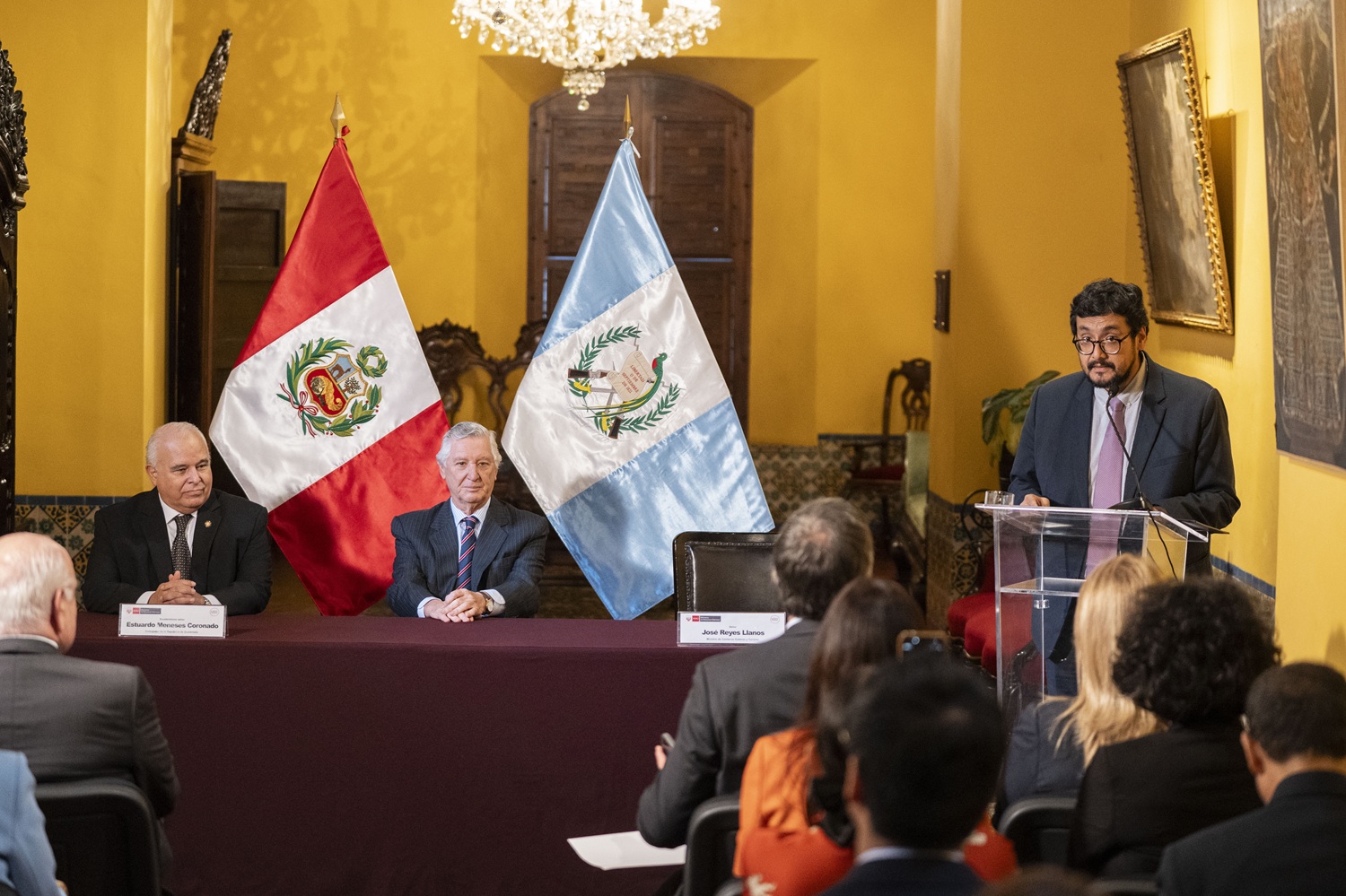
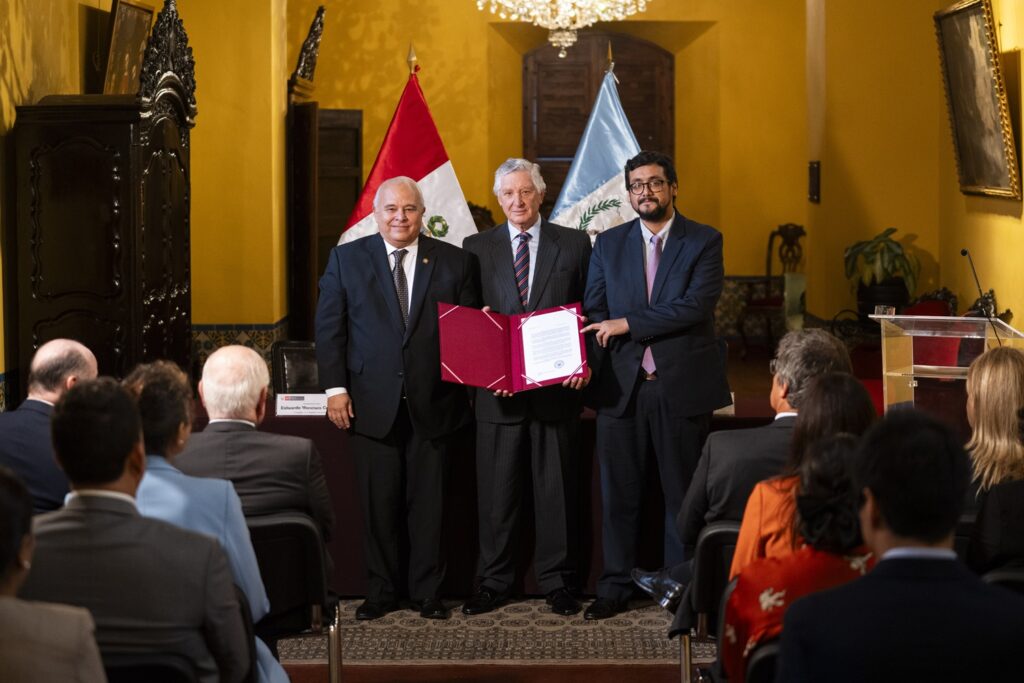
La entrega de la nota diplomática se formalizó en una ceremonia solemne realizada en el Palacio de Torre Tagle, sede del Ministerio de Relaciones Exteriores. El evento fue liderado por el ministro Reyes y el canciller Carlos Pareja, y contó con la presencia del embajador de Guatemala en el Perú, Herbert Meneses Coronado, así como del viceministro de Comercio Exterior, César Llona.
El ministro Reyes resaltó que este resultado no fue casualidad, sino el fruto del trabajo técnico continuo y el diálogo constructivo entre los equipos de ambos gobiernos durante años. Informó además que, como paso final, próximamente el Mincetur emitirá el Decreto Supremo de Puesta en Ejecución, documento que oficializará la entrada en vigor del acuerdo y completará todo el procedimiento legal para su aplicación práctica, dando inicio a una nueva etapa en los vínculos entre ambas naciones.
Tratado de Libre Comercio (TLC): Acuerdo entre dos o más países para eliminar o reducir significativamente los aranceles, cuotas y otras restricciones al intercambio de bienes y servicios. Su finalidad es facilitar el comercio, atraer inversión, generar empleo y ofrecer a los consumidores mayor variedad de productos a mejores precios.
La ratificación reafirma el compromiso del Perú con una política exterior basada en la apertura comercial, la cooperación y el beneficio mutuo. Una vez activo, el tratado permitirá reducir progresivamente las barreras arancelarias y no arancelarias, promover la inversión recíproca y, sobre todo, ampliar las oportunidades de acceso a mercados, especialmente para las Micro, Pequeñas y Medianas Empresas (MYPE), que constituyen el motor principal de la economía peruana.
Micro, Pequeñas y Medianas Empresas (MYPE): Unidades productivas que representan la gran mayoría de empresas en el país y generan la mayor cantidad de empleos. Su participación en mercados internacionales es fundamental para su crecimiento, por lo que los TLC buscan facilitar su inserción eliminando obstáculos burocráticos y comerciales.
GUATEMALA: EL TERCER SOCIO COMERCIAL DEL PERÚ EN CENTROAMÉRICA
La importancia estratégica de este acuerdo se respalda en la evolución positiva del intercambio comercial bilateral. Según cifras oficiales del año 2025, el comercio total entre ambos países alcanzó los 206 millones de dólares estadounidenses, lo que posiciona a Guatemala como el tercer socio comercial del Perú en la región centroamericana, solo por detrás de Panamá y Costa Rica.
“Estas cifras evidencian que nuestros países cuentan con una relación comercial activa, complementaria y con amplio potencial de crecimiento. La próxima entrada en vigor del TLC y su Protocolo abrirá una nueva etapa para ampliar el intercambio de bienes y servicios, diversificar la oferta exportable, promover mayores encadenamientos productivos y facilitar la participación de más empresas, en particular de las MYPE”, explicó el ministro Reyes.
En el año 2025, las exportaciones peruanas con destino a Guatemala sumaron 132 millones de dólares, destacando productos de alto valor agregado como:
1.- Productos agropecuarios: uvas, aceite de palma y mandarinas.
2.- Industria química y farmacéutica.
3.- Materiales plásticos y metalmecánicos, incluidos grupos electrógenos.
4.- Minerales como el zinc y aceites lubricantes.
Por su parte, las importaciones peruanas desde Guatemala estuvieron lideradas principalmente por azúcar, así como otros productos agroindustriales y manufacturados, lo que demuestra una relación comercial complementaria y equilibrada.
UN CAMINO DE MÁS DE UNA DÉCADA: DELL ACUERDO A LA VIGENCIA
El Tratado de Libre Comercio entre Perú y Guatemala tiene una trayectoria larga y perseverante. Fue inicialmente suscrito el 6 de diciembre de 2011 y ratificado por el Congreso de Guatemala en el año 2013. Sin embargo, por razones técnicas y normativas internas, su puesta en marcha se mantuvo en pausa durante varios años.
Fue en el año 2024 cuando ambas naciones decidieron retomar las conversaciones, logrando consensuar un Protocolo Modificatorio que actualizó y adaptó el texto original a las normativas vigentes, permitiendo finalmente destrabar el proceso. El Gobierno peruano completó su trámite interno al aprobar ambos instrumentos mediante el Decreto Supremo N° 023-2026-RE, publicado oficialmente el 29 de mayo de 2026.
DATOS
1.- Se consolida una política comercial de largo plazo: La ratificación del TLC con Guatemala demuestra que la integración económica es una prioridad nacional que trasciende administraciones, culminando más de una década de esfuerzos para ampliar la presencia del Perú en el mercado centroamericano.
2.- Se fortalece la seguridad jurídica para los inversionistas: Al establecer reglas claras y estables, el acuerdo reduce la incertidumbre y brinda garantías a los empresarios peruanos y guatemaltecos, lo que incentiva no solo el intercambio de bienes, sino también la llegada de inversiones que generan desarrollo y empleo.
3.- Se abre una gran oportunidad para la diversificación exportadora: Más allá de las cifras actuales, el tratado permitirá que una mayor variedad de productos peruanos —especialmente aquellos de la agricultura, la industria y la manufactura— ingresen con ventajas competitivas, ampliando la cartera de mercados y reduciendo la dependencia de destinos tradicionales.
4.- Las MYPE son las grandes beneficiadas: Al facilitar los trámites y reducir costos, el acuerdo rompe barreras que históricamente han dificultado la salida de las pequeñas empresas al exterior, permitiéndoles crecer, generar más ingresos y contribuir de manera más dinámica a la economía nacional.
Fuente: Agencia Peruana de Noticias PRENSAPERU.PE https://www.prensaperu.pe Twitter: @prensaperupe
Translate
Peru delivers ‘Diplomatic Note’: “The FTA with Guatemala is ready to enter into force after more than a decade of effort, being the trade agreement that unites Peru with Central America.”
Peruvian News Agency PRENSAPERU.PE https://www.prensaperu.pe Twitter: @prensaperupe The Government of Peru has completed a fundamental step in its international agenda by officially submitting the diplomatic note of ratification of the Free Trade Agreement (FTA) between Peru and Guatemala, as well as its Amending Protocol. This act marks the conclusion of an administrative and legal stage, paving the way for the upcoming entry into force of this trade agreement, whose main objective is to deepen economic ties, reduce barriers, and strengthen integration between the two Latin American nations.
Diplomatic note of ratification: The official document through which a State formally confirms to another that it has met all internal legal and constitutional requirements necessary to commit to an international treaty. Its mutual submission is the essential preliminary step for the agreement to begin to govern relations between the two countries.
The Minister of Foreign Trade and Tourism, José Reyes, highlighted that the completion of this long process represents a true historical milestone in bilateral relations. He explained that this instrument will make it possible to consolidate a modern and predictable legal framework, an essential element for building trust among market players.
Predictable legal framework: A set of clear, stable, and transparent rules governing trade between two countries. It allows entrepreneurs to plan their investments and operations over the long term without fear of sudden changes in regulations, reducing risks and fostering legal certainty.
“This act represents a decisive step in strengthening economic and trade relations between Peru and Guatemala. Once these instruments enter into force, we will consolidate a modern and predictable bilateral legal framework that will provide greater certainty to economic operators and generate new opportunities for trade, investment, and cooperation,” stated the head of MINCETUR.
The submission of the diplomatic note was formalized during a solemn ceremony held at the Torre Tagle Palace, headquarters of the Ministry of Foreign Affairs. The event was led by Minister Reyes and the Minister of Foreign Affairs, Carlos Pareja, and was attended by the Ambassador of Guatemala to Peru, Herbert Meneses Coronado, as well as the Vice Minister of Foreign Trade, César Llona.
Minister Reyes emphasized that this outcome was not a matter of chance, but rather the result of continuous technical work and constructive dialogue between the teams of both governments over several years. He further reported that, as a final step, MINCETUR will soon issue the Supreme Decree on Implementation, the document that will officially bring the agreement into force and complete all legal procedures for its practical application, marking the beginning of a new stage in relations between the two nations.
Free Trade Agreement (FTA): An agreement between two or more countries to eliminate or significantly reduce tariffs, quotas, and other restrictions on the exchange of goods and services. Its purpose is to facilitate trade, attract investment, create jobs, and offer consumers a wider variety of products at better prices.
The ratification reaffirms Peru’s commitment to a foreign policy based on trade openness, cooperation, and mutual benefit. Once in effect, the agreement will allow for the gradual reduction of tariff and non-tariff barriers, promote reciprocal investment, and, above all, expand market access opportunities, especially for Micro, Small, and Medium-sized Enterprises (MSMEs), which are the main driving force of the Peruvian economy.
Micro, Small, and Medium-sized Enterprises (MSMEs): Production units that account for the vast majority of businesses in the country and generate the largest share of employment. Their participation in international markets is essential for their growth; therefore, FTAs seek to facilitate their integration by removing bureaucratic and trade barriers.
GUATEMALA: PERU’S THIRD LARGEST TRADING PARTNER IN CENTRAL AMERICA
The strategic importance of this agreement is supported by the positive trend in bilateral trade. According to official figures for 2025, total trade between the two countries reached approximately US$ 206 million, positioning Guatemala as Peru’s third largest trading partner in the Central American region, behind only Panama and Costa Rica.
“These figures show that our countries have an active, complementary trade relationship with significant growth potential. The upcoming entry into force of the FTA and its Protocol will open a new stage for expanding the exchange of goods and services, diversifying the export supply, promoting greater production linkages, and facilitating the participation of more companies, particularly MSMEs,” Minister Reyes explained.
In 2025, Peruvian exports to Guatemala amounted to US$ 132 million, highlighting high value-added products such as:
1.- Agricultural products: grapes, palm oil, and mandarins.
2.- Chemical and pharmaceutical products.
3.- Plastic and metal-mechanical materials, including power generators.
4.- Minerals such as zinc and lubricating oils.
Meanwhile, Peruvian imports from Guatemala were led mainly by sugar, as well as other agro-industrial and manufactured products, demonstrating a complementary and balanced trade relationship.
A PATH SPANNING MORE THAN A DECADE: FROM AGREEMENT TO ENTRY INTO FORCE
The Free Trade Agreement between Peru and Guatemala has a long and persistent history. It was initially signed on December 6, 2011, and ratified by the Congress of Guatemala in 2013. However, due to internal technical and regulatory reasons, its implementation was put on hold for several years.
It was in 2024 that both nations decided to resume talks, reaching an agreement on an Amending Protocol that updated and adapted the original text to current regulations, thus finally unblocking the process. The Peruvian Government completed its internal procedures by approving both instruments through Supreme Decree No. 023-2026-RE, officially published on May 29, 2026.
KEY FACTS
1.- A long-term trade policy is consolidated: The ratification of the FTA with Guatemala demonstrates that economic integration is a national priority that transcends individual administrations, concluding more than a decade of efforts to expand Peru’s presence in the Central American market.
2.- Legal certainty for investors is strengthened: By establishing clear and stable rules, the agreement reduces uncertainty and provides guarantees to Peruvian and Guatemalan entrepreneurs, encouraging not only the exchange of goods but also the arrival of investments that generate development and employment.
3.- A major opportunity opens up for export diversification: Beyond current figures, the agreement will allow a wider variety of Peruvian products — especially those from agriculture, industry, and manufacturing — to enter with competitive advantages, expanding the range of markets and reducing dependence on traditional destinations.
4.- MSMEs are the main beneficiaries: By simplifying procedures and reducing costs, the agreement breaks down barriers that have historically hindered the expansion of small businesses abroad, allowing them to grow, generate higher income, and contribute more dynamically to the national economy.
Source: Peruvian News Agency PRENSAPERU.PE https://www.prensaperu.pe Twitter: @prensaperupe