
Agencia Peruana de Noticias PRENSAPERU.PE https://www.prensaperu.pe Twitter: @prensaperupe Se aceptó el ‘Recurso de Apelación’, el mismo que ha sido admitido por el Jurado Electoral Especial de Lima Centro 1 en el marco de la Segunda Elección Presidencial de las Elecciones Generales 2026. En la nota de nuestra unidad de investigación en PrensaPerú explicamos la decisión de admitir un recurso de apelación presentado por la organización política Juntos por el Perú, que cuestiona la validez de los resultados en mil setecientos cincuenta y uno mesas de sufragio por presuntas irregularidades. También se detalla el procedimiento legal que sigue a continuación, al elevar el caso a la máxima instancia electoral del país para su resolución definitiva.
RECURSO DE APELACIÓN
Mecanismo legal que permite a quien se siente afectado por una decisión de una autoridad inferior, solicitar que una instancia superior revise, confirme, modifique o deje sin efecto esa resolución, garantizando el derecho a la defensa.
NULIDAD DE ESCRUTINIO
Medida excepcional mediante la cual se deja sin validez el conteo de votos realizado en una o varias mesas de sufragio, cuando se acreditan errores graves, fraude, alteración de actas o incumplimiento de las normas electorales.
INDICIOS RAZONABLES DE FRAUDE
Conjunto de señales, pruebas preliminares o inconsistencias que sugieren que pudo haberse alterado el resultado real de la votación, sin constituir todavía una sentencia definitiva, pero suficientes para dar trámite a la impugnación.
JURADO NACIONAL DE ELECCIONES (JNE)
Órgano constitucional autónomo, máxima autoridad en materia electoral en el Perú, encargado de interpretar las normas, resolver en última instancia las controversias y garantizar la legalidad y transparencia de los procesos electorales.
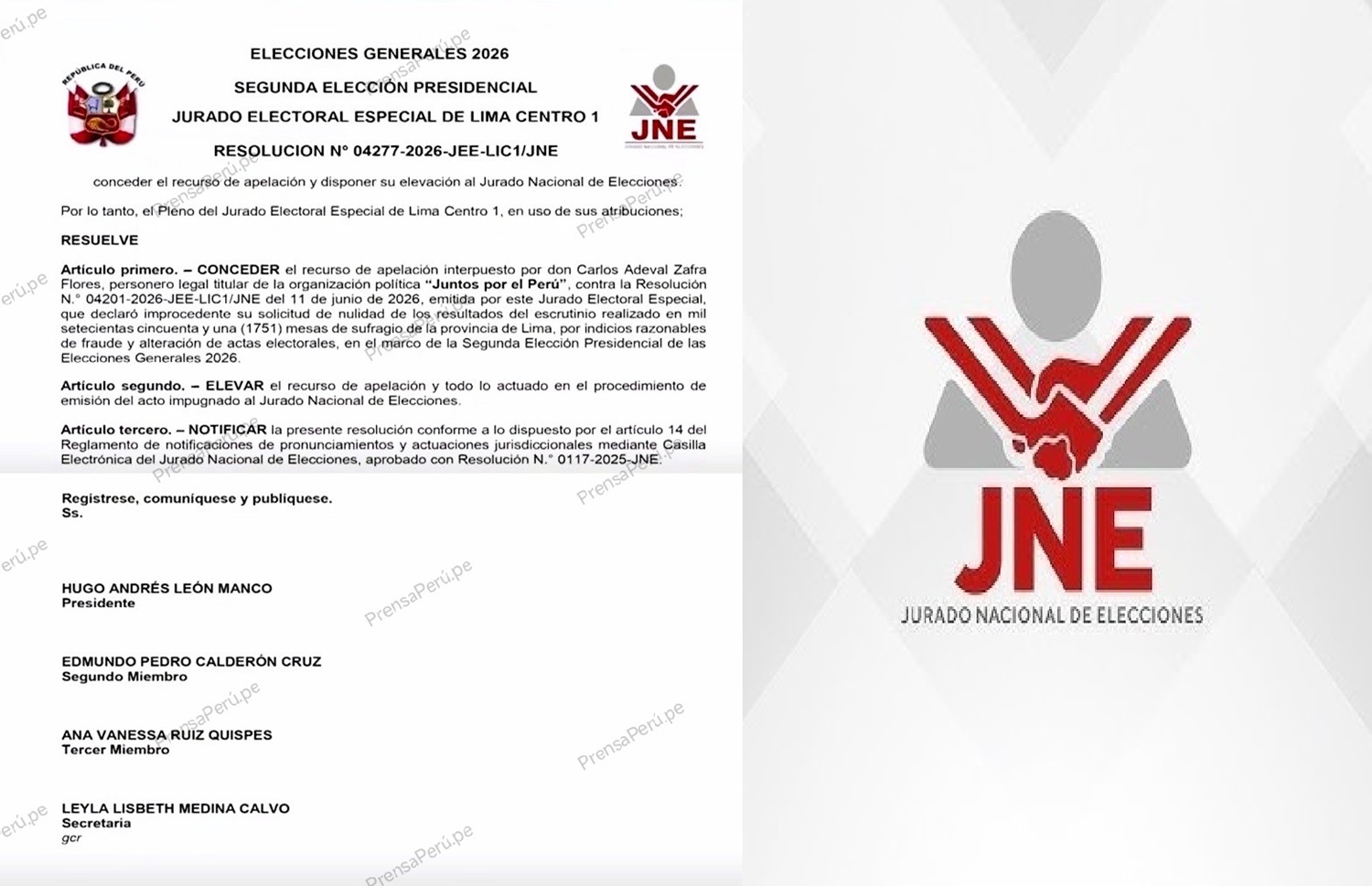
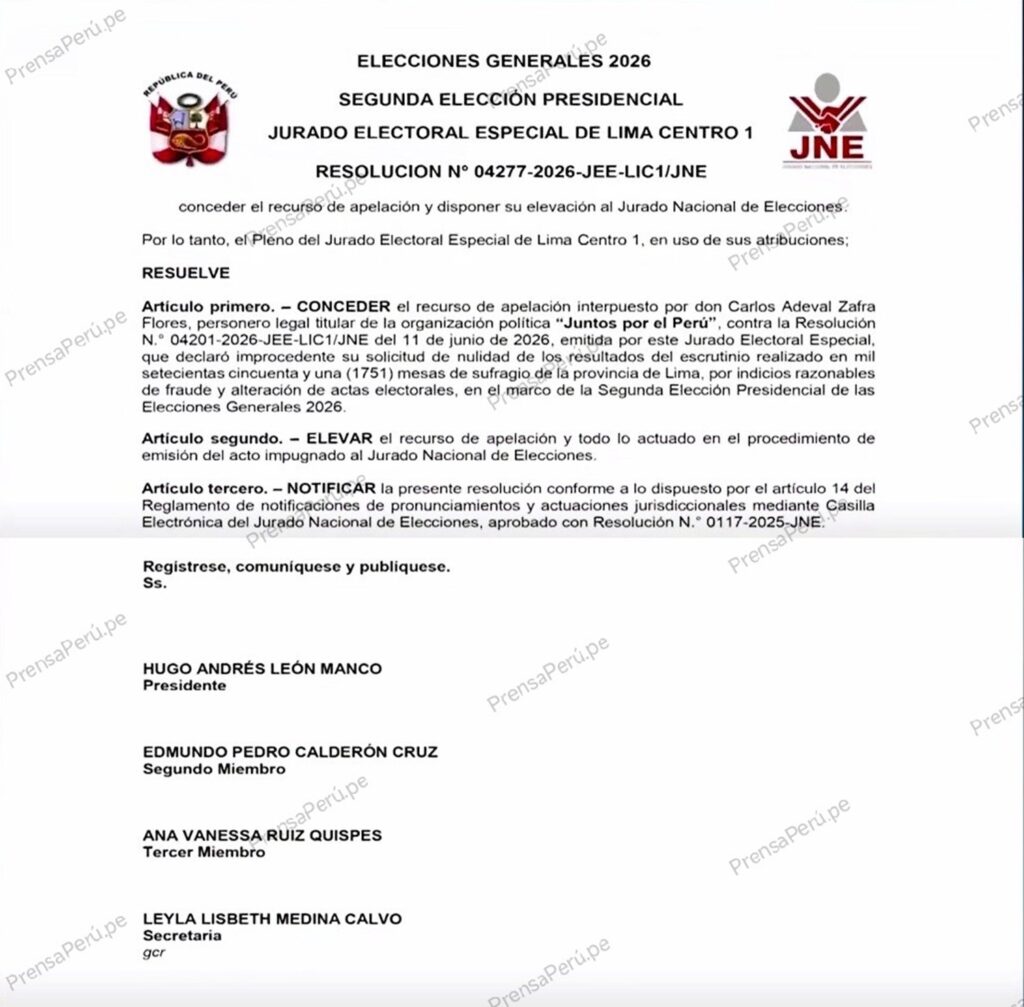
En ese sentido el Jurado Electoral Especial (JEE) de Lima Centro 1 emitió la Resolución N° 04277-2026-JEE-LIC1/JNE, mediante la cual decide conceder el recurso de apelación interpuesto por el personero legal titular de la organización política Juntos por el Perú, Carlos Adeval Zafra Flores. Esta acción se dirige contra la resolución anterior N° 04201-2026-JEE-LIC1/JNE del 11 de junio de 2026, que había declarado improcedente la solicitud de anular los resultados del escrutinio en 1,751 mesas de sufragio de toda la provincia de Lima.
El pedido de la agrupación política se sustenta en la existencia de indicios razonables de fraude y alteración de actas electorales, situaciones que, de confirmarse, podrían afectar la veracidad y validez de los resultados obtenidos en la segunda vuelta presidencial. Al admitir el recurso, el JEE reconoce que la solicitud plantea asuntos que requieren un análisis más profundo y corresponde ser evaluados por la instancia jerárquicamente superior.
En su artículo segundo, la resolución dispone elevar el recurso de apelación y todo lo actuado en el procedimiento al Jurado Nacional de Elecciones. Esto significa que el expediente completo —con todas las pruebas, argumentos y antecedentes presentados por ambas partes— pasa ahora a la revisión de la máxima autoridad electoral, quien tiene la facultad exclusiva de emitir una decisión final e inapelable sobre este caso.
Finalmente, en su artículo tercero, se establece la forma de notificación: se hará efectiva a través de la Casilla Electrónica del JNE, cumpliendo estrictamente con el Reglamento de notificaciones vigente, aprobado mediante Resolución N° 0117-2025-JNE. Este mecanismo garantiza agilidad, seguridad y validez legal en la comunicación de la resolución a todas las partes involucradas.
Este procedimiento forma parte del sistema de garantías del proceso electoral: permite que cualquier duda o denuncia sobre irregularidades sea revisada en instancias sucesivas, asegurando que la voluntad popular expresada en las urnas se respete y que los resultados respondan a la realidad de la votación. La decisión que tome el JNE será determinante para definir la validez de los resultados en las mesas cuestionadas y, en última instancia, para la transparencia del proceso electoral en curso.
DATOS CONTEXTUALES
1.- Derecho a impugnar reconocido: La admisión del recurso confirma que la normativa electoral garantiza a las organizaciones políticas el derecho a cuestionar resultados cuando presentan fundamentos o indicios de posibles irregularidades.
2.- Paso a instancia superior: El caso queda bajo competencia del Jurado Nacional de Elecciones, órgano con la autoridad final para analizar los argumentos y pruebas, y resolver con carácter definitivo.
3.- Revisión de la transparencia: El procedimiento abierto permite verificar si existieron alteraciones en las actas o errores en el conteo, aportando seguridad jurídica a todo el proceso de la segunda vuelta presidencial.
4.- Cumplimiento de procedimientos: La resolución respeta estrictamente las normas de trámite y notificación, asegurando que todas las actuaciones se ajusten a la ley electoral vigente en el país.
Fuente: Agencia Peruana de Noticias PRENSAPERU.PE https://www.prensaperu.pe Twitter: @prensaperupe
Translate
General Elections 2026: JEE admits appeal against decision that rejected the annulment of tally sheets in Lima, due to alleged irregularities in 1,751 polling stations; now the verdict rests with the highest electoral authority.
Peruvian News Agency PRENSAPERU.PE https://www.prensaperu.pe Twitter: @prensaperupe The “Appeal” has been accepted and admitted by the Special Electoral Jury of Lima Center 1 within the framework of the Second Presidential Election of the 2026 General Elections. In this report from our research unit at PrensaPerú, we explain the decision to admit an appeal filed by the political organization Juntos por el Perú, which challenges the validity of results in one thousand seven hundred and fifty‑one polling stations due to alleged irregularities. It also details the subsequent legal procedure, whereby the case is referred to the highest electoral authority in the country for a final ruling.
APPEAL
A legal mechanism that allows any person or entity affected by a decision issued by a lower authority to request that a higher‑level body review, confirm, modify, or revoke such resolution, thereby guaranteeing the right to due process.
ANNULMENT OF THE COUNT
An exceptional measure by which the vote tally recorded at one or more polling stations is declared invalid, when serious errors, fraud, tampering with electoral records, or violations of electoral regulations are proven.
REASONABLE INDICATIONS OF FRAUD
A set of signals, preliminary evidence, or inconsistencies suggesting that the actual outcome of the vote may have been altered; while not yet constituting a final judgment, these elements are sufficient to justify proceeding with the challenge.
NATIONAL JURY OF ELECTIONS (JNE)
An autonomous constitutional body and the highest electoral authority in Peru, responsible for interpreting regulations, resolving disputes at the final instance, and ensuring the legality and transparency of all electoral processes.
Accordingly, the Special Electoral Jury (JEE) of Lima Center 1 issued Resolution No. 04277‑2026‑JEE‑LIC1/JNE, by which it decides to grant the appeal filed by the official legal representative of the political organization Juntos por el Perú, Carlos Adeval Zafra Flores. This action is directed against the earlier Resolution No. 04201‑2026‑JEE‑LIC1/JNE, dated June 11, 2026, which had ruled the request to annul the results of the count in 1,751 polling stations throughout the province of Lima inadmissible.
The political group’s request is based on the existence of reasonable indications of fraud and tampering with electoral records — circumstances that, if confirmed, could affect the accuracy and validity of the results obtained in the presidential runoff. By admitting the appeal, the JEE acknowledges that the claim raises issues requiring deeper analysis and that these must be evaluated by the higher‑level authority.
In its second article, the resolution orders the referral of the appeal and the entire record of proceedings to the National Jury of Elections. This means the complete file — including all evidence, arguments, and background submitted by both parties — is now transferred for review by the highest electoral authority, which holds the exclusive power to issue a final and unappealable decision in this matter.
Finally, in its third article, the method of notification is established: it shall be carried out through the JNE Electronic Case File, in strict compliance with the current Regulations on Notifications, approved by Resolution No. 0117‑2025‑JNE. This system ensures speed, security, and legal validity in communicating the resolution to all parties involved.
This procedure forms part of the safeguards built into the electoral process: it allows any doubt or report of irregularities to be reviewed at successive levels, ensuring that the will of the people expressed at the polls is respected and that results reflect the actual vote count. The decision issued by the JNE will be decisive in determining the validity of results at the contested polling stations and, ultimately, in upholding the transparency of the ongoing electoral process.
CONTEXTUAL DATA
1.- Right to challenge recognized: The admission of the appeal confirms that electoral regulations guarantee political organizations the right to contest results when they present grounds or indications of possible irregularities.
2.- Referral to higher authority: The case falls under the jurisdiction of the National Jury of Elections, the body with final authority to examine arguments and evidence and to issue a definitive ruling.
3.- Review of transparency: The procedure initiated allows verification of whether records were altered or counting errors occurred, thereby reinforcing legal certainty throughout the presidential runoff.
4.- Compliance with formalities: The resolution strictly adheres to procedural and notification rules, ensuring that all actions conform to the electoral laws in force in the country.
Source: Peruvian News Agency PRENSAPERU.PE https://www.prensaperu.pe Twitter: @prensaperupe