
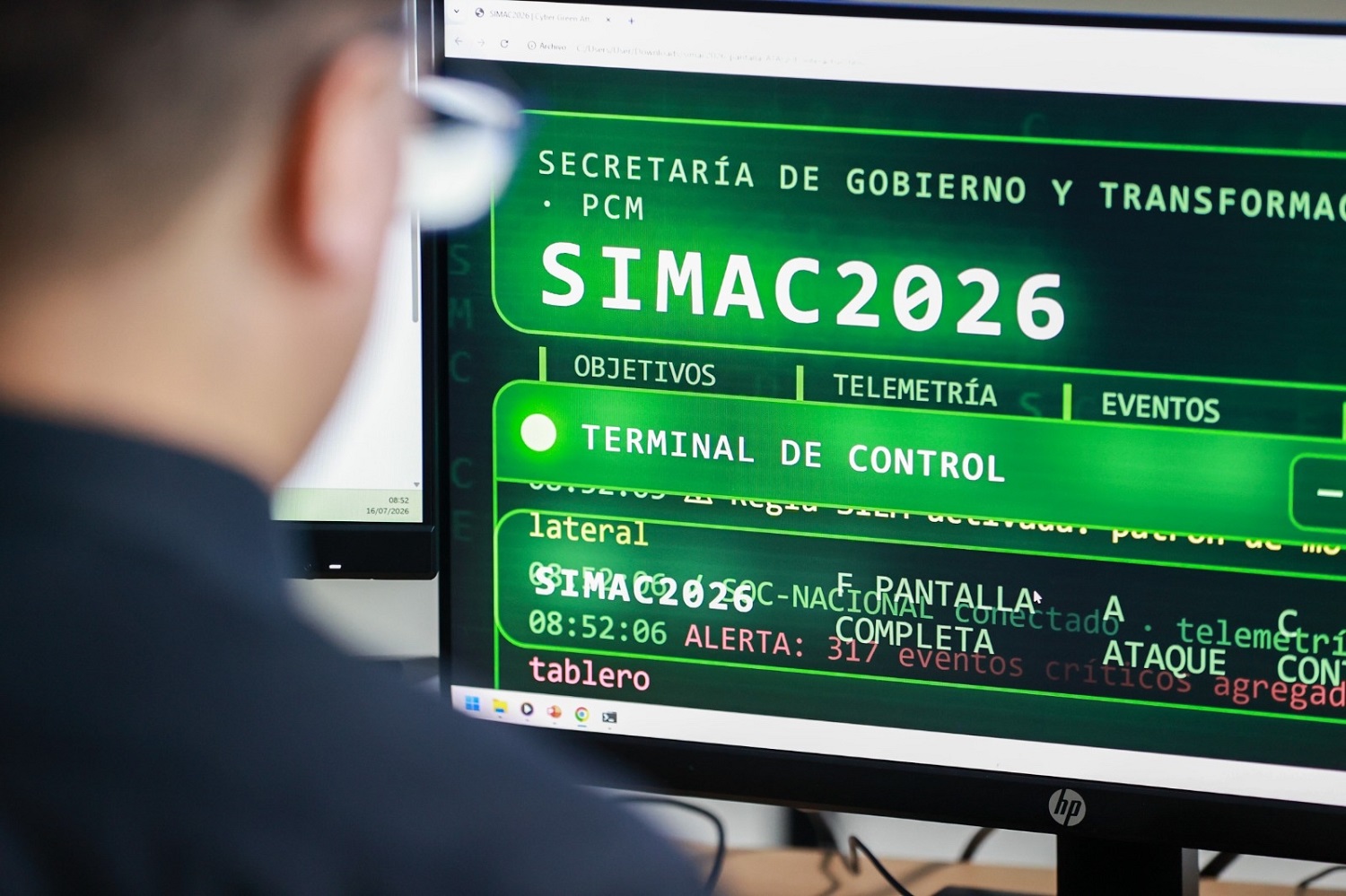
Agencia Peruana de Noticias PRENSAPERU.PE https://www.prensaperu.pe Twitter: @prensaperupe La Presidencia del Consejo de Ministros (PCM), por medio de la Secretaría de Gobierno y Transformación Digital y bajo la dirección técnica del Centro Nacional de Seguridad Digital, llevó a cabo con éxito el Simulacro Nacional de Ataques Cibernéticos SIMAC 2026, el ejercicio más importante del país en materia de preparación ante riesgos digitales. Su objetivo principal es elevar el nivel de respuesta de todas las instituciones públicas y privadas, fortaleciendo las cuatro etapas fundamentales ante cualquier incidente: preparación anticipada, detección temprana, contención y mitigación, y recuperación ágil de los servicios afectados.
Esta edición reunió la participación de 152 entidades de distintos sectores —entre organismos públicos nacionales y regionales, empresas de servicios esenciales, universidades y fuerzas del orden— y sumó 256 profesionales especializados en seguridad informática y gestión de riesgos. Durante cuatro horas continuas, los equipos trabajaron en un entorno totalmente aislado, controlado y seguro, diseñado especialmente para reproducir condiciones reales sin poner en riesgo la infraestructura operativa ni los datos verdaderos de ninguna organización. Allí se pusieron a prueba los procedimientos establecidos, la capacidad técnica de los equipos y la rapidez con la que distintas instituciones pueden coordinarse entre sí ante una emergencia compartida.
“El SIMAC 2026 no es solo un ejercicio técnico: es una herramienta estratégica de Estado. Nos permite entrenar para escenarios que podrían ocurrir en la realidad, corregir fallos antes de que se presenten y asegurar que los servicios digitales que usa la ciudadanía —desde trámites hasta sistemas de salud o finanzas— sigan funcionando incluso ante intentos de interrupción”, destacó el secretario de Gobierno y Transformación Digital de la PCM.
En el desarrollo del ejercicio, todos los equipos participantes integraron el llamado Blue Team (equipo defensivo), encargado de proteger los sistemas y reaccionar ante las agresiones. Se plantearon 12 escenarios de actividades maliciosas distintas, entre ellas intentos de acceso no autorizado, secuestro de información, interrupción de plataformas y suplantación de identidad. Los profesionales debieron identificar el origen y el tipo de amenaza, analizar su alcance, contener el ataque para evitar que se propague, eliminar su efecto y restablecer el funcionamiento normal de los servicios, manteniendo comunicación constante con los organismos de coordinación.
Más allá de la evaluación de capacidades, el simulacro permitió detectar puntos críticos y oportunidades concretas de mejora: desde actualizaciones en protocolos internos hasta la necesidad de optimizar los canales de comunicación entre instituciones. De esta manera, el SIMAC se consolida como una política permanente que eleva la resiliencia digital del país: es decir, la capacidad de resistir, adaptarse y recuperarse rápidamente frente a agresiones al sistema digital nacional. Todo esto redunda directamente en la protección de los servicios que utilizan millones de peruanos, así como la estabilidad de actividades productivas y administrativas.
El Centro Nacional de Seguridad Digital fue el responsable total del diseño, la puesta en marcha y la dirección del ejercicio. Durante todo el desarrollo, brindó orientación metodológica, asistencia técnica inmediata a los participantes, monitoreó cada paso y recopiló toda la información generada. Con estos datos se elaborará un informe final con recomendaciones específicas para cada entidad y lineamientos nacionales, que servirán para actualizar planes de contingencia y fortalecer el sistema de seguridad digital del Perú.
Con esta iniciativa, la Presidencia del Consejo de Ministros reafirma su compromiso de construir un entorno digital confiable. El objetivo es consolidar una cultura de prevención, colaboración interinstitucional y mejora continua, que permita enfrentar con mayor eficacia las amenazas cibernéticas que evolucionan constantemente en el mundo actual.
DATOS CONCEPTUALES
Centro Nacional de Seguridad Digital: Organismo rector encargado de definir normas, coordinar acciones y brindar apoyo técnico para proteger la infraestructura digital del Estado peruano y los servicios esenciales.
SIMAC: Ejercicio nacional periódico que simula ataques cibernéticos en un entorno seguro, para entrenar equipos y evaluar la respuesta del país sin afectar el funcionamiento real de los sistemas.
Blue Team: Equipo defensivo que tiene como misión identificar, bloquear y neutralizar amenazas, así como restaurar los servicios afectados durante un incidente o simulacro.
Resiliencia digital: Capacidad de las instituciones y del sistema nacional para resistir un ataque cibernético, mantener sus funciones esenciales y recuperarse completamente en el menor tiempo posible.
Entorno controlado: Espacio digital aislado, creado exclusivamente para simulacros, que reproduce las características de los sistemas reales sin conectarse a redes operativas ni comprometer información sensible.
CONCLUSIONES
1.- El SIMAC 2026 demuestra que la seguridad digital no es una tarea aislada, sino que requiere la participación coordinada de instituciones públicas, privadas y académicas para proteger los servicios que el país necesita.
2.- El ejercicio permitió confirmar avances importantes en la capacidad técnica de detección y respuesta, además de identificar oportunidades concretas para optimizar protocolos y tiempos de actuación.
3.- La preparación mediante simulacros realistas es la estrategia más efectiva para reducir riesgos y garantizar que los servicios digitales esenciales sigan disponibles para la ciudadanía ante cualquier amenaza.
4.- Esta iniciativa consolida al Perú en la ruta de fortalecer su resiliencia digital, convirtiéndose en una práctica permanente que se adapta a la evolución constante de las amenazas cibernéticas mundiales.
Fuente: Agencia Peruana de Noticias PRENSAPERU.PE https://www.prensaperu.pe Twitter: @prensaperupe

Translate
PCM: Successful SIMAC 2026! “The Major National Drill Strengthening Peru’s Digital Defense” — How the National Digital System Was Protected: Blue Team in Action Against 12 Simulated Threats.
Peruvian News Agency PRENSAPERU.PE https://www.prensaperu.pe Twitter: @prensaperupe The Presidency of the Council of Ministers PCM through the Secretariat of Government and Digital Transformation and under the technical leadership of the National Center for Digital Security successfully held the National Cyber Attack Drill SIMAC 2026 the countrys most important exercise in preparation for digital risks. Its main objective is to raise the response level of all public and private institutions by strengthening the four fundamental stages for any incident proactive preparation early detection containment and mitigation and swift recovery of affected services.
This edition brought together 152 entities from different sectors including national and regional public bodies essential service companies universities and law enforcement agencies and counted 256 specialized professionals in computer security and risk management. For four consecutive hours teams worked in a fully isolated controlled and secure environment specially designed to replicate real conditions without endangering the operational infrastructure or actual data of any organization. Established procedures technical capacity of teams and the speed at which different institutions can coordinate with each other in the face of a shared emergency were put to the test there.
SIMAC 2026 is not just a technical exercise it is a strategic State tool. It allows us to train for scenarios that could occur in reality correct flaws before they arise and ensure that digital services used by citizens from administrative procedures to health or financial systems continue to operate even in the face of disruption attempts said the Secretary of Government and Digital Transformation of the PCM.
During the exercise all participating teams joined the so called Blue Team defensive team which is tasked with protecting systems and reacting to attacks. Twelve different malicious activity scenarios were presented including unauthorized access attempts data hijacking platform disruption and identity spoofing. Professionals had to identify the origin and type of threat analyze its scope contain the attack to prevent it from spreading eliminate its impact and restore normal service operation while maintaining constant communication with coordinating bodies.
Beyond assessing capabilities the drill allowed to identify critical points and specific areas for improvement ranging from updates to internal protocols to the need to optimize communication channels between institutions. In this way SIMAC is consolidated as a permanent policy that enhances the countrys digital resilience that is the ability to withstand adapt and recover quickly from aggressions against the national digital system. All this directly contributes to protecting the services used by millions of Peruvians as well as the stability of productive and administrative activities.
The National Center for Digital Security held full responsibility for the design launch and leadership of the exercise. Throughout the process it provided methodological guidance immediate technical assistance to participants monitored every step and compiled all generated information. This data will be used to prepare a final report with specific recommendations for each entity and national guidelines which will serve to update contingency plans and strengthen Perus digital security system.
Through this initiative the Presidency of the Council of Ministers reaffirms its commitment to building a reliable digital environment. The goal is to consolidate a culture of prevention interinstitutional collaboration and continuous improvement that allows addressing constantly evolving global cyber threats more effectively.
CONCEPTUAL DEFINITIONS
National Center for Digital Security: Governing body responsible for setting standards coordinating actions and providing technical support to protect the digital infrastructure of the Peruvian State and essential services.
SIMAC: Periodic national exercise that simulates cyber attacks in a secure environment to train teams and assess the countrys response without affecting the actual operation of systems.
Blue Team: Defensive team whose mission is to identify block and neutralize threats as well as restore affected services during an incident or drill.
Digital resilience: The ability of institutions and the national system to withstand a cyber attack maintain essential functions and fully recover in the shortest possible time.
Controlled environment: Isolated digital space created exclusively for drills that replicates the characteristics of real systems without connecting to operational networks or compromising sensitive information.
CONCLUSIONS
1.- SIMAC 2026 demonstrates that digital security is not an isolated task but requires coordinated participation of public private and academic institutions to protect the services the country relies on.
2.- The exercise confirmed significant progress in technical detection and response capacity in addition to identifying specific opportunities to optimize protocols and response times.
3.- Preparation through realistic drills is the most effective strategy to reduce risks and ensure that essential digital services remain available to citizens in the face of any threat.
4.- This initiative consolidates Peru on the path to strengthening its digital resilience becoming a permanent practice that adapts to the constant evolution of global cyber threats.
Source: Peruvian News Agency PRENSAPERU.PE https://www.prensaperu.pe Twitter: @prensaperupe