
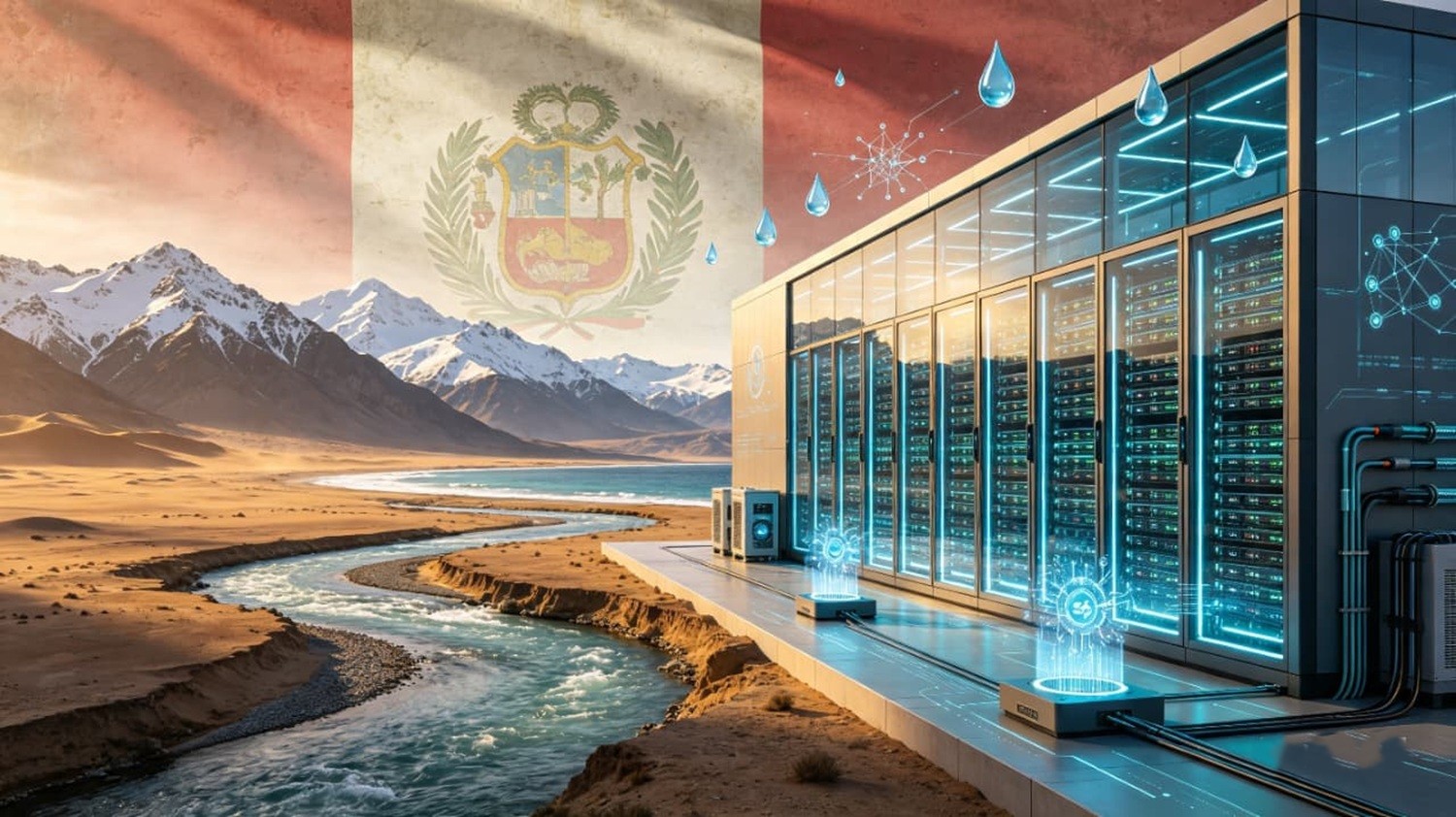
Agencia Peruana de Noticias PRENSAPERU.PE https://www.prensaperu.pe Twitter: @prensaperupe La expansión de la inteligencia artificial y sus infraestructuras base —los centros de datos— se presenta como un gran salto hacia el futuro, pero su desarrollo no es neutro, ni automático, ni garantiza por sí solo el bienestar colectivo. Este informe analiza con rigor: qué tipo de agua realmente requieren estas instalaciones, si el Perú puede aprovechar recursos hídricos que hoy desperdicia, y sobre todo, plantea la pregunta fundamental: ¿de qué sirve invertir millones en tecnología de punta si el país sigue sin resolver problemas básicos de salud, equidad y acceso? No se trata de rechazar el progreso, sino de exigir que este sea útil, justo, sostenible y esté al servicio de las personas, y no al revés.
I.- INVESTIGACIÓN Y ANÁLISIS PROFUNDO
A.- ¿Qué agua se necesita realmente? Y ¿Qué tiene el Perú para ofrecer?
El primer mito que hay que derribar es este: los centros de datos NO consumen agua potable. Exigirles agua apta para el consumo humano sería un error de planificación y una injusticia social. Lo que requieren es agua tratada industrialmente, con baja dureza y limpia de sedimentos, pero no potable.
Esto cambia todo el panorama para el Perú:
1.- El país cuenta con ríos que bajan de la sierra hacia la costa desértica y se pierden en el océano: agua que nadie usa, que no llega a ciudades ni campos, y que por su composición tampoco podría ser destinada a consumo humano sin obras costosísimas. Esa agua sí puede captarse, tratarse con procesos sencillos y usarse en refrigeración.
2.- También disponemos de aguas residuales tratadas —que hoy se vierten al mar—, agua de mar misma, o agua de lluvia recolectada en zonas altas. Ninguna de estas fuentes compite con el agua para beber, ni con la agricultura, ni con el abastecimiento de pueblos.
3.- El problema real no es la falta de agua, sino la falta de infraestructura para desviar esos flujos y la falta de normas obligatorias que digan claramente: “en el Perú, para centros de datos está prohibido usar agua potable; solo se admite agua de ríos no aprovechados, reciclada o salina”.
Lo que ocurre hoy es que no hay regulación alguna: si una empresa quiere, puede conectarse a la red de agua potable, usar millones de litros para enfriar servidores y dejar a una comunidad sin suministro. Eso es lo que hay que impedir desde el principio.
B.- LA PREGUNTA FUNDAMENTAL: ¿DE QUÉ SIRVE LA TECNOLOGÍA SI NO RESOLVEMOS LO BÁSICO?
Aquí está el punto central que casi nadie dice: no hay sentido lógico ni social en construir grandes centros de datos y promover la inteligencia artificial si el país no ha resuelto primero sus necesidades fundamentales. El progreso no se mide por servidores de última generación, sino por la vida de su gente. Veamos la realidad peruana:
El caso de la salud: el ejemplo más claro del desorden de prioridades
Los pacientes madrugan desde las 3 o 4 de la mañana para conseguir una ficha de atención en hospitales, esperan horas y días, y muchas veces no logran ver al especialista.
El sistema de citas es precario, desorganizado, lento. La información clínica se pierde o se repite.
Los medicamentos básicos faltan en establecimientos públicos. Las personas se ven obligadas a comprar en farmacias privadas, donde los precios son altísimos y arbitrarios.
Existe un problema estructural: medicamentos que se fabrican en el extranjero y cuestan mucho menos, no pueden ingresar al Perú, porque las normas de homologación son rígidas, lentas y costosas. Se impone barreras que protegen a grupos económicos, monopolios y oligopolios locales, en lugar de proteger al paciente.
En el aeropuerto, a personas que traen medicinas para su propio tratamiento o para sus familias, se les decomisa porque no tienen registro local, aunque sean productos seguros y probados en otros países.
¿Qué tiene que ver esto con la IA y los centros de datos?
Tiene todo que ver. Si inviertes cientos de millones en infraestructura digital, pero tu sistema de salud sigue sin poder dar una cita a tiempo, sin poder abastecer medicinas, sin permitir que la gente acceda a fármacos más baratos, estás construyendo una torre de lujo sobre un suelo agrietado.
La inteligencia artificial podría ayudar a organizar colas, gestionar inventarios, predecir brotes, diagnosticar mejor y más rápido. Pero no lo hará sola. Si no hay voluntad política, si no hay reforma del sistema, si los intereses privados siguen por encima del interés público, la tecnología se convierte en adorno, o peor: en herramienta para hacer más eficiente la injusticia.
La lógica de las prioridades: primero lo que sostiene la vida
Hay una regla sencilla: la tecnología es una herramienta, no un fin. En el Perú, las brechas son enormes:
1.- Millones de personas sin acceso a agua segura, desagüe ni electricidad estable.
2.- Agricultores que pierden cosechas por falta de información o apoyo.
3.- Educación que no llega igual a todos los territorios.
4.- Sistemas de salud que no cubren las necesidades básicas.
Si destinamos recursos, tierra, agua y energía a proyectos de alta tecnología sin haber cerrado estas brechas, estamos invirtiendo al revés. Estamos diciendo: “Tenemos dinero para enfriar servidores, pero no para que un niño tenga agua potable; tenemos capacidad para procesar datos del mundo, pero no para dar medicinas baratas a los enfermos”. Eso no es desarrollo, es desorden, desigualdad y mala administración.
C.- ¿Entonces: rechazar o dirigir? ¿Qué beneficios reales podría tener el Perú?
No se trata de decir “no a la tecnología”. Se trata de decir: “sí, pero con condiciones claras, orden de prioridades y beneficio nacional real”.
Si se hace bien, con normas estrictas, la IA y los centros de datos sí pueden ayudar al Perú, pero solo si se diseñan para resolver lo que nos duele:
1.- En salud: sistemas de gestión que eliminen colas, que permitan ver historiales clínicos en cualquier lugar, que ayuden a detectar enfermedades tempranas, que permitan comparar precios y calidad de medicamentos, y que apoyen a la autoridad para eliminar barreras injustificadas y bajar costos.
2.- En recursos hídricos: modelos predictivos que adviertan sequías o lluvias extremas, que gestionen mejor el agua que hoy se desperdicia, que ayuden a distribuirla con justicia.
3.- En agricultura: alertas sobre plagas, clima, rendimiento, para que el productor decida mejor.
4.- En educación: acceso a conocimiento e investigación donde no llegan escuelas ni maestros, ni universidades.
5.- En economía: generación de empleo especializado, exportación de servicios digitales, atracción de inversión que pague impuestos justos y no se lleve todo el beneficio afuera.
El riesgo es otro: que permitamos que estas instalaciones se instalen solo porque “están de moda”, sin exigir que usen agua que nadie necesita, sin exigir que paguen por el recurso, sin exigir que desarrollen tecnología local, sin exigir que resuelvan problemas locales. Entonces sí: será un negocio para unos pocos, y el país habrá entregado agua, tierra y energía a cambio de nada.
D.- ¿Cómo lo han vivido otros países?
1.- En Estados Unidos, en zonas secas como Arizona o Texas, grandes empresas tecnológicas compraron derechos de agua, dejando a comunidades y agricultores sin el recurso. Porque no había normas que prohibieran usar agua potable para enfriar servidores.
2.- En Chile, se detuvieron proyectos porque se descubrió que iban a usar acuíferos que ya estaban sobreexplotados.
3.- En Singapur, país sin agua propia, obligan a usar solamente agua reciclada o de mar. No permiten tocar ni una gota de agua potable. Ese es el modelo que el Perú debería copiar.
4. Noruega, solo se autorizan centros de datos en zonas donde hay energía renovable y agua fría abundante, y donde el agua usada se devuelve limpia al río.
La lección es única: cuando se planifica mal, se pierde. Cuando se ponen reglas claras, se puede crecer sin destruir ni perjudicar.
II.- DATOS CONCEPTUALES
Centro de Datos de Alto Rendimiento para IA: Instalación que concentra miles de procesadores potentes que funcionan sin detenerse. Generan gran cantidad de calor, y su operación depende totalmente de sistemas de refrigeración. No son simples almacenes de información: son fábricas de cálculo que consumen energía y agua de forma intensiva.
Calidad del agua para refrigeración: No se requiere agua potable ni apta para consumo humano. Esta es la confusión más extendida y peligrosa. Lo que necesitan es agua con bajos niveles de minerales, sólidos y sustancias que incrusten o dañen equipos. Puede ser agua de río, agua residual tratada, agua de mar, agua de lluvia o reciclada —toda agua que no sirve para beber ni para regar cultivos sensibles, sí sirve aquí—. Lo que importa es el tratamiento físico-químico, no que sea agua potable.
Agua vertida sin aprovechamiento: En el Perú, cerca del 97% del agua dulce que circula por ríos y cuencas desemboca directamente al mar, sin uso agrícola, industrial ni doméstico. Gran parte de este volumen es agua de calidad media o baja, que no cumple normas para consumo humano ni riego, pero que podría ser utilizada para usos industriales —incluida la refrigeración— si se construye la infraestructura de captación y tratamiento adecuada.
Eficiencia en el uso del recurso: Medida de cuánto trabajo útil se obtiene por cada litro de agua empleada. Un buen estándar mundial es consumir menos de 0,7 litros por cada kilovatio-hora. El objetivo es usar agua que no compita con nadie más, y devolverla al ciclo natural sin contaminar.
Desarrollo tecnológico al servicio del bienestar: Principio que establece que ninguna infraestructura debe considerarse un fin en sí mismo. Su valor se mide únicamente por su capacidad para resolver problemas concretos, mejorar la calidad de vida, reducir brechas y fortalecer la soberanía nacional. Si no cumple esto, es solo gasto y riesgo.
III.- DATOS CONTEXTUALES
1.- Los centros de datos NO necesitan agua potable. Esta es la verdad más importante que hay que difundir. Se pueden usar aguas de ríos sin aprovechamiento, recicladas, residuales tratadas o de mar. El Perú tiene cantidades enormes de agua que hoy se pierden en el mar sin uso: ahí está el recurso, no en los grifos de las ciudades ni en los canales de riego. El problema no es la falta de agua, sino la falta de infraestructura y normas para usar la adecuada.
2.- Sin reforma estructural, la tecnología no sirve de nada. Si el sistema de salud sigue fallando, si los medicamentos siguen siendo caros o prohibidos, si las barreras de entrada protegen monopolios en lugar de proteger a la gente, tener inteligencia artificial es como tener un auto de lujo en una carretera llena de huecos: se ve bonito, pero no avanza. La tecnología no arregla por sí sola las injusticias, las ineficiencias ni la corrupción.
3.- Las prioridades deben ir de abajo hacia arriba, no al revés. No se puede hablar de transformación digital nacional si todavía millones de personas no tienen servicios básicos garantizados. El desarrollo no se mide por capacidad de procesamiento, sino por calidad de vida. Si invertimos en servidores antes que en salud, educación, agua y justicia, estamos poniendo el carro delante de los bueyes.
4.- El riesgo mayor no es técnico, sino político y social. El peligro no es que se instalen centros de datos, sino que se instalen sin reglas: que usen agua que le corresponde a la gente, que no paguen impuestos justos, que no generen conocimiento local, y que no resuelvan ningún problema nacional. Si pasa eso, el país habrá entregado sus recursos naturales para beneficio de empresas extranjeras o grupos poderosos, sin obtener nada a cambio.
5.- Sí es posible avanzar, pero bajo condiciones estrictas. El Perú puede ser un hub regional de datos, pero solo si exige: uso exclusivo de agua no potable ni destinada a otros usos, ubicación donde no haya competencia por el recurso, uso de energía limpia, aportes al desarrollo científico local, y que la tecnología se aplique primero a solucionar los problemas más graves del país: salud, gestión del agua, agricultura y equidad.
Fuente: Agencia Peruana de Noticias PRENSAPERU.PE https://www.prensaperu.pe Twitter: @prensaperupe

Translate
“AI and Data Centers! ‘They do not need drinking water — they need water for cooling.’ The Truth About Data Centers: Peru wastes entire rivers that flow into the sea. Could this water be the key to growth without harming anyone?”
Peruvian News Agency PRENSAPERU.PE https://www.prensaperu.pe Twitter: @prensaperupe The expansion of artificial intelligence and its underlying infrastructure — data centers — is often presented as a major leap toward the future. Yet its development is neither neutral nor automatic, and it does not guarantee collective well-being on its own. This report conducts a rigorous analysis: what type of water these facilities actually require, whether Peru can make use of water resources currently being wasted, and above all, it poses the fundamental question: what is the point of investing millions in cutting-edge technology when the country still fails to resolve basic issues regarding health, equity, and access? This is not about rejecting progress, but about demanding that progress be useful, fair, sustainable, and designed to serve people — rather than the other way around.
I.- IN-DEPTH RESEARCH AND ANALYSIS
A.- What kind of water is actually needed? And what does Peru have to offer?
The first myth that must be debunked is this: data centers do NOT consume drinking water. Requiring them to use water fit for human consumption would be a planning error and a social injustice. What they need is industrially treated water — low in mineral content and free of sediment — but not potable water.
This changes the entire outlook for Peru:
1. The country has rivers that flow down from the highlands toward the arid coast and empty directly into the ocean. This is water that no one uses, that never reaches cities or farmland, and that, due to its natural composition, could not be made safe for human consumption without extremely costly infrastructure. This water, however, can be captured, treated through simple processes, and used for cooling purposes.
2. We also have access to treated wastewater — currently discharged into the sea — seawater itself, or rainwater collected in high-altitude areas. None of these sources compete with drinking water supplies, agricultural needs, or community water services.
3. The real problem is not a lack of water, but a lack of infrastructure to divert these flows, and the absence of binding regulations that clearly state: “In Peru, the use of drinking water for data centers is prohibited; only water from untapped river basins, recycled water, or seawater is permitted.”
Currently, there is no regulation whatsoever: if a company wishes, it can connect to the public drinking water network, use millions of liters to cool servers, and leave local communities without supply. This is exactly what must be prevented from the very beginning.
B.- THE FUNDAMENTAL QUESTION: WHAT IS THE POINT OF TECHNOLOGY IF WE DO NOT SOLVE BASIC NEEDS FIRST?
Here lies the core truth that almost no one speaks about: there is no logical or social sense in building large-scale data centers and promoting artificial intelligence if the country has not first addressed its most fundamental needs. Progress is not measured by state-of-the-art servers, but by the quality of life of its people. Consider the reality in Peru:
Healthcare: the clearest example of misplaced priorities
Patients arrive as early as 3:00 or 4:00 a.m. just to secure an appointment slip at public hospitals. They wait for hours or even days, and often never get to see a specialist.
Appointment systems are precarious, disorganized, and slow. Medical records are frequently lost, duplicated, or inaccessible.
Essential medicines are in short supply at public health facilities. People are forced to buy them at private pharmacies, where prices are exorbitant and arbitrarily set.
There is a structural problem: medicines manufactured abroad and sold at much lower cost cannot be brought into Peru, because approval processes are rigid, slow, and expensive. Barriers are put in place to protect local economic groups, monopolies, and oligopolies — rather than protecting patients.
At airports, medicines brought in by individuals for their own treatment or for their families are often confiscated because they lack local registration — even though they are safe, proven products accepted in other countries.
What does this have to do with AI and data centers?
Everything. If you invest hundreds of millions in digital infrastructure, yet your healthcare system still cannot schedule appointments on time, cannot guarantee access to essential medicines, and prevents people from obtaining more affordable treatments — you are building a luxury tower on cracked ground.
Artificial intelligence could help organize queues, manage inventories, predict disease outbreaks, and improve speed and accuracy in diagnosis. But it will not do so on its own. Without political will, without systemic reform, and when private interests continue to be placed above the public good, technology becomes nothing more than a decorative feature — or worse, a tool that makes injustice operate more efficiently.
The logic of priorities: first, what sustains life
There is a simple principle: technology is a tool, not an end in itself. In Peru, development gaps remain enormous:
1.- Millions of people still lack access to safe drinking water, sanitation, or reliable electricity.
2.- Farmers lose entire harvests due to lack of information or support.
3.- Education services are not available equally across all regions and territories.
4.- Healthcare systems fail to meet basic needs.
When we allocate resources, land, water, and energy to high-tech projects before closing these fundamental gaps, we are investing in the wrong order. We are essentially saying: “We have money to cool servers, but not enough to ensure every child has safe drinking water; we have the capacity to process data from around the world, but not the ability to provide affordable medicines to the sick.” That is not development — that is disorder, inequality, and poor governance.
C.- So: reject or direct? What real benefits could Peru gain?
This is not about saying “no to technology.” It is about saying: “Yes — but only under clear conditions, proper order of priorities, and in ways that deliver real national benefit.”
If implemented correctly, under strict regulations, AI and data centers can indeed help Peru — but only if they are designed to solve our most pressing problems:
1.- In healthcare: management systems that eliminate waiting lists, allow access to medical records anywhere, support early disease detection, enable price and quality comparisons for medicines, and help authorities remove unjustified barriers and lower costs.
2.- In water resources: predictive models that warn of droughts or extreme rainfall events, better management of water currently wasted, and fairer distribution systems.
3.- In agriculture: timely alerts regarding pests, weather conditions, and crop performance, so producers can make better decisions.
4.- In education: access to knowledge and research in places beyond the reach of schools, teachers, and universities.
5.- In the economy: creation of skilled jobs, export of digital services, and attraction of investment that pays fair taxes and does not simply extract value and take it abroad.
The real risk is different: that we allow these facilities to be built simply because “it is the trend,” without requiring that they use water nobody else needs, that they pay a fair price for resources, that they develop local technology capacity, or that they solve domestic problems. If that happens, it will be a profitable business for a few — while the country gives away its water, land, and energy, and gets nothing in return.
D.- How have other countries experienced this?
1.- United States: In arid regions such as Arizona and Texas, large technology companies purchased water rights, leaving local communities and farmers without access to resources. This happened simply because there were no laws prohibiting the use of drinking water to cool servers.
2.- Chile: Several projects were halted when it was discovered they intended to draw water from aquifers that were already overexploited.
3.- Singapore: A country with almost no natural water resources, it enforces a strict rule: only recycled wastewater or seawater may be used. Not a single drop of drinking water is allowed for these purposes. This is the model Peru should adopt.
4.- Norway: Data centers are only authorized in locations with abundant renewable energy and naturally cold water, and where water used in operations is returned to the river clean and unpolluted.
The lesson is always the same: when planning is poor, everyone loses. When clear rules are established, growth is possible without destruction or harm.
II.- CONCEPTUAL DEFINITIONS
High-Performance Data Center for AI: A facility housing thousands of powerful processors operating continuously. They generate massive amounts of heat, and their operation depends entirely on cooling systems. They are not simply storage facilities — they are computing factories that consume high volumes of energy and water.
Water Quality Requirements for Cooling: Drinking water or water fit for human consumption is not required. This is the most widespread and dangerous misconception. What is needed is water with low mineral content, low sediment levels, and free of substances that could cause corrosion or deposits in equipment. It can be river water, treated wastewater, seawater, rainwater, or recycled water — any water that is not safe to drink or suitable for irrigating sensitive crops is perfectly usable here. What matters is chemical and physical treatment, not potability.
Unutilized Water Discharge: In Peru, approximately 97% of all freshwater flowing through rivers and basins flows directly into the ocean without being used for agriculture, industry, or domestic supply. Much of this volume is of medium or low quality — not meeting standards for drinking water or irrigation — yet it could be used for industrial purposes, including cooling, if proper capture and treatment infrastructure were built.
Resource Use Efficiency: A measure of how much useful output is obtained per liter of water consumed. A widely accepted global standard is to consume less than 0.7 liters of water per kilowatt-hour of energy used. The objective is to use water that does not compete with other essential needs, and to return it to the natural cycle without pollution.
Technological Development in Service of Well-being: The principle that no infrastructure should be considered an end in itself. Its value is measured exclusively by its ability to solve concrete problems, improve quality of life, reduce inequalities, and strengthen national sovereignty. If it fails to do so, it represents only cost and risk.
III.- CONTEXTUAL FINDINGS
1.- Data centers do NOT need drinking water. This is the most important truth to communicate. Water can be sourced from untapped rivers, recycled systems, treated wastewater, or the sea. Peru has vast quantities of water that currently flow unused into the ocean — that is where the resource lies, not in household taps or irrigation canals. The problem is not scarcity, but the lack of infrastructure and regulations to use the right kind of water.
2.- Without structural reform, technology is useless. If the healthcare system remains broken, if medicines remain expensive or restricted, if barriers to entry protect monopolies instead of people, then having artificial intelligence is like owning a luxury car on a road full of potholes: it looks impressive, but it does not move forward. Technology alone cannot fix injustice, inefficiency, or corruption.
3. – must be built from the bottom up, not the top down. You cannot talk about national digital transformation while millions still lack basic services. Development is not measured by processing power — it is measured by quality of life. When we invest in servers before investing in health, education, water, and justice, we are putting the cart before the horse.
4.- The greatest risk is not technical — it is political and social. The danger is not that data centers will be built, but that they will be built without rules: using water meant for people, paying no fair taxes, generating no local knowledge, and solving no national problems. If this happens, the country will have given away its natural resources for the benefit of foreign companies or powerful groups, in exchange for nothing.
5.- Progress is possible — but only under strict conditions. Peru can become a regional data hub, but only if it demands: exclusive use of non-potable water or water not allocated to other essential uses; location only in areas where there is no competition for resources; reliance on clean energy; contributions to local scientific development; and the application of technology first and foremost to solve the country’s most serious problems: health, water management, agriculture, and equity.
Source: Peruvian News Agency PRENSAPERU.PE https://www.prensaperu.pe Twitter: @prensaperupe