
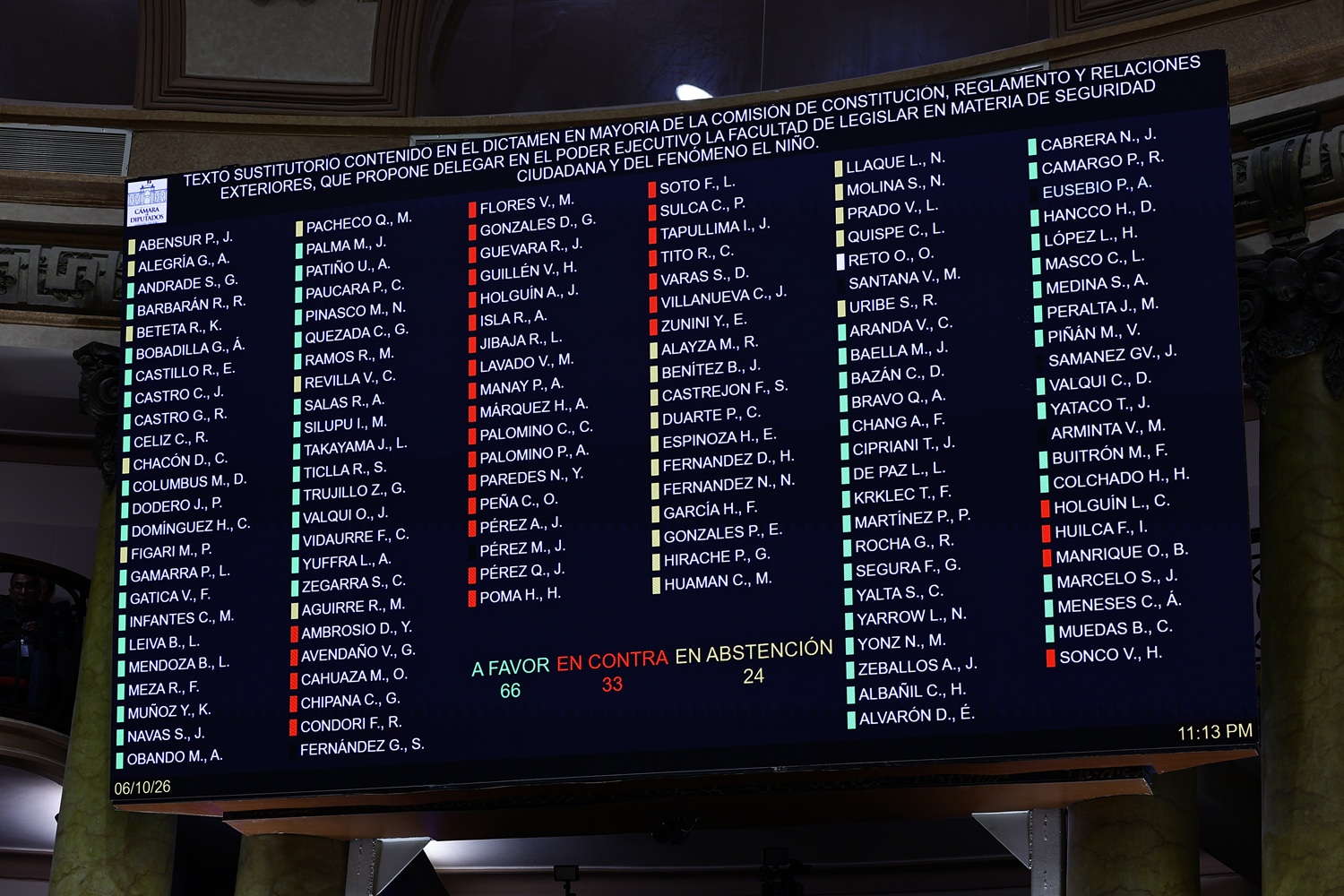
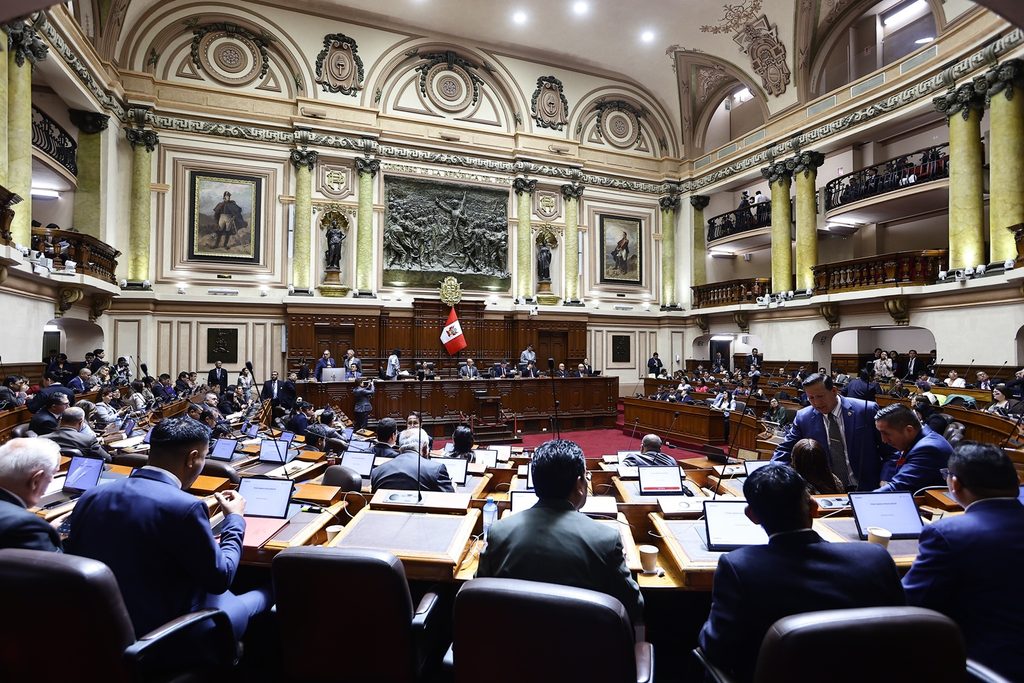
Agencia Peruana de Noticias PRENSAPERU.PE https://www.prensaperu.pe Twitter: @prensaperupe El Pleno de la Cámara de Diputados aprobó por mayoría la Proposición Legislativa 00098-2026-2031-CD mediante la cual se delega al Poder Ejecutivo la facultad de legislar en dos áreas de trascendencia nacional. Estas son seguridad ciudadana y atención integral al fenómeno El Niño. El plazo otorgado es de noventa días calendario contados a partir de la vigencia de la norma. La votación registró sesenta y seis votos a favor, treinta y cuatro en contra y veinticuatro abstenciones. El proceso no fue lineal ni exento de contradicciones. La propuesta fue inicialmente rechazada. Posteriormente se desaprobaron dos dictámenes en minoría presentados por las bancadas de Fuerza Popular y Juntos por el Perú. La aprobación final se produjo tras la reconsideración planteada por la diputada Roxana Rocha Gallegos del partido Renovación Popular. Esta reconsideración obtuvo setenta y cinco votos a favor, treinta y tres en contra y dieciséis abstenciones. El presidente de la Cámara de Diputados Oscar Reto Otero dispuso el envío de lo aprobado al Senado conforme a lo establecido en el literal h del artículo ciento dieciséis y el artículo ciento cuarenta y ocho del Reglamento de la Cámara de Diputados para continuar el trámite legislativo.
De otro lado, la exposición de motivos sustenta la delegación de facultades en la necesidad de dotar al Poder Ejecutivo de herramientas normativas ágiles para enfrentar dos crisis que afectan de manera directa la vida de la población. La primera crisis corresponde al deterioro de la seguridad ciudadana con manifestaciones que van desde la extorsión y el sicariato hasta el crimen organizado y la ciberdelincuencia. La segunda crisis está vinculada a la llegada del fenómeno El Niño que según pronósticos oficiales tendrá impactos en la agricultura la infraestructura y la seguridad de las familias en amplias zonas del país. La fórmula sustitutoria aprobada con veinte temas a delegar fue expuesta por la presidenta de la Comisión de Constitución Giannina Avendaño Vilca de Juntos por el Perú. La iniciativa se ajusta al artículo ciento cuatro de la Constitución Política preservando la separación de poderes y estableciendo mecanismos de control.
Así mismo, en materia de seguridad ciudadana los veinte ítems comprenden medidas de control migratorio para ordenar el ingreso y permanencia de personas en el territorio nacional. Se contempla también la identificación y bloqueo de comunicaciones vinculadas a actividades ilícitas. Se fortalece la fiscalización de armas de fuego y municiones. Se plantea la reforma del sistema penitenciario para corregir déficits de infraestructura y reinserción social. Se establecen lineamientos para enfrentar con mayor rigor la extorsión el sicariato el crimen organizado y la ciberdelincuencia que han venido ganando espacios en distintas regiones del país.
Del mismo modo, en materia del fenómeno El Niño las facultades delegadas buscan agilizar la respuesta estatal. Se autoriza al Instituto Nacional de Defensa Civil para entregar ayuda humanitaria de manera directa durante los primeros quince días de declarada la emergencia reduciendo intermediaciones y tiempos de espera. Se contemplan mecanismos de respaldo económico y técnico a los productores agrarios quienes suelen ser los primeros afectados por inundaciones y sequías. Se simplifican procedimientos administrativos para la ejecución de obras de infraestructura de prevención y reparación. Se establecen garantías para el acceso a vivienda digna agua potable y saneamiento en zonas damnificadas.
En ese sentido, la norma consta de dos artículos sustantivos y tres Disposiciones Complementarias Finales. La primera disposición regula el ámbito y límites de las facultades delegadas. La segunda establece que toda modificación o habilitación presupuestaria requerida se ajusta a la Ley de Presupuesto vigente. La tercera disposición señala expresamente que ninguna medida emitida al amparo de esta ley afecta la autonomía de los gobiernos regionales y locales. Esta última cláusula responde a una de las principales críticas formuladas durante el debate referida a la concentración de decisiones en el nivel central del Estado.
Finalmente, el análisis crítico de la medida muestra dos caras. Por un lado la delegación responde a urgencias reales. Los índices de inseguridad ciudadana han venido incrementándose en forma sostenida según reportes del Instituto Nacional de Estadística e Informática. Por otro lado la concentración de facultades legislativas en el Poder Ejecutivo plantea riesgos para el equilibrio entre poderes. El plazo de noventa días si bien es breve en apariencia permite emitir normas con rango de ley que modifican derechos y obligaciones de la ciudadanía. La limitación del control parlamentario durante ese periodo constituye un punto de atención especial. Las posturas que rechazaron la medida argumentan que la urgencia no justifica la renuncia al ejercicio directo de la función legislativa ni la concentración de atribuciones. Quienes la aprobaron sostienen que la lentitud del procedimiento legislativo ordinario resulta insuficiente ante la velocidad con la que avanzan los fenómenos delictivos y climáticos. La solución transitada es intermedia y controvertida: se delega pero con límites materiales y temporales y se reserva al Parlamento la facultad de controlar lo actuado.
DATOS CONCEPTUALES
Delegación de facultades legislativas: Es el acto mediante el cual el Congreso de la República transfiere temporalmente al Poder Ejecutivo la capacidad de emitir normas con rango de ley. Se encuentra regulada en el artículo ciento cuatro de la Constitución Política del Perú. Esta figura solo procede por motivos extraordinarios y dentro de materias expresamente delimitadas. Las normas que el Ejecutivo dicta en uso de esta facultad se denominan Decretos Legislativos y tienen el mismo valor que una ley pero sometidas a los límites de materia plazo y finalidad establecidos en la ley autoritativa.
Separación de poderes: Es el principio organizador del Estado peruano por el cual las funciones de gobierno se distribuyen entre distintos órganos independientes entre sí. Ninguno puede arrogarse las funciones de otro. La delegación de facultades legislativas constituye una excepción a este principio que debe interpretarse de manera restrictiva. Toda delegación debe preservar la esencia de la función parlamentaria y permitir un control efectivo posterior.
Control material efectivo: Es el mecanismo por el cual el Congreso verifica que las normas emitidas por el Ejecutivo dentro del periodo de delegación se ajusten estrictamente a las materias y límites establecidos. No basta con que la norma se dicte dentro del plazo sino que su contenido debe corresponder a lo autorizado.
Fenómeno El Niño: Es un evento climático caracterizado por el calentamiento anómalo de las aguas del Pacífico ecuatorial que altera los patrones de lluvia y temperatura en el territorio peruano. Según el Servicio Nacional de Meteorología e Hidrología este fenómeno genera impactos en la agricultura la infraestructura vial la salud y la seguridad alimentaria. Su atención requiere coordinación intergubernamental y celeridad en la asignación de recursos.
Seguridad ciudadana: Es el estado en el que las personas pueden ejercer sus derechos y libertades sin sufrir amenazas a su integridad su patrimonio o su tranquilidad. Comprende acciones de prevención control persecución del delito y rehabilitación social. Es responsabilidad del Estado en todos sus niveles nacional regional y local.
CONCLUSIONES
1.- La aprobación de la delegación de facultades legislativas responde a una coincidencia de urgencias sentidas por la población pero entraña un riesgo real de debilitamiento del control parlamentario si los mecanismos de supervisión no se aplican con rigor durante los noventa días.
2.- La medida no es un chequeo en blanco. La delimitación de veinte materias específicas y la preservación de la autonomía de los gobiernos regionales y locales constituyen contrapesos importantes que deben ser vigilados por la ciudadanía y las organizaciones de la sociedad civil.
3.- La celeridad en la atención de emergencias climáticas y de seguridad no puede confundirse con supresión de procedimientos democráticos. La eficiencia en la gestión pública es compatible con la transparencia y la rendición de cuentas. Ambas deben fortalecerse conjuntamente.
4.- La fragmentación política mostrada en el desarrollo de la votación y la necesidad de recurrir a una reconsideración revelan que la gobernabilidad requiere de consensos más sólidos y sostenidos más allá de mayorías circunstanciales. La estabilidad institucional se construye con diálogo y no solo con votos.
5.- El éxito de esta medida se medirá por los resultados tangibles en la reducción de índices delictivos y en la protección efectiva de las poblaciones vulnerables ante el fenómeno El Niño y no por la rapidez con la que se dicten normas. La facultad delegada debe traducirse en bienestar concreto y verificable para la ciudadanía.
Fuente: Agencia Peruana de Noticias PRENSAPERU.PE https://www.prensaperu.pe Twitter: @prensaperupe
Translate
With 66 votes in favor, the Chamber of Deputies has delegated legislative powers regarding “Citizen Security and the El Niño Phenomenon”; the measure moves to the Senate following an initial rejection and subsequent reconsideration. The Executive branch has ninety days to act.
Peruvian News Agency PRENSAPERU.PE https://www.prensaperu.pe Twitter: @prensaperupe The Plenary Session of the Chamber of Deputies approved by majority Legislative Proposal 00098-2026-2031-CD, whereby the power to legislate in two areas of national significance is delegated to the Executive Branch. These areas are citizen security and comprehensive response to the El Niño phenomenon. The term granted is ninety calendar days as from the entry into force of the law. The vote recorded sixty-six votes in favor, thirty-four against and twenty-four abstentions. The process was neither linear nor free from contradictions. The proposal was initially rejected. Subsequently, two minority opinions presented by the parliamentary groups of Fuerza Popular and Juntos por el Perú were disapproved. Final approval came after a motion for reconsideration filed by Deputy Roxana Rocha Gallegos of the Renovación Popular party. This reconsideration obtained seventy-five votes in favor, thirty-three against and sixteen abstentions. The President of the Chamber of Deputies, Oscar Reto Otero, ordered the approved text to be sent to the Senate in accordance with paragraph h of Article One Hundred and Sixteen and Article One Hundred and Forty-Eight of the Chamber of Deputies Rules of Procedure, to continue the legislative process.
Furthermore, the explanatory statement grounds the delegation of powers on the need to provide the Executive Branch with agile regulatory tools to address two crises directly affecting the lives of the population. The first crisis concerns the deterioration of citizen security, with manifestations ranging from extortion and contract killing to organized crime and cybercrime. The second crisis is linked to the arrival of the El Niño phenomenon, which according to official forecasts will impact agriculture, infrastructure and family safety across broad areas of the country. The approved substitute formula, covering twenty subject matters to be delegated, was presented by the Chair of the Constitution, Bylaws and Foreign Relations Commission, Giannina Avendaño Vilca of Juntos por el Perú. The initiative complies with Article One Hundred and Four of the Political Constitution, upholds the separation of powers and establishes oversight mechanisms.
Likewise, in matters of citizen security, the twenty items include migration control measures to regulate entry and residence of persons within the national territory. They also cover the identification and blocking of communications linked to illicit activities. Oversight of firearms and ammunition is strengthened. Reform of the penitentiary system is proposed to address infrastructure and social reintegration deficits. Guidelines are established to more rigorously confront extortion, contract killing, organized crime and cybercrime, which have been gaining ground in various regions of the country.
Similarly, in matters of the El Niño phenomenon, the delegated powers seek to accelerate state response. The National Institute of Civil Defence is authorized to deliver humanitarian aid directly within the first fifteen days following a state of emergency declaration, reducing intermediation and waiting times. Economic and technical support mechanisms are provided for agricultural producers, who are usually the first affected by floods and droughts. Administrative procedures for the execution of prevention and repair infrastructure works are simplified. Guarantees are established for access to decent housing, drinking water and sanitation in affected areas.
Accordingly, the law consists of two substantive articles and three Final Supplementary Provisions. The first provision regulates the scope and limits of the delegated powers. The second establishes that any budgetary modification or authorization required shall be processed in accordance with the current Budget Law. The third provision expressly states that no measure issued under this law shall affect the autonomy of regional and local governments. This final clause addresses one of the main criticisms raised during debate, namely the concentration of decision-making at the central level of the State.
Finally, critical analysis of the measure reveals two sides. On the one hand, the delegation responds to real emergencies. Citizen insecurity indices have been rising steadily according to reports from the National Institute of Statistics and Informatics. On the other hand, the concentration of legislative powers in the Executive Branch poses risks to the balance of powers. The ninety-day term, although brief in appearance, allows the issuance of norms having the force of law that modify the rights and obligations of citizens. The limitation of parliamentary oversight during that period is a matter of particular concern. Those who opposed the measure argued that urgency does not justify relinquishing direct exercise of legislative functions nor concentrating authority. Those who approved it maintained that the ordinary legislative process is too slow given the speed at which criminal and climatic phenomena progress. The path taken is intermediate and controversial: powers are delegated but with material and temporal limits, and Parliament retains the authority to review actions taken.
CONCEPTUAL DATA
Delegation of legislative powers: The act by which the Congress of the Republic temporarily transfers to the Executive Branch the capacity to issue norms having the force of law. It is regulated in Article One Hundred and Four of the Political Constitution of Peru. This mechanism may only be resorted to for extraordinary reasons and within expressly defined subject matters. Norms issued by the Executive in exercise of this authority are called Legislative Decrees and carry the same legal force as laws, but are subject to the limits of subject matter, term and purpose established in the authorizing law.
Separation of powers: The organizing principle of the Peruvian State whereby governmental functions are distributed among independent bodies, none of which may assume the functions of another. Delegation of legislative powers constitutes an exception to this principle and must be interpreted restrictively. Any delegation must preserve the essential nature of the parliamentary function and permit effective subsequent oversight.
Effective substantive oversight: The mechanism by which Congress verifies that norms issued by the Executive within the delegation period conform strictly to the authorized subject matters and limits. It is not sufficient that a norm be issued within the term; its content must correspond to what was authorized.
El Niño phenomenon: A climatic event characterized by anomalous warming of equatorial Pacific waters that alters rainfall and temperature patterns across Peruvian territory. According to the National Service of Meteorology and Hydrology, this phenomenon impacts agriculture, road infrastructure, health and food security. Response requires intergovernmental coordination and prompt resource allocation.
Citizen security: The condition in which persons may exercise their rights and freedoms without threats to their integrity, property or peace of mind. It encompasses prevention, control, prosecution and social reintegration efforts. It is the responsibility of the State at the national, regional and local levels.
CONCLUSIONS
1.- Approval of the delegation of legislative powers responds to widely felt national urgencies, yet carries a real risk of weakening parliamentary oversight if supervisory mechanisms are not applied rigorously throughout the ninety-day period.
2.- This measure is not a blank check. The definition of twenty specific subject matters and the preservation of regional and local government autonomy constitute important safeguards that must be monitored by citizens and civil society organizations.
3.- Speed in responding to climate and security emergencies must not be mistaken for the suspension of democratic procedures. Efficiency in public management is compatible with transparency and accountability. Both must be strengthened together.
4.- The political fragmentation evident during voting and the need to resort to reconsideration reveal that governance requires deeper and more sustained consensus beyond temporary majorities. Institutional stability is built through dialogue, not solely through votes.
5.- Success of this measure will be measured by tangible results in reducing crime rates and effectively protecting vulnerable populations from the El Niño phenomenon, not by how quickly norms are enacted. Delegated authority must translate into concrete and verifiable well-being for the people.
Source: Peruvian News Agency PRENSAPERU.PE https://www.prensaperu.pe Twitter: @prensaperupe