
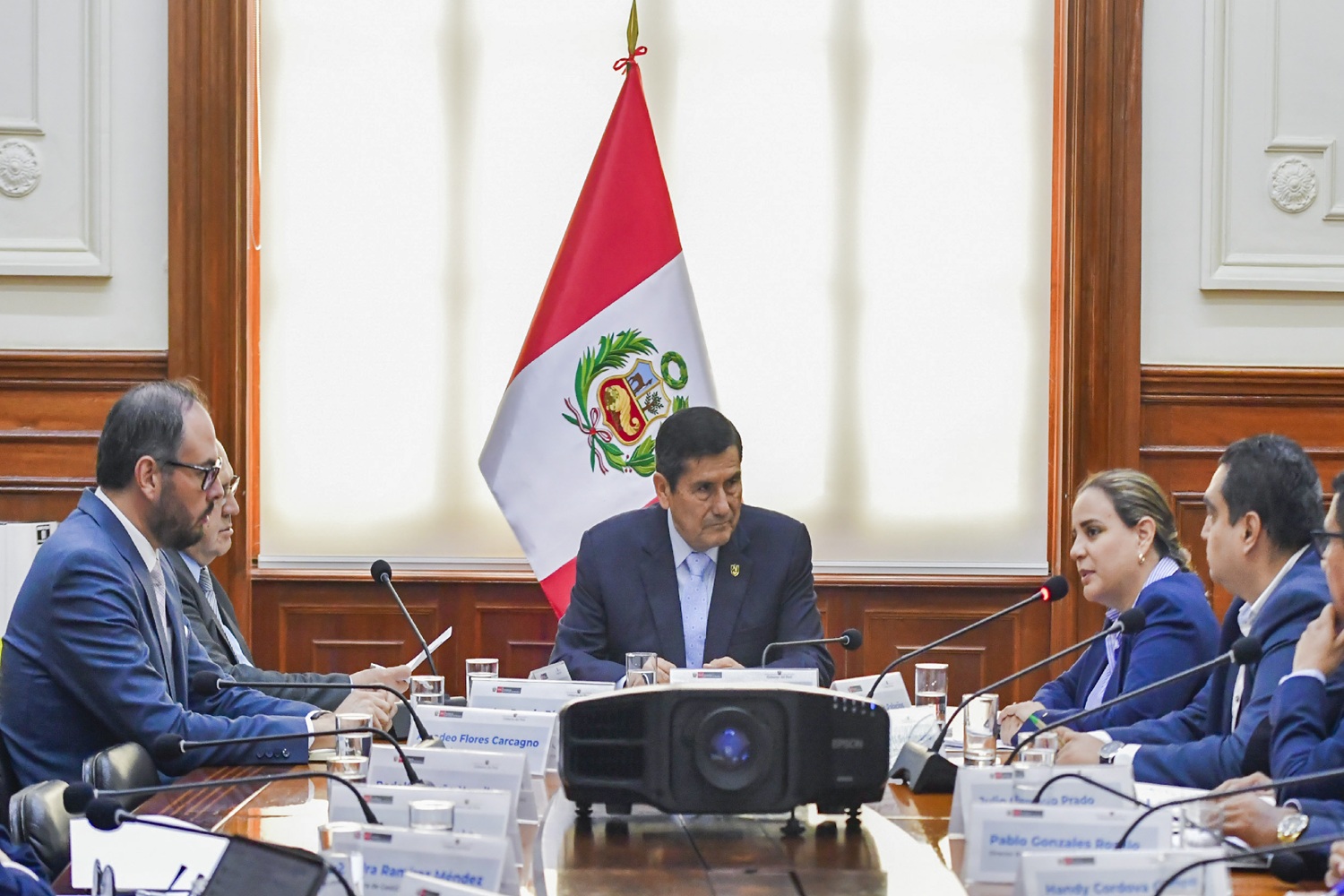
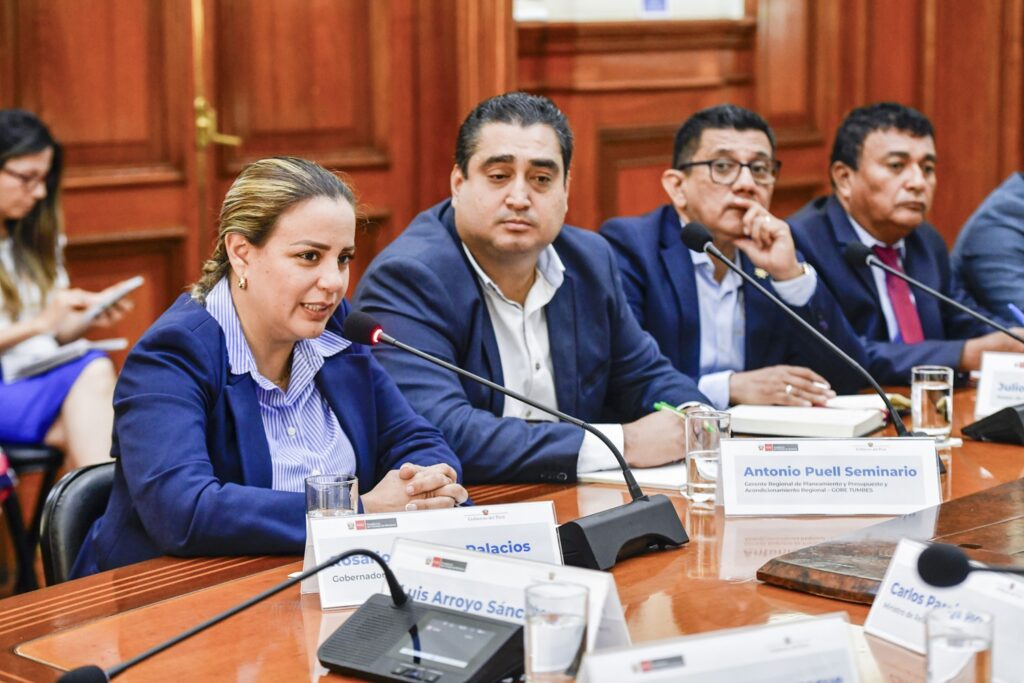
Agencia Peruana de Noticias PRENSAPERU.PE https://www.prensaperu.pe Twitter: @prensaperupe En el marco de una política de Estado basada en la apertura, la descentralización y el diálogo permanente como herramientas fundamentales para la gobernabilidad y el desarrollo territorial, el presidente del Consejo de Ministros, Luis Arroyo Sánchez, encabezó una reunión de trabajo multisectorial y de alto nivel con la gobernadora regional de Tumbes, Avelina Palacios. Este encuentro, realizado en la sala Javier Pérez de Cuéllar de la sede de la Presidencia del Consejo de Ministros (PCM), constituye una muestra clara de la voluntad del Gobierno Nacional de abordar, de manera conjunta, coordinada y con decisiones concretas, la compleja problemática que afecta a esta región estratégica del norte del país, poniendo énfasis especial en cuatro pilares esenciales: seguridad ciudadana, salud pública, infraestructura vial y fronteriza, y atención de necesidades básicas, todo ello con el objetivo central de elevar la calidad de vida de la ciudadanía tumbesina y reducir las brechas históricas que aún persisten en esta zona.
Durante la sesión de trabajo, el jefe del gabinete ministerial destacó la disposición absoluta del Poder Ejecutivo para escuchar, atender y dar respuesta técnica y presupuestal a las demandas de la población, reconociendo que Tumbes, por su condición de región fronteriza, cumple un rol vital para la integración nacional y la seguridad del país. En esa línea, el titular de la PCM reafirmó su compromiso personal y del Gobierno con la región, recordando y dando continuidad a la agenda que se trazó durante su última visita oficial a Tumbes, realizada el pasado 26 de abril. En aquella oportunidad, también sostuvo reuniones con autoridades locales y recorrió obras clave, entre ellas el Puente Internacional Aguas Verdes – Huaquillas y las instalaciones del Centro Binacional de Atención Fronteriza Perú – Ecuador, espacios que simbolizan la vinculación, el comercio y la cooperación entre ambas naciones y que requieren atención prioritaria para su funcionamiento óptimo.
Sobre el aspecto financiero, que es la base para la ejecución de cualquier proyecto, Luis Arroyo Sánchez fue categórico: ratificó la voluntad política de apoyar todas aquellas iniciativas y demandas que tengan como fin mejorar las condiciones de vida de las familias tumbesinas, y anunció que se ha establecido una priorización técnica de proyectos clave para Tumbes dentro del próximo Crédito Suplementario del Presupuesto del Sector Público. Esta medida es fundamental, ya que permitirá incorporar los recursos económicos adicionales necesarios para garantizar el financiamiento inmediato y la conclusión de obras que están en curso, así como el inicio de aquellas que son urgentes e impostergables para la región.
En la reunión, que contó con la participación de los principales sectores del Ejecutivo, se detallaron los avances y compromisos específicos por cada materia:
En Salud: El ministro del sector, Juan Carlos Velasco, presentó la situación actual del Hospital de Apoyo Saúl Garrido Rosillo (SAGARO), una infraestructura sanitaria de gran envergadura y trascendencia regional, que cuenta con una inversión ejecutada y comprometida de 231 millones de soles. La autoridad informó que, para poder culminar su construcción, equipamiento y puesta en funcionamiento total, se requiere una asignación presupuestal adicional de 55 millones de soles, monto que ya ha sido identificado y que será incluido en las modificaciones presupuestarias próximas, con el fin de que esta moderna infraestructura médica empiece a atender a la población con todos los servicios especializados que necesita.
En Infraestructura y Conectividad: El ministro de Transportes y Comunicaciones, Aldo Prieto, dio a conocer avances significativos en materia de conectividad vial y digital para Tumbes, resaltando que ya se ha formalizado la contratación del servicio integral de reparación, mantenimiento y mejora del Puente Internacional Aguas Verdes – Huaquillas, obra esencial para el comercio y el tránsito binacional, con una inversión asignada de 2.7 millones de soles. Esta intervención permitirá recuperar las condiciones de seguridad y operatividad de este punto de unión entre Perú y Ecuador.
En Seguridad y Defensa: El ministro de Defensa, Amadeo Flores, abordó uno de los temas más sensibles para la zona fronteriza: la seguridad y la lucha contra el crimen organizado. Informó que este jueves 28 de mayo sostendrá una reunión bilateral de alto nivel con su homólogo de la República del Ecuador, Gian Carlo Loffredo. El objetivo central de este encuentro es coordinar acciones conjuntas, compartir inteligencia y fortalecer la vigilancia y el control en todo el corredor fronterizo, mediante la implementación de operaciones de tipo “Espejo”, mecanismo estratégico mediante el cual ambas naciones ejecutan acciones simultáneas y coordinadas en sus respectivos territorios para combatir el tráfico ilícito de bienes, personas y drogas, así como para garantizar la tranquilidad de las poblaciones de frontera.
A la cita asistieron también los ministros del Interior, José Zapata; de la Producción, César Quispe; de Educación, María Cuadros; de Desarrollo Agrario y Riego, Felipe Meza; además del viceministro de Gobernanza Territorial, Francisco Gavidia, y otros altos funcionarios, lo que demuestra el carácter multisectorial y la importancia que el Gobierno otorga a esta región.
Con esta acción, la Presidencia del Consejo de Ministros ratifica una vez más su línea de trabajo: gobernar escuchando, articulando esfuerzos entre el nivel nacional y el nivel regional, y priorizando la inversión pública en zonas estratégicas. El objetivo final es claro: cerrar las brechas sociales y económicas que históricamente han afectado a Tumbes, y garantizar la seguridad nacional y la integración fronteriza como pilares fundamentales del desarrollo de todo el país.
CONCEPTOS CONTEXTUALES
Política de puertas abiertas y diálogo constante: Es una estrategia de gobernanza que implica la disposición permanente del Gobierno Nacional a recibir, escuchar y coordinar con las autoridades subnacionales. No se trata solo de reunirse, sino de construir soluciones conjuntas, reconociendo que los gobiernos regionales y locales conocen mejor su realidad y que la toma de decisiones compartida es más eficaz y legítima.
Crédito Suplementario: Es una modificación presupuestaria autorizada por ley que permite incorporar nuevos recursos al Presupuesto del Sector Público, ya sea por mayores ingresos o por transferencias, destinados a financiar gastos prioritarios, obras o servicios que no estaban previstos inicialmente o que requieren recursos adicionales para su conclusión. Es la herramienta técnica clave para atender demandas urgentes.
Operaciones tipo “Espejo”: Son acciones de seguridad y defensa coordinadas entre dos países vecinos, en este caso Perú y Ecuador, que se ejecutan de manera simultánea, con procedimientos similares y objetivos compartidos en sus respectivos territorios fronterizos. Su fin es combatir delitos trasnacionales, evitar que las organizaciones criminales se desplacen de un lado a otro aprovechando la frontera, y fortalecer el control territorial conjunto.
Brechas sociales y económicas: Se refiere a la distancia o desigualdad existente entre lo que la población requiere para vivir dignamente y lo que efectivamente recibe en servicios, infraestructura y oportunidades. En regiones como Tumbes, estas brechas se notan en la falta de culminación de hospitales, mal estado de vías o menor cobertura de servicios, y el objetivo de la política pública es reducirlas hasta eliminarlas.
Centro Binacional de Atención Fronteriza: Es una infraestructura compartida y gestionada por ambos países, diseñada para integrar en un solo lugar todos los servicios de control migratorio, aduanero, sanitario y de seguridad. Su finalidad es agilizar el tránsito legal de personas y mercancías, facilitar el comercio y el turismo, y mejorar la seguridad en la línea de frontera.
CONCLUSIONES ESTRATÉGICAS
1.- Priorización presupuestal como respuesta concreta: El anuncio de incluir proyectos de Tumbes en el próximo crédito suplementario, destacando los 55 millones de soles para el hospital SAGARO y los 2.7 millones para el puente internacional, demuestra que el diálogo no queda solo en acuerdos políticos, sino que se traduce en asignación real de recursos. Esto confirma que la región ha pasado a ser una prioridad en la agenda de inversiones del Gobierno Nacional.
2.- Seguridad fronteriza: una responsabilidad compartida: La reunión bilateral programada con Ecuador y la implementación de operaciones “Espejo” marcan un salto cualitativo en la gestión de seguridad. Se entiende que en las zonas de frontera, los problemas no terminan en la línea divisoria, por lo que la cooperación internacional y la acción conjunta son la única forma efectiva de combatir el crimen organizado y proteger a la población de ambos lados.
3.- Infraestructura sanitaria y de conectividad, motores del desarrollo: La culminación del hospital regional y la recuperación de la vía internacional no son solo obras de mejora, sino herramientas de desarrollo. Un hospital completo garantiza salud y bienestar, mientras que un puente operativo impulsa la economía, el comercio y la integración. El Estado ha reconocido que atender estos dos ejes es fundamental para que Tumbes cumpla su rol de puerta de entrada del país.
Fuente: Agencia Peruana de Noticias PRENSAPERU.PE https://www.prensaperu.pe Twitter: @prensaperupe
Translate
PCM and Regional Government of Tumbes: Agree on a joint agenda in health, security and infrastructure; a supplementary credit will be generated that will include priority projects for Tumbes.
Peruvian News Agency PRENSAPERU.PE https://www.prensaperu.pe Twitter: @prensaperupe Within the framework of a State policy based on openness, decentralization and permanent dialogue as fundamental tools for governance and territorial development, the President of the Council of Ministers, Luis Arroyo Sánchez, led a high‑level multisectoral working meeting with the Regional Governor of Tumbes, Avelina Palacios. This meeting, held in the Javier Pérez de Cuéllar room at the headquarters of the Presidency of the Council of Ministers (PCM), constitutes a clear demonstration of the National Government’s willingness to address —in a joint, coordinated manner and with concrete decisions— the complex set of problems affecting this strategic region in the north of the country, placing special emphasis on four essential pillars: public safety, public health, road and border infrastructure, and the provision of basic needs. All of this is undertaken with the central objective of raising the quality of life for the citizens of Tumbes and reducing the historical gaps that still persist in this area.
During the working session, the Head of the Ministerial Cabinet highlighted the absolute readiness of the Executive Branch to listen to, attend to and provide technical and budgetary responses to the population’s demands, recognizing that Tumbes, by virtue of its status as a border region, fulfils a vital role in national integration and the country’s security. In this regard, the Head of the PCM reaffirmed his personal commitment and that of the Government to the region, recalling and giving continuity to the agenda outlined during his last official visit to Tumbes, carried out on 26 April. On that occasion, he also held meetings with local authorities and toured key infrastructure works, including the Aguas Verdes – Huaquillas International Bridge and the facilities of the Peru – Ecuador Binational Border Service Centre; spaces that symbolize the links, trade and cooperation between the two nations and which require priority attention to ensure their optimal operation.
Regarding the financial aspect, which is the foundation for the execution of any project, Luis Arroyo Sánchez was categorical: he ratified the political will to support all those initiatives and demands aimed at improving the living conditions of families in Tumbes, and announced that technical prioritization of key projects for Tumbes has been established within the next Supplementary Credit of the Public Sector Budget. This measure is fundamental, since it will allow the incorporation of the additional economic resources required to guarantee the immediate financing and completion of works currently in progress, as well as the launch of those that are urgent and cannot be postponed for the region.
Specific progress and commitments in each area were detailed during the meeting, which was attended by the main sectors of the Executive:
Health: The Minister of the sector, Juan Carlos Velasco, presented the current situation of the Saúl Garrido Rosillo Support Hospital (SAGARO), a large‑scale healthcare infrastructure of regional significance, with an executed and committed investment of 231 million soles. The authority reported that, in order to complete its construction, equipping and full commissioning, an additional budget allocation of 55 million soles is required —an amount that has already been identified and will be included in the forthcoming budget amendments, so that this modern medical facility can begin serving the population with all the specialized services it needs.
Infrastructure and Connectivity: The Minister of Transport and Communications, Aldo Prieto, reported significant progress in road and digital connectivity for Tumbes, highlighting that the contracting of comprehensive repair, maintenance and improvement services for the Aguas Verdes – Huaquillas International Bridge has already been formalized. This work, essential for binational trade and transit, has an assigned investment of 2.7 million soles. The intervention will restore safety and operational conditions at this point of connection between Peru and Ecuador.
Security and Defence: The Minister of Defence, Amadeo Flores, addressed one of the most sensitive issues for the border area: security and the fight against organized crime. He reported that on Thursday, 28 May, he will hold a high‑level bilateral meeting with his counterpart from the Republic of Ecuador, Gian Carlo Loffredo. The central objective of this meeting is to coordinate joint actions, share intelligence and strengthen surveillance and control throughout the border corridor, through the implementation of “Mirror‑type” operations —a strategic mechanism whereby both nations carry out simultaneous and coordinated actions within their respective territories to combat the illicit trafficking of goods, people and drugs, as well as to guarantee peace of mind for populations living in border areas.
Also present at the meeting were the Minister of the Interior, José Zapata; the Minister of Production, César Quispe; the Minister of Education, María Cuadros; the Minister for Agrarian Development and Irrigation, Felipe Meza; as well as the Deputy Minister for Territorial Governance, Francisco Gavidia, among other senior officials —attendance that demonstrates the multisectoral nature of the effort and the importance the Government attaches to this region.
Through this action, the Presidency of the Council of Ministers reaffirms once again its line of work: governing by listening, coordinating efforts between the national and regional levels, and prioritizing public investment in strategic zones. The ultimate goal is clear: to close the social and economic gaps that have historically affected Tumbes, and to guarantee national security and border integration as fundamental pillars for the development of the entire country.
CONTEXTUAL CONCEPTS
Open‑door policy and permanent dialogue: A governance strategy that implies the National Government’s permanent readiness to receive, listen to and coordinate with subnational authorities. It is not merely about holding meetings, but about building joint solutions, recognizing that regional and local governments have better knowledge of their own realities and that shared decision‑making is more effective and legitimate.
Supplementary Credit: A budget modification authorized by law that allows new resources to be incorporated into the Public Sector Budget —whether from increased revenue or transfers— intended to finance priority expenditures, works or services that were not initially foreseen or that require additional funds for their completion. It is the key technical instrument for addressing urgent demands.
“Mirror‑type” operations: Security and defence actions coordinated between two neighbouring countries —in this case Peru and Ecuador— that are carried out simultaneously, following similar procedures and with shared objectives within their respective border territories. Their purpose is to combat transnational crime, prevent criminal organizations from moving back and forth across the border to take advantage of it, and strengthen joint territorial control.
Social and economic gaps: Refers to the distance or inequality that exists between what the population requires in order to live with dignity and what they effectively receive in terms of services, infrastructure and opportunities. In regions such as Tumbes, these gaps are evident in the incomplete construction of hospitals, poor road conditions or lower service coverage; the objective of public policy is to reduce them until they are eliminated.
Binational Border Service Centre: An infrastructure shared and managed by both countries, designed to bring together in one place all migration, customs, health and security control services. Its purpose is to streamline the legal movement of people and goods, facilitate trade and tourism, and improve security along the border line.
STRATEGIC CONCLUSIONS
1.- Budgetary prioritization as a concrete response: The announcement that projects for Tumbes will be included in the next supplementary credit —highlighting the 55 million soles for the SAGARO hospital and the 2.7 million soles for the international bridge— demonstrates that dialogue does not remain at the level of political agreements, but translates into the actual allocation of resources. This confirms that the region has become a priority in the National Government’s investment agenda.
2.- Border security: a shared responsibility: The scheduled bilateral meeting with Ecuador and the implementation of “Mirror‑type” operations mark a qualitative leap in security management. It is recognized that in border areas, problems do not stop at the dividing line; therefore, international cooperation and joint action are the only effective way to combat organized crime and protect the population on both sides.
3.- Health and connectivity infrastructure as drivers of development: The completion of the regional hospital and the restoration of the international route are not merely improvement works, but development tools. A fully operational hospital guarantees health and well‑being, while a functioning bridge boosts the economy, trade and integration. The State has recognized that addressing these two pillars is essential if Tumbes is to fulfil its role as the gateway to the country.
Source: Peruvian News Agency PRENSAPERU.PE https://www.prensaperu.pe Twitter: @prensaperupe