

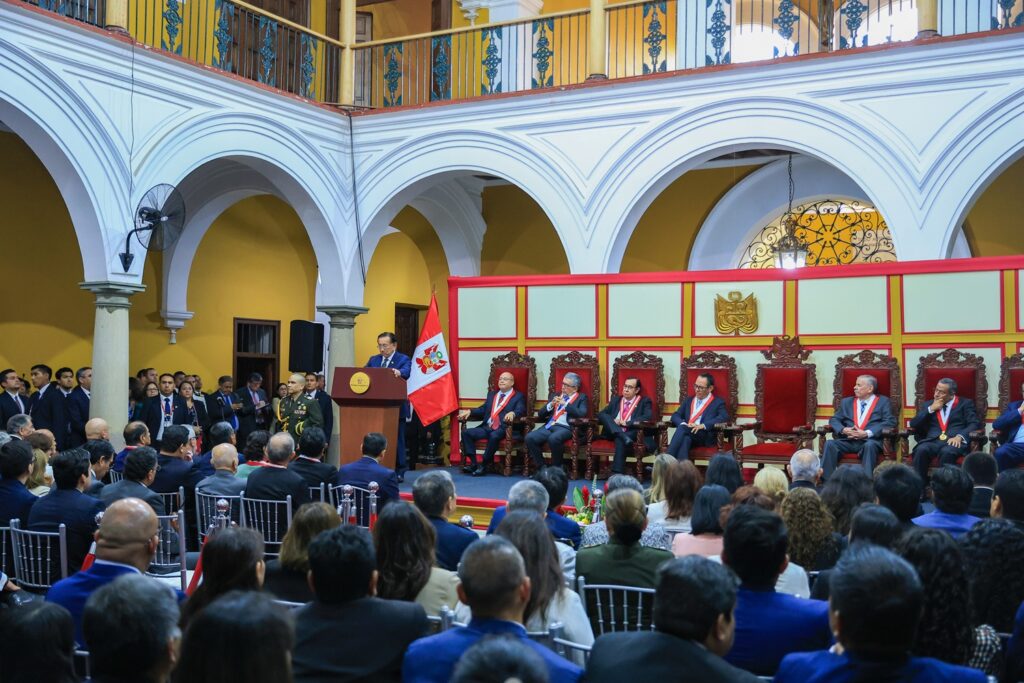
Agencia Peruana de Noticias PRENSAPERU.PE https://www.prensaperu.pe Twitter: @prensaperupe El presidente José María Balcázar participó en la ceremonia de conmemoración por el 30.º aniversario del Tribunal Constitucional (TC), realizada en su sede del Centro de Lima. El evento sirvió para reflexionar sobre el rol, la trayectoria y los retos de esta institución, reconocida como el máximo órgano encargado de garantizar el cumplimiento de la norma fundamental del país.
Para entender su función, es necesario definir que el Tribunal Constitucional es la instancia suprema de interpretación de la Constitución Política. Esto significa que sus fallos definen el alcance de los derechos fundamentales y establecen los límites entre los poderes del Estado, asegurando que ninguna autoridad actúe por encima de la ley. Actúa además como garante del Estado de Derecho, principio según el cual toda actividad pública y privada se rige por normas claras y justas, y no por decisiones arbitrarias.
Durante su intervención, el jefe de Estado destacó que la credibilidad de esta institución depende directamente de quienes la integran: los magistrados. En este sentido, resaltó que para cumplir su misión, estos funcionarios deben contar con dos cualidades esenciales: probidad —es decir, integridad, honestidad y conducta intachable— y una sólida formación jurídica que les permita resolver asuntos complejos con fundamento técnico y ético.
El mandatario señaló también que el TC no solo se pronuncia sobre temas legales, sino que aborda asuntos que impactan directamente en la vida nacional, entre ellos los de carácter económico. En este punto, planteó una relación fundamental: no puede haber desarrollo económico sostenible sin instituciones tutelares sólidas. Estas instituciones son aquellas que protegen los derechos, garantizan la seguridad jurídica y generan confianza, condiciones indispensables para atraer inversiones, fomentar la actividad empresarial y mejorar la calidad de vida de la población.
Asimismo, el presidente Balcázar puso el foco en la juventud, un sector que considera clave para el futuro del país. Señaló que es necesario escuchar sus inquietudes, garantizar el ejercicio de sus derechos y ofrecerles perspectivas claras y estables. Expresó que el objetivo común debe ser construir una nación desarrollada, con pleno respeto a los derechos políticos, sin corrupción, con educación de calidad y una economía inclusiva —entendida como aquella que permite que todos los sectores de la sociedad, sin exclusiones, puedan acceder a oportunidades, generar ingresos y participar en el progreso—.
En su discurso, también hizo referencia a la importancia de la inclusión y la gobernabilidad. Mencionó que es necesario avanzar en proyectos largamente esperados por la población, evitando retrasos que generen descontento o divisiones; como ejemplo citó los avances logrados en la región Puno. Además, recordó la próxima visita del papa León XIV, prevista para noviembre, y resaltó que coincide con estos propósitos: promover la paz social y brindar atención especial a las nuevas generaciones.
CONCLUSIONES
1.- El TC es pilar del orden constitucional: Sus 30 años de funcionamiento confirman que su rol como intérprete supremo de la Constitución es indispensable para mantener el equilibrio entre poderes y proteger los derechos de todos los ciudadanos.
2.- Confianza basada en la integridad: La legitimidad de la institución depende de la calidad humana y profesional de sus magistrados; sin independencia y probidad, sus decisiones pierden validez ante la sociedad.
3.- Instituciones sólidas = desarrollo: Existe una relación directa entre el buen funcionamiento de órganos como el TC y el progreso económico; la seguridad jurídica es requisito para crecer de forma estable.
4.- Visión de futuro e inclusión: Los retos actuales requieren articular la labor institucional con las demandas sociales, especialmente de la juventud, y avanzar en políticas que reduzcan brechas y fortalezcan la unidad nacional.
Fuente: Agencia Peruana de Noticias PRENSAPERU.PE https://www.prensaperu.pe Twitter: @prensaperupe
Translate
Peru: 30 Years of the Constitutional Court – “Its role as guarantor of the Constitution is essential, as its rulings define the scope of fundamental rights and establish the limits between the powers of the State.”
Peruvian News Agency PRENSAPERU.PE https://www.prensaperu.pe Twitter: @prensaperupe President José María Balcázar took part in the commemoration ceremony for the 30th anniversary of the Constitutional Court (TC), held at its headquarters in downtown Lima. The event served as an opportunity to reflect on the role, trajectory, and challenges of this institution, recognized as the highest body responsible for ensuring compliance with the country’s fundamental law.
To understand its function, it is necessary to define that the Constitutional Court is the supreme authority for interpreting the Political Constitution. This means that its rulings determine the scope of fundamental rights and establish the limits between the branches of government, ensuring that no authority acts above the law. It also acts as a guarantor of the Rule of Law, a principle under which all public and private activity is governed by clear and fair rules, rather than arbitrary decisions.
During his address, the Head of State emphasized that the credibility of this institution depends directly on its members: the justices. In this regard, he stressed that to fulfill their mission, these officials must possess two essential qualities: integrity — that is, honesty, uprightness, and irreproachable conduct — and a solid legal background that enables them to resolve complex matters with technical and ethical grounding.
The President also noted that the TC does not only rule on legal issues but also addresses matters that have a direct impact on national life, including those of an economic nature. On this point, he outlined a fundamental relationship: sustainable economic development cannot exist without strong guardian institutions. These are bodies that protect rights, guarantee legal certainty, and build confidence — essential conditions for attracting investment, promoting business activity, and improving the population’s quality of life.
Likewise, President Balcázar focused attention on young people, a sector he considers key to the country’s future. He stated that it is necessary to listen to their concerns, ensure the exercise of their rights, and provide them with clear and stable prospects. He expressed that the shared goal must be to build a developed nation, with full respect for political rights, zero corruption, quality education, and an inclusive economy — understood as one that allows all sectors of society, without exclusion, to access opportunities, generate income, and participate in progress.
In his speech, he also referred to the importance of inclusion and good governance. He mentioned that it is necessary to move forward with projects long awaited by the public, avoiding delays that cause discontent or division; as an example, he cited the progress achieved in the region of Puno. In addition, he recalled the upcoming visit of Pope Leo XIV, scheduled for November, and highlighted that it aligns with these goals: promoting social peace and giving special attention to the new generations.
CONCLUSIONS
1.- The TC is a pillar of the constitutional order: Its 30 years of operation confirm that its role as the supreme interpreter of the Constitution is essential to maintain the balance of powers and protect the rights of all citizens.
2.- Trust built on integrity: The institution’s legitimacy depends on the personal and professional quality of its justices; without independence and integrity, its rulings lose validity in the eyes of society.
3.- Strong institutions equal development: There is a direct link between the proper functioning of bodies such as the TC and economic progress; legal certainty is a requirement for stable growth.
4.- Forward-looking vision and inclusion: Current challenges require aligning institutional work with social demands — especially those of young people — and advancing policies that reduce gaps and strengthen national unity.
Source: Peruvian News Agency PRENSAPERU.PE https://www.prensaperu.pe Twitter: @prensaperupe