
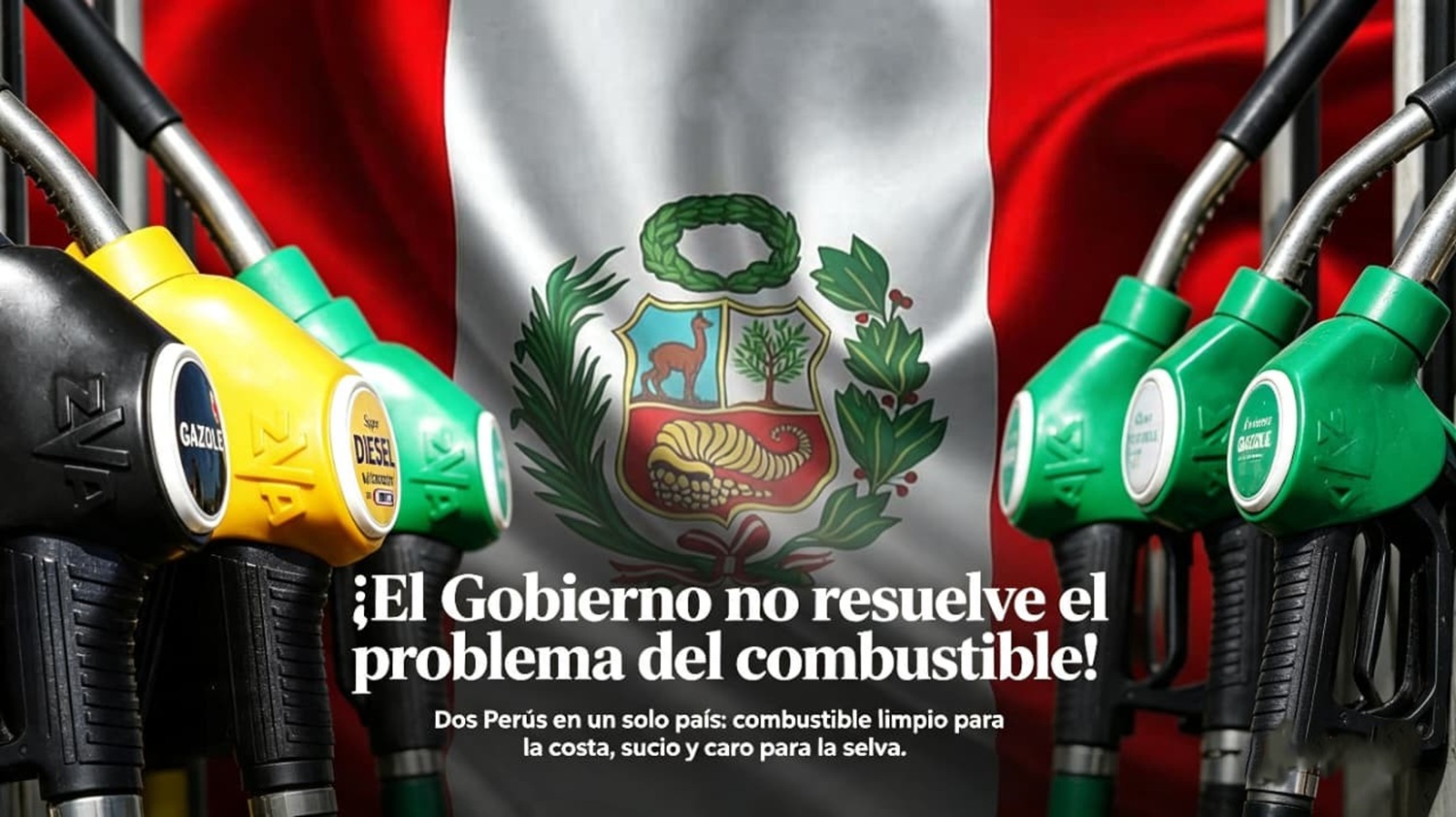
Agencia Peruana de Noticias PRENSAPERU.PE https://www.prensaperu.pe Twitter: @prensaperupe Existe una división profunda que pocos nombran con claridad: en el Perú no todos reciben el mismo combustible ni pagan el mismo precio. Quienes viven en la costa y en Lima acceden a diésel limpio, regulado y a un costo razonable. En cambio, en Ucayali, en Loreto y en gran parte de la Amazonía, la población recibe un producto de calidad muy inferior, a un precio mucho más alto, y sin que nadie explique por qué ni quién lo autoriza.
Esta diferencia no es casualidad ni se debe únicamente a la distancia. Está escrita en normas oficiales. El Decreto Supremo N° 014-2021-EM estableció que desde julio de 2021 todo el país debía recibir diésel con un máximo de 50 partes por millón (ppm) de azufre, un estándar que protege los motores, la salud y el ambiente. Sin embargo, la misma norma exceptuó a la selva del cumplimiento de esa exigencia. El resultado es escandaloso: en zonas como Pucallpa llega diésel con hasta 3,300 ppm de azufre, es decir, 66 veces más contaminante que el que se vende en la capital. Y encima de ser peor, cuesta más: mientras en Lima el galón ronda los S/ 13.50, en Ucayali llega a S/ 22.00.
Esta realidad ha sido la verdadera causa de fondo del paro indefinido que ha paralizado Ucayali y que se replica en otras regiones. Los transportistas no solo protestan por el aumento de precio internacional —que, por lo demás, aún no se siente con la misma intensidad en la costa— sino por un sistema que los condena a pagar más por algo que daña sus vehículos, eleva el costo de todos los productos de primera necesidad y enferma a sus familias. Exigen combustible de calidad, precio justo, fin a la especulación y fiscalización real.
Ante la movilización, la presidenta Keiko Fujimori anunció un paquete de medidas el 14 de agosto de 2026: un subsidio focalizado del 15% al 20% para transportistas de carga, pasajeros, fluviales y mototaxistas por tres meses; la declaratoria de emergencia en abastecimiento de hidrocarburos en Ucayali por un año; la instalación de un nuevo tanque de almacenamiento de 20,000 barriles; el empadronamiento de unos 100,000 mototaxistas; y el anuncio de “revisar” el decreto vinculado a la calidad del combustible y el uso de infraestructura de Petroperú. El gobernador de Ucayali, Manuel Gambini, informó el levantamiento del paro tras la firma de un acta de compromisos.
A primera vista, las medidas buscan desactivar la crisis inmediata. Sin embargo, un análisis detenido muestra que no atacan la raíz del problema. El subsidio es temporal y no garantiza que la rebaja llegue al pasajero ni al consumidor final. No se ha reactivado el Fondo de Estabilización de Precios de Combustibles (FEPC), mecanismo creado precisamente para amortiguar las alzas sin golpear de golpe a la ciudadanía y que dejó de funcionar en noviembre de 2025. Y lo más preocupante: el anuncio de “revisar un decreto” sobre calidad es demasiado vago, sin plazo, sin responsable y sin sanción. Mientras tanto, la excepción que permite combustible sucio en la selva sigue vigente.
Lo que ocurre en Ucayali no es un problema aislado: es la expresión de una política que ha permitido que miles de peruanos sean tratados como ciudadanos de segunda clase. Se permite que unos pocos se beneficien con sobreprecios y productos deficientes, mientras la mayoría paga con su economía, su salud y su futuro. No hay justificación válida para que un producto esencial llegue en condiciones indignas a una parte del país. El trato desigual no puede sostenerse bajo ninguna ley ni ninguna autoridad.
DATOS CONCEPTUALES
Partes por millón (ppm): Unidad de medida que indica la cantidad de azufre u otros contaminantes contenida en el combustible. Cuanto menor el número, más limpio y menos dañino es el producto.
Diésel de ultra bajo azufre: Combustible con un máximo de 50 ppm de azufre, obligatorio en la costa desde 2021; protege motores, reduce emisiones contaminantes y cuida la salud pública.
Excepción normativa: Disposición legal que permite a ciertas zonas no cumplir con un estándar nacional; en este caso, ha mantenido a la Amazonía recibiendo combustible de baja calidad durante años.
Fondo de Estabilización de Precios de Combustibles (FEPC): Mecanismo creado en 2004 para amortiguar las variaciones internacionales del petróleo y evitar que los aumentos se trasladen de golpe al consumidor; dejó de operar a finales de 2025.
Subsidio focalizado: Ayuda económica dirigida a un grupo específico —en este caso los transportistas— que busca aliviar el impacto inmediato pero no resuelve las causas estructurales del problema.
Oligopolio de distribución: Situación en la que pocas empresas controlan el suministro en una zona, lo que dificulta la competencia y permite fijar precios altos sin justificación real.
Desigualdad regional: Trato diferenciado entre distintas zonas del país que, en materia de combustibles, se traduce en peor calidad, mayor precio y menor protección para la población amazónica.
CONCLUSIONES
1.- Existe una brecha inaceptable dentro del mismo país: mientras la costa recibe combustible limpio y a precio razonable, Ucayali y la Amazonía consumen un producto hasta 66 veces más contaminante y casi un 60% más caro.
2.- Esta desigualdad no es casual: está amparada en decretos que exceptúan a la selva de cumplir con los estándares nacionales de calidad, una norma que debió ser derogada hace mucho tiempo y que ningún gobierno ha corregido.
3.- El paro de Ucayali responde no solo al aumento de precios, sino a un agravio acumulado: la población ve que se le trata con menosprecio, sin fiscalización real y sin respeto a su derecho a recibir bienes esenciales en condiciones dignas.
4.- Las medidas anunciadas por el gobierno calman la emergencia inmediata, pero son temporales y no resuelven el fondo: el subsidio vence en tres meses, no llega directamente al consumidor y no se ha reactivado el FEPC como mecanismo permanente de protección.
5.- El anuncio de “revisar” el decreto sobre calidad del combustible es insuficiente y poco claro: no hay fecha, no hay responsable y no hay sanción; mientras tanto, la población sigue expuesta a un producto que daña su salud y su economía.
6.- No puede haber dos categorías de ciudadanos en un mismo país: la solución real requiere igualdad de estándares, precios transparentes, fiscalización permanente y fin a toda excepción que permita tratar a la Amazonía con inferioridad.
Fuente: Agencia Peruana de Noticias PRENSAPERU.PE https://www.prensaperu.pe Twitter: @prensaperupe
Translate
“The Government Fails to Solve the Fuel Issue! Two Perús in One Nation: Clean Fuel for the Coast, Dirty and Expensive for the Jungle. 66 Times More Polluting and S/ 22 Per Gallon — The Reason Ucayali Is Paralyzed.”
Peruvian News Agency PRENSAPERU.PE https://www.prensaperu.pe Twitter: @prensaperupe There exists a deep division that few name clearly: in Peru, not everyone receives the same fuel or pays the same price. Those who live on the coast and in Lima have access to clean, regulated diesel at a reasonable cost. In contrast, in Ucayali, in Loreto, and across much of the Amazon, the population receives a far inferior product at a much higher price — and no one explains why or who authorizes it.
This difference is no accident, nor is it due solely to distance. It is written into official regulations. Supreme Decree No. 014-2021-EM established that as of July 2021, the entire country should receive diesel with a maximum of 50 parts per million (ppm) of sulfur, a standard that protects engines, health, and the environment. However, the very same regulation exempted the jungle from meeting that requirement. The result is scandalous: in areas such as Pucallpa, diesel arrives with up to 3,300 ppm of sulfur — that is, 66 times more polluting than what is sold in the capital. Worse still, it costs more: while in Lima the gallon averages S/ 13.50, in Ucayali it reaches S/ 22.00.
This reality has been the true underlying cause of the indefinite strike that has paralyzed Ucayali and is spreading to other regions. Transport workers are not only protesting the international price increase — which, incidentally, has not yet been felt with the same intensity on the coast — but a system that condemns them to pay more for something that damages their vehicles, drives up the cost of all essential goods, and makes their families ill. They demand quality fuel, fair pricing, an end to speculation, and genuine oversight.
Responding to the mobilization, President Keiko Fujimori announced a set of measures on August 14, 2026: a targeted subsidy of 15% to 20% for cargo, passenger, river, and motorcycle-taxi drivers for three months; a declaration of emergency in hydrocarbon supply in Ucayali for one year; the installation of a new 20,000-barrel storage tank; the registration of some 100,000 motorcycle-taxi drivers; and the announcement to “review” the decree linked to fuel quality and Petroperú infrastructure use. Ucayali Governor Manuel Gambini reported the lifting of the strike following the signing of a memorandum of understanding.
At first glance, the measures seek to defuse the immediate crisis. However, careful analysis shows they do not strike at the root of the problem. The subsidy is temporary and offers no guarantee that savings will be passed on to passengers or end consumers. The Fuel Price Stabilization Fund (FEPC), a mechanism created precisely to cushion price hikes without hitting citizens all at once and which ceased operating in November 2025, has not been reactivated. Most concerningly, the pledge to “review a decree” on quality is far too vague — lacking deadlines, responsible parties, and penalties. Meanwhile, the exemption allowing dirty fuel in the jungle remains in force.
What is happening in Ucayali is no isolated issue: it is the expression of a policy that has allowed thousands of Peruvians to be treated as second-class citizens. A privileged few are permitted to profit from inflated prices and substandard products, while the majority pays with their livelihoods, their health, and their future. There is no valid justification for an essential commodity to reach any part of the nation in unworthy conditions. Unequal treatment cannot be sustained under any law or any authority.
CONCEPTUAL DATA
Parts per million (ppm): Unit of measurement indicating the amount of sulfur or other pollutants contained in fuel. The lower the number, the cleaner and less harmful the product.
Ultra-low-sulfur diesel: Fuel with a maximum of 50 ppm sulfur, mandatory on the coast since 2021; protects engines, reduces polluting emissions, and safeguards public health.
Regulatory exemption: Legal provision allowing certain zones to be excluded from meeting a national standard; in this case, it has kept the Amazon receiving low-quality fuel for years.
Fuel Price Stabilization Fund (FEPC): Mechanism created in 2004 to cushion international oil price fluctuations and prevent sudden increases from being passed to consumers; ceased operations at the end of 2025.
Targeted subsidy: Financial assistance directed at a specific group — in this case transport workers — intended to alleviate immediate impact but not resolving the structural causes of the problem.
Distribution oligopoly: A situation where few companies control supply in an area, hindering competition and enabling inflated pricing without real justification.
Regional inequality: Differentiated treatment across different areas of the country which, in fuel matters, translates to inferior quality, higher prices, and less protection for Amazonian populations.
CONCLUSIONS
1.- An unacceptable gap exists within one and the same country: while the coast receives clean fuel at fair prices, Ucayali and the Amazon consume a product up to 66 times more polluting and nearly 60% more expensive.
2.- This inequality is no coincidence: it is upheld by decrees that exempt the jungle from meeting national quality standards — a regulation that should have been repealed long ago and which no government has corrected.
3.- The Ucayali strike responds not merely to price increases, but to accumulated grievance: people see themselves treated with disregard, without real oversight, and denied their right to receive essential goods in worthy conditions.
4.- The measures announced by the government calm the immediate emergency but are temporary and do not address the core issue: the subsidy expires in three months, does not reach consumers directly, and the FEPC has not been reinstated as a permanent protection mechanism.
5.- The announcement to “review” the fuel quality decree is insufficient and unclear: there is no timeline, no designated authority, and no enforcement; meanwhile, the population remains exposed to a product that harms their health and economy.
6.- There cannot be two classes of citizens in one country: a genuine solution requires equal standards, transparent pricing, permanent oversight, and an end to every exemption that permits treating the Amazon as lesser.
Source: Peruvian News Agency PRENSAPERU.PE https://www.prensaperu.pe Twitter: @prensaperupe