
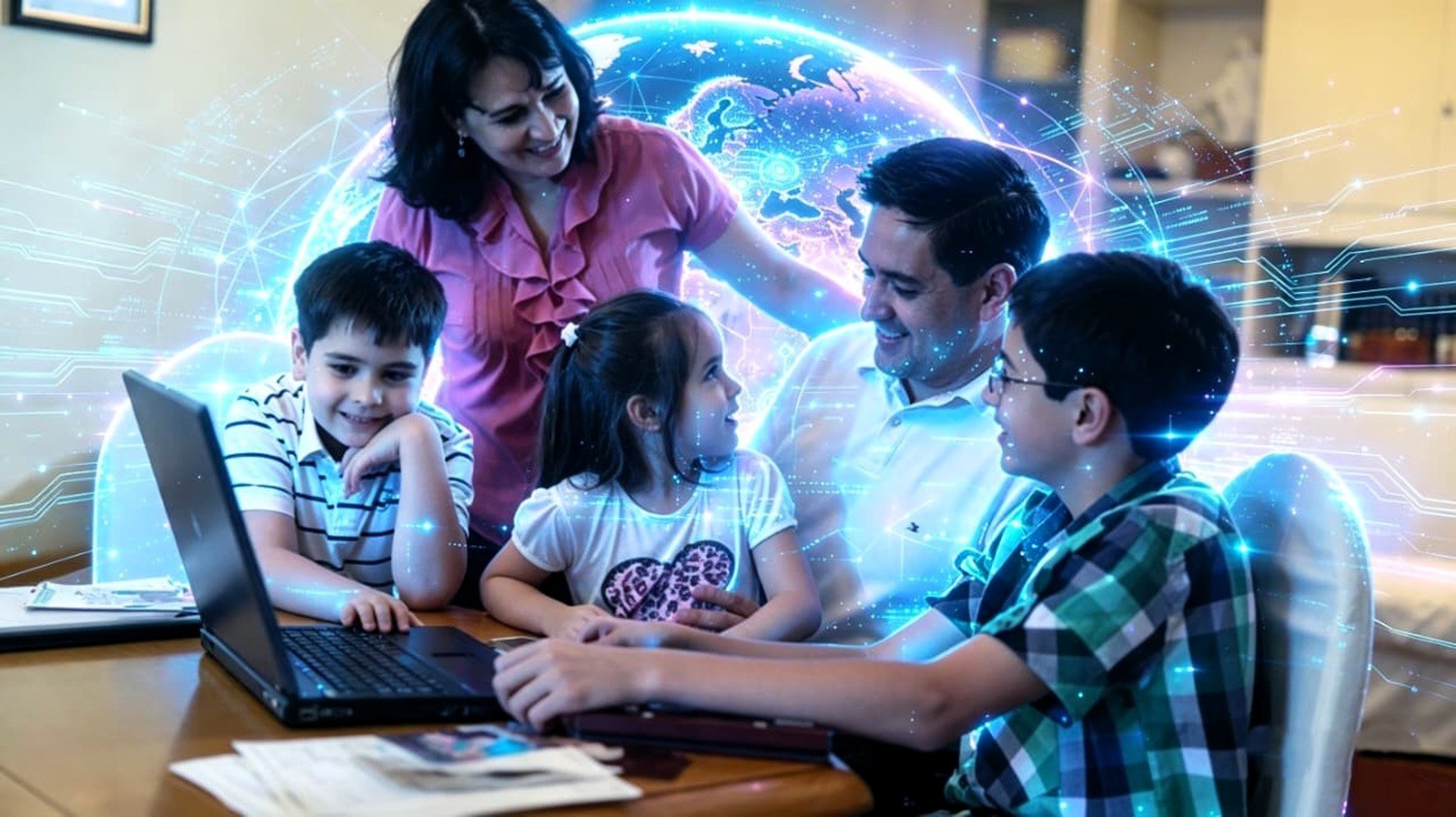
Agencia Peruana de Noticias PRENSAPERU.PE https://www.prensaperu.pe Twitter: @prensaperupe Antes de hablar de tecnología, de aulas o de políticas públicas, debemos reconocer que la educación humana nace en el hogar, se nutre del ejemplo de los padres y se construye sobre los valores y hábitos que la familia transmite desde los primeros años. Ninguna reforma educativa, ninguna inteligencia artificial y ningún avance científico puede reemplazar esa influencia primigenia: el niño aprende primero en casa, y todo lo que reciba después —en la escuela, en el instituto, en la universidad— se asentará sobre esa base. El liderazgo educativo no empieza en un despacho ministerial ni en una dirección escolar: empieza en la mesa familiar, y de ahí se extiende por toda la sociedad formando una cadena continua donde cada eslabón es indispensable para preparar a las nuevas generaciones ante los retos del futuro.
I.- LA RAÍZ PRIMIGENIA: EL HOGAR COMO PRIMERA ESCUELA Y LOS PADRES COMO PRIMEROS LÍDERES
Antes de cualquier aula, antes de cualquier docente, de cualquier política o de cualquier tecnología, existe un espacio insustituible donde se gesta todo el desarrollo de la persona: el hogar, la familia. Son el primer entorno donde el niño y la niña aprenden a comunicarse, a relacionarse, a esforzarse, a respetar, a tener curiosidad, a resolver conflictos y a valorar el conocimiento. Los padres y madres son los primeros y más influyentes líderes educativos, mucho antes de que el sistema educativo formal comience su labor. Ninguna reforma escolar, ninguna tecnología ni estrategia pública logra compensar por completo la ausencia de esa formación temprana en casa.
Cuando hablamos de preparar a las nuevas generaciones para el futuro —incluida la era de la inteligencia artificial—, la conversación suele empezar por la escuela, por los planes de estudio o por las herramientas digitales. Pero la base se construye en el hogar: la disciplina, la responsabilidad, la perseverancia, el pensamiento crítico, los valores y el amor por el aprendizaje son semillas que se siembran desde los primeros años. Sin esos cimientos, por más moderna que sea la educación que se reciba después, será mucho más difícil que arraigue y fructifique.
En países en desarrollo como el Perú, donde el debate sobre la IA y el futuro del trabajo está politizado y a menudo se queda en discursos, la familia representa el actor más poderoso y a la vez el más olvidado en las conversaciones públicas. No se trata de sustituir al Estado ni a la escuela, sino de reconocer que ningún sistema educativo puede tener éxito si no cuenta con el respaldo activo, comprometido y constante de la familia. Los padres no son espectadores del proceso formativo: son los primeros líderes, los primeros formadores, los primeros modelos. Su liderazgo no requiere título universitario ni cargo público, sino presencia, tiempo, ejemplo y acompañamiento.
II.- EL LIDERAZGO EDUCATIVO: UNA CADENA QUE EMPIEZA EN CASA Y SE EXTIENDE POR TODOS LOS NIVELES
El informe de la UNESCO Liderazgo en la educación: Liderar para aprender y los estudios de la OCDE y el Banco Mundial coinciden en algo trascendental: el liderazgo es el factor clave para transformar las políticas en aprendizajes reales. Pero ese liderazgo no empieza en el ministerio ni en la dirección del colegio: empieza en la mesa del hogar, en las conversaciones, en el estímulo constante, en la confianza que los padres depositan en sus hijos y en la educación. A partir de ahí, la cadena de liderazgo se amplía: docentes, directivos, funcionarios y autoridades completan el proceso. Pero el eslabón inicial y más determinante es la familia.
El liderazgo educativo es una cadena: la familia es el primer eslabón, la escuela el segundo, el sistema educativo el tercero. Si el primero es débil, toda la cadena se resiente. Ninguna tecnología, ninguna IA, ninguna reforma compensa la falta de acompañamiento, de estímulo y de valores que solo el hogar puede brindar.
En el caso peruano, esta realidad es aún más urgente. Muchas familias enfrentan grandes dificultades —trabajo excesivo, economía precaria, distancia— que les quitan tiempo y presencia. Sin embargo, el rol formativo de los padres no depende de recursos económicos ni de nivel de instrucción: depende de la presencia, del diálogo, del ejemplo y del interés genuino por el aprendizaje de sus hijos. Ese es el verdadero punto de partida para que luego, en la escuela y más adelante, cualquier conocimiento —incluido el dominio de tecnologías y de la IA— pueda ser asimilado con solidez.
III.- DESAJUSTE DE COMPETENCIAS: LA FAMILIA TAMBIÉN PUENTE ENTRE EDUCACIÓN Y VIDA
El Banco Mundial advierte que en muchos países los egresados salen de las aulas sin las habilidades que el mundo laboral demanda. Esa brecha empieza a reducirse o a ensancharse desde casa. Los padres que estimulan la curiosidad, la lectura, el esfuerzo y la adaptación al cambio ya están preparando a sus hijos para el futuro, mucho antes de que cualquier institución lo haga. La orientación vocacional, el conocimiento de la realidad productiva del país, la valoración del trabajo digno: todo eso también se transmite en el hogar.
En el Perú, donde la informalidad, la precariedad laboral y las desigualdades son profundas, la familia cumple además un papel de resiliencia y sostén que ningún sistema puede reemplazar. Fortalecerla como primera instancia de formación es la política pública más efectiva que existe, aunque rara vez figure en los discursos sobre tecnología y modernización.
IV.- DATOS CONCEPTUALES
Familia como primera escuela: Es el espacio primigenio donde se forman la personalidad, los valores, los hábitos y las capacidades relacionales del ser humano, mucho antes del ingreso al sistema educativo formal. Allí se construyen los cimientos sobre los que se levantará toda la formación posterior.
Padres como primeros líderes educativos: Madres y padres son los primeros referentes, formadores y estímulos del aprendizaje. Su influencia modela la disposición del niño hacia el conocimiento, el esfuerzo y la vida. No requieren títulos ni cargos: su autoridad y su liderazgo nacen del afecto, del ejemplo y del acompañamiento cotidiano.
Liderazgo educativo integral: No se limita a autoridades escolares o gubernamentales. Se ejerce primero en el hogar y se extiende por todos los niveles del sistema educativo, formando una cadena continua donde cada actor cumple un papel complementario e indispensable.
Desajuste de competencias: Es la brecha entre lo que el sistema educativo entrega a los estudiantes y lo que el mundo laboral realmente necesita. Esta brecha empieza a reducirse desde casa: la familia puede cerrarla fomentando autonomía, adaptabilidad, responsabilidad y visión de futuro.
Inteligencia Artificial y educación: La IA es una herramienta poderosa, pero solo produce frutos si se apoya sobre bases sólidas. Esas bases —pensamiento crítico, valores, curiosidad, perseverancia— se cultivan primero en el hogar. La tecnología potencia lo que encuentra: si la persona está bien formada, la IA será su aliada; si no lo está, puede ampliar las desigualdades.
Aprendizaje a lo largo de la vida: Es la disposición a seguir aprendiendo, desaprendiendo y adaptándose durante toda la existencia. Esta actitud indispensable para navegar los cambios acelerados del mundo moderno se cultiva desde la infancia en el hogar, cuando los padres muestran que el conocimiento nunca termina.
V. – DATOS CONTEXTUALES
1. – Antes que la escuela, antes que la tecnología, está la familia: el cimiento más sólido de la educación se construye en casa. Los padres y madres son los primeros y más influyentes líderes educativos. Sin su activa participación, ninguna reforma ni tecnología rinde frutos plenos.
2.- El liderazgo educativo es una cadena, y la familia es su primer eslabón: se extiende desde el hogar hasta las aulas, las instituciones y las políticas públicas. Ningún nivel puede cumplir su función si el anterior falla.
3.- La IA y la automatización requieren primero seres humanos con valores firmes y hábitos sólidos: la tecnología potencia lo que encuentra. Si el niño crece con responsabilidad, honestidad, curiosidad y perseverancia, la IA será una herramienta a su servicio. Si esos valores faltan, la tecnología puede ampliar las brechas.
4. – El desafío peruano empieza por fortalecer el acompañamiento familiar: no basta con invertir en equipos, internet o currículos nuevos. Es igualmente indispensable reconocer, fortalecer y respaldar a las familias en su insustituible labor de primeros formadores.
5. – El éxito educativo del Perú en la era de la IA no dependerá solo de lo que pase en las aulas, sino también de lo que pase en los hogares: la escuela complementa, pero no sustituye. Familias presentes, involucradas y valoradas en su rol formador son la mejor garantía de futuro para el país.
6. – La educación es una responsabilidad compartida, no exclusiva del Estado: Estado, escuela y familia deben actuar en sintonía, con la familia como protagonista inicial y permanente. La politización del tema a menudo ignora esta verdad elemental.
Fuente: Agencia Peruana de Noticias PRENSAPERU.PE https://www.prensaperu.pe Twitter: @prensaperupe
Translate
“Before school comes the family: the first educational leaders are at home; without a solid foundation in the home, no AI will transform education. To prepare the Peru of the future, governments and society must strengthen the home.”
Peruvian News Agency PRENSAPERU.PE https://www.prensaperu.pe Twitter: @prensaperupe Before speaking of technology, classrooms, or public policies, we must recognize that human education is born in the home, nurtured by the parents’ example, and built upon the values and habits that the family transmits from the earliest years. No educational reform, no artificial intelligence, and no scientific advancement can replace that primal influence: children learn first at home, and everything they receive afterward —in school, in technical institute, in university— will rest upon that foundation. Educational leadership does not begin in a ministry office or a school principalship: it begins at the family table, and from there extends throughout society, forming a continuous chain where every link is indispensable to preparing new generations for the challenges of the future.
I.- THE PRIMAL ROOT: THE HOME AS THE FIRST SCHOOL AND PARENTS AS THE FIRST LEADERS
Before any classroom, before any teacher, any policy, or any technology, there exists an irreplaceable space where the full development of the human being takes shape: the home, the family. It is the first environment where children learn to communicate, relate to others, strive, respect, be curious, resolve conflicts, and value knowledge. Fathers and mothers are the first and most influential educational leaders, long before the formal education system begins its work. No school reform, no technology, and no public strategy can fully compensate for the absence of that early formation at home.
When we speak of preparing new generations for the future —including the age of artificial intelligence— the conversation usually starts with school, curricula, or digital tools. Yet the foundation is built at home: discipline, responsibility, perseverance, critical thinking, values, and a love for learning are seeds sown from the earliest years. Without those foundations, no matter how modern the education received afterward, it will be far harder for it to take root and bear fruit.
In developing countries such as Peru, where the debate over AI and the future of work is politicized and often remains at the level of discourse, the family stands as the most powerful —yet most overlooked— actor in public conversation. This is not about replacing the State or the school, but about recognizing that no educational system can succeed without the active, committed, and ongoing backing of the family. Parents are not spectators in the formative process: they are the first leaders, the first educators, the first role models. Their leadership requires no university degree or public office, but rather presence, time, example, and accompaniment.
II.- EDUCATIONAL LEADERSHIP: A CHAIN THAT BEGINS AT HOME AND EXTENDS ACROSS ALL LEVELS
The UNESCO report Leadership in Education: Learning to Lead, along with studies by the OECD and the World Bank, all coincide on a momentous point: leadership is the key factor in turning policies into real learning outcomes. Yet that leadership does not begin in the ministry or the school principal’s office —it begins at the family table, in daily conversations, in constant encouragement, and in the trust parents place in their children and in education. From there, the chain of leadership broadens: teachers, school administrators, officials, and authorities complete the process. But the initial and most decisive link is the family.
Educational leadership is a chain: the family is the first link, the school the second, and the educational system the third. If the first link is weak, the entire chain suffers. No technology, no AI, and no reform can make up for the lack of guidance, encouragement, and values that only the home can provide.
This reality is even more urgent in the Peruvian context. Many families face great difficulties —excessive working hours, precarious finances, distance— that take away time and physical presence. Yet the formative role of parents does not depend on economic resources or educational attainment: it depends on presence, dialogue, example, and genuine interest in their children’s learning. That is the true starting point so that later, in school and beyond, any body of knowledge —including proficiency in technologies and AI— can be solidly assimilated.
III.- SKILLS MISMATCH: THE FAMILY AS A BRIDGE BETWEEN EDUCATION AND LIFE
The World Bank warns that in many countries, graduates leave classrooms without the skills the labor market demands. That gap begins to narrow —or widen— at home. Parents who foster curiosity, reading, effort, and adaptability to change are already preparing their children for the future, long before any institution does so. Vocational guidance, an understanding of the country’s productive reality, and the appreciation of dignified work: all of these are also transmitted within the home.
In Peru, where informality, labor precariousness, and deep inequalities prevail, the family also fulfills a role of resilience and support that no system can fully replace. Strengthening the family as the first instance of education is the most effective public policy that exists, even though it rarely appears in discourses on technology and modernization.
IV.- CONCEPTUAL FRAMEWORK
Family as the first school: It is the primal space where personality, values, habits, and relational skills are formed, long before entry into the formal education system. The foundations upon which all subsequent education will be built are laid there.
Parents as the first educational leaders: Mothers and fathers are the first role models, educators, and influencers of learning. Their outlook shapes the child’s disposition toward knowledge, effort, and life. They require no titles or positions: their authority and leadership grow from affection, example, and daily accompaniment.
Comprehensive educational leadership: It is not limited to school or government authorities. It is first exercised within the home and extends across every level of the educational system, forming a continuous chain where each stakeholder fulfills a complementary and essential role.
Skills mismatch: The gap between what the educational system delivers to students and what the labor market truly requires. This gap begins to close at home: the family can bridge it by fostering autonomy, adaptability, responsibility, and a forward-looking vision.
Artificial Intelligence and education: AI is a powerful tool, but it yields results only when built upon solid foundations. Those foundations —critical thinking, values, curiosity, perseverance— are cultivated first in the home. Technology amplifies what it finds: if a person is well-grounded, AI becomes their ally; if not, it may widen existing inequalities.
Lifelong learning: The willingness to keep learning, unlearning, and adapting throughout one’s life. This mindset —essential for navigating today’s rapid global changes— is nurtured from childhood within the home, when parents demonstrate that learning never ends.
V.- KEY CONCLUSIONS
1.- Before the school, before technology, comes the family: the most solid foundation of education is built at home. Fathers and mothers are the first and most influential educational leaders. Without their active involvement, no reform or technology can bear its full fruit.
2.- Educational leadership forms a chain, and the family is its first link: it stretches from the home to classrooms, institutions, and public policy. No level can fulfill its purpose if the preceding one fails.
3.- AI and automation require, first and foremost, human beings with firm values and sound habits: technology amplifies what it finds. If a child grows up with responsibility, integrity, curiosity, and perseverance, AI becomes a tool serving them. If those values are absent, technology may widen existing gaps.
4.- Peru’s challenge begins with strengthening family involvement: investing in equipment, internet connectivity, or new curricula alone is not enough. It is equally vital to recognize, strengthen, and support families in their irreplaceable role as the first educators.
5.- Peru’s educational success in the AI era will depend not only on what happens in classrooms but also on what happens in households: the school complements, but does not substitute. Present, engaged families whose formative role is valued are the nation’s best guarantee for the future.
6.- Education is a shared responsibility, not an exclusive one of the State: the State, the school, and the family must act in harmony, with the family as the initial and permanent protagonist. The politicization of this subject often overlooks this elemental truth.
Source: Peruvian News Agency PRENSAPERU.PE https://www.prensaperu.pe Twitter: @prensaperupe