
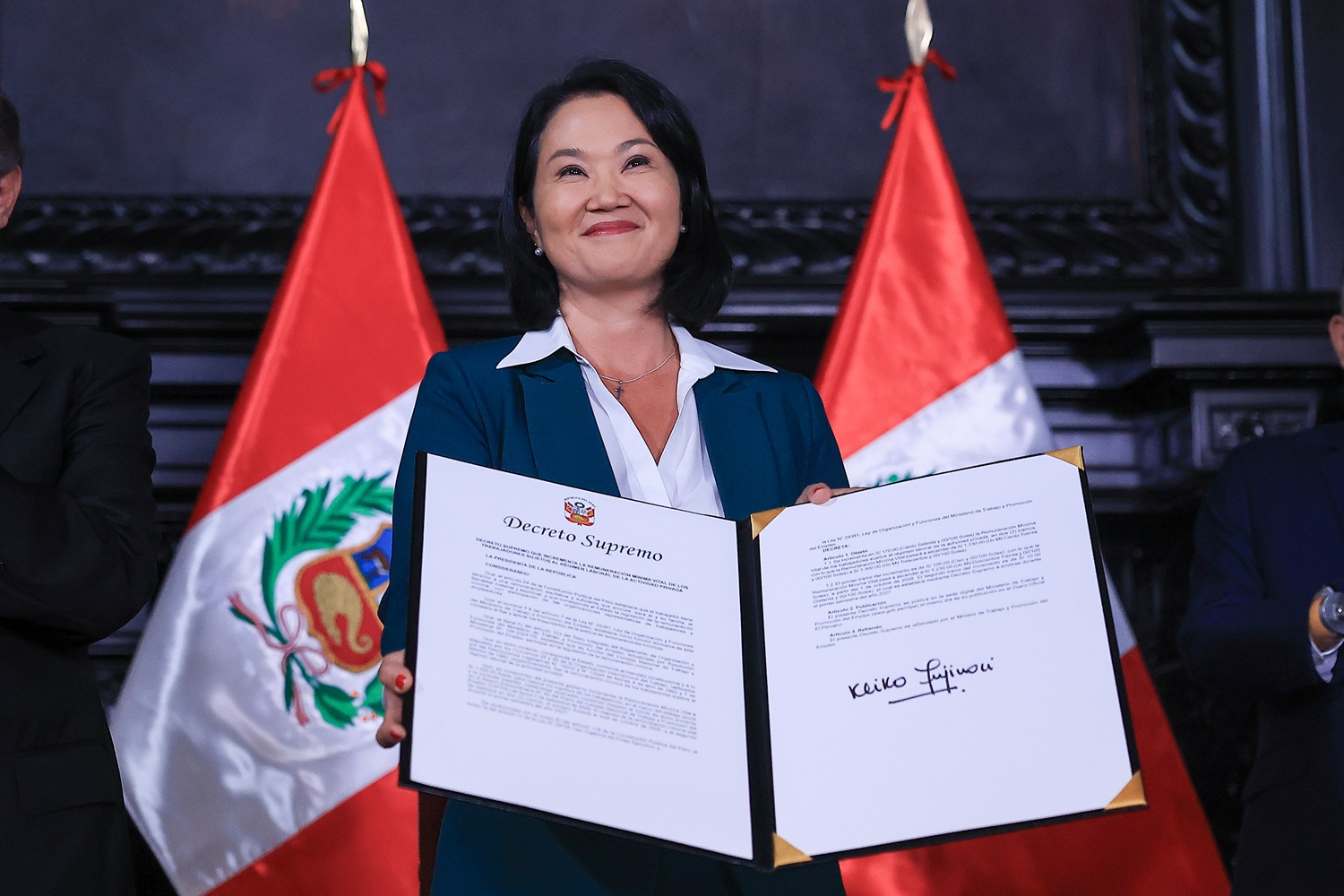
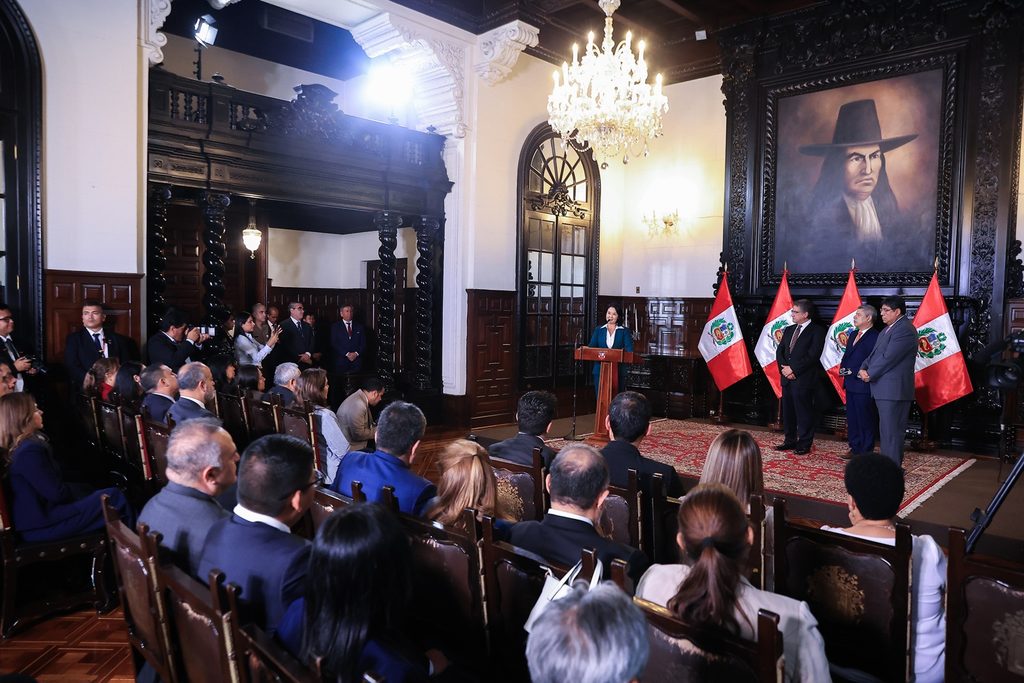
Agencia Peruana de Noticias PRENSAPERU.PE https://www.prensaperu.pe Twitter: @prensaperupe La firma del decreto supremo que eleva la Remuneración Mínima Vital (RMV) de manera escalonada —de 1.130 a 1.230 soles el 1.º de octubre y a 1.300 soles tras el Fenómeno El Niño— marca un hito en la gestión de la presidenta Keiko Fujimori, y su razón más consistente es que se condice con su promesa electoral ofrecida al país y de otro lado tiene una dosis completa de consenso social. Esta medida beneficiará a unos 600 mil trabajadores y se ha construido mediante el consenso en el Consejo Nacional de Trabajo, instancia que no sesionaba desde hace ocho años. Sin embargo, más allá del anuncio, es necesario examinar la decisión en su dimensión histórica, económica y social, reconociendo sus aciertos pero también planteando sus límites, sus riesgos y lo que aún falta para que un salario mínimo cubra verdaderamente la canasta básica de las familias peruanas. En suma hay que precisar que el sueldo mínimo en el Perú subirá tal como lo hemos explicado al inicio y el bono de S/ 100 estará dirigido a las micro y pequeñas empresas (mypes), no a los trabajadores como un subsidio personal.
PERÚ ¿CÓMO HAN EVOLUCIONADO LOS AUMENTOS EN EL PAÍS?
La Remuneración Mínima Vital (RMV) no ha seguido una trayectoria constante. En la última década, los incrementos han sido discontinuos, a veces condicionados a coyunturas políticas más que a estudios técnicos, y en muchos casos se han dado de manera unilateral, sin el concurso de los actores sociales. Por ejemplo, en gestiones anteriores se anunciaron alzas sin previsión sobre su impacto en las empresas, especialmente las más pequeñas, o sin considerar adecuadamente el comportamiento de la inflación. El resultado ha sido que el aumento nominal no siempre se ha traducido en mayor poder de compra: cuando los precios suben más rápido que los sueldos, el salario real se reduce.
Esta vez, el procedimiento marca una diferencia: se convocó al diálogo tripartito —gobierno, trabajadores y empleadores— y se acordó un cronograma en dos tramos. No obstante, el monto total del incremento es de 170 soles, repartido en dos etapas. Para dimensionar la cifra: la RMV pasó de 930 a 1.025 soles en 2022; de 1.025 a 1.130 soles en 2024; y ahora a 1.230 y luego a 1.300 en 2026. Aunque la tendencia es al alza, el ritmo de crecimiento ha sido moderado y, en términos reales, aún no alcanza a recuperar por completo lo perdido frente al encarecimiento de la vida.
ROBUSTEZ DE LA MEDIDA
Institucionalidad y diálogo social: El hecho de que la decisión se haya consensuado en el Consejo Nacional de Trabajo, con participación de sindicatos y gremios empresariales, representa un avance democrático. Ningún sector se impuso por completo; hubo concesiones mutuas, lo que da mayor legitimidad y estabilidad a la norma.
Protección a la microempresa: El bono de 100 soles por trabajador para las unidades económicas con entre 2 y 10 empleados reconoce que este sector no tiene la misma capacidad de pago que las grandes empresas. Esta distinción busca evitar despidos o cierres, lo cual es un acierto técnico.
Capacidad y prudencia: Al dividir el aumento en dos momentos, el gobierno reconoce que el Fenómeno El Niño puede afectar la economía nacional y la capacidad de pago de las empresas. Es una señal de responsabilidad fiscal y de previsión ante riesgos naturales.
Cobertura directa: Se estima que 600 mil personas verán mejorar sus ingresos, lo que dinamizará el consumo interno en los sectores de menor ingreso y tendrá un efecto multiplicador en la economía local.
PUNTOS DÉBILES Y RIESGOS EXTERNOS
El monto sigue por debajo del costo de vida: Según cifras del Instituto Nacional de Estadística e Informática, la canasta básica familiar en Lima Metropolitana supera los 1.500 soles mensuales para un hogar de cuatro personas. Una RMV de 1.300 soles no alcanza a cubrirla. Esto significa que, incluso tras el segundo aumento, un trabajador con sueldo mínimo seguirá siendo pobre según los estándares de necesidades básicas insatisfechas.
El segundo tramo queda sujeto a la incertidumbre: La fecha del aumento final no está definida con exactitud, sino que depende de cuándo pase el Fenómeno El Niño. Esto genera inseguridad tanto a trabajadores que no saben cuándo recibirán el ingreso completo como a empresas que deben planificar sus presupuestos.
No resuelve la brecha estructural: El aumento beneficia principalmente al sector formal. Quedan fuera del alcance de la norma más del 70 % de la fuerza laboral del país, que trabaja en la informalidad sin derechos ni ingresos mínimos. Mientras no se formalice el empleo, los aumentos de RMV dejan por fuera a la mayoría de los peruanos.
El bono es temporal, no permanente: El subsidio de 100 soles es una ayuda puntual, no un incremento salarial. Esto puede generar confusión y decepción entre los trabajadores, así como presión futura para que el Estado mantenga transferencias que no son sostenibles a largo plazo.
Inflación puede erosionar el aumento: Si los precios continúan subiendo —especialmente alimentos y servicios—, la ganancia de 170 soles podría perderse en parte en pocos meses. El aumento nominal no garantiza aumento real si no se controla el costo de vida.
¿ES SUFICIENTE? LO QUE SIGNIFICA Y LO QUE FALTA
La respuesta honesta es: es un paso adelante, pero insuficiente para garantizar una vida digna. Un aumento de 170 soles repartido en meses no transforma la realidad de un hogar que hoy no llega a fin de mes. La RMV debe guardar relación con el costo real de la canasta de consumo, y hoy esa relación sigue desequilibrada. No se trata de subir por subir, sino de establecer una fórmula técnica que vincule el sueldo mínimo con la inflación y la productividad, de manera que los trabajadores recuperen año tras año su poder de compra.
Además, es indispensable distinguir entre remuneración mínima e ingreso digno. La primera es un piso legal; el segundo es un derecho humano que el Estado debe garantizar. Para cerrar la brecha hacen falta políticas que van más allá de un decreto: educación de calidad, salud, vivienda, transporte asequible y, sobre todo, masiva formalización laboral. Mientras la mayoría trabaje sin contrato ni beneficios, los anuncios sobre la RMV serán necesarios pero insuficientes.
DATOS CONTEXTUALES
1.- El aumento de la Remuneración Mínima Vital aprobado por el gobierno es un avance en lo político y social, porque se ha logrado mediante el diálogo y el consenso, respetando las instituciones. Sin embargo, en términos económicos, el monto sigue siendo modesto frente al costo real de la vida de las familias peruanas.
2.- La decisión de dividir el incremento en dos tramos, esperando que pase el Fenómeno El Niño, refleja prudencia, pero también deja a los trabajadores sin certidumbre sobre cuándo recibirán el ingreso prometido. El segundo aumento debe fijarse en una fecha clara y cumplirse sin postergaciones.
3.- El bono de apoyo a la microempresa es una medida de acompañamiento acertada, pero no sustituye un aumento salarial permanente. El Estado debe diseñar políticas de productividad y acceso a mercados para que las pequeñas empresas puedan asumir mejores sueldos sin depender siempre de subsidios.
4.- Ningún aumento de RMV será suficiente mientras no se atienda la informalidad laboral. Más de dos tercios de los trabajadores del país no reciben sueldo mínimo, vacaciones ni seguro. La medida deja fuera a la mayoría y no resuelve la raíz del problema: la precariedad del empleo.
5.- El verdadero reto no es solo subir el sueldo, sino que ese aumento se mantenga en el tiempo. La inflación es el enemigo silencioso que reduce el valor del dinero. Por eso, la RMV debe ajustarse anualmente según fórmulas técnicas transparentes, no por decisiones coyunturales, y complementarse con control de precios en alimentos y servicios esenciales.
Fuente: Agencia Peruana de Noticias PRENSAPERU.PE https://www.prensaperu.pe Twitter: @prensaperupe
Translate
The minimum wage rises to 1,230 in October and to 1,300 following the ‘El Niño’ phenomenon. The government calls this progress, but is it enough to live a dignified life? A 100-sol bonus for micro-enterprises—necessary aid, but a one-time-only measure.
Peruvian News Agency PRENSAPERU.PE https://www.prensaperu.pe Twitter: @prensaperupe The signing of the supreme decree that raises the Minimum Living Wage (RMV) in stages —from S/ 1,130 to S/ 1,230 on October 1st and to S/ 1,300 following the El Niño Phenomenon— marks a milestone in President Keiko Fujimori’s administration. Its most consistent basis is that it matches the electoral promise made to the country and, on the other hand, carries a full measure of social consensus. This measure will benefit some 600,000 workers and was built through consensus within the National Labor Council, a body that had not convened in eight years. Beyond the announcement, however, it is necessary to examine the decision in its historical, economic, and social dimensions —acknowledging its achievements while also setting out its limits, its risks, and what remains to be done so that a minimum wage truly covers the basic basket of Peruvian families. In short, it should be clarified that the minimum wage in Peru will rise as we have explained above, and the S/ 100 bonus will be directed to micro and small enterprises (MSEs), not to workers as an individual subsidy.
PERU: HOW HAVE INCREASES EVOLVED IN THE COUNTRY?
The Minimum Living Wage (RMV) has not followed a constant trajectory. Over the past decade, increases have been discontinuous, sometimes conditioned by political circumstances rather than technical studies, and in many cases applied unilaterally without the participation of social stakeholders. For example, previous administrations announced hikes without foreseeing their impact on businesses —especially the smallest ones— or without adequately considering inflation trends. The result has been that the nominal increase has not always translated into greater purchasing power: when prices rise faster than wages, real wages fall.
This time, the procedure makes a difference: tripartite dialogue —government, workers, and employers— was convened, and a two-phase schedule was agreed. Nonetheless, the total increase amounts to S/ 170, spread across two stages. To place this figure in perspective: the RMV rose from S/ 930 to S/ 1,025 in 2022; from S/ 1,025 to S/ 1,130 in 2024; and now to S/ 1,230 and subsequently to S/ 1,300 in 2026. While the trend is upward, the pace of growth has been moderate and, in real terms, has not yet fully recovered what was lost to the rising cost of living.
STRENGTH OF THE MEASURE
Institutional framework and social dialogue: The fact that the decision was agreed within the National Labor Council, with the participation of labor unions and business associations, represents democratic progress. No single sector prevailed entirely; there were mutual concessions, which lends greater legitimacy and stability to the regulation.
Protection for microenterprises: The S/ 100 bonus per worker for economic units with between 2 and 10 employees recognizes that this sector does not have the same payment capacity as large enterprises. This distinction seeks to prevent layoffs or business closures, which is a technically sound approach.
Capacity and prudence: By dividing the increase into two moments, the government acknowledges that the El Niño Phenomenon may affect the national economy and businesses’ ability to pay. This is a sign of fiscal responsibility and foresight in the face of natural risks.
Direct coverage: It is estimated that 600,000 people will see their incomes improve, which will boost domestic consumption in lower-income sectors and have a multiplier effect across the local economy.
WEAK POINTS AND EXTERNAL RISKS
The amount remains below the cost of living: According to data from the National Institute of Statistics and Informatics, the basic family basket in Metropolitan Lima exceeds S/ 1,500 per month for a household of four. An RMV of S/ 1,300 does not cover it. This means that even after the second increase, a minimum-wage worker will still be poor according to standards of meeting basic needs.
The second phase is subject to uncertainty: No exact date has been set for the final increase; it will depend on when the El Niño Phenomenon passes. This creates insecurity —for workers who do not know when they will receive the full promised income, and for businesses that must plan their budgets.
Structural gap remains unaddressed: The increase benefits primarily the formal sector. More than 70 % of the national workforce works in the informal economy, without rights or guaranteed minimum earnings. Until employment is formalized, RMV increases will leave the majority of Peruvians behind.
The bonus is temporary, not permanent: The S/ 100 subsidy is one-off assistance, not a wage increase. This may generate confusion and disappointment among workers, as well as future pressure on the State to maintain transfers that are not sustainable in the long term.
Inflation may erode the increase: If prices continue to rise —particularly food and services— part of the S/ 170 gain could be lost within months. A nominal increase does not guarantee a real increase unless the cost of living is kept in check.
IS IT ENOUGH? WHAT IT MEANS AND WHAT REMAINS TO BE DONE
The honest answer is: it is a step forward, but insufficient to guarantee a dignified life. An increase of S/ 170 spread over months does not transform the reality of households that today cannot make ends meet. The RMV must be aligned with the actual cost of the consumption basket —a relationship that remains unbalanced today. The goal is not simply to raise wages for the sake of it, but to establish a technical formula linking the minimum wage to inflation and productivity, so that workers recover their purchasing power year after year.
Furthermore, it is essential to distinguish between minimum wage and dignified income. The former is a legal floor; the latter is a human right that the State must guarantee. Closing this gap requires policies extending beyond a single decree: quality education, healthcare, housing, affordable transport, and above all, widespread labor formalization. As long as most people work without contracts or benefits, RMV announcements will remain necessary yet insufficient.
CONTEXTUAL DATA
1.- The Minimum Living Wage increase approved by the government represents progress in political and social terms, because it was achieved through dialogue and consensus, upholding institutions. Economically, however, the amount remains modest relative to the actual cost of living for Peruvian families.
2.- The decision to split the increase into two phases, waiting for the El Niño Phenomenon to pass, reflects prudence, but also leaves workers without certainty as to when they will receive the promised income. The second increase must be set for a clear date and implemented without further delay.
3.- The bonus supporting microenterprises is a well-designed complementary measure, but it does not replace a permanent wage increase. The State must develop policies to boost productivity and market access so that small businesses can sustain better wages without permanent reliance on subsidies.
4.- No RMV increase will be sufficient while labor informality remains unaddressed. More than two-thirds of the nation’s workers do not earn a minimum wage, nor do they receive leave or social security. This measure excludes the majority and fails to address the root cause: precarious employment.
5.- The true challenge is not merely raising wages, but ensuring that this increase endures over time. Inflation is the silent enemy that reduces the value of money. Therefore, the RMV should be adjusted annually according to transparent technical formulas —not short-term political decisions— and complemented by price controls on food and essential services.
Source: Peruvian News Agency PRENSAPERU.PE https://www.prensaperu.pe Twitter: @prensaperupe