
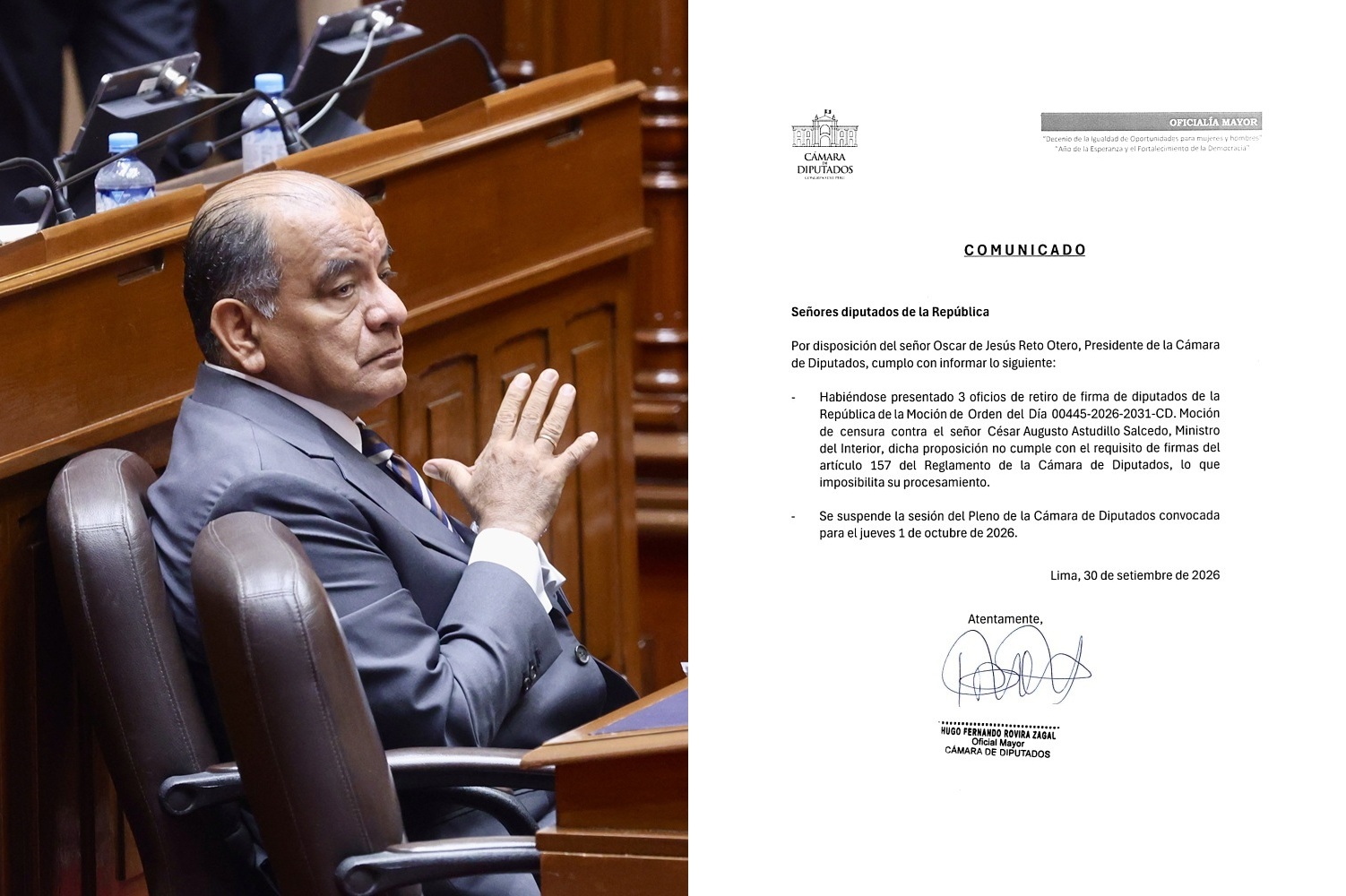
Agencia Peruana de Noticias PRENSAPERU.PE https://www.prensaperu.pe Twitter: @prensaperupe La moción de censura N.º 445-2026-2031-CD contra el ministro del Interior, César Augusto Astudillo Salcedo, quedó imposibilitada de continuar su trámite parlamentario tras la presentación de tres oficios de retiro de firma por parte de diputados de la República. La información fue comunicada por disposición del presidente de la Cámara de Diputados, Oscar de Jesús Reto Otero, determinando que la proposición ya no cumple con el requisito mínimo de firmas establecido en el Artículo 157 del Reglamento de la Cámara, lo que obliga a dar por concluida la iniciativa y suspender la sesión del Pleno convocada para el jueves 1 de octubre de 2026.
Los diputados que retiraron su respaldo son Víctor Piñán, vocero de la bancada, Luis Masco y Heber López. La decisión se produjo horas después de que se confirmara que el partido Obras —uno de los impulsores originales de la moción— dejaría de apoyar la iniciativa tras una reunión con su líder y candidato a la alcaldía de Lima, Ricardo Belmont. El senador Daniel Barragán había anunciado previamente esta determinación política.
La moción había sido presentada el 24 de septiembre con el respaldo conjunto de las bancadas de Juntos por el Perú, Partido Cívico Obras y Partido del Buen Gobierno. El retiro de respaldo de una de las tres fuerzas políticas proponentes rompió el consenso inicial y redujo el apoyo por debajo del umbral reglamentario necesario para mantener vigente el trámite. Este desenlace modifica sustancialmente la agenda política prevista y refleja la fragilidad de las alianzas parlamentarias en el actual contexto institucional.
Desde la perspectiva cuantitativa, los hechos muestran un cambio decisivo:
a) Tres firmas retiradas dejan la moción por debajo del número mínimo requerido reglamentariamente;
b) Tres fuerzas políticas iniciaron la propuesta y una de ellas se desvincula por completo;
c) La sesión plenaria convocada expresamente para debatir la censura queda suspendida;
d) El plazo reglamentario de debate, que debía producirse entre el cuarto y décimo día tras la presentación, se interrumpe antes de iniciarse;
e) La decisión política se produce tras una reunión con un dirigente partidario y candidato electoral, lo que vincula la dinámica parlamentaria con la coyuntura electoral.
Metodológicamente, el análisis se sustenta en el contraste entre el acto formal —comunicado oficial de la Presidencia de la Cámara— y los hechos políticos que lo determinan: la convergencia de intereses partidarios, la influencia de figuras electorales y la aplicación estricta del reglamento como límite al ejercicio del control político.
Entre las cuestiones que plantea este desenlace: la necesidad de fortalecer la transparencia en las decisiones de las bancadas; la conveniencia de revisar los mecanismos de mantenimiento de firmas para evitar que iniciativas de control queden sin trámite por decisiones individuales; y la importancia de desvincular el ejercicio de la función parlamentaria de presiones externas o coyuntura electoral.
DATOS CONCEPTUALES
Retiro de firma: Acto mediante el cual un diputado manifiesta formalmente que deja de respaldar una iniciativa parlamentaria que había suscrito. Cuando la cantidad de firmas desciende por debajo del mínimo establecido, la propuesta no puede continuar su trámite. Fuente: Reglamento de la Cámara de Diputados.
Moción de Orden del Día: Iniciativa escrita que se presenta para ser incluida en la agenda del Pleno y que puede versar sobre asuntos de interés institucional, político o de control. Las de censura son una modalidad específica de estas mociones. Fuente: Reglamento de la Cámara de Diputados.
Requisito de firmas: Cantidad mínima de respaldos necesaria para que una iniciativa sea admitida a trámite. Su finalidad es garantizar que las propuestas cuenten con un respaldo mínimo representativo antes de ocupar la agenda del Pleno. Fuente: Artículo 157 del Reglamento de la Cámara de Diputados.
Suspensión de sesión: Interrupción o cancelación de la reunión del Pleno dispuesta por la Presidencia cuando no se cumplen las condiciones reglamentarias para debatir los asuntos previstos. Fuente: Reglamento de la Cámara de Diputados.
Bancada parlamentaria: Conjunto de diputados pertenecientes a un mismo partido o agrupación política que actúan de manera coordinada en el ejercicio de su función legislativa y de control. Fuente: Ley Orgánica del Poder Legislativo.
DATOS CONTEXTUALES
1.- El retiro de tres firmas demuestra que el trámite de control político depende de respaldos que pueden modificarse en cualquier momento, lo que evidencia vulnerabilidad en la estabilidad de las iniciativas de fiscalización parlamentaria.
2.- La decisión del partido Obras de desvincularse de la moción tras reunirse con su líder y candidato a la alcaldía de Lima pone de manifiesto que la agenda de control puede verse condicionada por cálculos electorales y dinámicas internas de cada organización política.
3.- La suspensión de la sesión del Pleno sin que se haya debatido el fondo de los cuestionamientos al ministro del Interior impide que la ciudadanía conozca los argumentos de ambas partes, lo que reduce la transparencia y la rendición de cuentas públicas.
4.- El cumplimiento estricto del Reglamento ha operado como barrera procedimental, pero no ha resuelto ni descartado las preocupaciones que motivaron la presentación de la moción, dejando abierta la posibilidad de que se replantee en el futuro.
5.- La pérdida del respaldo de una de las tres bancadas proponentes revela que las alianzas entre fuerzas políticas distintas son frágiles y pueden romperse por decisiones internas, sin que medie explicación ante el Pleno o la opinión pública.
Fuente: Agencia Peruana de Noticias PRENSAPERU.PE https://www.prensaperu.pe Twitter: @prensaperupe
Translate
The withdrawal of three signatures leaves the congressional motion of censure against Minister César Astudillo Salcedo without the necessary backing and halts its processing, leading to the suspension of the plenary session scheduled for this Thursday, October 1, 2026.
Peruvian News Agency PRENSAPERU.PE https://www.prensaperu.pe Twitter: @prensaperupe Censure Motion No. 445-2026-2031-CD against the Minister of the Interior, César Augusto Astudillo Salcedo, was rendered unable to proceed through its parliamentary stage following the submission of three notices of withdrawal of signatures by members of the Chamber of Deputies. The information was communicated by order of the President of the Chamber of Deputies, Oscar de Jesús Reto Otero, determining that the proposal no longer meets the minimum signature requirement established in Article 157 of the Chamber’s Regulations, which makes it necessary to conclude the initiative and cancel the Plenary session convened for Thursday, October 1, 2026.
The deputies who withdrew their support are Víctor Piñán, spokesperson for the parliamentary group, Luis Masco, and Heber López. The decision came hours after it was confirmed that the Obras party —one of the original sponsors of the motion— would cease supporting the initiative following a meeting with its leader and candidate for Mayor of Lima, Ricardo Belmont. Senator Daniel Barragán had previously announced this political determination.
The motion had been presented on September 24 with the joint backing of the parliamentary groups of Together for Peru, Civic Works Party, and Good Government Party. The withdrawal of support by one of the three sponsoring political forces broke the initial consensus and reduced backing below the regulatory threshold required to keep the proceeding alive. This outcome substantially alters the anticipated political agenda and reflects the fragility of parliamentary alliances within the current institutional context.
From a quantitative perspective, the events reveal a decisive shift:
a) Three withdrawn signatures leave the motion below the minimum number required under the Regulations;
b) Three political forces initiated the proposal and one has fully disassociated itself;
c) The plenary session called specifically to debate the censure is suspended;
d) The regulatory timeframe for debate, which was to take place between the fourth and tenth day following submission, is interrupted before it could begin;
e) The political decision follows a meeting with a party leader and electoral candidate, linking parliamentary dynamics to the electoral cycle.
Methodologically, the analysis is based on the contrast between the formal act —official communication from the Presidency of the Chamber— and the political events that determined it: the convergence of partisan interests, the influence of electoral figures, and the strict application of the Regulations as a limit on the exercise of political oversight.
Among the issues raised by this outcome: the need to strengthen transparency in parliamentary group decision-making; the advisability of reviewing signature retention mechanisms to prevent oversight initiatives from being halted by individual decisions; and the importance of insulating parliamentary functions from external pressures or electoral considerations.
CONCEPTUAL DATA
Withdrawal of Signature: The formal act by which a deputy declares they no longer support a parliamentary initiative they had previously signed. When the number of signatures falls below the established minimum, the proposal cannot proceed. Source: Regulations of the Chamber of Deputies.
Order of the Day Motion: A written proposal submitted for inclusion in the Plenary agenda, addressing institutional, political, or oversight matters. Censure motions constitute a specific type of this form. Source: Regulations of the Chamber of Deputies.
Signature Requirement: The minimum number of endorsements needed for an initiative to be admitted for processing. Its purpose is to ensure proposals carry a minimum level of representative support before occupying Plenary time. Source: Article 157, Regulations of the Chamber of Deputies.
Suspension of Session: The postponement or cancellation of a Plenary meeting ordered by the Presidency when regulatory conditions for debating scheduled items are not met. Source: Regulations of the Chamber of Deputies.
Parliamentary Group: Deputies belonging to the same party or political organization who act in coordination in exercising legislative and oversight functions. Source: Organic Law of the Legislative Branch.
CONTEXTUAL DATA
1.- The withdrawal of three signatures demonstrates that political oversight proceedings depend on backing that may change at any time, revealing vulnerability in the stability of parliamentary oversight initiatives.
2.- The Obras party’s decision to disengage from the motion after meeting with its leader and Lima mayoral candidate shows that the oversight agenda may be shaped by electoral calculations and internal party dynamics.
3.- Suspending the Plenary session without debating the substance of the allegations against the Minister of the Interior prevents the public from hearing arguments from both sides, diminishing transparency and public accountability.
4.- Strict compliance with the Regulations has acted as a procedural barrier, but has not resolved or dismissed the concerns that prompted the motion, leaving open the possibility that it may be reintroduced.
5.- The loss of support from one of the three sponsoring groups reveals that cross-party alliances are fragile and may be dissolved through internal decisions without explanation being provided to the Plenary or public opinion.
Source: Peruvian News Agency PRENSAPERU.PE https://www.prensaperu.pe Twitter: @prensaperupe