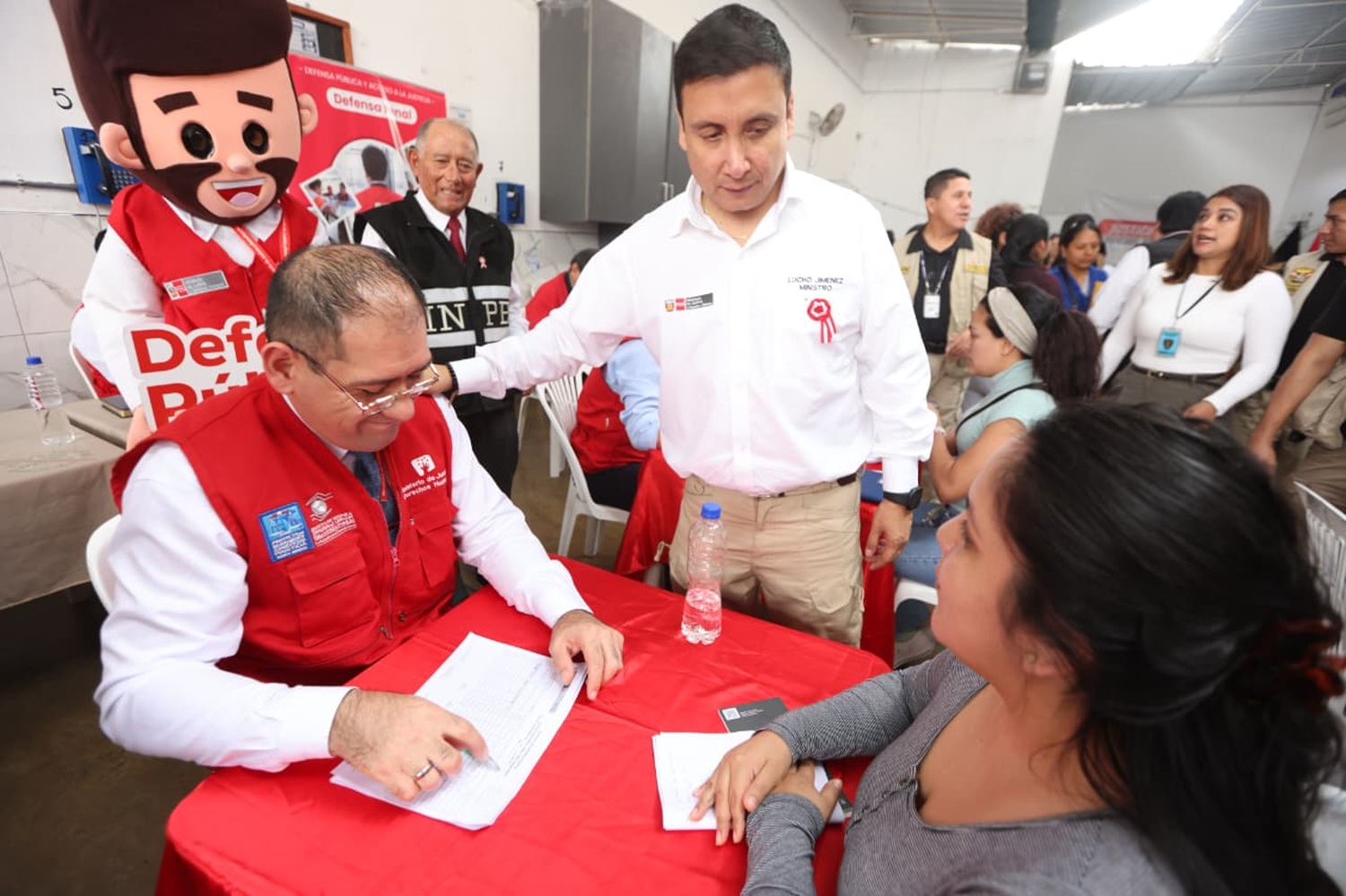
Agencia Peruana de Noticias PRENSAPERU.PE https://www.prensaperu.pe Twitter: @prensaperupe En el establecimiento penitenciario Anexo Mujeres Chorrillos, el ministro de Justicia y Derechos Humanos, Luis Jiménez Borra, firmó la Resolución Ministerial que da carácter oficial a la campaña “Justicia Móvil – Servicios sin barreras”.
I.- DATOS CONCEPTUALES
Justicia accesible: condición por la cual toda persona puede ejercer sus derechos sin obstáculos, independientemente de su situación o lugar donde se encuentre.
Personas privadas de libertad: ciudadanas y ciudadanos que se hallan en establecimientos penitenciarios, manteniendo plenamente sus derechos fundamentales salvo aquellos limitados por la ley debido a la medida de privación de libertad.
Resolución Ministerial: norma administrativa que ordena y regula acciones dentro del sector, dándoles validez oficial y continuidad.
De otro lado, esta iniciativa está diseñada para llevar directamente servicios especializados:
1.- Orientación y patrocinio jurídico.
2.- Trámites registrales.
3.- Atención notarial.
4.- Gestión documental y otros apoyos necesarios.
Todo con el fin de reducir las barreras que dificultan el ejercicio de derechos mientras cumplen condena o esperan resolución.
II.- ORGANIZACIÓN Y COORDINACIÓN INSTITUCIONAL
Según lo establecido, corresponde al Instituto Nacional Penitenciario – INPE la conducción operativa de la campaña. Para lograrlo, trabajará de forma articulada con:
1.- Dirección General de Defensa Pública y Acceso a la Justicia.
2.- Superintendencia Nacional de Registros Públicos – SUNARP.
3.- Consejo del Notariado.
4.- Otras entidades que puedan colaborar.
DEFINICIONES OPERATIVAS
Defensa Pública: servicio gratuito y obligatorio que brinda asesoría y representación legal a quienes no pueden contratar un abogado particular.
Coordinación interinstitucional: trabajo conjunto para que los procedimientos no se dupliquen ni se fragmenten, sino que se complementen.
Patrocinio legal: acompañamiento y defensa técnica por parte de profesionales autorizados.
Como señaló el ministro Luis Jiménez Borra esta forma de organización permite que la oferta sea completa y llegue realmente a quienes lo necesitan.
III.- SEGUIMIENTO CARÁCTER PERMANENTE
Para asegurar resultados y continuidad, se estableció que el INPE remita informes semestrales al Ministerio de Justicia y Derechos Humanos. Allí detallará ejecución, avances y dificultades halladas.
El ministro resaltó: “No basta con tener una idea o entusiasmo. Esta medida debe consolidarse como política de Estado, no solo de un gobierno, para que permanezca en el tiempo”.
¿Qué es una política de Estado?
Conjunto de acciones que superan períodos de gobierno y se mantienen vigentes durante varias administraciones gubernamentales por ser consideradas necesarias y permanentes para todo el país.
IV.- ORIGEN DE LA CAMPAÑA: DE LA SUPERVISIÓN A LA ACCIÓN
La campaña no surgió al azar, se derivó directamente de las visitas y supervisiones realizadas en establecimientos penitenciarios. Durante este proceso se detectó que la falta de acceso a servicios legales y administrativos agrava la situación de las personas internas.
Como paso previo, a manera de ‘Programas Pilotos’ ya se realizaron atenciones similares en más de 10 penales del país, lo que sirvió como experiencia para estructurar esta campaña nacional.
V.- DESARROLLO DE LA JORNADA
En la actividad realizada en Anexo Mujeres Chorrillos, las internas recibieron atención integral:
1.- Asesoría legal y defensa.
2.- Trámites registrales.
3.- Actuaciones notariales.
4.- Apoyo en gestiones documentarias.
5.- Orientación especializada según su caso.
Estuvieron presentes las principales autoridades vinculadas participando de la actividad, como: el presidente del INPE, Raúl Inga Garay; el superintendente adjunto de la SUNARP, Pablo Rioja Cueva; el director general de Defensa Pública y Acceso a la Justicia, Abel Hurtado Espinoza; el decano del Colegio de Notarios de Lima, Alejandro Collantes Becerra; entre otras autoridades.
VI.- CONCLUSIONES
1.- La campaña “Justicia Móvil” rompe el aislamiento institucional y convierte el acceso a la justicia en una realidad también dentro de los penales.
2.- La coordinación entre INPE, Defensa Pública, SUNARP y notariado permite ofrecer atención integral, evitando que cada trámite sea complejo o imposible.
3.- Establecer informes periódicos y carácter de política de Estado garantiza seguimiento y evita que la medida quede solo como acción momentánea.
4.- Nacida de la supervisión directa, responde a problemas reales detectados, demostrando que la vigilancia oficial se transforma en soluciones concretas.
Fuente: Agencia Peruana de Noticias PRENSAPERU.PE https://www.prensaperu.pe Twitter: @prensaperupe
Translate
“Mobile Justice – Services without Barriers! Official oversight becomes solutions for persons deprived of liberty; Ministry of Justice and Human Rights launches campaign bringing legal defence, registry and notary services to prisons nationwide.”
Peruvian News Agency PRENSAPERU.PE https://www.prensaperu.pe Twitter: @prensaperupe At the Chorrillos Women’s Annex Prison facility, the Minister of Justice and Human Rights, Luis Jiménez Borra, signed the Ministerial Resolution that gives official status to the campaign “Mobile Justice – Services without Barriers”.
I.- CONCEPTUAL DATA
Accessible justice: the condition whereby every person may exercise their rights without obstacles, regardless of their situation or place of residence.
Persons deprived of liberty: citizens held in prison facilities, who retain all their fundamental rights except those restricted by law as a consequence of the deprivation‑of‑liberty measure.
Ministerial Resolution: an administrative regulation that orders and governs actions within the sector, granting them official validity and continuity.
Furthermore, this initiative is designed to deliver specialized services directly:
1.- Legal guidance and representation.
2.- Registry procedures.
3.- Notarial services.
4.- Document processing and other necessary support.
All aimed at reducing barriers that hinder the exercise of rights while serving sentences or awaiting resolution.
II.- ORGANIZATION AND INTER‑INSTITUTIONAL COORDINATION
According to the provisions, the National Penitentiary Institute – INPE is responsible for the operational management of the campaign. To this end, it shall work in coordination with:
1.- General Directorate of Public Defence and Access to Justice.
2.- National Superintendency of Public Registries – SUNARP.
3.- Notarial Council.
4.- Other collaborating bodies.
OPERATIONAL DEFINITIONS
Public Defence: free and mandatory service providing advice and legal representation to persons unable to retain private counsel.
Inter‑institutional coordination: joint work ensuring procedures are complementary rather than duplicated or fragmented.
Legal representation: technical support and defence provided by qualified professionals.
As stated by Minister Luis Jiménez Borra, this organizational model ensures comprehensive coverage and effective delivery to those who require it.
III.- MONITORING AND PERMANENCE
To guarantee results and continuity, INPE shall submit semi‑annual reports to the Ministry of Justice and Human Rights detailing implementation progress and difficulties encountered.
The Minister emphasized: “An idea or willingness alone is insufficient. This measure must be consolidated as a State policy, not merely a government initiative, so it endures over time”.
What is a State policy?
A set of measures that transcend specific administrations and remain in force across successive governments, because they are deemed essential and permanent for the country.
IV.- ORIGIN OF THE CAMPAIGN: FROM INSPECTION TO ACTION
The initiative was not conceived arbitrarily; it derives directly from monitoring visits and inspections carried out in prison facilities. During those activities, it was confirmed that lack of access to legal and administrative services worsens the situation of persons deprived of liberty.
Previously, under pilot schemes, similar services were already provided in more than ten prisons nationwide — experience that served as the basis for structuring this national campaign.
V.- DEVELOPMENT OF THE ACTIVITY
At the event held at the Chorrillos Women’s Annex Prison, inmates received comprehensive care:
1.- Legal advice and defence.
2.- Registry procedures.
3.- Notarial acts.
4.- Assistance with documentation formalities.
5.- Specialized guidance tailored to individual cases.
Key authorities attended and participated: the President of INPE, Raúl Inga Garay; the Deputy Superintendent of SUNARP, Pablo Rioja Cueva; the Director‑General of Public Defence and Access to Justice, Abel Hurtado Espinoza; the Dean of the Lima Notarial College, Alejandro Collantes Becerra; among other officials.
VI.- CONCLUSIONS
1.- The “Mobile Justice” campaign breaks institutional isolation and makes access to justice a reality also within prison facilities.
2.- Coordination between INPE, Public Defence, SUNARP and the notarial profession enables comprehensive care, preventing procedures from becoming unduly complex or unfeasible.
3.- Establishment of periodic reporting and the State‑policy approach ensures follow‑up and prevents the measure from remaining merely temporary.
4.- Developed from direct monitoring, it responds to verified problems and demonstrates how official oversight can be transformed into concrete solutions.
Source: Peruvian News Agency PRENSAPERU.PE https://www.prensaperu.pe Twitter: @prensaperupe