
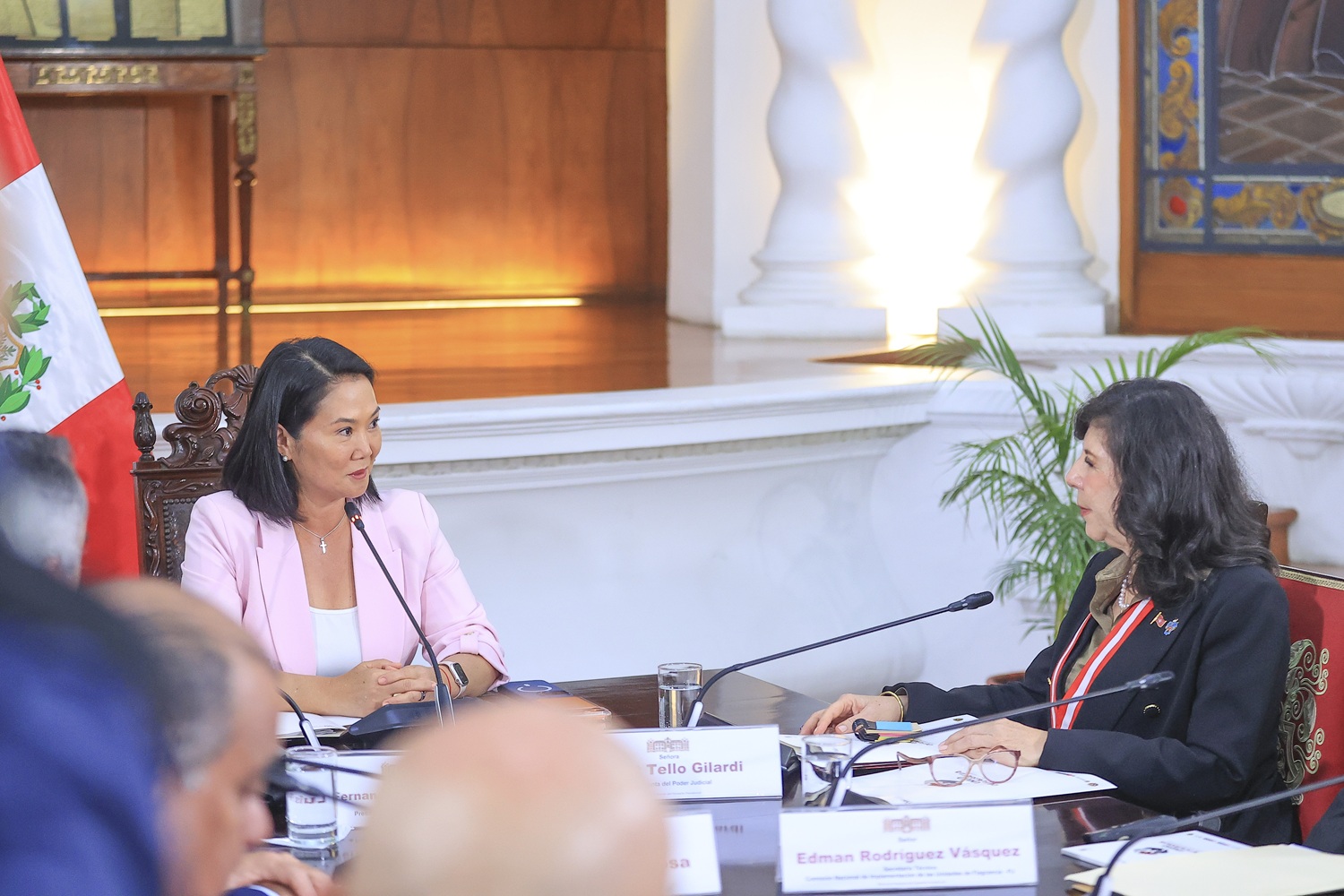
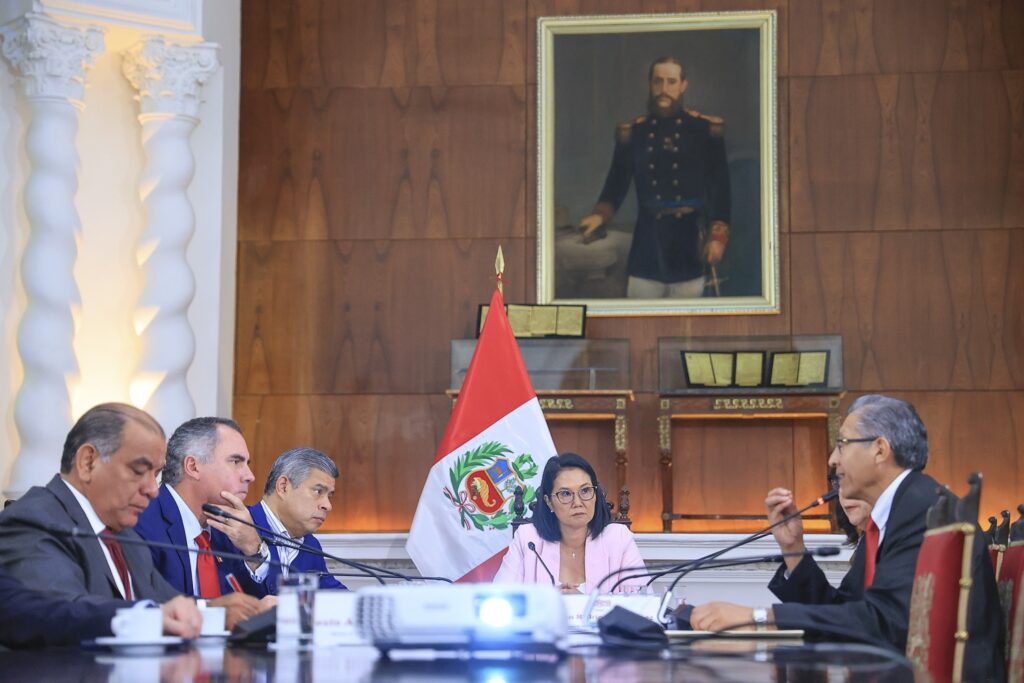
Agencia Peruana de Noticias PRENSAPERU.PE https://www.prensaperu.pe Twitter: @prensaperupe En Palacio de Gobierno se llevó a cabo una reunión de trabajo de alto nivel entre la jefa de Estado, presidenta Keiko Fujimori Higuchi, y la presidenta del Poder Judicial, la magistrada Janet Tello Gilardi, con la presencia del presidente del Consejo de Ministros, Luis Galarreta Velarde, y los titulares de las carteras de Defensa, Rafael Belaúnde Llosa; del Interior, César Astudillo Salcedo; y de Justicia y Derechos Humanos, Ernesto Álvarez Miranda. Por parte del Poder Judicial acompañó también la jefa de Gabinete de Asesores, Susana Silva Hasemback, junto a asesores técnicos.
El encuentro tuvo como eje central la articulación de esfuerzos contra la inseguridad ciudadana y la criminalidad organizada. En ese marco, se abordó de manera prioritaria el fortalecimiento del Sistema Nacional de Flagrancia, herramienta que permite juzgar con celeridad los delitos cometidos en el momento o inmediatamente después de su comisión. Asimismo, se trató el avance del Sistema Nacional Especializado de Justicia para la Protección y Sanción de la Violencia contra las Mujeres e Integrantes del Grupo Familiar (SNEJ), así como la implementación de la Justicia Itinerante, mecanismo que acerca los servicios judiciales a poblaciones alejadas o de difícil acceso.
En ese sentido, la presidenta Fujimori resaltó que las instituciones del Estado deben funcionar como un solo equipo con el fin de recuperar el orden y la paz en el país. Subrayó, con claridad, que toda coordinación se enmarca en el absoluto respeto a la autonomía e independencia de cada poder del Estado: la colaboración no significa subordinación, sino trabajo conjunto dentro de las atribuciones propias de cada institución. “Tenemos que ver la forma de cómo podemos colaborar para que todo el sistema de justicia pueda tener una mejor capacidad de enfrentar a estos flagelos que tanto daño hacen a la sociedad”, afirmó.
Por su parte, la magistrada Janet Tello Gilardi destacó que, desde que asumió la presidencia del Poder Judicial, su gestión ha impulsado de manera constante la colaboración interinstitucional con el Ejecutivo y el Legislativo. Gracias a ese trabajo conjunto, se lograron avances concretos como la aprobación del Sistema Nacional de Flagrancia y el marco normativo para la Justicia Itinerante. La titular del Poder Judicial agradeció el espacio de diálogo y ratificó el compromiso de su institución: “Sepan que la posición del Poder Judicial ha sido siempre mantener una colaboración estrecha que permita implementar políticas de Estado, especialmente en estos momentos de lucha contra la inseguridad ciudadana”. En ese sentido, saludó expresamente el respaldo de la jefa de Estado a las unidades de flagrancia, a la Justicia Itinerante y al sistema especializado contra la violencia familiar y de género.
De otro lado, ambas autoridades coincidieron en que los grandes problemas nacionales —criminalidad, violencia, inseguridad— no se resuelven desde un solo poder: requieren que cada uno cumpla su rol, comparta información y avance en la misma dirección, sin renunciar a su independencia ni abandonar su misión.
DATOS CONCEPTUALES
Autonomía e independencia de poderes: Principio fundamental de la democracia por el cual el Poder Ejecutivo, el Legislativo y el Judicial tienen funciones propias y no se subordinan entre sí. La colaboración no anula la independencia: la refuerza, porque cada uno actúa dentro de su competencia.
Sistema Nacional de Flagrancia: Mecanismo procesal que permite que los delitos cometidos en el momento o con inmediatez sean investigados y juzgados con celeridad. Busca que la sanción llegue rápido, desincentivando la impunidad.
Justicia Itinerante: Servicio mediante el cual equipos judiciales se desplazan a zonas rurales, fronterizas o de difícil acceso para atender casos, brindar orientación y acercar el Estado a quienes viven lejos de las capitales de región.
SNEJ: Sistema Nacional Especializado de Justicia para la Protección y Sanción de la Violencia contra las Mujeres e Integrantes del Grupo Familiar. Diseñado para atender con enfoque especializado los delitos de violencia doméstica, sexual y de género, evitando revictimización.
Colaboración interinstitucional: Acción coordinada entre organismos públicos que, respetando sus atribuciones legales, trabajan por metas comunes. No es fusión de poderes, sino alineamiento de esfuerzos.
Políticas de Estado: Decisiones y acciones de largo plazo que trascienden gobiernos de turno; se basan en acuerdos nacionales y buscan soluciones permanentes a problemas estructurales.
DATOS RELEVANTES
1.- La reunión entre el Poder Ejecutivo y el Poder Judicial marca un hito: por primera vez se plantea con claridad que la lucha contra la inseguridad requiere que ambos poderes avancen juntos, sin que uno absorba ni condicione al otro.
2.- El respaldo expresado a las unidades de flagrancia confirma que la celeridad en la justicia es una prioridad compartida: la rapidez en juzgar es hoy la mejor respuesta frente a la sensación de impunidad que vive la ciudadanía.
3.- La Justicia Itinerante y el sistema especializado contra la violencia familiar demuestran que la seguridad no se reduce solo a presencia policial: también es llevar justicia a donde no llega y proteger a quienes suelen quedar invisibilizados.
4.- Queda reafirmado que la colaboración entre poderes no atenta contra la independencia: por el contrario, la fortalece, pues cada institución actúa con mayor eficacia cuando sabe que no está sola.
5.- Lo acordado es el inicio de una ruta, no la solución definitiva. Su éxito dependerá de que los acuerdos se transformen en presupuesto, personal, infraestructura y resultados visibles en cada rincón del país.
Fuente: Agencia Peruana de Noticias PRENSAPERU.PE https://www.prensaperu.pe Twitter: @prensaperupe
Translate
“Unity Without Subordination: The Executive and the Judiciary Work as a Team While Respecting Independence. In Flagrante Delicto, Itinerant Justice, and Family Protection Form the Tripod of Peru’s Policy for Modernizing and Democratizing Judicial Service.”
Peruvian News Agency PRENSAPERU.PE https://www.prensaperu.pe Twitter: @prensaperupe A high‑level working meeting was held at the Government Palace between the Head of State, President Keiko Fujimori Higuchi, and the President of the Judiciary, Magistrate Janet Tello Gilardi, with the presence of the President of the Council of Ministers, Luis Galarreta Velarde, and the heads of the portfolios of Defense, Rafael Belaúnde Llosa; Interior, César Astudillo Salcedo; and Justice and Human Rights, Ernesto Álvarez Miranda. Also accompanying the President of the Judiciary was the Head of the Advisory Cabinet, Susana Silva Hasemback, together with technical advisors.
The central focus of the meeting was the coordination of efforts against citizen insecurity and organized crime. Within this framework, priority was given to strengthening the National In Flagrante Delicto System, a tool enabling crimes committed in the act or immediately thereafter to be tried with celerity. Progress was also addressed regarding the National Specialized Justice System for the Protection and Punishment of Violence Against Women and Members of the Family Group (SNEJ), as well as the implementation of Itinerant Justice, a mechanism bringing judicial services to remote or hard‑to‑reach populations.
In this regard, President Fujimori emphasized that State institutions must function as a single team for the purpose of restoring order and peace throughout the country. She clearly underscored that all coordination takes place within full respect for the autonomy and independence of each branch of State: collaboration does not mean subordination, but rather joint work within the proper sphere of authority of each institution. “We must determine how we can collaborate so that the entire justice system is better equipped to confront these scourges that harm society so deeply,” she stated.
For her part, Magistrate Janet Tello Gilardi highlighted that since assuming the presidency of the Judiciary, her administration has consistently promoted inter‑institutional collaboration with the Executive and Legislative branches. Through this joint effort, concrete achievements were reached, including the approval of the National In Flagrante Delicto System and the regulatory framework for Itinerant Justice. The Head of the Judiciary thanked the forum for dialogue and reaffirmed her institution’s commitment: “Be assured that the Judiciary’s position has always been to maintain close collaboration that enables the implementation of State policies, especially at this time of struggle against citizen insecurity.” In this vein, she expressly welcomed the Head of State’s support for in flagrante delicto units, Itinerant Justice, and the specialized system addressing family and gender‑based violence.
Furthermore, both authorities agreed that major national problems —criminality, violence, insecurity— cannot be resolved by a single branch alone: they require each to fulfill its role, share information, and advance in the same direction, without renouncing independence or abandoning their mission.
CONCEPTUAL DATA
Autonomy and independence of branches: Fundamental principle of democracy whereby the Executive, Legislative, and Judicial branches have distinct functions and are not subordinated to one another. Collaboration does not annul independence; it reinforces it, since each acts within its sphere of competence.
National In Flagrante Delicto System: Procedural mechanism enabling crimes committed in the act or immediately thereafter to be investigated and tried with celerity. It seeks to ensure prompt sentencing, thereby deterring impunity.
Itinerant Justice: Service through which judicial teams travel to rural, border, or hard‑to‑reach areas to hear cases, provide guidance, and bring the State closer to those living far from regional capitals.
SNEJ: National Specialized Justice System for the Protection and Punishment of Violence Against Women and Members of the Family Group. Designed to address domestic, sexual, and gender‑based crimes with specialized focus, preventing re‑victimization.
Inter‑institutional collaboration: Coordinated action among public bodies that, while respecting their legal mandates, work toward shared goals. It is not a merging of branches, but an alignment of efforts.
State policies: Long‑term decisions and actions that transcend individual administrations; founded on national consensus and aimed at permanent solutions to structural problems.
RELEVANT FINDINGS
1.- The meeting between the Executive and Judicial branches marks a milestone: for the first time it has been clearly articulated that combating insecurity requires both branches to advance together, without one absorbing or dictating to the other.
2.- The expressed support for in flagrante delicto units confirms that celerity in justice is a shared priority: swift adjudication is today the strongest response to the public’s perception of impunity.
3.- Itinerant Justice and the specialized family protection system demonstrate that security extends beyond police presence: it also means bringing justice where it has not reached and protecting those who are often rendered invisible.
4.- It is reaffirmed that collaboration between branches does not undermine independence; on the contrary, it strengthens it, as each institution acts with greater effectiveness knowing it is not alone.
5.- What has been agreed is the beginning of a path, not the definitive solution. Success will depend on translating commitments into budget, personnel, infrastructure, and visible results in every corner of the nation.
Source: Peruvian News Agency PRENSAPERU.PE https://www.prensaperu.pe Twitter: @prensaperupe