
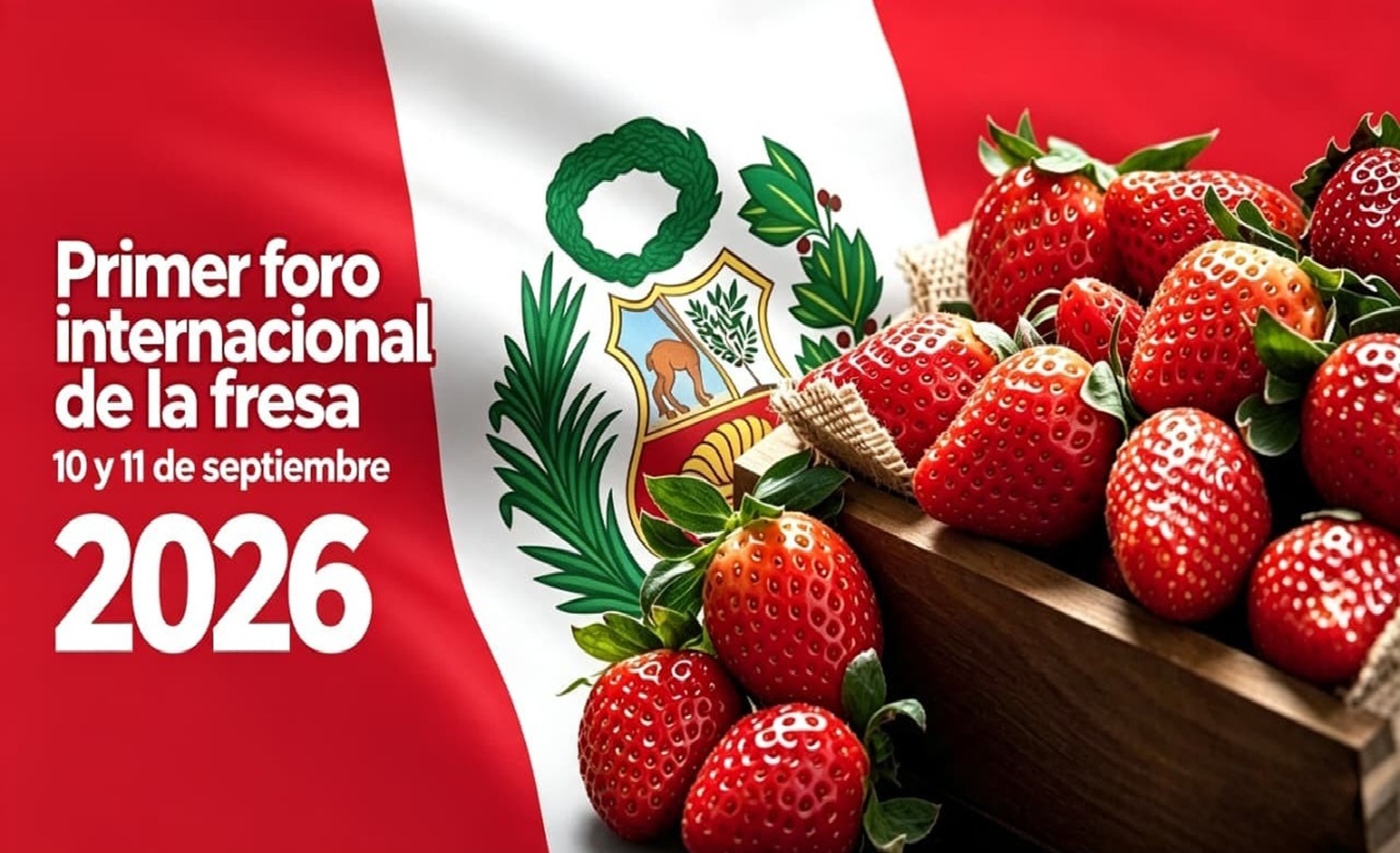
Agencia Peruana de Noticias PRENSAPERU.PE https://www.prensaperu.pe Twitter: @prensaperupe Las exportaciones peruanas de fresa han registrado un impulso notable en el primer semestre de 2026, consolidándose como uno de los productos agrícolas con mayor dinamismo del país. Entre enero y junio, los envíos sumaron US$ 21 millones 027 mil, lo que representa un crecimiento de 35.5% respecto al mismo periodo del año anterior. Así lo informó el Centro de Investigación de Economía y Negocios Globales de la Asociación de Exportadores (CIEN‑ADEX), entidad que monitorea y analiza el comportamiento del comercio exterior peruano.
Este avance se explica principalmente por una mayor demanda procedente de Estados Unidos, el principal comprador de la fruta peruana. En el primer semestre, EE.UU. adquirió fresas por US$ 11 millones, un incremento de 96% comparado con los US$ 5 millones 616 mil registrados en 2025. Solamente este mercado concentra el 52.3% del total exportado. Le siguen Canadá (US$ 4 millones 628 mil), Japón (US$ 2 millones 419 mil), Guatemala (US$ 1 millón 034 mil) y Corea del Sur (US$ 823 mil), entre otros destinos.
Por tipo de presentación, la fresa congelada —entera o en trozos— es la de mayor participación: US$ 20 millones 377 mil, equivalente al 97% del valor total. En proporciones menores se comercializan fresa deshidratada, fresca y en forma de pulpa o puré. Esta predominancia del producto congelado responde a que permite mayor durabilidad, facilita el transporte hacia mercados lejanos y mantiene cualidades nutritivas y organolépticas.
A nivel regional, los principales protagonistas son Lima (US$ 9 millones 991 mil), La Libertad (US$ 4 millones 254 mil), Áncash (US$ 3 millones 569 mil), Callao (US$ 2 millones 153 mil), Ica (US$ 640 mil) y Piura (US$ 415 mil). La distribución geográfica revela que la producción y exportación de fresa se extiende por costa y sierra, mostrando el potencial agrícola de distintas zonas del país.
Los resultados de 2026 se enmarcan en una tendencia sostenida: durante todo el 2025, las exportaciones superaron los US$ 60 millones, con un crecimiento interanual de 32.4%. En ese año, 35 empresas peruanas colocaron el producto en 28 naciones del mundo. Entre 2021 y 2025, el valor de los envíos creció a una tasa promedio anual de 11.5%. Actualmente, Perú ocupa el puesto 16 entre los proveedores mundiales de fresa, en un mercado global valorado en US$ 6 mil 300 millones. Los principales importadores son EE.UU., Alemania y Canadá; mientras que España, Egipto y México lideran como exportadores a nivel internacional.
Para consolidar este crecimiento y fortalecer la articulación entre el Estado, el sector privado y los propios agricultores, ADEX organiza el Primer Foro Internacional de la Fresa, que se realizará el 10 y 11 de septiembre en la Universidad Nacional José Faustino Sánchez Carrión, en Huacho, Lima. El encuentro busca trazar estrategias conjuntas para ampliar mercados, mejorar la calidad y abrir nuevas oportunidades a los productores.
DATOS CONCEPTUALES
Valor FOB: Significa “Libre a Bordo”. Es el valor de la mercancía en el puerto de embarque, sin incluir gastos de transporte internacional ni seguro. Es la referencia oficial para medir las exportaciones.
Variación porcentual: Comparación entre dos periodos que muestra cuánto ha aumentado o disminuido un indicador. En este caso, 35.5% significa que las ventas crecieron más de un tercio respecto al año anterior.
Participación de mercado: Porcentaje que representa cada comprador sobre el total exportado. EE.UU. con 52.3% es el socio principal, lo que da oportunidad pero también exige diversificar destinos.
Tasa de crecimiento promedio anual: Es el ritmo constante de aumento durante varios años. 11.5% anual confirma que el crecimiento no es eventual, sino sostenido en el tiempo.
Articulación público‑privada: Coordinación entre gobierno, empresas y productores para trabajar en un mismo objetivo. El Foro Internacional de la Fresa es una expresión de esta alianza.
CONCLUSIONES
1.- La fresa se ha consolidado como un producto estrella de la agroexportación peruana, con un crecimiento de 35.5% en el primer semestre de 2026 y una tendencia sostenida de más de 11% anual desde 2021.
2.- Estados Unidos es el motor principal de este avance, duplicando sus compras y absorbiendo más de la mitad del total exportado; sin embargo, la alta concentración en un solo mercado hace necesario diversificar hacia Asia, América Latina y Europa.
3.- La fresa congelada representa el 97% de los envíos, demostrando que la transformación y conservación del producto amplían su alcance y vida útil, permitiendo llegar a mercados lejanos.
4.- Perú avanza firmemente en el escenario internacional —puesto 16 mundial— y el Primer Foro Internacional de la Fresa en Huacho es la oportunidad para fortalecer la cadena productiva, unir a los actores y proyectar al país hacia los primeros lugares como proveedor global.
Fuente: Agencia Peruana de Noticias PRENSAPERU.PE https://www.prensaperu.pe Twitter: @prensaperupe
Translate
Huacho will be the center of the world: on September 10 and 11, the First International Strawberry Forum will bring together producers, the government, and businesses. Peru is already the world’s 16th-largest supplier, and Peruvian strawberries are capturing markets in 28 countries.
Peruvian News Agency PRENSAPERU.PE https://www.prensaperu.pe Twitter: @prensaperupe Peru’s strawberry exports have registered remarkable growth in the first half of 2026, consolidating as one of the country’s most dynamic agricultural products. Between January and June, shipments totaled US$ 21.027 million, representing an increase of 35.5% compared with the same period the previous year. This was reported by the Center for Research on Global Economy and Business of the Exporters’ Association (CIEN‑ADEX), the entity that monitors and analyzes Peru’s foreign trade performance.
This progress is driven primarily by increased demand from the United States, the main buyer of Peruvian fruit. In the first half, the U.S. purchased strawberries for US$ 11 million, an increase of 96% compared with the US$ 5.616 million recorded in 2025. This market alone accounts for 52.3% of total exports. It is followed by Canada (US$ 4.628 million), Japan (US$ 2.419 million), Guatemala (US$ 1.034 million), and South Korea (US$ 823 thousand), among other destinations.
By presentation form, frozen strawberries —whole or in pieces— account for the largest share: US$ 20.377 million, equivalent to 97% of total value. In smaller quantities, dried, fresh, and pulp or purée forms are marketed. The predominance of the frozen product reflects its longer shelf life, easier transport to distant markets, and retention of nutritional and organoleptic qualities.
By region, the leading producers are Lima (US$ 9.991 million), La Libertad (US$ 4.254 million), Áncash (US$ 3.569 million), Callao (US$ 2.153 million), Ica (US$ 640 thousand), and Piura (US$ 415 thousand). The geographic distribution shows that strawberry production and exports extend across the coast and highlands, demonstrating agricultural potential across different areas of the country.
The 2026 results form part of a sustained trend: throughout 2025, exports exceeded US$ 60 million, with year‑on‑year growth of 32.4%. That year, 35 Peruvian companies placed the product in 28 countries worldwide. Between 2021 and 2025, export value grew at an average annual rate of 11.5%. Peru currently ranks 16th among global strawberry suppliers, in a world market valued at US$ 6.3 billion. The largest importers are the U.S., Germany, and Canada; while Spain, Egypt, and Mexico lead as international exporters.
To consolidate this growth and strengthen coordination between the State, the private sector, and farmers themselves, ADEX is organizing the First International Strawberry Forum, to be held on September 10–11 at the Universidad Nacional José Faustino Sánchez Carrión in Huacho, Lima. The meeting aims to develop joint strategies to expand markets, improve quality, and open new opportunities for producers.
CONCEPTUAL DATA
FOB Value: Means “Free On Board”. It is the value of goods at the port of shipment, excluding international freight and insurance costs. It is the official reference standard for measuring export figures.
Percentage Variation: Comparison between two periods showing how much an indicator has increased or decreased. In this case, 35.5% means sales grew by more than one‑third compared with the previous year.
Market Share: The proportion of total exports represented by each buyer. At 52.3%, the U.S. is the main trading partner — an opportunity, but also a signal to diversify toward other destinations.
Average Annual Growth Rate: The steady pace of increase over several years. The 11.5% annual figure confirms that growth is not temporary but sustained over time.
Public‑Private Coordination: Collaboration between government, businesses, and producers working toward shared goals. The International Strawberry Forum is one expression of this alliance.
CONCLUSIONS
1.- Strawberries have consolidated as a flagship Peruvian agro‑export product, with 35.5% growth in the first half of 2026 and a sustained trend of over 11% annual growth since 2021.
2.- The United States is the primary engine of this expansion, doubling purchases and absorbing more than half of total exports; however, high concentration in a single market makes diversification toward Asia, Latin America, and Europe essential.
3.- Frozen strawberries represent 97% of shipments, demonstrating that processing and preservation extend reach and shelf life, enabling access to distant markets.
4.- Peru is steadily advancing in the international arena — currently ranked 16th globally — and the First International Strawberry Forum in Huacho offers the opportunity to strengthen the value chain, unite stakeholders, and position the country among the world’s leading suppliers.
Source: Peruvian News Agency PRENSAPERU.PE https://www.prensaperu.pe Twitter: @prensaperupe