
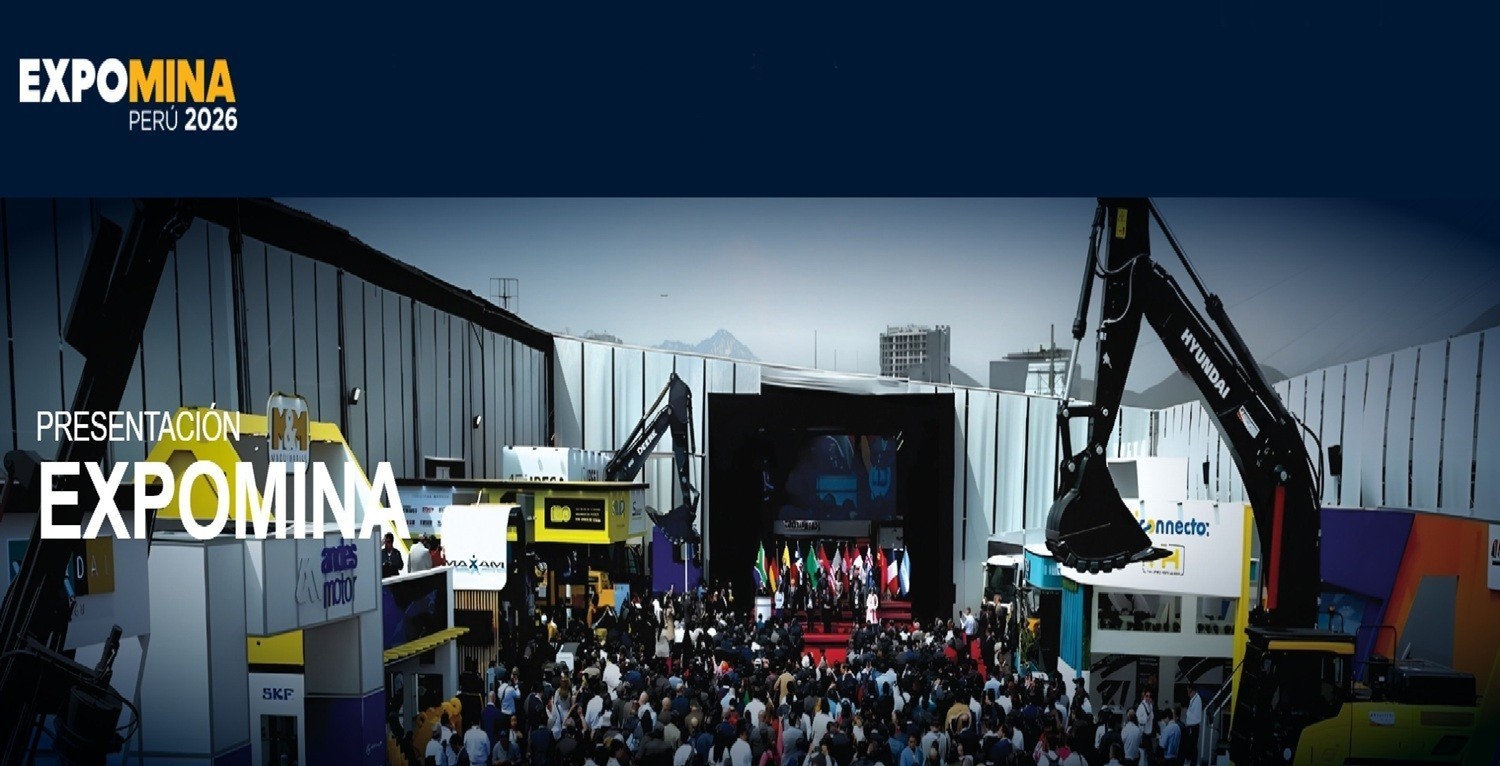
Agencia Peruana de Noticias PRENSAPERU.PE https://www.prensaperu.pe Twitter: @prensaperupe Tras nueve ediciones exitosas y más de 18 años de trayectoria consolidada, EXPOMINA PERÚ se reafirma como el encuentro comercial más relevante de la industria extractiva en la región y uno de los más influyentes a escala mundial. Su Décima Edición se desarrollará en el Centro de Exposiciones Jockey, Lima, convirtiéndose durante tres días en el principal punto de convergencia entre oferta y demanda, tecnología, capital y conocimiento. El recinto de 49,200 metros cuadrados albergará más de 1,250 stands y delegaciones provenientes de todos los continentes, proyectando recibir a más de 85,000 visitantes, entre profesionales, inversores, autoridades y representantes de la cadena de valor minera.
El evento va mucho más allá de una simple exhibición de equipos y servicios: funciona como un verdadero motor de integración económica. En su marco se desarrollan iniciativas de alto nivel: la VIII Cumbre Internacional de Minería de las Américas — AMERICA MINING SUMMIT, referente analítico y estratégico del sector; el Mining Investment America (MIA) 2026, espacio dedicado exclusivamente a la atracción y formalización de capitales; la 7ma Rueda Internacional de Negocios, mecanismo directo de vinculación comercial; el III Congreso Latinoamericano de Logística Minera, clave para la eficiencia y reducción de costos operativos; además de encuentros especializados como Mantemin, Processmin, el Congreso CESCO y actividades de la Society for Mining, Metallurgy and Exploration (SME), que reúnen a expertos mundiales para compartir avances técnicos, normativos y científicos. Todo este conjunto conforma un ecosistema donde se definen tendencias, se cierran acuerdos y se proyecta el desarrollo económico basado en recursos naturales.
Un estudio independiente realizado por Ipsos en 2026, titulado Revisión y Análisis Comparativo de Ferias Mineras 2024–2026, ha posicionado a EXPOMINA PERÚ dentro del Top 5 mundial de eventos del rubro. La investigación evaluó la infraestructura, alcance y dimensión comercial de ferias en Asia, Europa, América, África y Oceanía, tomando como criterios el número de expositores y stands habilitados —únicamente considerando aquellos encuentros que superan los 400 espacios de exhibición. Con más de 1,250 stands, el evento peruano ocupa el quinto puesto a nivel global, solo precedido por encuentros de gran tradición como Bauma China, MINExpo, PDAC Expo y Expomin, y se consolida entre los tres referentes más importantes de América Latina. Este reconocimiento no solo valida su capacidad organizativa, sino que confirma al Perú como hub internacional de negocios mineros, elevando su visibilidad y atractivo como destino seguro y competitivo para la inversión.
La minería constituye el pilar estructural de la economía peruana, su principal fuente de divisas, generadora de empleo y base fiscal para el financiamiento del desarrollo nacional. El país posee una riqueza geológica única, siendo uno de los mayores productores mundiales de cobre, plata, zinc, plomo y oro, y se ha convertido en proveedor estratégico de minerales críticos para la transición energética global. Sin embargo, la abundancia de recursos representa también una responsabilidad: transformar esa dotación natural en bienestar sostenible, promoviendo una actividad legal, técnica, ambiental y socialmente responsable.
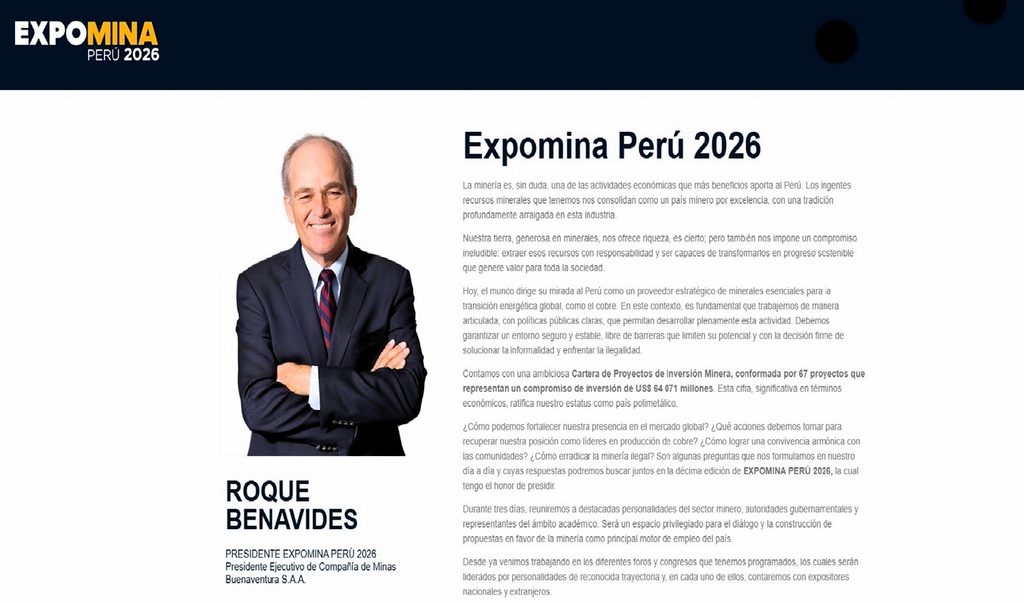
En este contexto, el presidente de EXPOMINA PERÚ 2026 y presidente ejecutivo de Compañía de Minas Buenaventura S.A.A., Roque Benavides, señala que el mundo mira al Perú como aliado indispensable para el suministro de minerales esenciales. Para aprovechar esta oportunidad histórica, es necesario fortalecer la institucionalidad, definir marcos normativos estables, combatir decididamente la informalidad y la minería ilegal, y garantizar un entorno seguro y predecible para las inversiones. Actualmente, la Cartera de Proyectos de Inversión Minera del país suma 67 iniciativas, que representan un compromiso de capital por US$ 64,071 millones, cifra que refleja la confianza internacional y el potencial de crecimiento que aún queda por materializar.
EXPOMINA PERÚ 2026 se plantea como el espacio ideal para responder a los grandes desafíos del sector: cómo recuperar el liderazgo productivo, cómo integrar la actividad con el desarrollo local y el bienestar de las comunidades, cómo erradicar la ilegalidad y cómo innovar para ser más competitivos y sostenibles. El evento reúne no solo a empresas extractivas, sino también a su cadena de proveedores —que aportan cerca del 4% del Producto Bruto Interno nacional—, convirtiéndose en un escaparate de la capacidad industrial, tecnológica y de servicios del país. En esta edición se espera superar los registros de asistencia anteriores, consolidando su rol como herramienta fundamental para el progreso económico.
DATOS CONCEPTUALES
Hub económico o comercial: Espacio físico o institucional donde convergen agentes económicos, capitales, información y tecnología, funcionando como centro de articulación y dinamización de intercambios, negocios y conocimientos. En este caso, EXPOMINA actúa como el nodo principal que conecta la oferta peruana con la demanda mundial.
Cartera de inversión: Conjunto de proyectos identificados, evaluados y planificados, susceptibles de recibir capital para su ejecución. Su valor y número son indicadores directos de la confianza que los mercados tienen en un país, así como de su potencial de crecimiento futuro.
Cadena de valor minera: Conjunto de actividades, procesos y sectores interrelacionados que van desde la exploración y extracción, hasta el procesamiento, comercialización, transporte y servicios asociados. Incluye a proveedores, industria auxiliar, tecnología, logística y mano de obra, y genera efectos multiplicadores sobre el resto de la economía.
Producto Bruto Interno (PBI): Valor total de los bienes y servicios finales producidos en un territorio durante un periodo determinado. La participación de la cadena minera —incluyendo sus proveedores— refleja su peso y contribución directa e indirecta al desarrollo económico nacional.
Ventaja comparativa: Situación en la que un país produce bienes o servicios a menor costo o con mayor abundancia de recursos que otros, permitiéndole especializarse y posicionarse como proveedor relevante en el mercado global. El Perú posee una ventaja comparativa natural en recursos minerales, la cual debe complementarse con infraestructura, normativa y estabilidad para convertirse en ventaja competitiva.
Transición energética global: Proceso mundial de sustitución de fuentes de energía basadas en combustibles fósiles por energías limpias y renovables, que requiere cantidades crecientes de minerales como cobre, litio, cobalto y tierras raras. Este fenómeno abre una nueva etapa de demanda estructural y sostenida para economías ricas en estos recursos.
DATOS CONTEXTUALES
1.- EXPOMINA PERÚ ya no es solo una feria, sino un activo estratégico de país: Al ubicarse entre los cinco eventos mineros más importantes del mundo, proyecta internacionalmente la imagen del Perú como destino confiable, moderno y competitivo, facilitando la llegada de capitales, tecnología y alianzas que benefician a toda la economía.
2.- La minería se confirma como el motor central del desarrollo económico: Con una cartera de inversiones superior a los 64 mil millones de dólares, el sector representa la mayor fuente de recursos, divisas y empleo formal, siendo el principal soporte para el financiamiento de obras públicas, infraestructura y bienestar social.
3.- El valor económico va mucho más allá de la extracción: La cadena de proveedores mineros aporta cerca del 4% del PBI nacional, demostrando que la actividad impulsa el crecimiento de la industria manufacturera, los servicios, la logística y la innovación tecnológica, generando un efecto multiplicador en todo el tejido productivo.
4.- El Perú tiene una oportunidad histórica por la demanda global de minerales críticos: La transición energética mundial ha convertido al cobre y otros metales en recursos indispensables, lo que coloca al país en una posición privilegiada, siempre que se consoliden marcos normativos estables, se eliminen barreras y se combata eficazmente la ilegalidad.
5.- El crecimiento depende de articulación y visión compartida: El éxito futuro no depende solo de la riqueza geológica, sino de la capacidad de coordinar acciones entre el Estado, la empresa privada, la academia y las comunidades, garantizando que el progreso económico se traduzca en desarrollo sostenible y bienestar para todos los peruanos.
Fuente: Agencia Peruana de Noticias PRENSAPERU.PE https://www.prensaperu.pe Twitter: @prensaperupe
Translate
EXPOMINA PERÚ 2026: Among the World’s Top 5 Mining Expos and Showcase for National Investment. US$ 64 Billion at Stake: The Mining Portfolio Shaping Peru’s Economic Future.
Peruvian News Agency PRENSAPERU.PE https://www.prensaperu.pe Twitter: @prensaperupe After nine successful editions and over 18 years of consolidated track record, EXPOMINA PERÚ reaffirms its position as the most relevant business gathering for the extractive industry in the region and one of the most influential worldwide. Its Tenth Edition will be held at the Jockey Exhibition Center in Lima, becoming over the course of three days the main convergence point for supply and demand, technology, capital and knowledge. The venue, spanning 49,200 square meters, will host more than 1,250 exhibition stands and delegations from every continent, with projections to welcome over 85,000 visitors, including industry professionals, investors, government authorities and representatives across the entire mining value chain.
This event goes far beyond a simple exhibition of equipment and services: it functions as a true driver of economic integration. High-level initiatives will be held within its framework: the VIII International Mining Summit of the Americas — AMERICA MINING SUMMIT, the sector’s leading analytical and strategic reference; Mining Investment America (MIA) 2026, a space dedicated exclusively to attracting and formalizing capital flows; the 7th International Business Roundtable, a direct mechanism for forging commercial links; the III Latin American Congress on Mining Logistics, essential for improving efficiency and reducing operational costs; alongside specialized gatherings such as Mantemin, Processmin, the CESCO Congress and activities organized by the Society for Mining, Metallurgy and Exploration (SME), which bring together global experts to share technical, regulatory and scientific advances. All these components form an ecosystem where industry trends are defined, agreements are finalized, and economic development based on natural resources is charted.
An independent study conducted by Ipsos in 2026, titled Review and Comparative Analysis of Mining Trade Shows 2024–2026, has ranked EXPOMINA PERÚ among the Top 5 mining events worldwide. The research evaluated the infrastructure, scope and commercial scale of trade shows across Asia, Europe, the Americas, Africa and Oceania, using the number of exhibitors and active exhibition stands as assessment criteria — only considering events with more than 400 exhibition spaces. With over 1,250 stands, this Peruvian event ranks fifth globally, preceded only by long-established industry benchmarks such as Bauma China, MINExpo, PDAC Expo and Expomin, and is firmly established as one of the three most important industry events in Latin America. This recognition not only validates its organizational excellence, but also confirms Peru’s status as an international hub for mining business, raising its global visibility and appeal as a safe and competitive destination for investment.
Mining is the structural pillar of the Peruvian economy, its primary source of foreign exchange, a major generator of employment, and the fiscal foundation that funds national development. The country possesses unique geological wealth, ranking among the world’s leading producers of copper, silver, zinc, lead and gold, and has emerged as a strategic supplier of critical minerals essential to the global energy transition. However, this abundance of resources also brings an unavoidable responsibility: to transform these natural endowments into sustainable prosperity, by promoting practices that are legally sound, technically robust, environmentally responsible and socially inclusive.
In this context, Roque Benavides, President of EXPOMINA PERÚ 2026 and Chief Executive Officer of Compañía de Minas Buenaventura S.A.A., notes that the world looks to Peru as an indispensable partner in securing the supply of essential minerals. To seize this historic opportunity, it is necessary to strengthen institutional frameworks, establish stable regulatory environments, resolutely combat informality and illegal mining, and ensure a secure and predictable climate for investment. Currently, the country’s Mining Investment Project Portfolio comprises 67 initiatives, representing a total capital commitment of US$ 64.071 billion — a figure that reflects international confidence and the vast potential for growth yet to be realized.
EXPOMINA PERÚ 2026 is conceived as the ideal platform to address the sector’s greatest challenges: how to regain leadership in production, how to align industry activity with local development and community well‑being, how to eradicate illegal operations, and how to innovate in order to become more competitive and sustainable. The event brings together not only extractive companies, but also their extensive supply chain — which contributes approximately 4% of the national Gross Domestic Product — serving as a showcase for the country’s industrial capacity, technological expertise and service capabilities. This edition aims to surpass previous attendance records, reinforcing its role as a fundamental instrument for economic progress.
CONCEPTUAL DATA
Economic or commercial hub: A physical or institutional space where economic agents, capital, information and technology converge, acting as a central node that organizes and drives exchanges, business transactions and knowledge sharing. In this case, EXPOMINA functions as the main link connecting Peruvian supply with global demand.
Investment portfolio: A set of identified, evaluated and planned projects that are ready or eligible to receive capital funding for implementation. Its total value and number of projects serve as direct indicators of market confidence in a country, as well as its future growth potential.
Mining value chain: The full range of interconnected activities, processes and sectors involved from exploration and extraction, through processing, marketing, transportation and associated services. It includes suppliers, supporting industries, technology providers, logistics operators and the workforce, and generates multiplier effects across the broader economy.
Gross Domestic Product (GDP): The total value of all final goods and services produced within a territory over a specific period. The contribution of the mining value chain — including its supporting industries — reflects its direct and indirect weight and impact on national economic development.
Comparative advantage: A situation where a country can produce goods or services at a lower relative cost or with greater resource abundance compared to others, enabling it to specialize and establish itself as a key supplier in the global market. Peru holds a natural comparative advantage in mineral resources, which must be complemented by infrastructure, regulation and stability to be transformed into competitive advantage.
Global energy transition: The worldwide process of shifting energy systems away from fossil fuels toward clean and renewable sources, which requires rapidly increasing volumes of minerals such as copper, lithium, cobalt and rare earth elements. This phenomenon has opened a new phase of structural and sustained demand for economies rich in these resources.
CONTEXTUAL FINDINGS
1.- EXPOMINA PERÚ is no longer just a trade show, but a strategic national asset: By ranking among the five most important mining events globally, it projects an international image of Peru as a reliable, modern and competitive destination, facilitating the inflow of capital, technology and partnerships that benefit the entire economy.
2.- Mining is confirmed as the central engine of economic development: With an investment portfolio valued at over US$ 64 billion, the sector represents the largest source of revenue, foreign exchange and formal employment, serving as the primary foundation for funding public works, infrastructure and social welfare.
3.- Economic value extends far beyond extraction itself: The mining supply chain contributes nearly 4% of national GDP, demonstrating that the industry drives growth in manufacturing, services, logistics and technological innovation, creating a multiplier effect throughout the entire productive structure.
4.- Peru faces a historic opportunity driven by global demand for critical minerals: The global energy transition has turned copper and other metals into indispensable resources, placing the country in a privileged position — provided that stable regulatory frameworks are consolidated, barriers are removed, and illegal activities are effectively combated.
5.- Growth depends on coordination and shared vision: Future success relies not only on geological wealth, but on the ability to align actions between the State, private enterprise, academia and communities, ensuring that economic progress translates into sustainable development and well‑being for all Peruvians.
Source: Peruvian News Agency PRENSAPERU.PE https://www.prensaperu.pe Twitter: @prensaperupe