
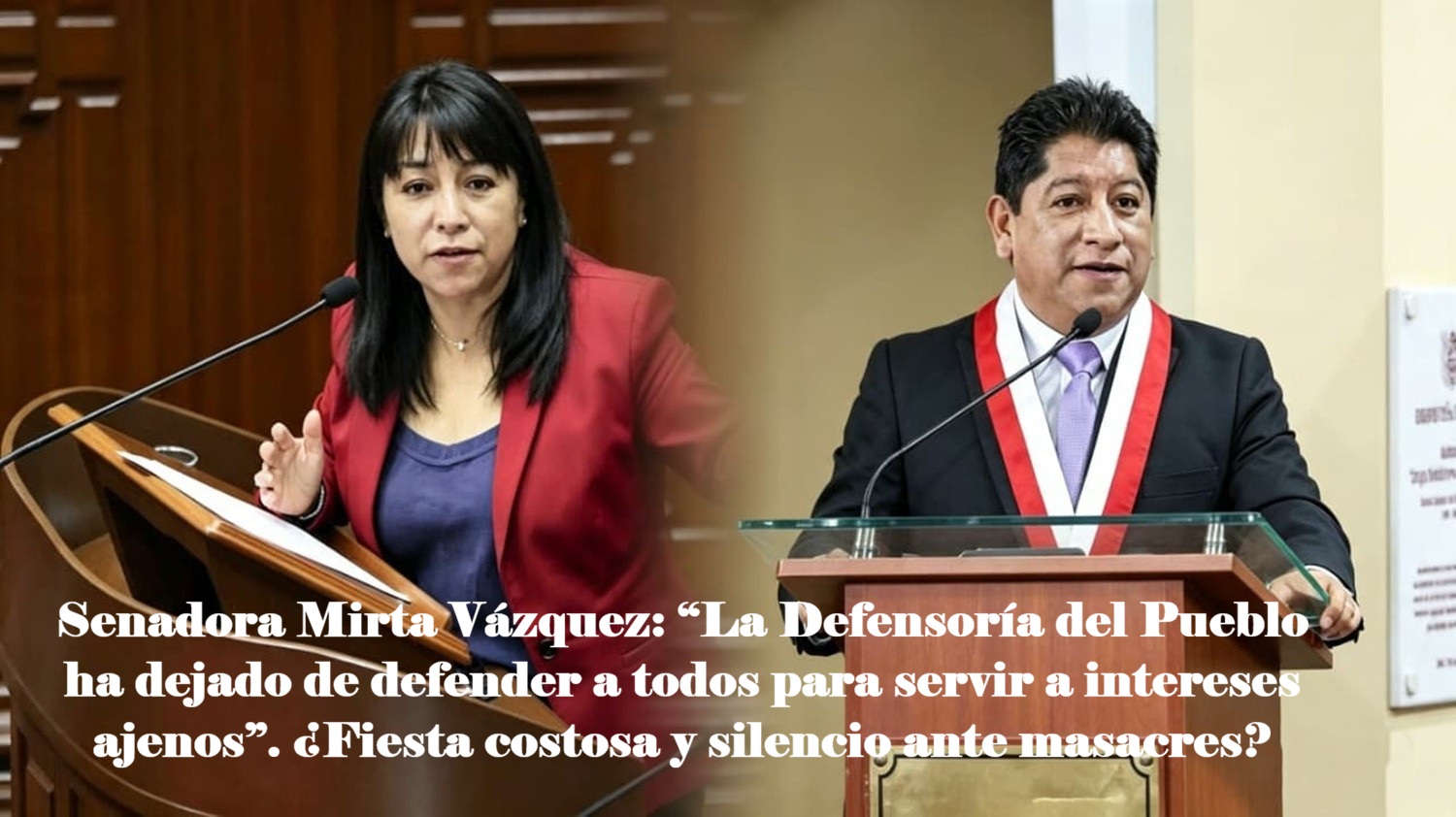
Agencia Peruana de Noticias PRENSAPERU.PE https://www.prensaperu.pe Twitter: @prensaperupe En su intervención parlamentaria, la senadora Mirta Vázquez planteó con firmeza las graves irregularidades y omisiones que, a su juicio, caracterizan la gestión actual de la Defensoría del Pueblo, encabezada por Josué Gutiérrez.
“Normalmente, cuando las instituciones públicas celebran su aniversario, organizan actividades institucionales, académicas o culturales. Sin embargo, aquí se hizo una gran fiesta, con orquestas de gran renombre y costos muy elevados. Y surge la pregunta obligada: ¿con qué dinero se pagó todo esto? ¿De dónde salieron esos recursos?”, cuestionó la legisladora.
Pero, advirtió, hay hechos mucho más graves: “Entre 2022 y 2023 ocurrieron sucesos de violación de derechos humanos conocidos como las masacres de ese periodo. Hasta hoy, la Defensoría del Pueblo no ha investigado nada, no ha dado seguimiento, no ha actuado. En cambio, sí ha salido a defender al señor Urresti, ha tomado partido y ha pronunciado posturas claras a su favor, justo en los casos más delicados”.
“Esto no lo digo yo nada más —señaló Vázquez—: el Relator Especial de Naciones Unidas ya lo dejó escrito en su informe oficial: el silencio de la Defensoría ante estas violaciones es alarmante. Se ha callado frente a las víctimas, pero ha hablado en favor de una persona concreta. ¿Por qué esa diferencia? ¿Por qué esa parcialidad? La Defensoría no pertenece a nadie, no debe servir a grupos ni intereses políticos: su deber es defender a todos por igual, garantizar la institucionalidad y el Estado de Derecho”.
La senadora añadió otras denuncias concretas: “Hay personas que visitan de forma particular el despacho del Defensor del Pueblo, y poco después aparecen contratos o órdenes de servicio a su nombre. Eso levanta sospechas muy serias: ¿hay favores? ¿Se usa el cargo para beneficiar a allegados? ¿Dónde está la transparencia? ¿Dónde la imparcialidad?”.
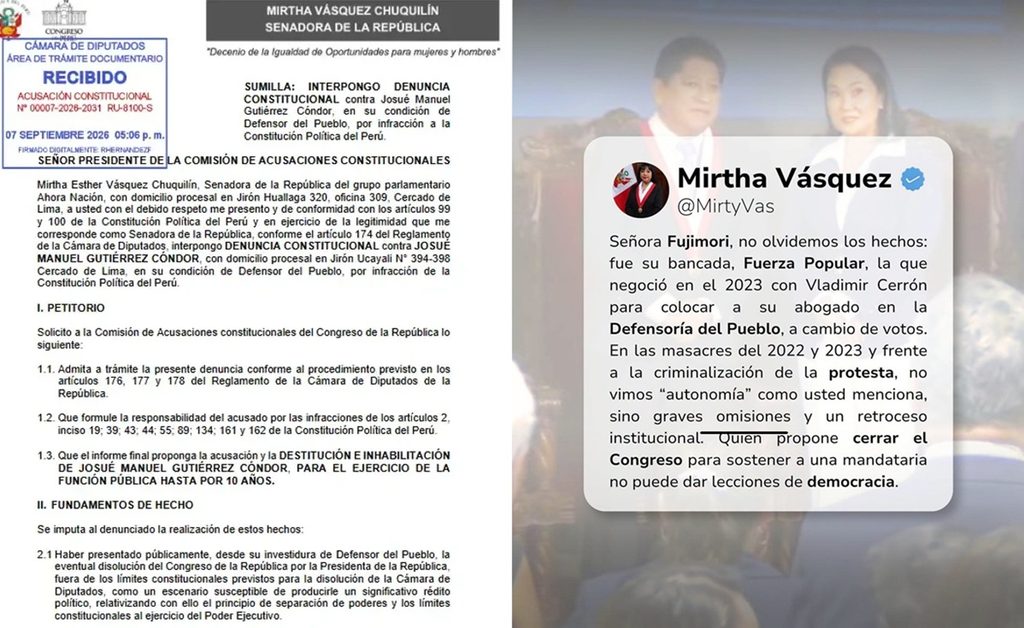
Ante este panorama, la legisladora anunció formalmente: “Por todo lo expuesto, he presentado la solicitud de interpelación al Defensor del Pueblo, Josué Gutiérrez. Asimismo, pido su censura y la inhabilitación por diez años para ejercer cualquier función pública. No es un capricho: es una medida necesaria para corregir rumbos, rendir cuentas y devolverle a la ciudadanía la confianza que esta institución debe merecer”.
Y remarcó con firmeza: “Si me atacan, si intentan descalificarme o callarme, no lo lograrán. No tengo obligaciones, no tengo presiones, actúo con total independencia. Todo lo que digo se puede debatir, revisar, contrastar. Pero nadie puede dudar de mi trayectoria, de mi compromiso ni de mi deber: buscar y hacer justicia”.
I.- ANÁLISIS: CONSTITUCIONALIDAD, ÉTICA Y RESPONSABILIDAD
Análisis Constitucional
La Defensoría del Pueblo es un organismo constitucionalmente autónomo, establecido en el Artículo 161 de la Constitución Política del Perú. Su mandato es claro: defender los derechos fundamentales de la persona y de la comunidad; vigilar el cumplimiento de los deberes de la administración estatal y la prestación de los servicios públicos. Por su naturaleza, debe actuar con absoluta imparcialidad, independencia y neutralidad política: no debe favorecer ni perjudicar a ninguna persona, grupo o autoridad, ni someterse a intereses particulares.
Las acusaciones planteadas por la senadora Mirta Vázquez tocan el núcleo mismo de esta naturaleza:
Omisión frente a violaciones de derechos humanos: La Constitución y el derecho internacional obligan a la Defensoría a investigar, documentar y denunciar cualquier vulneración de derechos. El silencio ante hechos graves —incluso observado por organismos internacionales— equivale a incumplir su función esencial.
Actuación parcializada: Si se confirma que interviene en favor de personas concretas o figuras políticas, rompe con el principio de imparcialidad, convirtiendo a la institución en instrumento de intereses ajenos a su misión.
Uso de recursos y transparencia: Todo gasto, contrato o actividad debe estar sustentado, ser público y responder al interés general. La duda sobre el financiamiento de eventos institucionales y la posible relación entre visitas y contrataciones plantea presuntas irregularidades en el uso del patrimonio público.
La solicitud de interpelación, censura e inhabilitación es un mecanismo previsto en el ordenamiento jurídico como control político y constitucional, destinado a garantizar que quienes ocupan cargos de alta responsabilidad cumplan con los requisitos de idoneidad, probidad y cumplimiento del mandato legal.
Análisis Moral y Ético
Más allá de la norma, la Defensoría del Pueblo tiene una función simbólica y ética: es el último recurso de protección para los ciudadanos frente al poder. Su autoridad no viene de la fuerza, sino de la confianza. Cuando se percibe que la institución selecciona a quién defender y a quién callar, que celebra fiestas costosas mientras no atiende denuncias de derechos humanos, o que sus decisiones parecen responder a favores, se rompe el vínculo ético con la sociedad.
El problema no es solo jurídico: es de legitimidad. Si la ciudadanía deja de creer que la Defensoría protege a todos por igual, se debilita la confianza en todo el sistema democrático.
II.- DATOS CONCEPTUALES
Defensoría del Pueblo: Organismo autónomo constitucional, encargado de la defensa de los derechos fundamentales, la vigilancia del funcionamiento de la administración pública y la protección de los derechos ciudadanos. No depende de ningún poder del Estado.
Interpelación: Mecanismo de control parlamentario mediante el cual el Congreso llama a una autoridad para que explique, informe y responda sobre sus actos de gestión, políticas o decisiones.
Censura: Declaración formal del Congreso mediante la cual se manifiesta reprobación por la actuación de una autoridad de alto nivel, que puede derivar en su destitución o inhabilitación.
Inhabilitación para función pública: Sanción administrativa o política que impide a una persona ejercer cargos, empleos o funciones en el Estado por un plazo determinado, como consecuencia de incumplimiento, falta ética o irregularidad.
Imparcialidad: Principio fundamental que obliga a toda autoridad pública a actuar sin favorecer ni perjudicar a nadie, basando sus decisiones solo en la ley y el interés general.
Estado de Derecho: Principio organizador del Estado en el que todas las personas, instituciones y autoridades están sometidas a la ley, y donde las actuaciones públicas deben tener sustento legal, ser transparentes y responsables.
III.- DATOS CONTEXTUALES
1.- La Defensoría del Pueblo tiene un mandato constitucional claro e irrenunciable: defender a todos por igual. Las omisiones ante violaciones graves de derechos humanos y la actuación presuntamente parcializada —tal como ha expuesto la senadora Vázquez— rompen con la esencia misma de su función, y su silencio ya ha sido observado y cuestionado por organismos internacionales.
2.- Las dudas sobre financiamiento y contrataciones ponen en riesgo la confianza pública: cuando se combinan gastos ostentosos, falta de claridad en el origen de los recursos y presuntas vinculaciones entre visitas particulares y órdenes de servicio, se genera sospecha de uso indebido del patrimonio y la autoridad.
3.- La interpelación, censura e inhabilitación solicitadas por la senadora Mirta Vázquez son herramientas legítimas de control democrático: no se trata de un ataque personal, sino del ejercicio de la facultad del Congreso para vigilar que las instituciones autónomas cumplan su misión y sus autoridades rindan cuentas.
4.- El verdadero daño no es solo institucional, sino social: la debilidad o desviación de la Defensoría del Pueblo deja sin protección a los ciudadanos, especialmente a los más vulnerables, y debilita los cimientos del Estado de Derecho y la confianza en la democracia peruana.
Fuente: Agencia Peruana de Noticias PRENSAPERU.PE https://www.prensaperu.pe Twitter: @prensaperupe
Translate
Senator Mirta Vázquez: “The Ombudsman’s Office has stopped defending everyone in order to serve outside interests.” A lavish party and silence in the face of massacres? The allegations rocking the Ombudsman and the institution he leads.
Peruvian News Agency PRENSAPERU.PE https://www.prensaperu.pe Twitter: @prensaperupe During her parliamentary intervention, Senator Mirta Vázquez firmly set out the serious irregularities and omissions that, in her view, characterize the current administration of the Office of the Ombudsman, led by Josué Gutiérrez.
“Normally, when public institutions celebrate their anniversary, they organize institutional, academic or cultural activities. However, in this case, a lavish celebration was held, featuring renowned orchestras and involving very high costs. And the inevitable question arises: with what funds was all this paid for? Where did these resources come from?” the legislator questioned.
But she warned that there are far more serious matters: “Between 2022 and 2023, events involving human rights violations took place, known as the massacres of that period. To this day, the Office of the Ombudsman has not investigated anything, has not followed up on anything, and has taken no action. Yet, it has stepped forward to defend Mr. Urresti, has taken sides, and has adopted clear positions in his favor, precisely in the most sensitive cases.”
“I am not the only one saying this,” Senator Vázquez pointed out. “The United Nations Special Rapporteur already stated this in his official report: the Office of the Ombudsman’s silence regarding these violations is alarming. It has remained silent when faced with victims, yet has spoken out in favor of a specific individual. Why this difference? Why this partiality? The Office of the Ombudsman belongs to no one. It must not serve groups or political interests. Its duty is to defend everyone equally, and to uphold institutional integrity and the Rule of Law.”
The Senator added further specific allegations: “There are individuals who visit the Ombudsman’s office in a private capacity, and shortly thereafter, contracts or service orders are issued in their names. This raises very serious suspicions: are favors being exchanged? Is the office being used to benefit associates? Where is transparency? Where is impartiality?”
Given this situation, the legislator formally announced: “Based on all of the above, I have submitted a request to interpellate the Ombudsman, Josué Gutiérrez. Furthermore, I am calling for his censure and disqualification from holding any public office for a period of ten years. This is not a whim: it is a necessary measure to correct the course of this institution, to ensure accountability, and to restore the public trust that this body is meant to command.”
And she emphasized firmly: “If they attack me, if they try to discredit me or silence me, they will not succeed. I have no obligations or pressures; I act with total independence. Everything I say can be debated, reviewed, and verified. But no one can question my track record, my commitment, or my duty: to seek and deliver justice.”
I. – ANALYSIS: CONSTITUTIONALITY, ETHICS AND RESPONSIBILITY
Constitutional Analysis
The Office of the Ombudsman is a constitutionally autonomous body, established under Article 161 of the Political Constitution of Peru. Its mandate is clear: to defend the fundamental rights of individuals and communities; to oversee compliance with the obligations of the State administration and the provision of public services. By its very nature, it must act with absolute impartiality, independence, and political neutrality: it must not favor or harm any person, group or authority, nor submit to private interests.
The accusations raised by Senator Mirta Vázquez strike at the very core of this mandate:
Omission in the face of human rights violations: The Constitution and international law oblige the Office of the Ombudsman to investigate, document and denounce any violation of rights. Silence in the face of serious events — even those observed and documented by international bodies — amounts to a failure to fulfill its essential function.
Biased conduct: If it is confirmed that the institution intervenes in favor of specific individuals or political figures, it violates the principle of impartiality and turns the body into an instrument of interests alien to its mission.
Use of resources and transparency: Every expenditure, contract or activity must be justified, public, and serve the general interest. Uncertainty regarding the financing of institutional events, as well as the potential link between private visits and the awarding of contracts, raises suspicions of misuse of public assets and authority.
The request for interpellation, censure and disqualification is a mechanism established under the legal framework as an instrument of political and constitutional oversight, designed to ensure that those holding high-level public office meet the requirements of integrity, probity, and compliance with their legal mandate.
Moral and Ethical Analysis
Beyond the letter of the law, the Office of the Ombudsman carries a symbolic and ethical function: it is the last line of defense for citizens against the power of the State. Its authority derives not from force, but from public trust. When the public perceives that the institution chooses whom to defend and whom to ignore; that it hosts expensive celebrations while ignoring reports of human rights violations; or that its decisions appear to respond to favors rather than duty, the ethical bond between the institution and society is broken.
This is not merely a legal issue: it is a matter of legitimacy. If citizens no longer believe that the Office of the Ombudsman protects everyone equally, trust in the entire democratic system is undermined.
II.- CONCEPTUAL DEFINITIONS
Office of the Ombudsman: A constitutionally autonomous body, responsible for defending fundamental rights, overseeing the functioning of public administration, and protecting citizens’ rights. It is independent from any branch of State power.
Interpellation: A mechanism of parliamentary oversight whereby the Congress calls upon a public official to explain, report on, and answer questions regarding their management, policies, or decisions.
Censure: A formal declaration by Congress expressing disapproval regarding the conduct of a high-ranking public official, which may result in their removal from office or disqualification.
Disqualification from public office: An administrative or political sanction that prohibits an individual from holding any position, employment or function within the State for a specified period, as a consequence of failure to comply with duties, ethical breaches or irregular conduct.
Impartiality: A fundamental principle requiring every public authority to act without favoring or harming any individual or group, and to base all decisions solely on the law and the general interest.
Rule of Law: The foundational principle of the State, whereby all persons, institutions and authorities are subject to the law, and all public actions must have a legal basis, be transparent, and be subject to accountability.
III.- CONTEXTUAL FINDINGS
1.- The Office of the Ombudsman has a clear and irrevocable constitutional mandate: to defend everyone equally. Failures to act in the face of serious human rights violations, as well as allegedly biased conduct — as denounced by Senator Vázquez — undermine the very essence of its function. Its silence has already been observed and criticized by international organizations.
2.- Uncertainty regarding funding and contracting practices places public trust at risk: when excessive spending, lack of clarity regarding the origin of resources, and alleged links between private visits and service orders coincide, this creates strong suspicion of misuse of public assets and authority.
3.- The request for interpellation, censure and disqualification submitted by Senator Mirta Vázquez is a legitimate tool of democratic oversight. This is not a personal attack: it is the exercise of Congress’s power to ensure that autonomous institutions fulfill their mandate and that their officials are held accountable.
4.- The true damage is not only institutional, but social: the weakening or deviation of the Office of the Ombudsman leaves citizens — especially the most vulnerable — without protection, and undermines the foundations of the Rule of Law and confidence in Peru’s democratic system.
Source: Peruvian News Agency PRENSAPERU.PE https://www.prensaperu.pe Twitter: @prensaperupe