
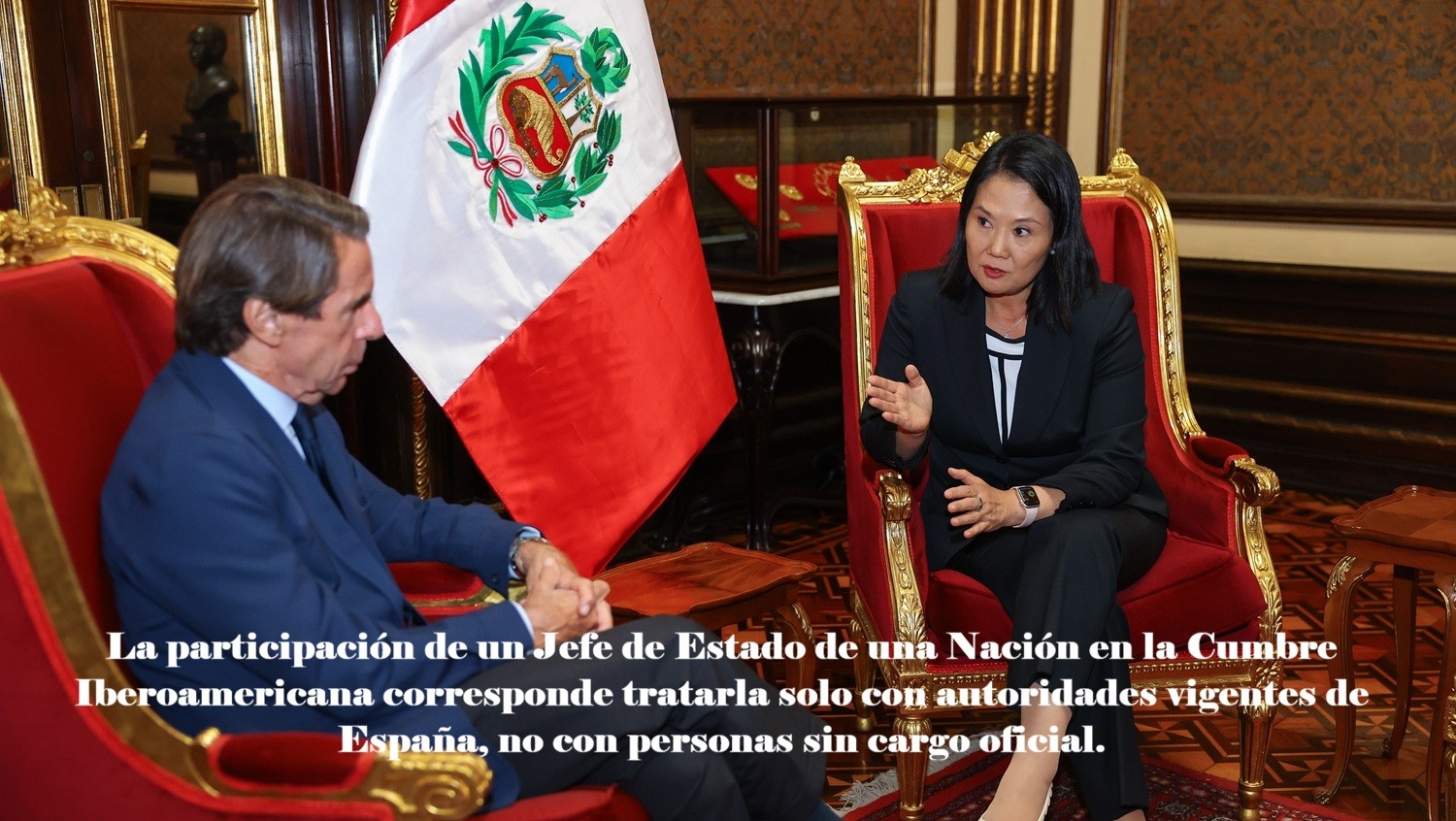
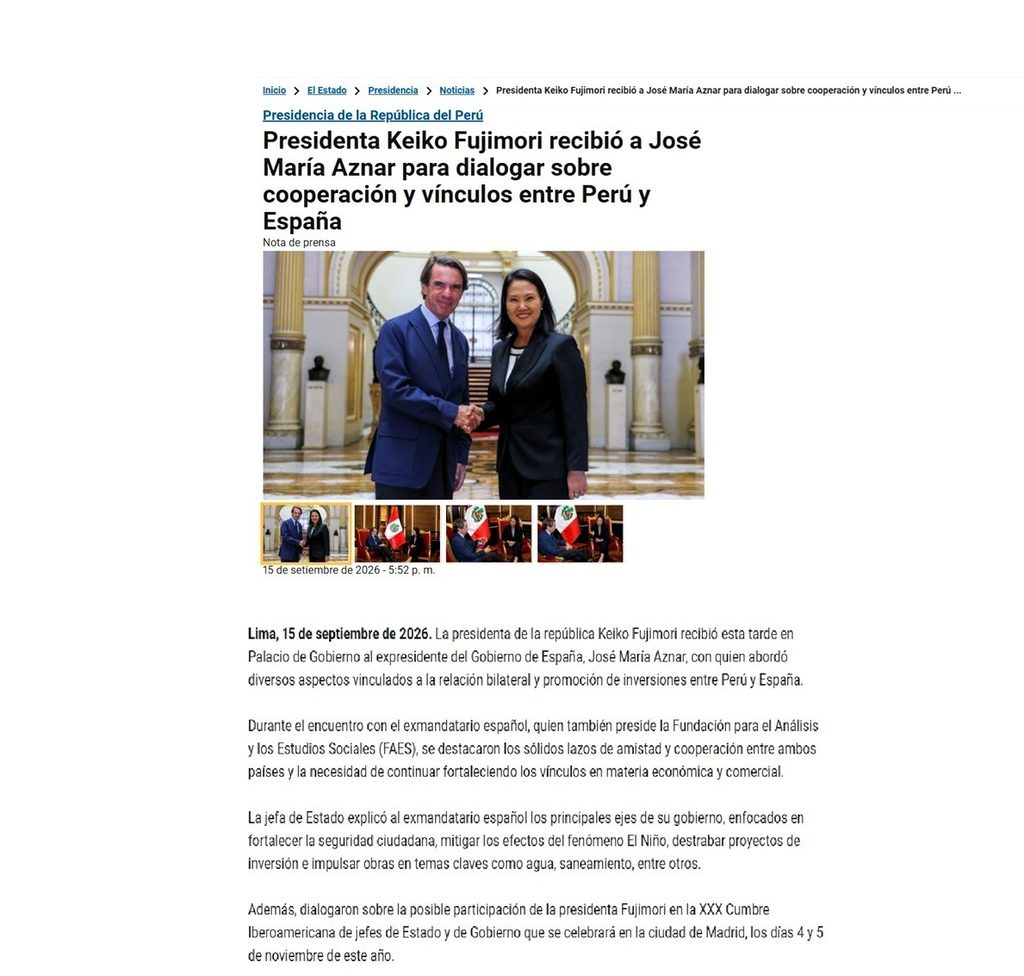
Agencia Peruana de Noticias PRENSAPERU.PE https://www.prensaperu.pe Twitter: @prensaperupe Por más relevancia, trayectoria o reconocimiento que haya tenido en su momento, José María Aznar es hoy, a septiembre de 2026, un ciudadano particular. No ejerce ningún cargo público, no representa al Gobierno ni al Estado de España, no tiene facultades oficiales, ni puede comprometer a su nación, ni negociar en nombre de nadie, ni tomar decisiones que tengan validez jurídica alguna. Por lo tanto, nada de lo que se dialogue o acuerde con él puede tener connotación nacional, ni generar compromisos, beneficios ni resultados para el Estado peruano. Su ámbito de acción es privado: fundaciones, institutos, consejos consultivos, actividades académicas o intereses empresariales —espacios que son totalmente ajenos a la diplomacia oficial, a la gobernanza del país y al interés general.
Lo que resulta aún más cuestionable es el punto que se ha difundido respecto a la posible participación de la Presidenta Keiko Fujimori en la Trigésima Cumbre Iberoamericana de Jefes de Estado y de Gobierno, que se celebrará en Madrid. Si se trata de un asunto de esta magnitud —un encuentro de las máximas autoridades del espacio iberoamericano, organizado por el Reino de España—, cualquier coordinación, consulta, trámite o gestión institucional debe realizarse exclusivamente con quienes hoy ejercen la representación oficial: el Presidente del Gobierno español, su Ministro de Asuntos Exteriores o los funcionarios competentes designados por la autoridad vigente. Solo ellos tienen la capacidad, la competencia y la facultad legal para tratar temas de Estado, protocolo, invitaciones o participación en cumbres internacionales. ¿Por qué habría de conversar o consultar algo de esta naturaleza con un expresidente que ya no tiene ninguna función, ninguna representación ni ninguna atribución sobre la materia? No existe justificación institucional ni diplomática para ello. Es darle a un encuentro privado el peso y la apariencia de una gestión oficial, cuando en realidad no hay ninguna autoridad, ningún mecanismo ni ninguna validez que permita a esta persona intermediar, decidir o dar trámite a temas que corresponden exclusivamente a las autoridades en ejercicio.
Pero lo más grave no es solo esto: no se trata de un hecho aislado. Se repite una conducta que ya hemos visto antes: se recibe, se difunde y se presenta con el mismo protocolo, el mismo tono solemne y el mismo despliegue mediático que se usa para dignatarios en ejercicio, a personas que ya no representan a ningún Estado, que actúan en su propio nombre o en el de grupos privados. Y aquí es donde surge el problema de fondo, que va mucho más allá de una sola reunión: se está haciendo un uso indebido de la investidura presidencial, de los recursos del Estado y de las estructuras públicas de comunicación.
La Jefa de Estado es la máxima representación de la nación, la autoridad suprema elegida para gobernar en beneficio de todos. Esa dignidad no es propiedad personal, ni tarjeta de presentación, ni herramienta de imagen: es un encargo público. Y junto con ella, se pone a su disposición todo el aparato del Estado: oficinas, personal, presupuesto, y sobre todo, la Oficina de Prensa y los canales oficiales de comunicación, que existen para informar sobre la gestión de gobierno, sobre decisiones, obras, políticas y acuerdos que afectan la vida de los ciudadanos —no para convertir encuentros privados en acontecimientos de Estado, ni para darles resonancia nacional con “bombos y platillos” a cosas que no tienen nada que ver con la gobernanza del país.
Vender humo, presentar como gran logro lo que no es nada, hacer creer al ciudadano que esto le va a mejorar su vida, cuando no hay ningún vínculo ni compromiso real, es engañar sutilmente. Es lo que en el lenguaje popular se dice claramente: dar gato por liebre. Y eso no puede ser práctica de una Presidencia de la República. La autoridad no está para persuadir con apariencias, ni para construir una imagen sobre bases falsas, ni para usar el prestigio y los recursos del país para dar brillo a reuniones que pertenecen a otros ámbitos.
Si se trata de temas específicos —cooperación, intercambios, iniciativas particulares—, hay niveles adecuados: los tratan viceministros, directores, funcionarios especializados o representantes de organismos correspondientes. La Presidenta de la República se reúne con sus pares, con jefes de Estado y de Gobierno en ejercicio, con quienes pueden firmar acuerdos vinculantes para la nación. Cuando baja el nivel de lo que se trata, pero se sube el despliegue de lo que se comunica, lo que se produce es desorden institucional, confusión y, sobre todo, descrédito.
Porque al final, lo que se pone en juego no es solo una nota de prensa: es el respeto a la institución, la confianza de la ciudadanía y la seriedad con la que se debe tratar lo público. No se puede usar lo que es de todos para promocionar lo que es de unos pocos; no se puede presentar como beneficio nacional lo que es, en el mejor de los casos, un diálogo particular. Y cuando se hace esto de forma recurrente, lo que se pierde no es solo credibilidad: se debilita la propia noción de qué significa ser Presidente, qué significa representar al país y qué significa respetar la verdad que el ciudadano merece recibir.
DATOS CONCEPTUALES
Investidura Presidencial: Dignidad, autoridad y representación que el pueblo otorga a la persona elegida como Jefa de Estado y de Gobierno. No es un atributo personal, sino una función pública limitada y responsable. Se ejerce en nombre de la nación, y su uso está sujeto a la Constitución, al interés general y al principio de veracidad.
Recursos Públicos: Bienes, presupuestos, instalaciones, personal y servicios financiados con los impuestos de todos los ciudadanos. Solo pueden destinarse a fines estrictamente institucionales y de beneficio colectivo. Utilizarlos para dar difusión o relevancia a actos de naturaleza privada o particular constituye un uso indebido.
Comunicación Oficial: Herramienta de servicio público. Su mandato es informar con exactitud, claridad y proporcionalidad. No existe para crear imagen, ni para exagerar, ni para confundir. Cuando se emplea para hacer pasar algo por lo que no es, se desvía su fin constitucional y se convierte en instrumento de persuasión engañosa.
Representación Diplomática: Capacidad exclusiva de las autoridades en ejercicio para comprometer al Estado, firmar tratados o gestionar asuntos internacionales. Quien ya no ocupa cargo alguno no tiene esta facultad, sin importar su pasado.
Interés General: El bienestar de toda la comunidad, por encima de grupos, personas, negocios o relaciones particulares. Es el único criterio válido para justificar toda acción y difusión oficial.
DATOS CONTEXTUALES
1.- La naturaleza de una reunión la define el cargo que ocupan las personas, no su historia pasada. Aznar no representa al Estado español hoy, por lo que nada de lo que se hable con él tiene valor oficial ni beneficio directo para el Perú.
2.- El problema no es el diálogo: es la difusión. Usar la prensa del Estado, redes oficiales y recursos públicos para presentar encuentros privados como cumbres diplomáticas es un uso indebido de lo que pertenece a todos. No es lo mismo conversar, que hacer creer al país que se gobierna o se negocia.
3.- No es un hecho aislado: es una conducta recurrente. Cuando se repite el mismo esquema —ex mandatarios, difusión desmedida, lenguaje solemne—, ya no es un error: es una forma de gestionar la imagen pública por encima de la realidad, vendiendo humo y presentando como gran avance lo que no tiene ningún efecto práctico.
4.- Hay jerarquías y competencias que no se pueden saltar ni disfrazar. Asuntos como la participación en cumbres internacionales solo se tratan con las autoridades vigentes correspondientes. Consultarlos con particulares, y además anunciarlo como gestión oficial, es desconocer el derecho internacional y la lógica institucional.
5.- La máxima autoridad del país tiene un nivel y una función que no se deben rebajar. La Presidenta no está para tratar temas menores o particulares, ni para convertirse en figura de escaparate. Su tiempo y su nombre son patrimonio nacional; no se deben gastar en aparentar.
6.- La confianza se construye diciendo lo que es. El ciudadano no necesita espectáculos: necesita saber qué hace el gobierno, con quién negocia, qué acuerda y qué resultados obtiene. Venderle ilusiones en lugar de hechos, y usar el aparato del Estado para ello, es la forma más rápida de dañar la institucionalidad y perder el respeto.
Fuente: Agencia Peruana de Noticias PRENSAPERU.PE https://www.prensaperu.pe Twitter: @prensaperupe
Translate
Dealing with former leaders while making announcements as if engaging with sitting governments—a confusing practice where private dealings masquerade as state business. When public resources are used to publicize private meetings, who truly benefits?
Peruvian News Agency PRENSAPERU.PE https://www.prensaperu.pe Twitter: @prensaperupe However relevant, distinguished or recognized he may have been in his time, as of September 2026, José María Aznar is today a private citizen. He holds no public office, does not represent the Government or the State of Spain, has no official authority, cannot commit his nation, negotiate on behalf of anyone, or make decisions that carry any legal validity whatsoever. Therefore, nothing discussed or agreed upon with him can carry national significance, nor generate commitments, benefits or outcomes for the Peruvian State. His sphere of action is private: foundations, institutes, advisory boards, academic activities or business interests — spaces entirely separate from official diplomacy, national governance and the general public interest.
Even more questionable is the point that has been disseminated regarding President Keiko Fujimori’s potential participation in the 30th Ibero-American Summit of Heads of State and Government, to be held in Madrid. When dealing with a matter of this magnitude — a gathering of the highest authorities across the Ibero-American space, organized by the Kingdom of Spain — any coordination, consultation, procedure or institutional management must be conducted exclusively with those who currently hold official representation: the President of the Spanish Government, its Minister of Foreign Affairs, or the competent officials designated by the incumbent authority. Only they possess the capacity, competence and legal authority to handle matters of State, protocol, invitations or participation in international summits. Why would matters of this nature be discussed or consulted with a former head of government who no longer holds any function, representation or authority over these issues? There is no institutional or diplomatic justification for this. It is granting a private meeting the weight and appearance of official business, when in reality there is no authority, mechanism or validity that allows this individual to mediate, decide or process matters that fall exclusively within the purview of serving authorities.
But what is most serious is not merely this: this is not an isolated incident. It reflects a pattern we have seen before: individuals who no longer represent any State, who act on their own behalf or on behalf of private groups, are received, promoted and presented with the same protocol, solemn tone and media fanfare reserved for accredited dignitaries. And here lies the core problem, which goes far beyond a single meeting: there is a misuse of presidential authority, of State resources and of public communication structures.
The Head of State is the supreme representative of the nation, the highest authority elected to govern for the benefit of all. This dignity is not personal property, nor a calling card, nor a public relations tool: it is a public trust. Alongside it, the entire apparatus of the State is placed at her disposal: offices, staff, budget, and above all, the Press Office and official communication channels. These exist to report on government management, decisions, projects, policies and agreements that affect citizens’ lives — not to transform private meetings into State events, nor to give national prominence and great fanfare to matters that have nothing whatsoever to do with national governance.
Selling smoke, presenting as a major achievement what is actually nothing, leading citizens to believe that this will improve their lives when there is no real connection or commitment, is a subtle form of deception. As the popular saying goes: “selling a cat as a hare” — passing something off as far more valuable than it really is. And this cannot be standard practice for the Presidency of the Republic. The highest authority is not there to persuade through appearances, build an image on false foundations, or use the prestige and resources of the country to lend glory to meetings that belong to entirely different spheres.
When dealing with specific matters — cooperation, exchanges, private initiatives — there are appropriate levels for them: these are handled by deputy ministers, directors, specialized officials or representatives of relevant bodies. The President of the Republic meets with her peers, with serving Heads of State and Government, with those who can sign binding agreements on behalf of the nation. When the substance of what is being discussed is lowered, but the publicity and prominence given to it are raised, the result is institutional disorder, confusion and, above all, loss of credibility.
Because ultimately, more than just a press release is at stake: what is at stake is respect for the institution, the trust of the citizenry, and the seriousness with which public affairs must be conducted. One cannot use what belongs to everyone to promote what benefits only a few; one cannot present as a national benefit what is, at best, merely a private conversation. And when this is done repeatedly, what is lost is not just credibility: the very meaning of what it means to be President, what it means to represent the country, and what it means to uphold the truth that every citizen deserves, is steadily eroded.
CONCEPTUAL DEFINITIONS
Presidential Investiture: The dignity, authority and representation granted by the people to the person elected as Head of State and Government. It is not a personal attribute, but a limited and responsible public function. It is exercised on behalf of the nation, and its use is bound by the Constitution, the general interest and the principle of truthfulness.
Public Resources: Assets, budget, facilities, personnel and services funded by the taxes of all citizens. They may only be used for strictly institutional purposes and collective benefit. Using them to promote or lend prominence to acts of a private or personal nature constitutes misuse.
Official Communication: A tool for public service. Its mandate is to inform with accuracy, clarity and proportionality. It does not exist to create image, exaggerate or mislead. When used to present something as what it is not, it deviates from its constitutional purpose and becomes an instrument of deceptive persuasion.
Diplomatic Representation: The exclusive capacity of serving authorities to commit the State, sign treaties or manage international affairs. Anyone who no longer holds office has no such authority, regardless of their past history.
General Interest: The well‑being of the entire community, above and beyond groups, individuals, business interests or personal relationships. It is the only valid criterion for justifying any official action or dissemination.
CONTEXTUAL FINDINGS
1.- The nature of a meeting is defined by the office people hold, not their past history. Aznar does not represent the Spanish State today, so nothing discussed with him carries official value or direct benefit for Peru.
2.- The problem is not the dialogue itself — it is how it is publicized. Using State press, official networks and public resources to present private meetings as diplomatic summits is a misuse of what belongs to everyone. Holding a conversation is not the same thing as leading the country to believe that governance or negotiation is taking place.
3.- This is not an isolated incident — it is a recurring pattern. When the same scheme is repeated — former leaders, excessive publicity, solemn language — it is no longer an error: it is a way of managing public image above reality, selling smoke and presenting as major progress what has no practical effect whatsoever.
4.- There are hierarchies and jurisdictions that cannot be bypassed or disguised. Matters such as participation in international summits must only be handled with the appropriate serving authorities. Consulting them with private individuals, and moreover announcing it as official government business, shows disregard for international law and institutional logic.
5.- The highest authority in the country has a standing and a function that must not be lowered. The President is not there to handle minor or private matters, nor to serve as a public display figure. Her time and her name are national assets; they must not be wasted on appearances.
6.- Trust is built by telling things as they truly are. Citizens do not need spectacles: they need to know what the government is doing, who it is negotiating with, what agreements it reaches and what results it delivers. Selling them illusions instead of facts, and using the machinery of the State to do so, is the fastest way to damage institutions and lose respect.
Source: Peruvian News Agency PRENSAPERU.PE https://www.prensaperu.pe Twitter: @prensaperupe