

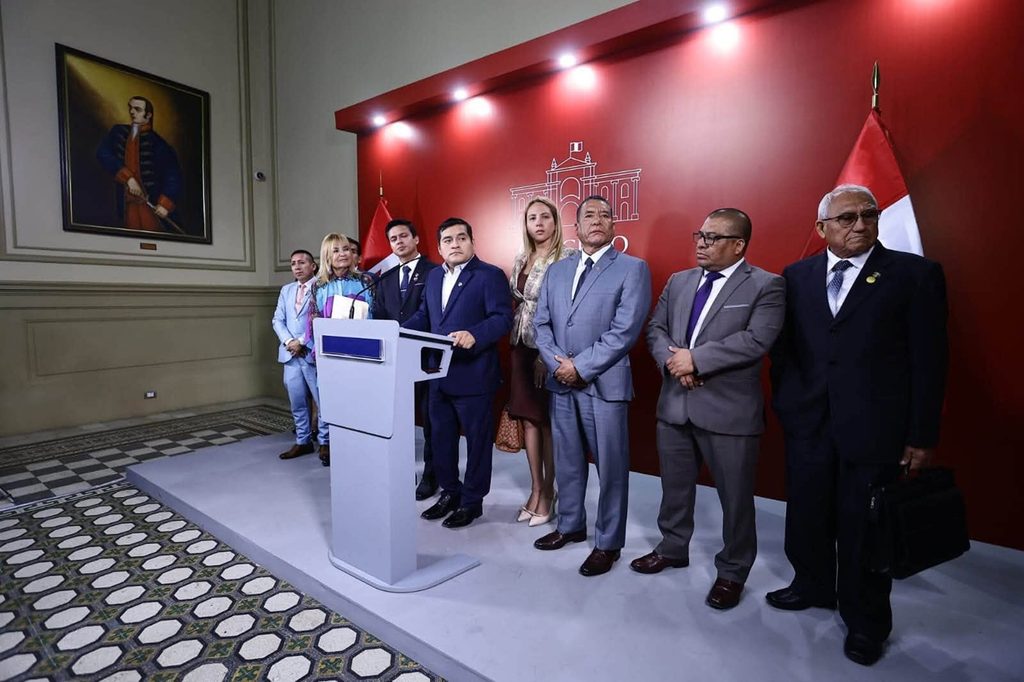
Agencia Peruana de Noticias PRENSAPERU.PE https://www.prensaperu.pe Twitter: @prensaperupe El presidente del Consejo de Ministros, Luis Galarreta Velarde, reafirmó ante la opinión pública y los representantes parlamentarios la voluntad expresa del Poder Ejecutivo de construir consensos amplios con la Cámara de Diputados respecto al pedido de delegación de facultades legislativas, descartando de forma tajante la intención de recurrir a la figura de la cuestión de confianza para imponer o forzar la aprobación de esta iniciativa.
En su exposición, el jefe del Gabinete Ministerial corrigió una interpretación frecuente pero errónea: la idea de que esta solicitud responde exclusivamente a situaciones de crisis o emergencia coyuntural. Por el contrario, explicó que se trata de una herramienta institucional prevista en el ordenamiento jurídico, utilizada históricamente por los gobiernos al inicio de su mandato, cuyo fin es dotar de agilidad al Estado para diseñar y ejecutar reformas estructurales, así como atender prioridades nacionales que requieren respuesta oportuna, entre ellas la modernización de la administración pública, la mejora de la gestión estatal y el cierre de brechas sociales acumuladas durante décadas.
“La ciudadanía peruana ha conocido ya los costos del aislamiento institucional y la falta de diálogo; por ello, esta administración apuesta decididamente por la concertación. Que se apruebe la totalidad del marco solicitado o una parte sustancial será resultado natural del debate democrático, y en cualquiera de los casos se respetará la decisión del Legislativo. Valoramos especialmente el esfuerzo de aquellas bancadas que, aun manteniendo posiciones distintas, buscan puntos de encuentro en beneficio del país”, expresó Galarreta.
Desde la perspectiva del Ejecutivo, un rechazo total de la iniciativa resultaría funcionalmente contraproducente, ya que limitaría la capacidad de respuesta frente a desafíos de gran magnitud: la lucha contra la criminalidad en todas sus formas, la preparación y mitigación de los efectos del Fenómeno El Niño, y la transformación de la gestión pública para hacerla más eficaz, transparente y cercana a la población. No obstante, el premier enfatizó que el cumplimiento del programa de gobierno y los compromisos contraídos con la ciudadanía no quedarán supeditados al resultado de esta votación, y que se avanzará por las vías disponibles para dar cumplimiento a los objetivos nacionales.
Detalló además que el alcance de las normas que se pretende dictar cubre aspectos fundamentales de la modernización del Estado, un eje estratégico que incide directamente en la calidad de los servicios básicos y en la reducción de desigualdades. Como ejemplo, mencionó situaciones en las que comunidades llevan más de dos décadas esperando obras elementales como el acceso al agua potable, demoras que deben superarse mediante marcos normativos ágiles y adecuados.
Para facilitar el acuerdo, hasta la fecha el titular del Consejo de Ministros ha sostenido reuniones técnicas y políticas con las bancadas de Renovación Popular y Buen Gobierno y Obras, con el propósito de explicar detalladamente el contenido, alcance y justificación de la solicitud, así como recibir propuestas y observaciones.
En otro orden de temas, el ministro Galarreta se refirió a la estabilidad del Gabinete: señaló que todo funcionario público está sujeto a evaluación continua por resultados, pero descartó reestructuraciones ministeriales inmediatas. “En este momento, todos los integrantes del Consejo de Ministros cuentan con el respaldo de la Presidenta de la República y el mío propio, salvo causas estrictamente personales o de salud que pudieran sobrevenir”, precisó.
Subrayó además la existencia de una coordinación institucional sólida y permanente entre la Presidencia de la República, el Senado y el despacho del Consejo de Ministros, afirmando que existe plena coincidencia en los objetivos estratégicos que guían la acción pública, orientados a mejorar las condiciones de vida de todos los peruanos.
DATOS CONCEPTUALES
Delegación de facultades legislativas: Es la atribución que el Congreso otorga al Poder Ejecutivo para que dicte normas con rango de ley, dentro de materias, plazos y límites definidos. Se trata de un mecanismo constitucional diseñado para agilizar la toma de decisiones, especialmente en temas complejos o de prioridad nacional, sin sustituir la función esencial del Parlamento como representante popular.
Cuestión de confianza: Instrumento político‑constitucional mediante el cual el Gabinete Ministerial somete su permanencia en el cargo a la aprobación del Congreso. Su uso está regulado y no debe emplearse como herramienta de presión indebida sobre el Legislativo.
Modernización del Estado: Proceso de reforma estructural que busca optimizar la organización, funcionamiento, recursos y servicios públicos, con criterios de eficiencia, transparencia, descentralización y cercanía al ciudadano, para reducir brechas y garantizar derechos fundamentales.
Concertación democrática: Proceso mediante el cual los poderes del Estado y las fuerzas políticas buscan puntos de coincidencia, dialogan y negocian para construir acuerdos estables, necesarios para la gobernabilidad y el desarrollo sostenible del país.
DATOS
1.- La solicitud de facultades legislativas no responde solo a emergencias, sino que constituye una práctica institucional ordinaria orientada a implementar reformas de mediano y largo plazo, especialmente la modernización del aparato estatal.
2.- El Ejecutivo reafirma su vocación de diálogo y rechaza usar mecanismos de presión política; cualquier resultado del debate parlamentario será asumido con respeto, aunque se advierte que un rechazo total limitaría la capacidad de respuesta ante problemas urgentes.
3.- La estabilidad del equipo ministerial está garantizada en este etapa, lo que refleja cohesión política y alineamiento entre las más altas autoridades del Estado respecto a las metas nacionales.
4.- El éxito de la gestión pública depende tanto de herramientas normativas como de la coordinación interinstitucional y la voluntad de alcanzar consensos, siendo la concertación el camino elegido para avanzar en soluciones duraderas para la población.
Fuente: Agencia Peruana de Noticias PRENSAPERU.PE https://www.prensaperu.pe Twitter: @prensaperupe
Translate
Legislative powers are an instrument for reform, not merely for emergencies; Premier Luis Galarreta affirmed that dialogue takes precedence over imposition and that there will be no vote of confidence. Modernizing the State is essential.
Peruvian News Agency PRENSAPERU.PE https://www.prensaperu.pe Twitter: @prensaperupe The President of the Council of Ministers, Luis Galarreta Velarde, reaffirmed before public opinion and parliamentary representatives the express will of the Executive Branch to build broad consensus with the Chamber of Deputies regarding the request for delegation of legislative powers, ruling out categorically any intention to resort to the mechanism of the question of confidence to impose or force the approval of this initiative.
In his statement, the Head of the Ministerial Cabinet corrected a common yet mistaken interpretation: the idea that this request responds exclusively to situations of crisis or temporary emergency. On the contrary, he explained that this is an institutional tool provided for in the legal framework, historically used by governments at the start of their term, whose purpose is to provide the State with the necessary agility to design and implement structural reforms, as well as address national priorities that require timely action — including the modernization of public administration, the improvement of state management, and the closing of social gaps accumulated over decades.
“The Peruvian people have already seen the cost of institutional isolation and lack of dialogue; therefore, this administration is firmly committed to consensus‑building. Whether the full scope of the request or a substantial part is approved will be the natural outcome of democratic debate, and in either case, the decision of the Legislature will be respected. We particularly value the effort made by those parliamentary groups that, while holding differing positions, still seek common ground for the benefit of the country,” stated Galarreta.
From the Executive Branch’s perspective, a total rejection of the initiative would be functionally counterproductive, as it would limit the State’s capacity to respond to major challenges: combating crime in all its forms, preparing for and mitigating the effects of El Niño, and transforming public management to make it more effective, transparent, and close to the people. Nevertheless, the Prime Minister emphasized that the fulfillment of the government program and the commitments made to the citizenry will not be conditional upon the outcome of this vote, and that progress will be made through all available channels to achieve national objectives.
He further explained that the scope of the regulations to be enacted covers fundamental aspects of State modernization — a strategic pillar that has a direct impact on the quality of basic services and the reduction of inequalities. As an example, he mentioned situations where communities have been waiting for more than two decades for essential works such as access to drinking water, delays that must be overcome through flexible and adequate regulatory frameworks.
To facilitate agreement, the President of the Council of Ministers has so far held technical and political meetings with the parliamentary groups of Popular Renewal and Good Government and Works, with the aim of explaining in detail the content, scope and rationale behind the request, as well as receiving proposals and observations.
On a separate matter, Minister Galarreta referred to the stability of the Cabinet: he stated that all public officials are subject to continuous performance evaluation, but ruled out immediate ministerial reshuffles. “At present, all members of the Council of Ministers have the full support of the President of the Republic and myself, except for strictly personal reasons or health issues that may arise,” he specified.
He also highlighted the existence of solid and permanent institutional coordination between the Presidency of the Republic, the Senate, and the office of the Council of Ministers, affirming that there is full alignment on the strategic objectives guiding public action, which are aimed at improving the living standards of all Peruvians.
CONCEPTUAL DEFINITIONS
Delegation of legislative powers: The authority granted by Congress to the Executive Branch to issue regulations having the force of law, within defined subject areas, timeframes and limits. It is a constitutional mechanism designed to accelerate decision‑making, especially on complex or high‑priority national issues, without replacing the essential function of Parliament as the representative body of the people.
Question of confidence: A political‑constitutional instrument whereby the Ministerial Cabinet places its continuation in office subject to the approval of Congress. Its use is regulated by law and must not be employed as a means of undue pressure upon the Legislature.
State modernization: A process of structural reform aimed at optimizing the organization, operation, resources and delivery of public services, applying principles of efficiency, transparency, decentralization and proximity to citizens, in order to reduce gaps and guarantee fundamental rights.
Democratic consensus‑building: The process through which State institutions and political forces identify areas of agreement, engage in dialogue and negotiation, and build stable accords — a necessary condition for good governance and the sustainable development of the country.
KEY FACTS
1.- The request for delegation of legislative powers is not limited to emergency situations; rather, it constitutes a standard institutional practice intended to enable medium‑ and long‑term reforms, with State modernization as a central priority.
2.- The Executive Branch reaffirms its commitment to dialogue and rejects the use of political pressure tactics; any outcome of the parliamentary debate will be accepted with respect, though it is noted that total rejection would restrict the State’s ability to respond to urgent national problems.
3.- The stability of the ministerial team is guaranteed at this stage, reflecting political cohesion and alignment among the highest State authorities regarding national development goals.
4.- Effective public management depends as much on regulatory tools as on inter‑institutional coordination and the willingness to reach agreements; consensus‑building is the path chosen to deliver lasting solutions for the population.
Source: Peruvian News Agency PRENSAPERU.PE https://www.prensaperu.pe Twitter: @prensaperupe