

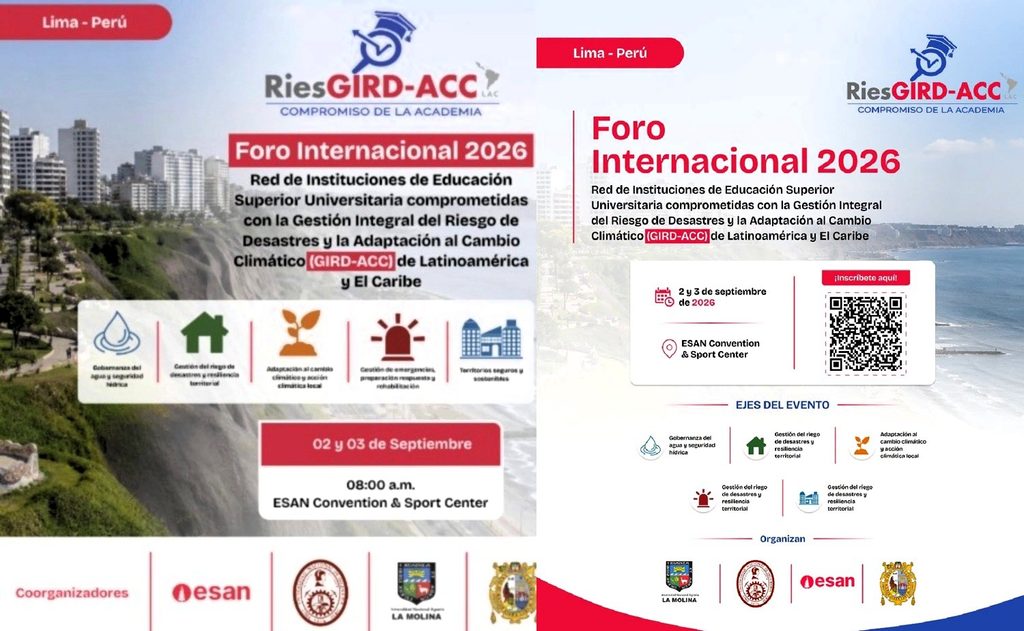
Agencia Peruana de Noticias PRENSAPERU.PE https://www.prensaperu.pe Twitter: @prensaperupe El miércoles 2 de septiembre de 2026 se inaugura en Lima, Perú, el Foro Internacional 2026 de la Red de Instituciones de Educación Superior Universitaria Comprometidas con la Gestión Integral del Riesgo de Desastres y la Adaptación al Cambio Climático (GIRD-ACC) de Latinoamérica y el Caribe, evento que se extenderá hasta el 3 de septiembre. Organizado conjuntamente por la Universidad Nacional Agraria La Molina (UNALM), la Universidad Nacional de Ingeniería (UNI), la Universidad Nacional Mayor de San Marcos y la Universidad ESAN, este encuentro congrega a especialistas nacionales e internacionales con el propósito central de transitar desde la respuesta reactiva hacia la prevención proactiva, ante fenómenos extremos como el Fenómeno El Niño, sismos, sequías y otros eventos asociados a la variabilidad climática. La iniciativa representa un paso fundamental para convertir el conocimiento científico en política pública, evidenciando el rol protagónico de las universidades en la construcción de resiliencia territorial.
DATOS CONCEPTUALES
Gestión Integral del Riesgo de Desastres (GIRD): Proceso social, técnico e institucional continuo que implica la identificación, evaluación, reducción, prevención, mitigación, preparación, respuesta, rehabilitación y reconstrucción de los factores de riesgo de desastre en todas sus dimensiones. No se limita a atender la emergencia, sino a intervenir antes para evitar que una amenaza se convierta en desastre.
Adaptación al Cambio Climático (ACC): Ajuste de los sistemas naturales y humanos ante los efectos del cambio climático —actuales y esperados— para moderar daños o aprovechar oportunidades. Implica modificar patrones de asentamiento, producción, infraestructura y consumo frente a escenarios de mayor temperatura, lluvia variable y eventos extremos más frecuentes.
Sistema de Alerta Temprana (SAT): Conjunto integrado de capacidades —detección, monitoreo, pronóstico, comunicación y respuesta— que permite emitir avisos oportunos y claros para que las comunidades y autoridades actúen antes de que ocurra un evento peligroso. Su valor no está solo en la predicción, sino en la capacidad de activar acción.
Resiliencia: Capacidad de un sistema, comunidad o territorio expuesto a una amenaza para resistir, absorber, adaptarse y recuperarse de manera oportuna y eficaz, preservando o restaurando sus estructuras y funciones básicas.
Gestión prospectiva del riesgo: Enfoque que analiza escenarios futuros y anticipa riesgos aún no manifiestos, evitando la creación de nuevos factores de peligro y reduciendo la vulnerabilidad antes de que se materialice el desastre. Es el paso de la “cultura de la emergencia” a la “cultura de la previsión”.
DESARROLLO: CIENCIA, COORDINACIÓN Y POLÍTICA DE ESTADO
El evento y su naturaleza: El Foro Internacional GIRD-ACC 2026 reúne a representantes de organismos multilaterales —Banco Interamericano de Desarrollo (BID), Naciones Unidas, JICA (Agencia de Cooperación Internacional del Japón) y el Programa Regional de Asistencia para Desastres (RDAP) del Departamento de Estado de los Estados Unidos— junto con expertos de países de América Latina y el Caribe. Durante dos días, se abordarán herramientas de frontera científica y tecnológica: sistemas de alerta temprana, seguridad hídrica, inteligencia artificial aplicada a la predicción, teledetección mediante drones, plataformas geoespaciales para el monitoreo territorial y mecanismos de financiamiento preventivo.
El rol de las universidades como actor estratégico: La participación protagónica de cuatro casas de estudio peruanas —UNALM, UNI, San Marcos y ESAN— no es casualidad. Las universidades constituyen el espacio natural de generación, validación y transferencia de conocimiento necesario para la gestión del riesgo. Sin embargo, en el Perú, históricamente el conocimiento científico ha estado desvinculado de la toma de decisiones públicas. Este foro busca romper esa brecha: pasar de la investigación a la política, del diagnóstico a la planificación.
¿Es política de Estado en el Perú? Si bien el Perú cuenta con el Marco Legal de Gestión del Riesgo de Desastres (Ley N.º 29664) y con el Plan Nacional de Gestión del Riesgo de Desastres 2022–2030, en la práctica la gestión del riesgo sigue siendo predominantemente reactiva: se asignan recursos cuando el desastre ya ocurrió, se atiende la emergencia con recursos que deberían destinarse a desarrollo, y la prevención aparece con frecuencia como una acción marginal. La iniciativa de las universidades surge, precisamente, para llenar un vacío de liderazgo y continuidad: el Estado peruano aún no ha logrado institucionalizar una cultura de prevención sostenida, transversal y de largo plazo. La red GIRD-ACC representa, así, una oportunidad para que el conocimiento se convierta en política de Estado, más allá de los cambios de gobierno.
La transición paradigmática, de la respuesta a la anticipación: El cambio central que propone el foro es el abandono del enfoque centrado exclusivamente en la atención de daños —donde el Estado actúa cuando la tragedia ya ocurrió— hacia una estrategia de anticipación: invertir en estudios, infraestructura resiliente, ordenamiento territorial, educación y sistemas de alerta antes de que el fenómeno se desate. Esto requiere inversión constante, voluntad política y coordinación entre el sector público, la academia, la cooperación internacional y el sector privado.
CONCLUSIONES
1.- El evento representa un avance trascendental hacia la institucionalización de la prevención, al reunir a la academia, el Estado, la cooperación internacional y el sector privado en un mismo espacio de diálogo técnico y científico. La participación de cuatro prestigiosas universidades peruanas confirma que el conocimiento científico debe ser el fundamento de toda política de gestión del riesgo.
2.- El Perú cuenta con el marco normativo necesario, pero aún no con la práctica política de Estado. La Ley N.º 29664 establece la Gestión del Riesgo de Desastres como política obligatoria, sin embargo la asignación presupuestal, la continuidad de los programas y la transversalidad en todos los sectores siguen siendo insuficientes. El foro surge como iniciativa que busca suplir esa brecha con conocimiento y coordinación.
3.- La tecnología y la ciencia —inteligencia artificial, plataformas geoespaciales, drones, sistemas de alerta temprana— ya no son opciones, sino herramientas indispensables de soberanía. Su incorporación sistemática en la planificación pública permite reducir la incertidumbre, anticipar escenarios y proteger vidas e infraestructura con mayor eficacia. El país no puede seguir gestionando el riesgo con herramientas del siglo pasado.
4.- La gestión del riesgo es inseparable del desarrollo y de la adaptación al cambio climático. No es posible pensar en crecimiento económico, seguridad hídrica, agricultura sostenible ni reducción de la pobreza sin integrar la variable de riesgo en cada decisión de inversión y planificación. El Fenómeno El Niño, los sismos y las sequías no son “emergencias eventuales”, son escenarios permanentes de la geografía y la realidad peruana.
5.- Es imperativo transformar los acuerdos del foro en acciones concretas y presupuestadas. El valor de este encuentro no estará en las declaraciones, sino en la capacidad de traducir el conocimiento generado en normativas, inversiones preventivas, planes territoriales y mecanismos de financiamiento que sobrevivan a los cambios de gobierno. La Red GIRD-ACC debe convertirse en un espacio permanente de incidencia técnica para que la prevención sea, definitivamente, una política de Estado.
Fuente: Agencia Peruana de Noticias PRENSAPERU.PE https://www.prensaperu.pe Twitter: @prensaperupe
Translate
2026 INTERNATIONAL FORUM: Science Takes the Floor — Peruvian Universities Lead the Way to Prevent, Not Just Lament. “Risk Management”: Policy of State or Emergency Response? The Challenge the Country Has Yet to Solve.
Peruvian News Agency PRENSAPERU.PE https://www.prensaperu.pe Twitter: @prensaperupe On Wednesday, September 2, 2026, the 2026 International Forum of the Network of University Higher Education Institutions Committed to Comprehensive Disaster Risk Management and Climate Change Adaptation (GIRD-ACC) for Latin America and the Caribbean will be inaugurated in Lima, Peru, an event running through September 3. Jointly organized by the National Agrarian University La Molina (UNALM), the National University of Engineering (UNI), the National University of San Marcos, and ESAN University, this gathering brings together national and international specialists with the central purpose of transitioning from reactive response to proactive prevention in the face of extreme phenomena such as El Niño, earthquakes, droughts, and other events linked to climate variability. The initiative represents a fundamental step toward turning scientific knowledge into public policy, demonstrating the leading role of universities in building territorial resilience.
CONCEPTUAL DATA
Comprehensive Disaster Risk Management (GIRD): A continuous social, technical, and institutional process involving the identification, assessment, reduction, prevention, mitigation, preparedness, response, rehabilitation, and reconstruction of disaster risk factors in all their dimensions. It is not limited to addressing emergencies, but rather intervening beforehand to prevent a hazard from becoming a disaster.
Climate Change Adaptation (ACC): The adjustment of natural and human systems to the effects of climate change — current and expected — in order to moderate harm or take advantage of opportunities. It involves modifying settlement patterns, production, infrastructure, and consumption in the face of scenarios of rising temperatures, variable rainfall, and more frequent extreme events.
Early Warning System (SAT): An integrated set of capacities — detection, monitoring, forecasting, communication, and response — that allows for timely and clear warnings so that communities and authorities may act before a dangerous event occurs. Its value lies not only in prediction, but in the capacity to trigger action.
Resilience: The capacity of a system, community, or territory exposed to a hazard to resist, absorb, adapt, and recover in a timely and effective manner, preserving or restoring its basic structures and functions.
Prospective Risk Management: An approach that analyzes future scenarios and anticipates risks not yet manifested, avoiding the creation of new hazard factors and reducing vulnerability before the disaster materializes. It is the shift from a “culture of emergency” to a “culture of foresight.”
DEVELOPMENT: SCIENCE, COORDINATION, AND STATE POLICY
The event and its nature: The 2026 GIRD-ACC International Forum brings together representatives of multilateral organizations — Inter-American Development Bank (IDB), United Nations, JICA (Japan International Cooperation Agency), and the Regional Disaster Assistance Program (RDAP) of the United States Department of State — along with experts from countries across Latin America and the Caribbean. Over two days, participants will address cutting-edge scientific and technological tools: early warning systems, water security, applied artificial intelligence for forecasting, drone-based remote sensing, geospatial platforms for territorial monitoring, and preventive financing mechanisms.
The role of universities as strategic actors: The leading participation of four Peruvian academic institutions — UNALM, UNI, San Marcos, and ESAN — is no coincidence. Universities constitute the natural space for the generation, validation, and transfer of knowledge required for risk management. However, historically in Peru, scientific knowledge has been disconnected from public decision-making. This forum seeks to bridge that gap: moving from research to policy, from diagnosis to planning.
Is it a State Policy in Peru? While Peru has the Legal Framework for Disaster Risk Management (Law No. 29664) and the National Disaster Risk Management Plan 2022–2030, in practice risk management remains predominantly reactive: resources are allocated once the disaster has already occurred, emergencies are addressed with funds that should be directed toward development, and prevention frequently appears as a marginal action. The universities’ initiative arises precisely to fill a gap in leadership and continuity: the Peruvian State has not yet institutionalized a sustained, cross-cutting, long-term culture of prevention. The GIRD-ACC network thus represents an opportunity for knowledge to become State policy, beyond changes in government.
The paradigmatic shift: from response to anticipation: The central change proposed by the forum is the abandonment of the approach focused exclusively on addressing damage — where the State acts once the tragedy has already occurred — toward a strategy of anticipation: investing in studies, resilient infrastructure, territorial planning, education, and warning systems before the event strikes. This requires constant investment, political will, and coordination between the public sector, academia, international cooperation, and the private sector.
CONCLUSIONS
1.- The event represents a transcendental advance toward the institutionalization of prevention, bringing together academia, the State, international cooperation, and the private sector in a single space for technical and scientific dialogue. The participation of four prestigious Peruvian universities confirms that scientific knowledge must be the foundation of all risk management policy.
2.- Peru has the necessary regulatory framework, but not yet the practice of State policy. Law No. 29664 establishes Disaster Risk Management as mandatory policy, yet budget allocation, program continuity, and cross-sectoral mainstreaming remain insufficient. The forum emerges as an initiative seeking to fill that gap through knowledge and coordination.
3.- Technology and science — artificial intelligence, geospatial platforms, drones, early warning systems — are no longer options, but indispensable tools of sovereignty. Their systematic integration into public planning reduces uncertainty, anticipates scenarios, and protects lives and infrastructure more effectively. The country cannot continue managing risk with last century’s tools.
4.- Risk management is inseparable from development and climate change adaptation. Economic growth, water security, sustainable agriculture, and poverty reduction cannot be considered without integrating the risk variable into every investment and planning decision. El Niño, earthquakes, and droughts are not “eventual emergencies” — they are permanent scenarios of Peru’s geography and reality.
5.- It is imperative to transform the forum’s agreements into concrete, budgeted actions. The value of this gathering will not lie in declarations, but in the capacity to translate generated knowledge into regulations, preventive investments, territorial plans, and financing mechanisms that survive changes in government. The GIRD-ACC Network must become a permanent space for technical advocacy so that prevention becomes, definitively, a State Policy.
Source: Peruvian News Agency PRENSAPERU.PE https://www.prensaperu.pe Twitter: @prensaperupe