
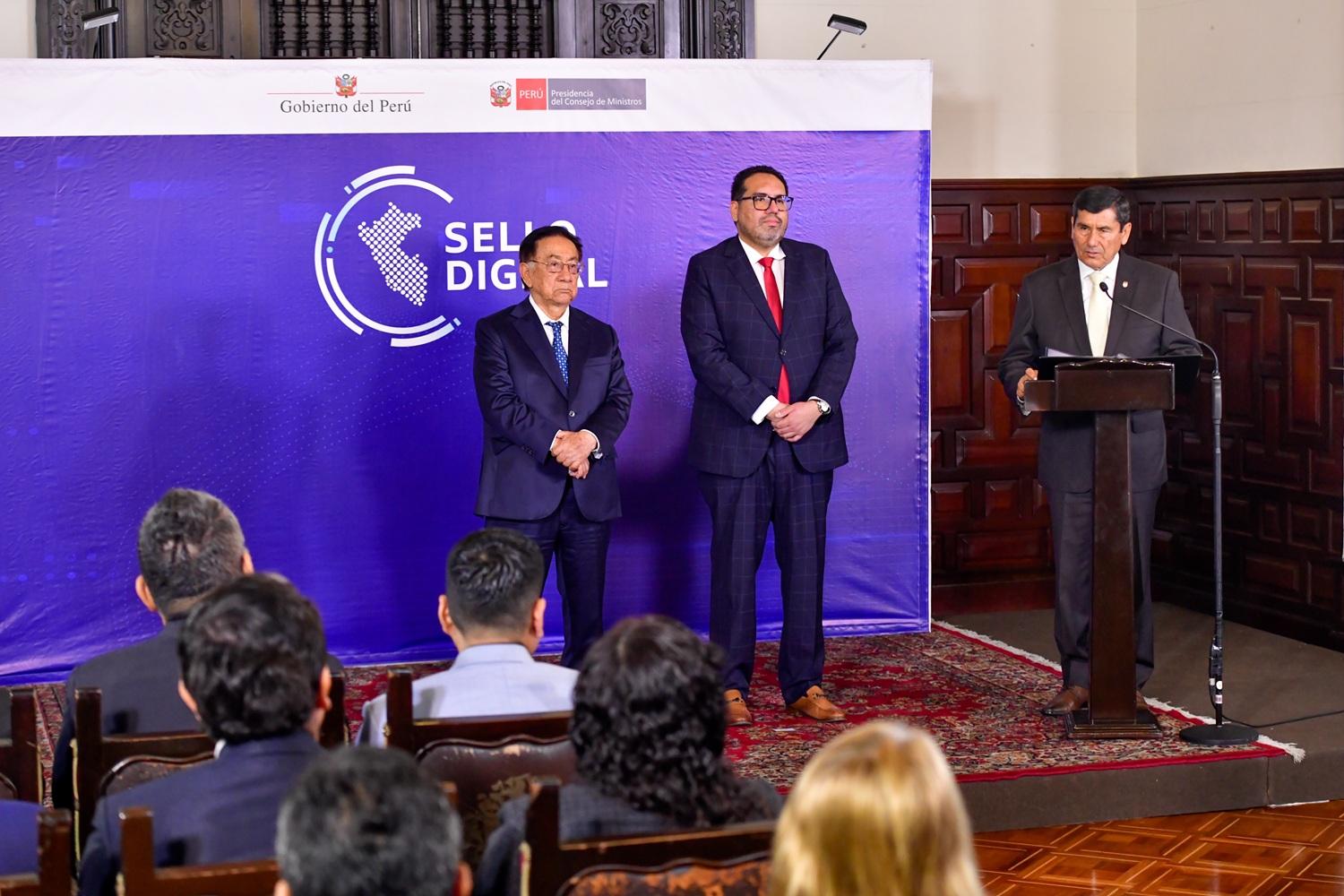
Agencia Peruana de Noticias PRENSAPERU.PE https://www.prensaperu.pe Twitter: @prensaperupe El presidente del Consejo de Ministros, Luis Arroyo, informó que ya se encuentran 6 593 servicios públicos digitalizados y disponibles en línea. Gracias a este avance, millones de ciudadanos pueden realizar gestiones ante el Estado peruano sin necesidad de trasladarse, con mayor rapidez, facilidad y transparencia.
SERVICIO PÚBLICO DIGITALIZADO
Es aquel trámite, prestación o ayuda del Estado que se diseña y ofrece por medios electrónicos. Simplifica requisitos, reduce tiempos y evita desplazamientos innecesarios, manteniendo validez oficial y seguridad jurídica.
El anuncio se dio durante la presentación oficial del “Sello Digital”, nuevo reconocimiento dirigido a las instituciones públicas que logran progresos efectivos en su modernización. El titular del gabinete detalló que desde el 18 de febrero —fecha de inicio del Gobierno de Transición presidido por José María Balcázar— se han incorporado 183 nuevas modalidades o espacios de atención digital.
En la ceremonia, donde también participó el jefe del Estado, se destacó que este distintivo refleja el compromiso con una administración moderna, eficaz y al servicio de las personas. “El Sello Digital reconoce avances concretos y, al mismo tiempo, marca una ruta común para que las entidades de los tres niveles de gobierno fortalezcan capacidades y aceleren su transformación”, explicó Arroyo.
El ministro llamó también a sumar esfuerzos: entidades nacionales, regionales y locales, empresas, universidades y organizaciones civiles deben actuar de forma coordinada. Solo así se logra construir un Estado más cercano, abierto y útil para el desarrollo del país.
TRANSFORMACIÓN DIGITAL: MARCO Y PROPÓSITO
Transformación digital: No es solo usar computadoras o aplicaciones, sino cambiar procesos, normas y formas de trabajar apoyándose en tecnología, para ofrecer mejores resultados, más sencillez y equidad. Se alinea con la Política Nacional de Transformación Digital al 2030, hoja de ruta del país en esta materia.
El Sello Digital es impulsado por la Secretaría de Gobierno y Transformación Digital de la Presidencia del Consejo de Ministros. Busca que todas las instituciones —sin importar su nivel— cuenten con condiciones verificables, soluciones adecuadas y buenas prácticas que generen valor real para la población.
SE ESTRUCTURA EN DOS CATEGORÍAS CLARAS
Primer nivel: reconoce que la entidad ya cuenta con bases institucionales y técnicas necesarias para avanzar de forma ordenada y sostenible.
Segundo nivel: distingue a quienes ya aplican la tecnología para mejorar la gestión y ofrecer servicios más útiles, seguros y accesibles.
El secretario Ricardo Zapata señaló que la evaluación se apoya en criterios técnicos y pruebas comprobables: “No basta con incorporar herramientas; se requiere la capacidad para mantenerlas y perfeccionarlas con el tiempo”.
De otro lado, el reconocimiento se otorgará cada año. Las instituciones galardonadas podrán exhibirlo en sus portales oficiales como garantía visible de su avance y mejora continua. Toda la información está disponible en: www.gob.pe/sellodigital
Esta iniciativa también busca cerrar brechas: que la calidad digital llegue por igual a todos los territorios y a todos los niveles de gobierno, evitando que la modernización se concentre solo en ciertas zonas o instituciones.
BRECHA DIGITAL
Es la diferencia entre quienes cuentan con acceso, conocimientos y servicios adecuados y quienes no. Reducirla significa garantizar igualdad de oportunidades para ejercer derechos y acceder al Estado.
DATOS CONTEXTUALES
1.- El proceso avanza de forma sostenida: ya existen más de 6 500 servicios digitales operativos y cerca de 200 nuevos incorporados en la etapa actual de gobierno.
2.- El Sello Digital no es solo un reconocimiento, sino también una guía técnica que fomenta avances ordenados, verificables y duraderos.
3.- La transformación digital requiere más que herramientas: exige fortalecer capacidades institucionales, coordinación entre sectores y trabajo conjunto entre todos los actores.
4.- Su meta final es reducir desigualdades territoriales y administrativas, acercando servicios públicos de calidad a todos los ciudadanos sin importar dónde vivan.
Fuente: Agencia Peruana de Noticias PRENSAPERU.PE https://www.prensaperu.pe Twitter: @prensaperupe

Translate
The ‘Digital Seal’—recognition of public sector modernization—has been launched, covering over 6,500 digital services; it represents the Peruvian State’s progress, driven by technical criteria and evidence, toward a country with fewer gaps and greater equality.
Peruvian News Agency PRENSAPERU.PE https://www.prensaperu.pe Twitter: @prensaperupe The President of the Council of Ministers, Luis Arroyo, reported that 6 593 digitized public services are now available online. Thanks to this progress, millions of citizens can complete procedures before the Peruvian State without travelling, with greater speed, ease and transparency.
DIGITIZED PUBLIC SERVICE
It refers to any procedure, benefit or assistance provided by the State that is designed and delivered through electronic means. It simplifies requirements, reduces processing times and avoids unnecessary travel, while preserving official validity and legal certainty.
The announcement was made during the official launch of the “Digital Seal”, a new recognition aimed at public institutions achieving effective progress in modernization. The Head of the Cabinet specified that since 18 February — the start date of the Transition Government led by President José María Balcázar — 183 new digital service modalities or channels have been added.
During the ceremony, also attended by the Head of State, it was highlighted that this distinction reflects commitment to a modern, efficient and citizen‑centred administration. “The Digital Seal acknowledges concrete achievements and, at the same time, establishes a common path for institutions at the three levels of government to strengthen capacities and accelerate their transformation”, Arroyo explained.
The Minister also called for joint efforts: national, regional and local bodies, businesses, universities and civil society organizations must act in a coordinated manner. This is the way to build a more accessible, open and effective State for national development.
DIGITAL TRANSFORMATION: FRAMEWORK AND PURPOSE
Digital transformation: It does not mean simply using computers or applications, but changing processes, regulations and working methods supported by technology, in order to deliver better results, greater simplicity and equity. It is aligned with the National Digital Transformation Policy to 2030, the country’s roadmap in this field.
The Digital Seal is promoted by the Secretariat of Government and Digital Transformation within the Presidency of the Council of Ministers. It seeks to ensure that all institutions — regardless of their level — meet verifiable conditions, adopt suitable solutions and apply good practices that generate real value for the public.
IT IS ORGANISED INTO TWO CLEAR CATEGORIES
First level: recognises that the institution has the necessary institutional and technical foundations to progress in an orderly and sustainable way.
Second level: distinguishes institutions already applying technology to improve public management and deliver more useful, safe and accessible services.
Secretary Ricardo Zapata stated that the assessment is based on technical criteria and verifiable evidence: “Introducing tools alone is not enough; there must be capacity to maintain and improve services over time”.
Furthermore, the recognition will be awarded annually. Awarded institutions may display it on their official portals as visible proof of progress and continuous improvement. Full information is available at: www.gob.pe/sellodigital
This initiative also aims to close gaps: ensuring digital quality reaches all territories and all levels of government equally, preventing modernisation from being concentrated only in certain areas or institutions.
DIGITAL GAP
It is the difference between those who have adequate access, knowledge and services and those who do not. Reducing it means guaranteeing equal opportunities to exercise rights and interact with the State.
CONTEXTUAL DATA
1.- Progress continues steadily: more than 6 500 digital services are operational, and nearly 200 new ones have been added during the current administration.
2.- The Digital Seal is not merely an award, but also a technical guide encouraging orderly, verifiable and lasting progress.
3.- Digital transformation requires more than tools: it demands strengthened institutional capacities, inter‑sector coordination and joint work among all stakeholders.
4.- Its ultimate goal is to reduce territorial and administrative inequalities, bringing quality public services closer to every citizen regardless of their place of residence.
Source: Peruvian News Agency PRENSAPERU.PE https://www.prensaperu.pe Twitter: @prensaperupe